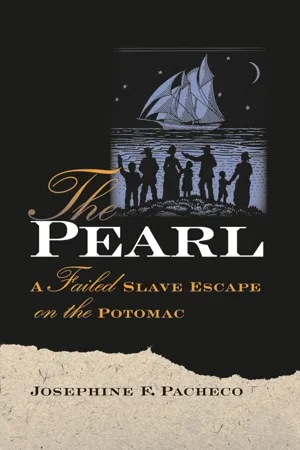
In the spring of 1848 seventy-six slaves from the nation’s capital hid aboard a schooner called the Pearl in an attempt to sail down the Potomac River and up the Chesapeake Bay to freedom in Pennsylvania. When inclement weather forced them to anchor for the night, the fugitive slaves and the ship’s crew were captured and returned to Washington. Many of the slaves were sold to the Lower South, and two men sailing the Pearl were tried and sentenced to prison.
Recounting this harrowing tale from the preparations for escape through the participants' trial, Josephine Pacheco provides fresh insight into the lives of enslaved blacks in the District of Columbia, putting a human face on the victims of the interstate slave trade, whose lives have been overshadowed by larger historical events. Pacheco also details the Congressional debates about slavery that resulted from this large-scale escape attempt. She contends that although the incident itself and the trials and Congressional disputes that followed were not directly responsible for bringing an end to the slave trade in the nation’s capital, they played a pivotal role in publicizing many of the issues surrounding slavery. Eventually, President Millard Fillmore pardoned the operators of the Pearl.
- 320 pages
- English
- ePUB (mobile friendly)
- Available on iOS & Android
eBook - ePub
About this book
Information
Chapter One
Slavery in the Nation’s Capital
Many Americans envision slavery as inseparable from plantations, not aware that the institution was also important in cities in the South, from Baltimore and Washington down to Mobile and New Orleans. According to David Goldfield, “Slavery and slave holding were as characteristic of the city as [they were] of the countryside, and perhaps even more so.” Urban slavery was different from its rural counterpart, just as city life for nonslaves was different; people—black, white, slave, and free—adapted to their environment. “Slavery, far from being an albatross to urban progress, grew more valuable to city dwellers as secession approached.”1
This chapter provides an examination of human bondage in the nation’s capital, how slaves worked and lived and how they interacted with whites and other blacks, both slave and free. While “the web of slave interrelationships” was significant on a large plantation,2 the same was true in an urban setting. The Pearl demonstrated that bondmen and bondwomen in the District used whatever devices were available to them to build a sense of community.
A very large number of slaves had known of the planned escape—not only the seventy-six that boarded the Pearl but also their families and friends. Yet no hint of the plan reached the ears of their owners. What their masters and mistresses described as cunning, slaves saw as the psychological mechanism needed to develop and maintain autonomy within the harsh regime of bondage. The story of American slavery is, to a very great extent, the ongoing conflict between the owners who wanted to erase initiative and a sense of self within their human property and the owned who used every possible means to protect and enlarge those same characteristics. Slavery, in spite of numerous instances to the contrary, was built on intimidation, exploitation, and violence. The story of the Pearl is extraordinary because it demonstrates concretely not only the extremity and complexity of any concerted effort to oppose slavery but also the swiftness and strength of the forces committed to maintaining it.
Slaves in the nation’s capital had access to information about public events that was not available to those living anywhere else in the South. They knew that Congress debated slavery (at least when a gag was not in effect), that there were members of both Houses opposed to the institution, and that many visitors to the city loathed human bondage. Although bondmen and bondwomen did not need an invitation to run away, they knew that there would be a greater chance of success if they could count on sympathy and assistance. When they fled on their own, acting as individuals without much knowledge, they felt a great sense of loss and bewilderment, as James Pennington did when he ran away from his Maryland owner.3 Washington slaves seem to have known whom to approach for help; they had some idea of the geographic distance to freedom; and they had a realistic view of the perils awaiting a fugitive.
Slaves thirsted for information, which they exchanged at every opportunity, and they were well aware of the importance of Congress’s actions. During the congressional debates on the admission of Missouri to the Union as a slave or free state (1819–20), the galleries were “crowded with colored persons, almost to the exclusion of whites.” Writing from Washington, a spectator said that though they understood “much less than half” of the debates, they knew it was “a question of servitude or freedom” and thought that they themselves would be affected. According to the observer, “When the slaves of the Southerners, now here [in Washington], return home with mutilated and exaggerated accounts of what they have heard, I fear that many deluded creatures will fall sacrifice to their misapprehension of the question.”4 Not only slaves residing permanently in Washington but also slaves brought to the capital as servants to members of Congress learned to listen for news of “servitude or freedom.”
Washington slaves never lacked for occasions to share news; indeed, mobility was the characteristic of urban slavery that first attracted the attention of visitors. Whereas plantation owners might emphasize keeping workers close to home, slavery in a city was most viable, from an economic standpoint, when people in bondage could move freely, running errands, delivering goods, accompanying children to school, shopping for food and household supplies. Close supervision in all such activities was impossible, and slaves traveled around Washington with amazing ease.
Some errands provided slaves with natural gathering places. In the 1830s water in Washington was only available from wells, one on each square. Every morning slaves waited their turn to fill buckets for their households; a woman could carry three pails, one in each hand and one on her head.5 Imagine the beauty of her posture! And the news and gossip she could exchange while she waited!
Male and female slaves filled the markets. An account of Richmond in 1853 could just as well apply to Washington: “Now go down to the markets, . . . and you will hear the voices of hundreds, wrangling, chaffering, buying and selling, till you would imagine yourself in Babel, but for the reason that the tongues are almost all of one kind, those of colored people.”6 They engaged in both buying and selling; indeed, one visitor observed that “negroes are the chief sellers.” While Josiah Henson, who claimed to be the model for Uncle Tom in Uncle Tom’s Cabin, lived in Montgomery County, Maryland, adjacent to the District, he regularly sold farm produce in the markets of Washington. It was there that he met a white man who talked freely about the evils of slavery and about his refusal, as a Christian, to own or even to hire a slave.7 Frederick Law Olmsted, who viewed Washington with a jaundiced eye, felt contempt for both animals and people when he went to the market. He found “the most miserable, dwarfish, ugly, lean kine that I ever saw.” The horses were as bad as the cattle, and, he added, “the human stock (negroes) is, if possible, worse than either.”8
Many owners allowed their slaves to plant foodstuffs on their own, and early in its history the District held a market on Sundays. It was the only time slaves could bring their produce to be sold. The practice was discontinued both because it seemed to violate the holiness of the Sabbath and because of claims of troublemakers in the market. Slave owners in the Virginia counties adjacent to Washington claimed that slaves “would steal various commodities from their owners and sell them to free Negroes or whites from the District who were passing through as itinerant peddlers.”9 Men and women in bondage made a place for themselves, either honestly or dishonestly, in the commerce of the Washington area.
Antebellum Washington hotel owners always employed slaves; a British traveler in the 1830s found seventy or eighty slaves working in Gadsby’s Hotel. In addition to being the main labor force in hotels, slaves were sent by hotel owners to attract to their establishments visitors alighting from coaches, boats, or the train (after the railroad arrived in the city). Travelers always commented on the omnipresence and competence of slave coachmen and hack drivers. They were so knowledgeable that there was no need to give them directions, for they knew everybody and where everybody lived.10
Although African Americans were frequently members of the crews of coastal vessels, they were not expected to captain them. Before Daniel Drayton sailed from Washington with his shipload of runaways, he checked on other vessels anchored near the Pearl, hoping to avoid trouble. Anchored close by was a “small vessel” in which “her crew were all black.” On speaking to the skipper, who apparently was African American, Drayton received assurance that he had nothing to fear, that the crew would be away from the waterfront and that he, the captain, “should go below and to sleep, so as neither to hear nor to see anything.”11
Slaves were very valuable property. According to an advertisement in the Sun of Baltimore, the reward for the return of an apprentice was six and a half cents; for a runaway slave, $200. A Richmond dealer listed among his expenses “25” for “Arresting runaway.” Nevertheless, as agriculture in the Upper South declined or changed its character, demand for farm labor decreased. Owners found it increasingly difficult to make a profit employing their slaves on farms and plantations. They had three choices: (1) they could migrate to the newly opened territory along the Mississippi River or in Texas, carrying their slaves with them; (2) they could sell off their surplus property to willing dealers and make trading in slaves a profitable business; or (3) they could rent their unneeded slaves in places such as the District. Some southerners followed the first alternative; one traveler encountered whole families, children, in-laws, and many slaves, on the move from the Old South to the New South. Historian James Oakes has shown the importance of the westward and southern movement of slave owners who hoped for a fresh start in a new region. Family migration probably accounted for about 30 percent of slaves traveling from the Upper to the Lower South. The third alternative, slave rental, appealed to Virginians and Marylanders who did not want to leave the area but needed additional income.12
The practice of hiring out unneeded slaves demonstrated the flexibility of the institution: it survived in areas where it should have died out because it was otherwise unprofitable. An owner, while retaining title to a slave, rented out the bondman or bondwoman and received payment for the enslaved person’s labor. By deriving a profit from property they could not directly use, owners managed to perpetuate the institution of human bondage.
In the neighboring Virginia county of Fairfax, owners unable to find gainful employment at home for increasing numbers of the enslaved could sell them or, while retaining title, rent them out for a profit. Virginians did both, and though the District was the closest and most convenient place for renting, historians of the county have found evidence of the hiring out of Fairfax slaves as far south as Mississippi.13
Hiring out took two forms. The master could negotiate a contract whereby a worker would be leased for a designated period in return for a set amount of money and other terms such as housing and food. For the fifteen years before the Civil War the average annual hire for an unskilled male slave was $85 to $175. Alternatively, the slave himself carried on negotiations with an employer and arranged the amount he paid his owner. In either case the slave was outside the direct control of his master, and in many instances he could find his own housing, often with free blacks and working-class whites. Historian Ira Berlin sees hiring out as so popular that by 1850 “few slaves in the Upper South escaped being hired at one time or another, and some lived apart from their owners for most of their lives.” According to another estimate, by the late 1840s one out of six slave households was “living out,” often without any white supervision.14 By providing profit through rental, these semifree bondmen made it possible for their owners to continue to hold property they might otherwise have lost; thus they helped the institution of slavery to survive. But their ability to live on their own made a mockery of claims that presumably childlike slaves required close direction in order to survive. The frequent use of middlemen and the introduction of contracts significantly altered master-slave relationships.
For the most part, hired slaves ignored the District’s strict regulations about where they could live; in other words, they were not enforced. The same was true in Richmond, 100 miles to the south, where, in spite of the mayor’s best efforts, he was unable to separate free blacks from slaves and to limit the mobility of hired slaves.15
Frederick Law Olmsted thought that most of the slaves in the District were brought into the city to work for people who had rented them. E. S. Abdy, an Englishman, said that his waiter at Gadsby’s in Washington was the property of someone living in Alexandria; the same was true for many of the hotel staff. Gadsby rented out his own slaves when business was slow in his hotel; at least one Washingtonian found that they made excellent house servants. Tavern keepers also hired slaves, paying a monthly fee to the owners and providing food for the workers but not clothing; that was the responsibility of the slaves. No wonder they were shabbily dressed.
Rented slaves provided much of the labor during the construction of a canal on the Potomac River. One contractor reported hiring “a gang of sixty or seventy slaves, paying for each at the rate of seventy-five dollars a year.” He claimed that he fed them well, never flogged them, and in return received good work; the men, it seems, were reluctant to return to their owners. The contractor believed that most slaves were “half-starved” and that if they stole, it was because they were always hungry.16
Many of those aboard the Pearl had been rented out. All of the children of Daniel Bell were sent out to work as soon as they were old enough and provided their owner, Mrs. Armstead, with almost her only income. Six members of the Edmondson family who fled aboard the Pearl were hired in the city, though born and raised in Maryland. After the capture of the Pearl, there was a delay in handing over some of the fugitives to their owners because they d...
Table of contents
- Cover Page
- The Pearl
- Copyright Page
- Dedication
- Contents
- Illustrations
- Acknowledgments
- Introduction
- Chapter One Slavery in the Nation’s Capital
- Chapter Two The Escape Attempt
- Chapter Three Men of Extraordinary Courage
- Chapter Four The Chaplain and the Slaver
- Chapter Five The Edmondsons
- Chapter Six The Trials
- Chapter Seven Congress Confronts Slavery
- Chapter Eight Congress, Runaways, and the Slave Trade
- Chapter Nine The Aftermath
- Conclusion
- Notes
- Index
Trusted by 375,005 students
Access to over 1.5 million titles for a fair monthly price.
Study more efficiently using our study tools.
Frequently asked questions
Yes, you can cancel anytime from the Subscription tab in your account settings on the Perlego website. Your subscription will stay active until the end of your current billing period. Learn how to cancel your subscription
No, books cannot be downloaded as external files, such as PDFs, for use outside of Perlego. However, you can download books within the Perlego app for offline reading on mobile or tablet. Learn how to download books offline
Perlego offers two plans: Essential and Complete
- Essential is ideal for learners and professionals who enjoy exploring a wide range of subjects. Access the Essential Library with 800,000+ trusted titles and best-sellers across business, personal growth, and the humanities. Includes unlimited reading time and Standard Read Aloud voice.
- Complete: Perfect for advanced learners and researchers needing full, unrestricted access. Unlock 1.5M+ books across hundreds of subjects, including academic and specialized titles. The Complete Plan also includes advanced features like Premium Read Aloud and Research Assistant.
We are an online textbook subscription service, where you can get access to an entire online library for less than the price of a single book per month. With over 1.5 million books across 990+ topics, we’ve got you covered! Learn about our mission
Look out for the read-aloud symbol on your next book to see if you can listen to it. The read-aloud tool reads text aloud for you, highlighting the text as it is being read. You can pause it, speed it up and slow it down. Learn more about Read Aloud
Yes! You can use the Perlego app on both iOS and Android devices to read anytime, anywhere — even offline. Perfect for commutes or when you’re on the go.
Please note we cannot support devices running on iOS 13 and Android 7 or earlier. Learn more about using the app
Please note we cannot support devices running on iOS 13 and Android 7 or earlier. Learn more about using the app
Yes, you can access The Pearl by Josephine F. Pacheco in PDF and/or ePUB format, as well as other popular books in Social Sciences & North American History. We have over 1.5 million books available in our catalogue for you to explore.