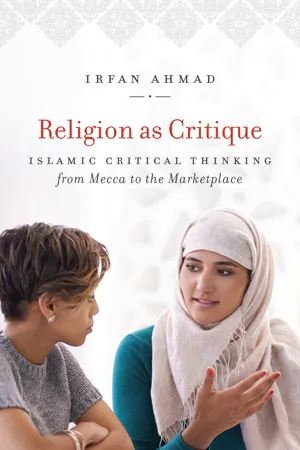
Irfan Ahmad makes the far-reaching argument that potent systems and modes for self-critique as well as critique of others are inherent in Islam — indeed, critique is integral to its fundamental tenets and practices. Challenging common views of Islam as hostile to critical thinking, Ahmad delineates thriving traditions of critique in Islamic culture, focusing in large part on South Asian traditions. Ahmad interrogates Greek and Enlightenment notions of reason and critique, and he notes how they are invoked in relation to “others,” including Muslims. Drafting an alternative genealogy of critique in Islam, Ahmad reads religious teachings and texts, drawing on sources in Hindi, Urdu, Farsi, and English, and demonstrates how they serve as expressions of critique. Throughout, he depicts Islam as an agent, not an object, of critique.
On a broader level, Ahmad expands the idea of critique itself. Drawing on his fieldwork among marketplace hawkers in Delhi and Aligarh, he construes critique anthropologically as a sociocultural activity in the everyday lives of ordinary Muslims, beyond the world of intellectuals. Religion as Critique allows space for new theoretical considerations of modernity and change, taking on such salient issues as nationhood, women’s equality, the state, culture, democracy, and secularism.
- 300 pages
- English
- ePUB (mobile friendly)
- Available on iOS & Android
eBook - ePub
About this book
Information
Topic
Theology & ReligionSubtopic
Islamic TheologyPART I
Formulation
1. INTRODUCTION
Insofar as Europe is the source of knowledge, it is also the center of ignorance [jehl]. . . . To her, the criterion for the health of an event [vāqeʿā] is not subject to the strength or weakness of an argument; rather, the acceptance or denial of it is based on how it will benefit its own interests or harm those of its rival/enemy [ḥarīf].
—SULAIMAN NADVI (1985 [1914], 132)
On 11 October 2006, the New York Times published a curiously long story: “Across Europe, Worries on Islam Spread to Center.” It “covered” many aspects, not necessarily congruent. I discuss the criticism and Islam the story dealt with. The first sentence concluded that “more people in the political mainstream are arguing that Islam can’t be reconciled with European values.” The next sentence was a quote from Patrick Gonman, owner of a “funky wine bar” in Antwerp, Belgium. Speaking about Pope Benedict XVI’s speech in Regensburg, Germany, Gonman remarked: “He said Islam is an aggressive religion. And the next day they [Muslims] kill a nun somewhere and make his point. Rationality is gone” (Bilefsky and Fisher 2006; italics mine).
♦ The Ubiquitous Absence, or the Received Wisdom
Gonman was described as “hardly an extremist”; rather, he was portrayed as sympathetic to Muslims because he had shut down his restaurant to show his disapproval of a far-right party’s anti-Muslim rally held near Antwerp a week earlier. From the far right, the New York Times story moved to the center: “centrists across Europe” also share the “worry” that “any criticism of Islam or Muslim immigration provokes threats of violence.” Quoting Jack Straw, the British Foreign Secretary, it noted that the veil was a “visible statement of separation and difference.” The next paragraph referred again to the pope’s speech calling aspects of Islam “evil and inhuman,” saying that while Muslims “berated” him, non-Muslims “applauded him for bravely speaking a hard truth.” The story then progressed to say how Muslims’ lack of rationality toward comments like the pope’s showed Europe’s “limits of tolerance.” It repeated its observation of “the growing fear that any criticism of Islam could provoke violence.” To prove this, it cited a few examples. A schoolteacher in France reportedly went underground because he received death threats for calling Prophet Muhammad “a merciless warlord, a looter, a mass murderer of Jews and a polygamist.” In Germany, an opera show depicting Prophet Muhammad’s severed head was called off for security reasons. German Chancellor Angela Merkel condemned the cancellation. It also referred to protests against the Danish cartoons depicting the Prophet as testimony of Muslims’ hostility to freedom of speech. A Belgian woman married to a Tunisian Muslim was quoted as saying that “no amount of explanation about free speech could convince her husband that the publication of cartoons lampooning Muhammad . . . was in any way justified” (Bilefsky and Fisher 2006).
The New York Times story left no doubt that Islam was a problem. It portrayed the issue in terms of a freedom-loving, enlightened, reason-driven Europe pitted against an uncritical, bigoted, freedom-despising Islam. While Gonman, a secular funky wine bar owner sympathized with Muslims, the Tunisian man had no idea about freedom of speech. While the pope “bravely” spoke “a hard truth,” Muslims were perceived as intellectually incapable of any response but to “kill a nun.” While Gonman was depicted as an ideal European embodying “Western values,” the veiled women only unveiled “separation and differences.” Furthermore, Muslims’ uncriticality led to violence and protest, thereby setting the “limits of tolerance” in the West. Importantly, the New York Times consolidated secular and critical as homologous, on the one hand, and Islam and critique as mutually hostile, on the other. As Gonman said, “Rationality is gone.” Writing in Yale Global Online, Sadanand Dhume (2008) made the point more flagrantly: “Islamic culture prohibits any criticism of Islamic traditions.”
The equation of Islam with the absence of critique has a longer genealogy (see chap. 2) in Western thought, which runs almost concurrently with Europe’s colonial expansion. In many ways, the popular image of Islam, from Martin Luther up to the present, bears this out. Luther (d. 1546) likened Muslims to the Antichrist (Quinn 2008, 43). Linking the immobility of Muslim societies with their intellectual traditions, Ernest Renan (1823–92) wrote, “Islam is the disdain of science, . . . restricting the human mind, closing it to all delicate ideas, . . . to all rational research” (qtd. in Kurzman 1998, 1). He indeed argued that Islam and knowledge could not go together (Nomani 1955, 168).1 The same Renan, let’s note, exhorted an “eternal war . . . that will not cease until the last son of Ishamel has died of misery or has been relegated to the ends of the deserts by way of terror” (qtd. in Anidjar 2008, 6). Similarly, William Muir observed that the Qurʿān is one of “the most stubborn enemies of Civilization, Liberty . . . which the world has yet known” (qtd. in Lester 1999, 46).
However, the reassertion of Islam’s lack of critique in the twentieth century dates to the end of the Cold War in 1989—which Nicole Falkenhayner (2010, 111) calls the “zero year for the envisioning of a new global order”—when the Salman Rushdie affair broke out. I don’t want to be misunderstood as saying that religion was absent—as it is usually held—during the Cold War. In fact, the term “Cold War” is linked to Islam. Don Juan Manuel (d. 1348), prince and nephew of Ferdinand II, used the Spanish guerra fría (cold war) to describe the relationship between Islam and Christendom as one of neither war nor peace (Trumpbour 2003, 107). Furthermore, the twentieth-century Cold War, as I discuss in chapter 2, was simultaneously religious and secular: Christian democracy versus godless communism. If religion was not absent in the Cold War, an important question is, Did Islam appear as a fault line only after the Cold War? It is relevant to note that the phrase “clash of civilizations,” associated with Samuel Huntington, was used as far back as 1964 by Bernard Lewis—also influential in U.S. power circles. In 1964, Lewis wrote: “The crisis in the Middle East . . . arises not from a quarrel between states but from a clash of civilizations” (qtd. in Trumpbour 2003, 93). Already in 1953, Lewis had identified the Cold War with Islam, as the British philosopher Bertrand Russell (1920, 27) had earlier done, likening Bolsheviks to the “successors of Mahomet [sic].” “The traditional Islamic division of the world into the House of Islam and the House of War,” Lewis wrote, has “obvious parallels in the Communist view of world affairs.” He continued, “The call to a Communist jihad—a new faith, but against the self-same Western Christian enemy—might well strike a responsive note” (qtd. in Trumpbour 2003, 100–101; italics mine). Karl Popper’s The Open Society and Its Enemies (1969) can be situated within this tradition. “Free debate,” use of “reason,” and “protection of freedom”—which to Popper (1972) were properties of an “open” society—were available only in the capitalist bloc.
With the 1979 Iranian Revolution and the collapse of communism, the Renan-like imaginary about Islam resurfaced; Ernest Gellner’s Postmodernism, Reason and Religion is perhaps its most succinct sketch. Gellner saw religious fundamentalism as opposed to “secular wisdom of the age” and “Enlightenment rationalism.” However, he felt impelled to say that “in our age fundamentalism is at its strongest in Islam” (Gellner 1992, 4). The Rushdie affair; the publication of Lajjā by Taslima Nasreen in the early 1990s; the series of writings and speeches by the Dutch politician Ayaan Hirsi Ali, including the film Submission (De Leeuw and van Wichelen 2005; Moors 2005), whose script she wrote; the horrendous murder of Theo van Gough, who directed Submission; and writings by tenure-seeking prophets like Irshad Manji have only reinforced this image: Islam is inimical to criticism.
Yet the watershed was the Rushdie affair of 1989, on which much has been written (Asad 1993). One strand of Rushdie’s defenders held that at stake was the very freedom of speaking and writing (MacDonogh 1993). Relatedly, some argued that the foundational Christianity of the Enlightenment, with its self-reflexivity, tolerance, and intellectual pluralism, was at a radical variance with Islam’s utter lack of these qualities. Falkenhayner (2010, 129n67) quoted the Canadian novelist Margaret Atwood’s description of Christianity as a “house with many living quarters” and paraphrased Atwood as arguing that “Christianity is supposed to include criticism as an inherent feature.” Muslims’ protest, in contrast, showed the sheer absence of such criticism. In a similar vein, Sadik Al-Azm (1991, 13, 20) wrote that the Rushdie affair brought “previously untouchable subjects within the compass of critical thought, autonomous reason.” Al-Azm concluded his essay on what he called “Rushdie’s explosive intervention” with a call that we “desperately need . . . the two great R’s of the modern world: Reason and Revolution” (italics mine). That Muslims critical of Rushdie’s novel The Satanic Verses were far out of the realm of reason, and consequently the modern world, was abundantly evident from Al-Azam’s priestly call.
In 2009, on the twentieth anniversary of Ayatollah Ruhollah Khomeini’s fatwa against Rushdie, New York University’s Wagner School of Public Policy and Service collaborated with Irshad Manji, author of The Trouble with Islam. As part of its “Moral Courage Project,” it organized a conversation with Rushdie. Manji asked him, “Why do you think the controversy on The Satanic Verses was and remains so intense?” Rushdie replied: “Free society argues about, disputes, tells and retells and changes its own story.” In contrast, in an unfree society “you are not allowed to do that. . . . And I also tell you in what manner the story can be told.” He continued, “Because I was trying to do something else, they came after me” (Rushdie 2009).
Any perceptive observer knows well the limits a “free” society too imposes on what to tell and how to tell a story and, therefore, the watertight, Popper-like distinction that Rushdie rehearsed between free and unfree society seems naive. A pertinent example is the trajectory of my own postdoctoral project that this book is based on and which I presented in many venues across the continents. I faced sharp disagreement over, even stiff opposition to, the idea that the Islamic tradition has its own mode of critique. The most eloquent expression of this opposition came in the form of the editorial rejection of the proposal for a special issue—comprising select papers from the workshop on immanent critique (see preface)—that I submitted to Thesis Eleven, an interdisciplinary journal that focuses on theories of society, culture, and politics. The editors justified their decision by arguing that “any discussion of immanent critique in Islam must first confront the basic failure of the Islamic world over the last three centuries to translate immanent critique into a process of reformation.” They continued: “No critical standpoint is articulated in relation to the theme of the proposed issue” (e-mail dated 19 March 2010; italics mine). I found the response curious, showing as it did how free “free society” is. That Islam historically did not have and, therefore, must have a reformation is a story that has resounding sway among many liberals and secularists—both in the West and non-West. This “lack” in Islam and, to use Günter Grass’s probing word (qtd. in Rasch 2009, 114), the simultaneous “luck” of the West to have had the Renaissance, Reformation, and Enlightenment cuts across ideological divides in such a way that it becomes central to figures as diverse as William Blunt (d. 1922; see Browers and Kurzman 2004), Grass, Silvio Berlusconi (Ahmad 2002), Jürgen Habermas (1987, 16–17; also see Rasch 2009, 116), Roman Loimeier (2005), and Rushdie (2005). That this narrative is no more than a story, for it is seldom asked how one can precisely demonstrate that one teleologically led to another—that is, Renaissance→ Reformation→ Enlightenment—needs to be stressed. The rejection of my proposal by Thesis Eleven illustrated well that a “free” society doesn’t necessarily argue about, only selectively disputes, tells, and retells, and rarely changes, its story.
Importantly, in Rushdie’s response there was no mention of “listening.” Is there an act of telling a story without a notion of a community of listeners? Taslima Nasreen, the Bangladeshi author of the novel Lajjā, situates herself in the same league as Rushdie. As do the Indian media, which routinely shower praise on her; her vitriol against Islam is defended in the name of free speech (Dasgupta 2012). However, the same media rarely speak of freedom of speech when activists such as Mirwaiz Omar Farooq, Bilal Lone, and Ali Shah Geelani are punched, hackled, and assaulted, and their seminars are disrupted in Calcutta, Chandigarh, and Delhi (NDTV 2010; Indian Express 2010). Disparaging depictions of Islam and Muslims by authors and activists such as Necla Kelek of Germany, Ayaan Hirsi Ali of the Netherlands and United States, Chahdortt Djavann of France, Manji of Canada, and others (often in “realist” genres like autobiographies and personal histories) are thus less about freedom of speech and more about what the audience wants to hear. Such voices offer authentication and evidence as “insiders” (Sieg 2010, 151) to validate what much of the audience is made to and/or likes to hear and which resonates with the mediatized views about Islam.
A number of issues are at stake in thinking about the alleged lack of critique in Islam. In my view, the meaningful question is not about the putative absence of critique in Islam. Rather, it is about the inability of our prevalent frameworks to recognize and study the principles and practices of critique already at work in Islam. The greatest inability of the existing frameworks is found in the Enlightenment legacy, according to which critique is often understood as critique of religion other than Christianity, not critique from within non-Christian religion. Christianity is exempted from the list of religions because, following Margaret Atwood (cited above), and almost the whole of Enlightenment thinking, Christianity (especially, Protestantism) is already rational, and critique is built into it. Likewise, secularism could emerge only within Christianity (see chap. 2). From this it logically follows that Islam can never be an agent and source of critique; it can only be an object of critique as the Enlightenment postulated it. Mohammed Arkoun’s writing is one among several examples. Since “Islam is presented and lived as a definite system of beliefs and non-beliefs which cannot be submitted to any critical inquiry,” he stressed “the necessity of starting with a critique of Islamic reason” (Arkoun 2003, 27, 20). In Arkoun’s diagnosis, this is due to the “intellectual gap between Muslim orthodoxy and Westernized secular thought,” which began in sixteenth-century Europe.
Streaks of current “new atheism” display a distinctly Enlightenment view of Islam, calling for its reformation. This call intensified in the wake of 9/11. Rushdie (2006) called for Islam’s reformation and enlightenment (Ahmad 2009b, 166). In a post-9/11 context, “new atheism,” says Terry Eagleton (2009), “operates wittingly or not . . . as the sort of intellectual wing of the War on Terror.” Eagleton named Rushdie and Christopher Hitchens in this context. This is also the case with the French atheist Michel Onfray. While traveling in Mauritania’s desert, Onfray had an intense discussion with his driver, Abduramane, a praying Muslim. Claiming that he “just read” the Qurʾān “pen in hand” and had “memorized several passages,” he insisted that Islam preached violence even as Abduramane refuted whatever Onfray (2007 [2005], xii) assigned to Islam—“jihad against unbelievers,” “state-of-the art terrorism,” and so on—as contrary to what he held was true Islam. Reading Onfray, one is led to believe that Onfray knew more about the correct Islam than did Abduramane.
In the writings of secularists and atheists like Onfray, Islam is not presented as one among many religions; it symbolizes religion in its ultimate essence in a manner that Islam becomes the most religious religion of all. Contemporary discussion of the secular and the religious—presumably encompassing all religions—in significant ways is specific to Islam. Consider the justification of the term “new terrorism” (NT). In Old & New Terrorism, Peter Neumann (2009, 29) contends that NT is different from old terrorism (OT) in that while OT was secular-nationalist, NT is “religiously inspired,” Islam being its insignia. Neumann devotes chapter 4 of his book (“From Marx to Mohammed? Religion and Terrorism”) to his thesis that new terrorism is religious/Islamic. In Jihad vs. McWorld, Benjamin Barber used “jihad” as shorthand for “atavistic politics” in general, yet “its evocative power ultimately rests in Islam”—the locus of the “essential jihad” (qtd. in Euben 2002, 6). This move to assign to Islam all that is religious is remarkable. From Christian discourses, which held that “Islam was not a religion” and called Prophet Muhammad an Arab Lucifer and charlatan, Islam has now been rendered as shorthand for all that is religious and hence the signifier of religiously inspired new terrorism. Such is the context that unveils contemporary debate on secularism and religion, Gil Anidjar observes, as “fundamentally related to anti-Islam” (qtd. in Shaikh 2004; italics in original).
♦ The Absent Ubiquity, or the Argument
At the center of this book are the well-known figure of Abul Ala Maududi (1903–79) and the lesser-known, diverse critics of Maududi. The founder of Jamaat-e-Islami in colonial India, Maududi is arguably one of the most prominent thinkers of “political Islam,” whose influence transcends South Asia (see chap. 4). The book examines the exposition on Islam by Maududi and the multilayered critiques of his exposition by his immanent critics: former members and sympathizers of Jamaat and its students’ wing, the Student Islamic Organization (SIO). Through a systematic, contextualized evaluation of critiques of and by Maududi, this book makes a number of interconnected arguments. The foremost among them is my claim that critique—in varying degrees and in different forms and modalities—has been integral to Islamic traditions. The Western/Enlightenment notion of critique is tied to and is an upshot of a distinct, highly local, political-anthropological formation, the generalization of whi...
Table of contents
- Cover Page
- Title Page
- Copyright Page
- Dedication
- Contents
- Figures and Table
- Preface
- Acknowledgments
- Notes on Transliteration
- Prologue
- Part I: Formulation
- Part II: Illustration
- Epilogue
- Notes
- Bibliography
- Index
Trusted by 375,005 students
Access to over 1.5 million titles for a fair monthly price.
Study more efficiently using our study tools.
Frequently asked questions
Yes, you can cancel anytime from the Subscription tab in your account settings on the Perlego website. Your subscription will stay active until the end of your current billing period. Learn how to cancel your subscription
No, books cannot be downloaded as external files, such as PDFs, for use outside of Perlego. However, you can download books within the Perlego app for offline reading on mobile or tablet. Learn how to download books offline
Perlego offers two plans: Essential and Complete
- Essential is ideal for learners and professionals who enjoy exploring a wide range of subjects. Access the Essential Library with 800,000+ trusted titles and best-sellers across business, personal growth, and the humanities. Includes unlimited reading time and Standard Read Aloud voice.
- Complete: Perfect for advanced learners and researchers needing full, unrestricted access. Unlock 1.5M+ books across hundreds of subjects, including academic and specialized titles. The Complete Plan also includes advanced features like Premium Read Aloud and Research Assistant.
We are an online textbook subscription service, where you can get access to an entire online library for less than the price of a single book per month. With over 1.5 million books across 990+ topics, we’ve got you covered! Learn about our mission
Look out for the read-aloud symbol on your next book to see if you can listen to it. The read-aloud tool reads text aloud for you, highlighting the text as it is being read. You can pause it, speed it up and slow it down. Learn more about Read Aloud
Yes! You can use the Perlego app on both iOS and Android devices to read anytime, anywhere — even offline. Perfect for commutes or when you’re on the go.
Please note we cannot support devices running on iOS 13 and Android 7 or earlier. Learn more about using the app
Please note we cannot support devices running on iOS 13 and Android 7 or earlier. Learn more about using the app
Yes, you can access Religion as Critique by Irfan Ahmad in PDF and/or ePUB format, as well as other popular books in Theology & Religion & Islamic Theology. We have over 1.5 million books available in our catalogue for you to explore.