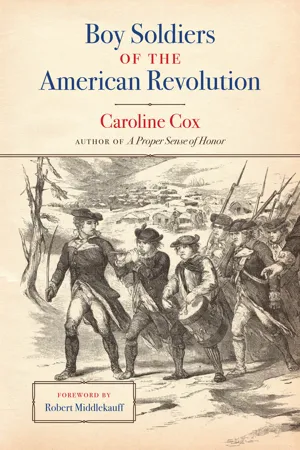
Between 1819 and 1845, as veterans of the Revolutionary War were filing applications to receive pensions for their service, the government was surprised to learn that many of the soldiers were not men, but boys, many of whom were under the age of sixteen, and some even as young as nine. In Boy Soldiers of the American Revolution, Caroline Cox reconstructs the lives and stories of this young subset of early American soldiers, focusing on how these boys came to join the army and what they actually did in service. Giving us a rich and unique glimpse into colonial childhood, Cox traces the evolution of youth in American culture in the late eighteenth century, as the accepted age for children to participate meaningfully in society — not only in the military — was rising dramatically.
Drawing creatively on sources, such as diaries, letters, and memoirs, Caroline Cox offers a vivid account of what life was like for these boys both on and off the battlefield, telling the story of a generation of soldiers caught between old and new notions of boyhood.
- 232 pages
- English
- ePUB (mobile friendly)
- Available on iOS & Android
eBook - ePub
Boy Soldiers of the American Revolution
About this book
Information
Chapter One: Answer the Purpose
The State of Alabama
County of Blount
County of Blount
On this 7th day of September in the year of our Lord one thousand eight hundred and thirty three personally appeared in open Court before the Court of Blount County now sitting George Hoffstaler, [sic] a resident of Gurleys settlement in the County of Blount in the State of Alabama aged seventy years who being first duly sworn according to law doth on his oath make the following Declaration in order to obtain a Benefit of the Act of Congress passed June 7th 1832.
That he enlisted in the service of the United States under the following named officers and served as herein stated. That on the first of August in the year 1778 he enrolled himself as a volunteer for the term of nine months in the militia or state troops of North Carolina to serve as a private therein the Company of Captain David Cowan . . . and he was enrolled for the term aforesaid under an offer from the Congress of the United States or the State of North Carolina of a Bounty of one hundred Dollars. [After duty guarding Guilford Court House, the Dan River, a brief furlough, and marching to Briar Creek] The deponent was in the Battle fought There where Gen[eral] Ash was defeated. . . . The Light Infantry and all that Escaped with us swam the River and joined General Rutherford’s Army on the Carolina side. Col. Lytle Lost Many of his Men. Some were killed and others were drowned in attempting to swim the River. And after our defeat at Briar’s Creek we were marched to and engaged in the assault on Fort Stono in the summer following Gen. Ash’s defeat.
. . . I was born in Frederick Town in the State of Maryland and in the year 1763 from the best of my information. I have no record of my age. My Father Died when I was about thirteen years old. I went to Salisbury, North Carolina where some of my relatives lived and I resided there when I first entered the service.
Perhaps it was like this:
George Hofstalar fell to the ground exhausted. The order to rest had finally been given. It was the evening of March 3, 1779, and darkness had long since fallen. It was a cold, damp night, and his clothes were still wet from his swim across Briar Creek and his struggle through the swampy ground where the creek flowed into the Savannah River. His company and other North Carolina and Continental troops were in full flight from British and loyalist soldiers. Before he gave himself up to sleep, he looked around and noticed how few of his friends were with him. Some, he was sure, would catch up with them during the night. But the afternoon had been confusing. He had no idea how many of his company had been killed or wounded in the short battle, but he knew that some had drowned crossing the creek. Despite its name, Briar Creek was really a river, more than sixty feet wide with deep, fast-moving water. Once they had made it to the other side, they marched away as quickly as they could and later heard British soldiers calling to each other as they searched the swamp for patriot stragglers. At one point, he thought he smelled smoke, and his sergeant told him that the British had probably lit the brush in the swamp to light their way and flush out anyone hiding. But now all was quiet. The British had given up their search for the night, and they were temporarily safe. He knew he should sleep, but he strained to identify the strange sounds he heard in the darkness. His old home in Maryland seemed a long way away.
His father’s death two years earlier had led to a lot of changes in his life. He had been born and raised in Frederick Town, Maryland, a small but bustling county town founded in 1745 by German immigrants. When his father died, Hofstalar was sent to live with an aunt and uncle on their farm in Salisbury, in Rowan County, North Carolina. It was awkward being in a new family, but he was familiar with farm labor, and he pulled his weight when he worked alongside his cousins. Like his hometown, Salisbury was small but lively. It was only recently settled, but it was the county seat and had a small courthouse, public buildings, and farmers and traders passing through. But he had to adjust to his new community. His relatives were closely tied to other German families in the area, and they argued all the time over minor differences in Lutheran Church doctrine. Hofstalar listened carefully, kept quiet, and learned which families shared his relatives’ opinions, who he could speak to and who not, and tried to fit in. In the summer of 1778, when he heard that there was a bounty of one hundred dollars to anyone enlisting, he was eager to go. He was not sure if his uncle would consent, as Hofstalar was only fifteen, but he did. His uncle went with him to the recruitment post at the tavern in Salisbury to sign his enlistment paper to serve for nine months. They said their farewells, and the boy went to stand with the other recruits.
The soldiers set off in high spirits, but their first few weeks of service were challenging. They marched in the summer heat more than sixty miles to Guilford Court House and from there to the Dan River (another sixty miles), carrying heavy packs and muskets. But the next weeks were better. Hofstalar made friends among his fellow soldiers and enjoyed their company. And they stopped marching great distances. Instead, they stayed around the Dan, standing guard and scouting until his unit made its way home on furlough for a few weeks.
When his company was called out again early in 1779 to keep a close eye on British movements south of Augusta, Georgia, their hard marching took him to the limits of his endurance. They tramped for miles day after day and food ran short. Hofstalar’s pack seemed to get heavier and heavier. His shoulders ached, and after one particularly rainy and miserable day, his skin was raw where the straps rubbed his shoulders. This was his condition before the British attacked at Briar Creek and the company had to flee.
Now he laid in darkness, his body aching, listening for sounds of the enemy until finally he fell asleep. The next morning, he woke slowly and heard the order to march. He staggered to his feet; an older soldier showed him how to make his pack more comfortable on his painful shoulders, and the company walked on at an easier pace now that their lives were not in danger. Soon they met a wagon carrying food supplies, and that lifted everyone’s spirits. Hofstalar dragged himself along; after a few days, he felt he had almost recovered from his ordeal. Over the remaining months of his enlistment, his company continued to wear out a lot of shoe leather. They tracked the movement of British troops and engaged in a few small skirmishes. Hofstalar returned home in September 1779. Overall, his months in the army had been tiring but satisfying, and the following year, a mature seventeen-year-old, he enlisted again, only this time in a mounted unit. He never wanted to march again.1
DETAILS DRAWN FROM HOFSTALAR’S pension application, from community records, as well as from facts surrounding the battle at Briar Creek allow us to imagine Hofstalar’s experience during his first year of service and to consider the ways in which young soldiers were both useful and encumbering to an eighteenth-century army. Hofstalar was eager and resilient. Like many boys his age, he had worked before joining the army. But he had neither the knowledge nor the stamina of an older youth or man. He was probably unaware that his presence had worried his officers and some of the older soldiers, all of whom kept a special eye on him. He was strong enough to use a musket in combat but struggled to carry it long distances. After only a mile or two, he began to slow down, altering the pace of the entire company.
Having the stamina for a march was important. In the eighteenth century, and for many centuries beforehand, armies often did little fighting. They engaged an enemy when they had to, or when it was to their obvious advantage, but commanders usually avoided clashing with one another, because that could be expensive in manpower and matériel. During the American Revolutionary War, in particular, where both sides needed to mobilize political and logistical resources in creative ways, the opposing generals preferred to target each other’s strategic posts, supply lines, or foraging parties, and otherwise wear each other down.
These generals led armies in states that were able to purchase and deliver supplies in the field. But even experienced quartermasters, the officers in charge of these well-developed administrative systems, often found this difficult to accomplish. It took a combination of political will, money, manufacturing ability, and transportation networks to keep an army equipped and fed on a campaign. Yet even when these elements were in place, the rebellious colonies and then the new United States were often short of horses and wagons. In November 1776, when thirteen-year-old slave Peter Brooks Nelson—enlisting for three months in Massachusetts with his master’s permission rather than at his request—set off to join Washington’s forces in New York, the troops had virtually no equipment. A few weeks earlier, Washington had written to Congress to report that the soldiers coming to join him were without “a Single Tent or a necessary of any kind . . . not a pan or kettle.” Fifteen-year-old soldier Joseph Plumb Martin of Connecticut confirmed these hardships. His company joined Washington’s forces at the same time, and he was sure he got sick after sweating from exertion during the day and then lying on wet, cold ground at night. It was a happy moment when he found some dry leaves and “made up a bed of these and nestled in it.” A friend foraged some food for him and found turnips and “some boiled hog’s flesh.” Intermittent shortages of basic necessities made life grueling.2
It was these tasks of survival that occupied soldiers through much of history. They had to be able to repair their equipment (or even make it), to endure the inefficient supply lines that delivered food of uncertain quality, to forage for food when none arrived, and finally to cook whatever they had been able to garner. When not doing these tasks, soldiers had to march great distances, carrying all the tools of their trade and their own few possessions, turn their hand to building the structures in which they might live and the defensive works they might guard. They would cut trees, build roads, and haul themselves and the army’s war matériel across great swaths of territory, and feel, alternately, content, miserable, bored, exhausted, and frightened.
If this were not difficult enough, tired and poorly fed soldiers, often living closely together in camp, were vulnerable to disease. There was no clear knowledge yet of the direct connection between poor hygiene and illness, although experience indicated there was one. Poor sanitation led to a variety of illnesses such as dysentery, bloody diarrhea, typhus, a flea- or tick-borne fever, and typhoid, contracted from drinking contaminated water. Any respiratory infection spread quickly among them. Soldiers’ lives were at much greater risk from disease in the army than in civilian life. For example, during the Seven Years’ War (1756–63), the last major war before the Revolution, Massachusetts provincial troops, in a few short months of service, were four times more likely to die from disease than they were in a whole year spent at home. European armies routinely lost three times more men to illness than battle, and these statistics became much worse if the army was operating in an unfamiliar climate, exposing the troops to new pathogens. Soldiering was a hard life, and that meant the preferred recruit for any army was a man who could withstand its rigors.3
Could boys under sixteen be good and useful soldiers? They certainly could not carry loads as heavy or march as far as some of their older comrades, but they were hardy and could recover quickly from the demands placed on them. Mostly coming from the countryside with little exposure to the pathogens of the larger world, boys were vulnerable to the diseases of camp life, but probably no more so than older soldiers if they also had previously little contact with crowds. But boys’ health and long-term stamina was not on recruiting officers’ minds. They focused instead on boys’ lack of physical strength. For example, in 1779, fourteen-year-old Simeon Hewitt stood before Connecticut militia officers hoping to be taken as a substitute for his father for two months of service. The militia was a force drawn from the community to deal with local emergencies for brief periods. But even for this short period of time, the officers wondered whether he was strong enough to do the job. His father had come to see the officers the day before to suggest the substitution. The officers consented to it provided, Hewitt later recalled, his father agreed “to return if I did not answer the purpose.” The boy duly presented himself, and the officers looked him over. They concluded that he would indeed “answer the purpose,” and the boy served.4
But senior officers were always annoyed to see boys in the lines. They simply did not think they were useful. Lord Barrington, the British secretary of war at the beginning of the American Revolution, thought “young boys” were so useless that recruiting them was an “abuse” that amounted to a “fraud on the public.” George Washington felt the same way. In 1776, he ordered that when “any boys or decripid [sic] persons are brought into the Service,” they would be discharged. The officer who enlisted them would, he threatened, “be chargeable with the Expence they may be to the publick.” This threat was not carried out, but other senior officers shared his sentiments. Barrington and Washington probably had no particular minimum age in mind or much information about the troops recruited for the service when they complained of boys in the line. They were simply looking at troops and noting that among them were those who looked too small and young to be useful. American General Arthur St. Clair was probably equally ignorant of the exact age of his soldiers when he lamented that many of them were “mere boys, altogether incapable of sustaining the fatigues of a soldier.” St. Clair, writing to Governor James Bowdoin of Massachusetts, explained why he had ordered his forces to abandon Fort Ticonderoga in the summer of 1777. Surveying his troops, he had noted their youthfulness, assessed what they might be capable of, and acted accordingly.5
Not surprisingly, the boy soldiers themselves had a higher opinion of their abilities. When they were old men applying for pensions, they and their witnesses emphasized their physical strength. Samuel Branch, who enlisted at age fourteen, insisted that even though he had been “very young for a soldier,” he was a “pretty good size for my age.” Thirteen-year-old Bishop Tyler “was a great boy and stout & strong.” Virginian Robert Gale, in the militia at age twelve, “was very young but was able to bear arms.” Thirteen-year-old Nathaniel Warner of Connecticut was “a stout rugged boy of sufficient age and capacity to bear arms as much as any man.” Of course, these veterans wanted pensions and had to convince the pension commissioner—just as years earlier they had to convince recruiting officers—that they could do a soldier’s work. Thus, they emphasized their physical maturity and usefulness.6
When Washington and Barrington railed against boys’ presence in the line, it was because they knew a soldier’s life was hard. Yet recruiting officers enlisted them. They did so not just because they had different opinions about work and war, about who was a useful soldier, or because they were under pressure to fill the ranks. Military leaders and junior recruiting officers had differences of opinion because they stood at an unusual juncture in history. In previous centuries, boys would have been as worthless as Barrington and Washington believed. However, since the seventeenth century, there had been changes in weaponry, communications, and military life that made service by boys possible and, to a degree, brought boys into the military community.
IN THE CENTURIES before the American Revolution, there is little data available on the ages of soldiers. Kings and their nobles raised armies, but they and their chroniclers thought there was little worth noting about the soldiers who fought—not their names, their places of origin, or their ages. William Shakespeare, in his play Henry V, written around 1599, demonstrated this state of affairs: after the battle of Agincourt, King Henry asks the number of the English dead. Handed the information on a piece of paper, he reads aloud: “Edward the Duke of York, the Earl of Suffolk, / Sir Richard Ketly, Davy Gam, esquire: / None else of name; and of all other men / But five-and-twenty.” The men named in this speech were ordered by social rank from nobleman to gentleman. Those beneath that rank were nameless.7
While Shakespeare was not a good historian, he was in this instance quite accurate. After the battle of Agincourt in 1415, in which the French and English clashed in northern France, chroniclers of the event named only the most illustrious figures and the age of no one. One Englishman recorded the French dead as two named noblemen, three dukes, seven counts, “100 barons, 1,500 knights, 7,000 men of gentle birth,” and listed the English dead the same way—the Duke of York, the Earl of Suffolk, and “more than 30 common people.” French chroniclers offered no more, naming a few men of high birth, then noting a number of “kni...
Table of contents
- Cover Page
- Boy Soldiers of the American Revolution
- Copyright Page
- Dedication
- Contents
- Foreword
- Preface and Acknowledgments
- Introduction: As Well As I Can Recollect
- Chapter One: Answer the Purpose
- Chapter Two: A Strong Desire to Enlist
- Chapter Three: My Father Caused Me to Enlist
- Chapter Four: He Took His Father’s Place
- Chapter Five: Fellow Citizens
- Notes
- Bibliography
- Index
Trusted by 375,005 students
Access to over 1.5 million titles for a fair monthly price.
Study more efficiently using our study tools.
Frequently asked questions
Yes, you can cancel anytime from the Subscription tab in your account settings on the Perlego website. Your subscription will stay active until the end of your current billing period. Learn how to cancel your subscription
No, books cannot be downloaded as external files, such as PDFs, for use outside of Perlego. However, you can download books within the Perlego app for offline reading on mobile or tablet. Learn how to download books offline
Perlego offers two plans: Essential and Complete
- Essential is ideal for learners and professionals who enjoy exploring a wide range of subjects. Access the Essential Library with 800,000+ trusted titles and best-sellers across business, personal growth, and the humanities. Includes unlimited reading time and Standard Read Aloud voice.
- Complete: Perfect for advanced learners and researchers needing full, unrestricted access. Unlock 1.5M+ books across hundreds of subjects, including academic and specialized titles. The Complete Plan also includes advanced features like Premium Read Aloud and Research Assistant.
We are an online textbook subscription service, where you can get access to an entire online library for less than the price of a single book per month. With over 1.5 million books across 990+ topics, we’ve got you covered! Learn about our mission
Look out for the read-aloud symbol on your next book to see if you can listen to it. The read-aloud tool reads text aloud for you, highlighting the text as it is being read. You can pause it, speed it up and slow it down. Learn more about Read Aloud
Yes! You can use the Perlego app on both iOS and Android devices to read anytime, anywhere — even offline. Perfect for commutes or when you’re on the go.
Please note we cannot support devices running on iOS 13 and Android 7 or earlier. Learn more about using the app
Please note we cannot support devices running on iOS 13 and Android 7 or earlier. Learn more about using the app
Yes, you can access Boy Soldiers of the American Revolution by Caroline Cox in PDF and/or ePUB format, as well as other popular books in History & Early American History. We have over 1.5 million books available in our catalogue for you to explore.