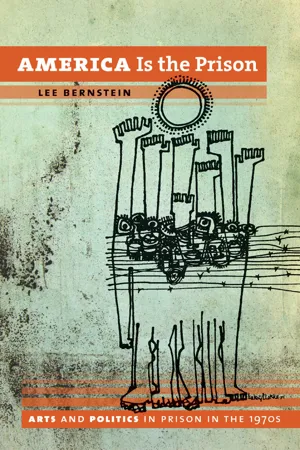
In the 1970s, while politicians and activists outside prisons debated the proper response to crime, incarcerated people helped shape those debates though a broad range of remarkable political and literary writings.
Lee Bernstein explores the forces that sparked a dramatic “prison art renaissance,” shedding light on how incarcerated people produced powerful works of writing, performance, and visual art. These included everything from George Jackson’s revolutionary Soledad Brother to Miguel Piñero’s acclaimed off-Broadway play and Hollywood film Short Eyes. An extraordinary range of prison programs — fine arts, theater, secondary education, and prisoner-run programs — allowed the voices of prisoners to influence the Black Arts Movement, the Nuyorican writers, “New Journalism,” and political theater, among the most important aesthetic contributions of the decade.
By the 1980s and '90s, prisoners' educational and artistic programs were scaled back or eliminated as the “war on crime” escalated. But by then these prisoners' words had crossed over the wall, helping many Americans to rethink the meaning of the walls themselves and, ultimately, the meaning of the society that produced them.
- 240 pages
- English
- ePUB (mobile friendly)
- Available on iOS & Android
eBook - ePub
About this book
Information
CHAPTER ONE
WE SHALL HAVE ORDER
THE CULTURAL POLITICS OF LAW AND ORDER
During the 1968 presidential campaign, Richard Nixon made Lyndon Johnson’s attorney general, Ramsey Clark, a target of his “law-and-order” campaign strategy. In accepting the GOP nomination at his party’s national convention in Miami, Nixon exhorted that whomever he nominated for attorney general would “open a new front against the filth peddlers and the narcotics peddlers who are corrupting the lives of the children of this country.”1 Once in the White House, Richard Nixon made the law-and-order rhetoric of his campaign a cornerstone of his first term, naming his campaign manager, John Mitchell, to the post formerly held by Clark. Mitchell immediately distanced himself from his predecessor. “There’s a difference,” he told the New York Times, “between my philosophy and Ramsey Clark’s. I think this is an institution for law enforcement, not social improvement.”2
The political ideology underlying this difference between “law enforcement” and “social improvement” reflects perhaps the most important transformation of the U.S. criminal justice system in its long history. This transition led to the sharp rise in repressive policing, high rates of incarceration, and the end of postwar liberalism.3 As a political and social flashpoint, “law and order” brought together conservative contempt for government programs and professional experts while drawing on growing public concern about urban uprisings, radical protest, and street crime. The Johnson administration—and later Hubert Humphrey’s failed presidential campaign—could not develop a coherent and convincing liberal response to the growth in the fear of crime.4 Law-and-order politics, along with the limits of Johnson’s Great Society and the failures in Vietnam, helps explain the decline of liberalism as a potent political force on the national stage.5
If 1968 marked the apogee of law and order as a political strategy, it was also the source of, at first, the expansion of heavily armed law enforcement and, over time, an explosive increase in prison populations.6 While the Nixon administration’s “law-and-order” politics laid the groundwork for federal, state, and municipal governments to transform and expand police departments and correctional facilities, broader social and economic factors help explain the shift in criminal justice ideology and tactics.7 The prison building boom of the 1980s and 1990s was closely linked to major political and economic changes of the late 1960s and early 1970s. As Ruth Wilson Gilmore points out, 1968 was the moment when “revolutionaries around the world made as much trouble as possible in as many places as possible.”8 The Watts riot of 1965 ushered in several years of “militant urban antiracist organizing.”9 In response, law-and-order politics sought to subdue what the government saw as domestic insurgencies. Economically, 1968 was the end of the three-decade “golden age” of U.S. capitalism that began with the buildup for World War II. Not all Americans enjoyed the benefits of that economic growth, and in the postwar period some made ambitious efforts to oppose inequality. As the economic crisis deepened during the 1970s, the country saw dramatic surpluses in land, labor, and population amid continuing unrest. Gilmore makes clear that prison building puts “certain state capacities into motion, makes use of a lot of idle land, gets capital invested via public debt, and takes more than 160,000 low-wage workers off the streets.”10 If law-and-order politics played a decisive role in the decline of postwar liberalism, it was also the result of a shifting political economy.
Law-and-order politics provide a useful way to understand the explosive growth in the U.S. prison population. By looking closely at the cultural and ideological underpinnings of the 1960s and 1970s shift in crime-control policy, we can see the place of crime control in the postwar decline of liberalism and rise of conservatism. These political and economic factors deeply influenced the cultural life of American prisons—and the place of prisons in American culture—during the 1970s. They did so, however, in ways that help explain the mainstream “tough on crime” consensus that would later develop around criminal justice. If 1968 was the beginning of the end of postwar liberalism, it was also when a consensus began to coalesce around abandoning rehabilitation for more purely punitive criminal justice. This shift would be gradual and indirect, but it had its roots in the 1960s and developed momentum during the 1970s.
The post-1968 shifts in the criminal justice system were firmly rooted in the Great Society’s liberalism while simultaneously inspiring what would later be termed neoconservatism. The Nixon campaign and administration did not replace the Great Society’s criminal justice apparatus. Rather, they employed a cultural strategy of assigning new meaning to key features of postwar liberalism such as “civil rights,” “freedom,” and “order.” Rather than work solely through the criminal justice system or through legislative channels, neoconservatives produced television ads, political speeches, and public policy books for a popular audience. This cultural strategy enabled the rapid discrediting of sociohistorical approaches to social problems like crime, poverty, and unequal access to health care. In particular, concerns over racial inequality—as well as the shape and pace of reform—were the central narrative in the cultural production of crime and criminal justice during the late 1960s and 1970s. Linked bureaucratically, however, liberal and neoconservative criminal justice both tended to distance themselves from explicit naming of racial differences as a factor in their policymaking decisions. The new cultural constructions of criminality and race that took shape during the 1970s simultaneously linked criminality as an assault on the “civil rights” of “decent citizens” and discredited civil rights activists in and out of prison who asserted an ongoing pattern of discrimination in the criminal justice system.
If law-and-order rhetoric enabled the conservative ascendancy it was also an invisible link between Johnson’s Great Society and Nixon’s silent majority, facilitated in part by crucial domestic policy advisors to Johnson like Daniel Patrick Moynihan and James Q. Wilson, both of whom also advised Nixon. In addition, the growth of a primarily repressive criminal justice system can be traced to bureaucratic and cultural resignification. That is, the bureaucracies of the Great Society and its language of civil rights and social improvement were not replaced by a new, more repressive government infrastructure. Rather, the institutions of the Great Society became conduits for repression and incarceration. At least as far as criminal justice was concerned, policymakers saw no need to replace or repeal the bureaucratic structures of postwar liberalism when shifting from “social improvement” to “law enforcement.”
Scholars have hastily reached a consensus on the meaning of this shift, seeing it largely in terms of the future war on drugs, the rapid rise in prison populations and the boom in prison construction. Nevertheless, the structural and political studies of the transition allow us to gain only a preliminary understanding of the cultural politics of the transition. A shift in the cultural significance of criminality and criminal justice accelerated during the late 1960s and 1970s amid polarized debate over the significance of repressive state power. Was the state a representative body with the power to carry out public demands for security and order? Or did the government use criminal justice to control the “dangerous classes” and maintain racial inequality? In order to shape the answers to these questions, the Nixon campaign and the administration’s policymakers entered the cultural realm, substituting postwar liberalism’s narrative of “social improvement” with one of law enforcement. Over time, this shift would become a neo-conservative reframing of crime control. However, the cultural politics of crime control in the late 1960s and early 1970s reveals a more complicated story of continuity and reversal. Although Ramsey Clark and the Great Society may have been convenient rhetorical foils for John Mitchell and Richard Nixon, Clark’s liberalism also was a useful bureaucratic and ideological structure for the repressive policing and incarceration that would come to dominate criminal justice.
Like all U.S. political campaigns of the postwar period, the Nixon campaign ran advertisements that advanced its ideological agenda. While the campaign did not specify what policies and practices Nixon’s administration would implement, the ads did demonstrate what Michael Denning calls “aesthetic ideology.” This refers to the ways that political expression engages forms and conventions that “establish ways of seeing and judging, canons of value.”11 For example, different genre conventions contain class inflections, political assumptions, and audience expectations. These ads did more than make a case for electing Nixon, they reflected and pushed for shifting “canons of value” toward more repressive state responses to disorder after 1968. Christopher P. Wilson explored this terrain of cultural narrative and political work in his analysis of police procedurals and organized crime narratives. Rather than dismiss the formulaic elements of popular crime and policing narratives as deceptive and unscholarly, Wilson asks us to consider the ways law enforcement and criminal justice intersect with—and depend on—“journalistic norms and literary conventions.”12 Much like the “aesthetic ideologies” mapped out in Denning’s The Cultural Front, these norms and conventions provide a way of seeing criminality and criminal justice that imply political affiliations, modes of policing, and, as Wilson notes, the political economy of crime and the role of the state.13
Just as cultural forms offer insight into particular social and ideological locations, the political field draws on aesthetic ideologies in its campaign ads and policy initiatives in order to reformulate political blocs and direct state resources toward favored initiatives. Furthermore, as the 1970s wore on, policymakers made it increasingly difficult for prisoners to engage in cultural politics or offer “ways of seeing and judging” criminality that might call into question the state’s repressive solutions. These substitutions, distortions, and attempted erasures call for a different kind of analysis. Rather than what Denning calls “the politics of the cultural field itself,” the shift in emphasis from “social improvement” to “law enforcement” necessitates an understanding of the cultural production of the political field itself.
Questions of racial inequality permeated the political field of the late 1960s. In particular, African American observers in and out of prisons increasingly saw the criminal justice system as a key enforcer of racial inequality. The police and prisons symbolized broader patterns of injustice throughout the era. The years preceding the 1968 election saw increasing attention to the racial context for crime, policing, and prisons. Most notably, the Nation of Islam developed analyses of prostitution and drug use in black communities that emphasized their origins in internalized racism and white domination. Furthermore, the Nation of Islam explicitly confronted police violence in African American communities while organizing and converting African American inmates. The specific appeal of its critique went well beyond members of its mosques. In The Fire Next Time (1963), James Baldwin explains that an interaction with police officers at age thirteen helped him realize “how little one could do to change one’s situation.” While crossing Fifth Avenue, far from his Harlem home, Baldwin was asked by a police officer, “Why don’t you niggers stay uptown where you belong?”14 Baldwin saw the unchecked ability of police officers to frisk and harass African Americans as a constant reminder of white power and a key means to limit the geographic and social mobility of African Americans. Echoing this sentiment in his 1973 Grammy award–winning single “Living for the City,” Stevie Wonder told the story of a hardworking African American unable to find a job in Mississippi. After he migrates to New York City, the naive man is tricked into transporting drugs, arrested by viscously racist police officers, and sentenced to ten years in prison.15 By the early 1970s, it was not just activists and intellectuals like the Black Panthers, George Jackson, Robert Chrisman, or Angela Davis who would articulate the view that the criminal justice system was a primary means and manifestation of state power and racial oppression.16
In this political climate, white support grew for repressive criminal justice amid the seemingly contradictory increasing acceptance of the principal of racial equality. This contradiction would ultimately be resolved in the cultural realm as conservative advertisements, books, and articles drew on the language of civil rights, equal citizenship, and defense of liberty as primary justifications for repressive policing and increased incarceration. By drawing on seemingly universal ideals of citizenship, personal responsibility, and community control, conservatives explicitly invoked and avoided a language of race while engaging in a pattern of racial control. As the sociologist Katherine Beckett reveals, polls during the late 1960s showed that Americans generally supported the principle of racial equality but also worried that the policies of the Johnson administration “pushed integration too fast.”17 For example, while many whites claimed to oppose segregated schools, they also opposed court-ordered efforts to integrate them. Moreover, Beckett found a correlation between white opposition to busing and support for punitive policing. Regardless of their party affiliation, respondents who opposed specific remedies to segregation and racial inequality tended to support conservative, punitive forms of law and order.18
Richard Nixon’s 1968 presidential campaign crafted television advertisements that specifically confirmed and emphasized this correlation. Short political ads emerged as a crucial element only during the 1964 presidential campaign. Drawing on dramatic news footage, jarring or suspenseful music, and quick montage, Nixon’s 1968 ads revolutionized the young genre.19 While the ads of Hubert Humphrey and George Wallace, his opponents in the race, featured stiff and defensive candidates standing behind a lectern or awkwardly conversing with voters, Nixon’s ads unleashed fears of social disintegration, with a first screen warning viewers, “This time vote like your whole world depended on it,” then a second giving them the only hope of a return to normalcy: “NIXON.” These advertisements marked more than a shift in political campaign strategy, they provided the core means to re-frame political protest and street crime as fundamental issues in need of repressive “law-and-order” solutions.
In these ads, made by Eugene Jones—the filmmaker best known for A Face of War (1967), his wrenching cinéma vérité documentary about a Marine rifleman in Vietnam—law and order appeared in two forms: the first concerned student protests and urban rioting; the second focused on violent crime.20 The ads conflated the two. In fact, while Nixon’s campaign released separate ads for each form of lawlessness, they relied on several of the same images and phrases, creating an odd equivalence of political protest and violent crime. An ad called “The First Civil Right” featured news photos of student protests (including one of a banner with the word “socialism” prominently displayed) and burning buildings. In it, Nixon’s voice avowed: “It is time for an honest look at the problem of order in the United States. Dissent is a necessary ingredient of change, but in a system of government that provides for peaceful change there is no cause that justifies resort to violence. Let us recognize that the first civil right of every American is to be free from domestic violence. So I pledge to you, we shall have order in the United States.”21 The revolutionary violence of groups like the Weather Underground and others would occur in the near future. Here, Nixon referred to the rioting that followed Martin Luther King’s assassination and, more specifically, to the violent protests outside the 1968 Democratic Convention at which Hubert Humphrey received his party’s nomination. During the convention, the images of the Chicago police attacking protesters in Grant Park symbolized the growing political divide within the Democratic Party. The fighting in the streets mirrored the primary battle between Humphrey and antiwar candidates like Eugene McCarthy and the recently assassinated Robert F. Kennedy. In addition, journalists covering the fighting in the streets emphasized that the police attacks were largely unprovoked.22 By seeing the political rebellion and what amounted to a police riot in terms of “disorder,” Nixon effectively absolved the Chicago police of any responsibility for the melee and reframed the event’s meaning in time for the general election.
Nixon’s voice-over linked antiwar activity to an undemocratic process and then interpreted the movements as a threat to the “first civil right of every American.” In a society with free elections, Nixon argued, there was no place for protest. This understanding of “civil rights” would be unrecognizable to those advocating for racial eq...
Table of contents
- Cover Page
- America is the Prison
- Copyright Page
- Dedication
- CONTENTS
- ILLUSTRATIONS
- ACKNOWLEDGMENTS
- INTRODUCTION
- CHAPTER ONE WE SHALL HAVE ORDER
- CHAPTER TWO THE AGE OF JACKSON
- CHAPTER THREE WHAT WORKS?
- CHAPTER FOUR WE TOOK THE WEIGHT
- CHAPTER FIVE CELL BLOCK THEATER
- CHAPTER SIX RADICAL CHIC
- CONCLUSION
- NOTES
- INDEX
Trusted by 375,005 students
Access to over 1.5 million titles for a fair monthly price.
Study more efficiently using our study tools.
Frequently asked questions
Yes, you can cancel anytime from the Subscription tab in your account settings on the Perlego website. Your subscription will stay active until the end of your current billing period. Learn how to cancel your subscription
No, books cannot be downloaded as external files, such as PDFs, for use outside of Perlego. However, you can download books within the Perlego app for offline reading on mobile or tablet. Learn how to download books offline
Perlego offers two plans: Essential and Complete
- Essential is ideal for learners and professionals who enjoy exploring a wide range of subjects. Access the Essential Library with 800,000+ trusted titles and best-sellers across business, personal growth, and the humanities. Includes unlimited reading time and Standard Read Aloud voice.
- Complete: Perfect for advanced learners and researchers needing full, unrestricted access. Unlock 1.5M+ books across hundreds of subjects, including academic and specialized titles. The Complete Plan also includes advanced features like Premium Read Aloud and Research Assistant.
We are an online textbook subscription service, where you can get access to an entire online library for less than the price of a single book per month. With over 1.5 million books across 990+ topics, we’ve got you covered! Learn about our mission
Look out for the read-aloud symbol on your next book to see if you can listen to it. The read-aloud tool reads text aloud for you, highlighting the text as it is being read. You can pause it, speed it up and slow it down. Learn more about Read Aloud
Yes! You can use the Perlego app on both iOS and Android devices to read anytime, anywhere — even offline. Perfect for commutes or when you’re on the go.
Please note we cannot support devices running on iOS 13 and Android 7 or earlier. Learn more about using the app
Please note we cannot support devices running on iOS 13 and Android 7 or earlier. Learn more about using the app
Yes, you can access America Is the Prison by Lee Bernstein in PDF and/or ePUB format, as well as other popular books in Social Sciences & Criminology. We have over 1.5 million books available in our catalogue for you to explore.