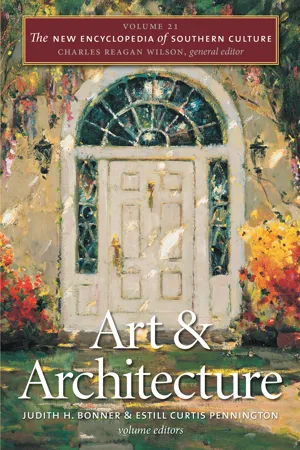
eBook - ePub
The New Encyclopedia of Southern Culture
Volume 21: Art and Architecture
- 544 pages
- English
- ePUB (mobile friendly)
- Available on iOS & Android
eBook - ePub
The New Encyclopedia of Southern Culture
Volume 21: Art and Architecture
About this book
From the Potomac to the Gulf, artists were creating in the South even before it was recognized as a region. The South has contributed to America's cultural heritage with works as diverse as Benjamin Henry Latrobe's architectural plans for the nation's Capitol, the wares of the Newcomb Pottery, and Richard Clague's tonalist Louisiana bayou scenes. This comprehensive volume shows how, through the decades and centuries, the art of the South expanded from mimetic portraiture to sophisticated responses to national and international movements. The essays treat historic and current trends in the visual arts and architecture, major collections and institutions, and biographies of artists themselves. As leading experts on the region's artists and their work, editors Judith H. Bonner and Estill Curtis Pennington frame the volume's contributions with insightful overview essays on the visual arts and architecture in the American South.
Trusted by 375,005 students
Access to over 1.5 million titles for a fair monthly price.
Study more efficiently using our study tools.
Information
Print ISBN
9780807837184
9780807837177
Subtopic
Architecture GeneralART IN THE SOUTH
Art in the South, 1800–1920. Though H. L. Mencken’s oft-quoted and much-lamented reference to the South as the “Sahara of the Bozart” has long been refuted by the achievements of the southern literary renascence, his stinging comments on the visual arts are worth revisiting as a prelude to an entire volume focused upon that very subject. From his perspective in 1917, “there is not a single picture gallery worth going into[,] . . . a single public monument that is worth looking at, or a single workshop devoted to the making of beautiful things,” and “when you come to . . . painters, sculptors, architects and the like, you will have to give it up, for there is not even a bad one between the Potomac mudflats and the Gulf.” Even as he wrote, the Telfair Academy in Savannah, with the assistance of Julius Garibaldi “Gari” Melchers, was assembling a fine collection of contemporary academic and impressionist art for its “picture galleries.” John Russell Pope’s architectural plans for Richmond ensured that “public monuments worth looking at” would indeed transform the old Confederate capital. Meanwhile, in New Orleans, artisans in the Newcomb Pottery workshop were busy producing wondrously painted and glazed art pottery that seemed to capture the actual moisture of the local atmosphere. To challenge the expansive dismissal of creative individuals working from the Potomac to the Gulf, one might simply recall John Ross Key’s monumental view of Washington, D.C., as seen from Arlington above the Potomac, or linger over one of Richard Clague’s tonalist landscapes set so near the Gulf and New Orleans.
For the past 30 years, many collectors, academics, and museum professionals have brought the vast and diverse assortment of southern artistic material culture to greater attention. This first overview, of the years between 1800 and 1920, highlights four expressive categories representing the rise and progress of 19th-century southern art, which spilled into the early 20th century. As the South expanded from colonial tidewaters and coastal plains to alluvial basins and mountain terrains, so too can the art of the South be seen as expanding from mimetic portraiture to more sophisticated responses to national and international avant-garde movements. In rough order, the demand for antebellum portraiture passed with the introduction of photographic technique, even as a growing awareness of natural beauty inspired several schools of landscape painting at midcentury. In the aftermath of the Civil War, conflicting issues in the sociocultural construct became subject matter for genre painting. Late in the 19th century, the introduction of international impressionism in schools and art academies coincided with an era whose creative individuals had begun to probe the complex mind and consciousness of the South.
Antebellum Portraiture. Portraiture in the antebellum South may be best explored in three categories that define the artists according to their travel and residency patterns. “Birds of passage”—a term coined by esteemed art historian Anna Wells Rutledge—are artists who may have visited the South only once but who left behind a body of work whose merit and popularity ensured imitation. “Seasonal itinerants,” whether native southerners or outside artists with long-standing ties to the South, often established temporary studios in certain recurring locations with favorable climate conditions. Many of these artists often fled the harsh winters of the North for the more moderate temperatures and active social life in the South. “Resident artists” were those whose long-term tenure in one urban area fostered a clientele that often returned for sittings, even in subsequent generations.
Birds of Passage. Birds of passage may be seen as artists who traversed the South in pursuit of commissions while imparting to a local community the international values and aesthetic tastes then current among artists and patrons in more sophisticated urban centers. These painters were more likely to seek out commissions in the more established and prosperous cities of the coastal South, notably Charleston and New Orleans, between 1790 and 1840. James Earl visited Charleston in 1794 and was praised in the local papers for “giving life to the eye, and expression of every feature.” Samuel Finley Breese Morse worked in Charleston in 1818, drawn by his extended connections in the Allston and Pinckney families, and he left behind an impressive body of work in the grand manner. Other artists of note who visited the city between 1818 and 1830 include John Wesley Jarvis, Cephas Thompson, John Vanderlyn, and miniaturist Benjamin Trott. New Orleans attracted itinerant painters from both the Upper South and abroad. In 1821, John Wesley Jarvis, having acquitted himself of several commissions in Louisville, took the downriver path to New Orleans. Once there, he established a studio, where he painted renegade general James Wilkinson and interviewed John James Audubon. Having examined some of Audubon’s drawings, he pronounced himself “unable to help him in the least.” Audubon had also arrived in New Orleans from Kentucky, where he had sustained his ambitions as a painter of wildlife by creating profile portraits, often in black-and-white chalk. Vanderlyn, discouraged in his efforts in Charleston, sought out work in New Orleans that same year, and he also viewed, with much greater courtesy, Audubon’s drawings. Although he admired their “beautiful coloring and good positions,” he did not feel they expressed any “knowledge of natural history.” Undeterred, Audubon could only wonder if all “men of talent were fools or rude naturally” and soon departed for England and fame eternal with the publication of Birds of America.
In the years following Audubon’s visit, New Orleans became fertile ground for ambitious itinerant artists. Drawn by the prosperous Creole families who continued their ties to France, Jean-Joseph Vaudechamp and Jacques Guillaume Lucien Amans visited the city several times between 1829 and 1856. A student of Anne-Louis Girodet de Roussy-Trioson, Vaudechamp worked in the French neoclassic spirit. His portraits are highly finished, with strong facial modeling, deep glazing, and a minute attention to costume detail. Vaudechamp’s figures are often turned away from the planar field (the surface of the painting) in a subtle and evocative contraposto, giving them a slightly distant, formal air. Amans also painted in the neoclassical style, and like Vaudechamp, he often worked in a larger, three-quarter-length format. This increase in size affects the presentation of the figure, making it larger and bolder. With their strong coloring, heavy modeling, and spatial dimensions, his figures are harbingers of the full-blown romanticism of the 1840s and 1850s—a style that might be called plantation baroque. Other French painters of note who worked in New Orleans include Louis Antoine Collas, who painted a rare portrait of a free woman of color, as well as François Bernard and Franz (François Jacques) Fleischbein.
George Cooke was among the most significant American painters to visit New Orleans in the age of the French itinerants. Following a European study tour, he returned to his country in 1832 with aspirations to create a “national gallery” of art. His writings on art for the Southern Literary Messenger, published in the spring of 1835, combine his thoughts on the mortality of life with the immortality of art. In these articles, he expresses concern that the viewing public is often more interested in the subject than in the execution of the artwork. He goes on to note that too great an emphasis upon content demeaned the true role of the artist—not to shock, excite, or entice the audience but rather to soothe and inform it with the collected knowledge gleaned from long observation. For Cooke, the artist functioned in the role of aesthetic preservationist, one who “by the magic of his pencil” captures “the very faces and persons of the fair and the brave of ages gone by.” In 1844, with the assistance of Daniel Pratt, an Alabama businessman, and James Robb, a New Orleans collector and financier, Cooke opened a “National Gallery of Painting” at 13 St. Charles in New Orleans. There he displayed works of art by some of the leading American painters of the day, including Thomas Sully, Emanuel Leutze, and Daniel Huntington. He continued to keep the gallery open until 1848, but his efforts to sustain the gallery on a long-term basis were not successful. While on a visit to New Orleans to conclude his project, in March 1849, he contracted Asiatic cholera and died. His ambitious intent and his published aesthetics place him amid the most important artists of the era.
Seasonal Itinerants. Following the purchase of the Louisiana Territory by President Jefferson in 1803, a large number of Kentucky families migrated to Mississippi, especially to the Natchez region. Those families and the growing economic ties between the upper Ohio Valley and the lower Mississippi Valley inspired the Kentucky-Mississippi itinerant portraitists. Their ability to travel was greatly improved when the first steamboat to descend the Mississippi, the New Orleans, began operations in 1812. Kentucky painter William Edward West was one of the first artists to take advantage of this travel and trade route when he went south from Philadelphia to Natchez and New Orleans in 1817. West was an astute observer in the Philadelphia studio of Thomas Sully, where he had assisted the master by painting background details. Sully’s portraits of Jean Terford and Mary Sicard David, with their faint echoes of French neoclassicism, provided the anatomical formula that West deployed in several Natchez and New Orleans works. Thomas Sully’s posthumously published “hints to young painters” reveal the artist’s impact upon his young followers. These “hints” are concerned with techniques of medium and support, preparing the canvas, ordering the palette, mixing color, gathering and laying out the artist’s tools, and varnishing the finished artwork. They reflect certain ongoing traditions in Western art instruction, dating from the Renaissance, offering in writing what had been an oral tradition, spoken in studios and ateliers.
A fellow Kentuckian, Matthew Harris Jouett, began to pursue a southern itinerancy in 1819, after West’s departure for Europe, taking advantage of the same acquaintances and family connections in the Natchez region. Jouett had worked with Gilbert Stuart in 1816 and kept notes on their encounter. “Rude hints & observations, from repeated Conversations with Gilbert Stuart, Esqr. In the months of July, August, September, & Oct. 1816 under whose patronage and care I was for the time” is that rare document, a firsthand account by an impressionable student working with an established master. The young artist admired Stuart as someone with a “singular facility in conversation and powers of illustration.” Jouett’s work from the 1820s demonstrates a fine command of style, especially seen in the ambitious compositions in his renderings of mothers with their children.
Slightly younger than West and Jouett, another Kentuckian, Joseph Henry Bush, began his itinerancy in 1818. Bush was more truly a wandering itinerant than either West or Jouett, who tended to establish “painting rooms” in local hostelries and steadily painted a group of sitters prearranged by word of mouth of their coming, as evident by multiple portraits of members of one family. Rarely resident in one locale, Bush worked from plantation to plantation, particularly among the extended Chotard families of Natchez and the Flowers family of Vicksburg. In later years, 1831–48, he gave up this wandering itinerancy and consistently spent his winters at the St. Charles Hotel in New Orleans.
Kentucky artists were not the only portraitists to pursue work along the Ohio-Mississippi Rivers trade route. James Reid Lambdin, resident in Louisville after 1832, pursued a seasonal itinerancy in Natchez from 1832 to 1837. Artists from Cincinnati who worked in the Deep South included James Henry Beard, intermittently active in New Orleans from 1838 to 1858; Minor Kellogg, who was there in 1840; and Joseph Oriel Eaton, active there in 1855 and 1857. It was not a one-way stream. Painters who came upriver to Kentucky include C. R. Parker, 1832–48, and the team of Theodore Sidney Moïse and Trevor Thomas Fowler, 1840–54.
Comparing and contrasting the recorded remarks of Sully and Stuart gives insight into the stylistic shifts then transforming American portraiture—from the forthright perspective of the young republic into the romantic expressionism of a rapidly expanding nation. While Stuart consistently advised his students to work from nature in order to create a painterly foundation for the “equal” application of paint, Sully assumed that the fledgling artists had “acquired the power to draw from memory the human figure in any position.” Stuart’s portraits began with observation, but Sully subjected the sitter to anatomical conventions absorbed from the Italian drawing master Pietro Ancora. Stuart encouraged Jouett to begin in paint; Sully began with a study “made in charcoal, with its proper effect of shadow relieved with white chalk.” Stuart prompted Jouett to paint from nature, observing character as he went. Sully advised adopting attitudes. Stuart was not interested in flattering his subjects, but Sully made his reputation on portraits that did just that, albeit with a masterful warmth of color and painterly detail.
Sully was quite honest about flattering his subjects. “From long experience I know that resemblance in a portrait is essential: but no fault will be found with the artist, at least by the sitter, if he improve the appearance.” This advice was well taken by William Edward West, whose early imitations of Sully’s compositional formulas matured into the much-demanded, and very lush, romanticism he practiced during his Baltimore period. While it would be far too simplistic to see the stylistic concerns of portraiture in Kentucky and the Ohio River Valley as rendered between these two dialectics of taste, the currents of style they inspired would linger until the outbreak of the Civil War. The diametric opposition of Stuart’s insistence upon honesty and truth to nature and Sully’s unabashed willingness to flatter can be revisited in the later careers of Oliver Frazer, Joseph Henry Bush, and George Peter Alexander Healy in Kentucky and in those of Joseph Oriel Eaton and the Soule family across the river in Ohio.
Resident Artists. By the mid-19th century, many urban centers in the South had resident portrait painters with an extended and loyal clientele. A native of England, William James Hubard began to work as an itinerant portraitist in Virginia in 1832, with residencies in Norfolk, Williamsburg, and Gloucester County. By 1836 he had acquired a settled residence with the purchase of The Retreat, a house in Gloucester Court House, Virginia. In the late 1840s Hubard and his family settled in a permanent residence on the edge of Richmond, near the home of the artist Edward F. Peticolas. During the next decade, Hubard became the portraitist of choice in the Richmond area, patronized by Virginia’s most prominent families, including sitters from the extended connections of the Tabb, Mayo, Randolph, Bolling, Cushing, Cocke, and St. George Tucker clans. At the same time he also became a close associate of Mann S. Valentine II, a writer and antiquarian with pronounced artistic interests. Hubard’s association with Valentine resulted in some of his most interesting work, notably the illustrative drawings he made for Valentine’s gothic romance Amadeus, or a Night with the Spirits. In 1852 Hubard announced that he would conduct art classes in his painting rooms at 11th and Broad Streets. He would not teach by the method of copying, “which leaves the pupil as much in the dark as to a knowledge of nature and art,” but rather by instruction, which would teach the student “to use his eyes, hands, and understanding in a way tending to remove the awkwardness arriving from that ignorance of nature and art.”
Charleston’s most famous resident artist was the miniaturist Charles Fraser, who was born there and then orphaned at the age of nine. During the 1790s, he attended the Academy of Bishop Smith in the company of Thomas Sully, who subsequently remarked that Fraser “was the first person that ever took the pains to instruct me in the rudiments of . . . art, and, although himself a mere tyro, his kindness and the progress made in consequence of it determined the course of my future life.” His first notice as an artist, published in the Charleston Courier on 29 November 1816, noted that “twenty very beautiful drawings of scenes, in different parts of the United States . . . have been purchased by the proprietors of this Journal,” who found them to be as “fine as any we have ever had occasion to i...
Table of contents
- Cover Page
- Art and Architecture
- Copyright Page
- Epigraph
- CONTENTS
- GENERAL INTRODUCTION
- INTRODUCTION
- ARCHITECTURE IN THE SOUTH
- ART IN THE SOUTH
- INDEX OF CONTRIBUTORS
- INDEX
Frequently asked questions
Yes, you can cancel anytime from the Subscription tab in your account settings on the Perlego website. Your subscription will stay active until the end of your current billing period. Learn how to cancel your subscription
No, books cannot be downloaded as external files, such as PDFs, for use outside of Perlego. However, you can download books within the Perlego app for offline reading on mobile or tablet. Learn how to download books offline
Perlego offers two plans: Essential and Complete
- Essential is ideal for learners and professionals who enjoy exploring a wide range of subjects. Access the Essential Library with 800,000+ trusted titles and best-sellers across business, personal growth, and the humanities. Includes unlimited reading time and Standard Read Aloud voice.
- Complete: Perfect for advanced learners and researchers needing full, unrestricted access. Unlock 1.5M+ books across hundreds of subjects, including academic and specialized titles. The Complete Plan also includes advanced features like Premium Read Aloud and Research Assistant.
We are an online textbook subscription service, where you can get access to an entire online library for less than the price of a single book per month. With over 1.5 million books across 990+ topics, we’ve got you covered! Learn about our mission
Look out for the read-aloud symbol on your next book to see if you can listen to it. The read-aloud tool reads text aloud for you, highlighting the text as it is being read. You can pause it, speed it up and slow it down. Learn more about Read Aloud
Yes! You can use the Perlego app on both iOS and Android devices to read anytime, anywhere — even offline. Perfect for commutes or when you’re on the go.
Please note we cannot support devices running on iOS 13 and Android 7 or earlier. Learn more about using the app
Please note we cannot support devices running on iOS 13 and Android 7 or earlier. Learn more about using the app
Yes, you can access The New Encyclopedia of Southern Culture by Judith H. Bonner, Estill Curtis Pennington, Judith H. Bonner,Estill Curtis Pennington, Charles Reagan Wilson in PDF and/or ePUB format. We have over 1.5 million books available in our catalogue for you to explore.