Whether picketing outside abortion clinics, speaking out at school board meetings, or attending anti–death penalty vigils, many Americans have publicly opposed local, state, or federal government policies on the basis of their religious convictions. In The Fracture of Good Order, Jason Bivins examines the growing phenomenon of Christian protest against civil authority and political order in the United States. He argues that since the 1960s, there has been a proliferation of religious activism against what protesters perceive as government’s excessive power and lack of moral principle. Calling this phenomenon “Christian antiliberalism,” Bivins finds at its center a belief that American politics is based on a liberal tradition that gives government too much social and economic influence and threatens the practice of a religious life.
Focusing on the Catholic pacifism of Daniel and Philip Berrigan and the Jonah House resistance community, the Christian Right’s homeschooling movement, and the evangelical Sojourners community, Bivins combines religious studies with political theory to explore the common ground shared by these disparate groups. Despite their vast ideological and institutional differences, Bivins argues, these activists justify their actions in overtly religious terms based on a rejection of basic tenets of the American political system. Analyzing the widespread dissatisfaction with the conventional forms of political identity and affiliation that characterize American civic life today, Bivins sheds light on the complex relations between religion and democratic society.
eBook - ePub
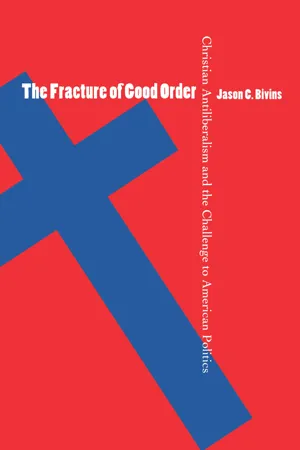
The Fracture of Good Order
Christian Antiliberalism and the Challenge to American Politics
- 232 pages
- English
- ePUB (mobile friendly)
- Available on iOS & Android
eBook - ePub
The Fracture of Good Order
Christian Antiliberalism and the Challenge to American Politics
About this book
Information
Topic
Theology & ReligionSubtopic
PoliticsChapter 1: The Irony of the Liberal State
Law is order, and good law is good order.
—ARISTOTLE
The things that Americans were taught and still wish to believe about self-government—the articles of civic faith we loosely call democracy—no longer seem to fit the present reality.
—WILLIAM GREIDER
Sociological or political interpretations of religion often tend, in the words of anthropologist Clifford Geertz, to look everywhere for explanations of religious phenomena but to religions themselves.1 New religious creations, particularly those that might be regarded as political, are often described as epiphenomena of larger geopolitical shifts such as the decline of the nation-state and the turn to local forms of identity; as a reaction to the travails of modernization; or as a response to disillusionment with the “master narratives” of the West, such as socialism or liberalism. Although such pronouncements can indeed border on a kind of intellectual reductionism, filtering the richness and complexity of religious expression down to a single causal factor, they also possess some explanatory merit.
In this chapter, I synthesize such “macrolevel” explanations of Christian antiliberalism with my focus on practitioners’ religious concerns and activities. My goal in so doing is to distinguish three levels on which Christian antiliberalism may be understood: as a religious phenomenon, with rich theological and doctrinal motivations at the heart of its critique; as the outgrowth of a specific constellation of historical circumstances in the United States since the 1960s; and as an impulse with independent political significance. Religiously, it is notable for its denominational and political diversity, and its shared qualities and its political aims transect the denominational and traditional boundaries that were once more reliable guides to the religious topography of American culture. An impulse whose political concerns and religious tactics are present in Baptist, Roman Catholic, Pentecostal, Evangelical, and other Christian communities, Christian antiliberalism is evidence that the shape of new religious movements is not easily captured by denominational or institutional affiliation.2
Historically, Christian antiliberalism is linked to older forms and traditions of religious social criticism and protest. Yet it is also part of a more recent shift in American political culture, one linked to the legitimation crisis of political liberalism and the rise of new social movements. Traces of American anarchism are evident in the antiliberal disdain for organized political logic; the fierce use of Christian moral rhetoric in the public sphere has accompanied protest movements as long as there has been political order in the United States; and ritual protest, too, has been acutely felt in American religious history, an early and notable example of which was William Lloyd Garrison’s burning of the American Constitution.3 Yet in the era since the civil rights movement, ritual protest has reentered public politics dramatically, in ways that are often unique to our historical moment.
Politically, Christian antiliberal action is frequently not only tied to specific issues but linked in addition to systemic critique of political order. Further, antiliberalism’s propensity for local politics represents a historical shift from earlier protest movements that, like the Populist campaigns of the 1890s or the fundamentalist “campaigns” of the 1920s, were aimed at influencing politics or culture on a national level. Contemporary critiques of liberalism often share normative concerns about the way society is organized and the way the state regards religious belief. Specifically, each group contends that liberal political order lacks legitimacy for two reasons: because it is bereft of the moral authority that it requires to align itself with the norms and ideals of a democratic society and because it provides insufficient resources for citizens to participate in the democratic process. Christian antiliberals give shape to these normative critiques through quite different communal or theological elaborations, varied issues around which antiliberal sentiments cohere, and different programmatic responses to their critiques.
Without appreciation for all these constitutive elements—particularly the religious worldviews that shape its motivations and practice—Christian antiliberalism cannot be understood. This complex religious creation is both heir to older traditions of American religious dissent and a product of its contemporary sociopolitical context. A phenomenon with deep historical roots but one that is also new and challenging, it must be seen in light of the changing nature of American politics.
Traditions of Dissent
Christian antiliberalism is both continuous and discontinuous with earlier movements and activists, both religious and nonreligious. The challenge to the legitimacy or the reach of the state has been prevalent in American politics, in both its religious and nonreligious forms, at least since the Federalist debates during the Constitutional era. Throughout the recorded history of the United States—stretching from long before the War of Independence into the twenty-first century—religious people from multiple traditions have debated the legitimacy, scope, character, and direction of political power. Indeed, there seems to be something uniquely American about the obsessive regularity with which such debates are held; and religious groups in particular have long found sport in denouncing the government that, at least on some level, guarantees them the freedom to utter such denunciations. In the twentieth century, debates about the state animated groups ranging across the political spectrum, from the Students for a Democratic Society to National Review conservatives.
Drawing power from its ability to name historical and critical forebears, Christian antiliberalism captures themes deeply embedded in the American political and religious imagination. A comprehensive list of its antecedents would extend back quite far in American history. Indeed, the historical range of Christian dissent itself is vast, stretching from the resistance of early Christian communities to Roman assimilation through the antinomian communities of the radical Reformation to peasant uprisings such as that led by German Thomas Müntzer, among many examples. Even within the United States, there are countless examples of Christian protest, such as Roger Williams’s rejection of theocratic government in Massachusetts in 1636, the religious presence in popular uprisings such Bacon’s or Shays’ Rebellion, the abolitionists of the 1830s–50s, Christians working for woman suffrage in the decades following the Civil War, trade union activism that churches spearheaded in the 1880s and 1890s, and dozens more. I purposefully do not touch on this broader history; nor even do I attempt to treat Christian dissent in the United States exhaustively. The purpose of my historical discussions here is simply to suggest, first, that Christian antiliberalism is continuous with some specific forms of earlier American dissent (most obviously the populism of the 1890s, the radical Christian politics of the 1920s, and the radical democratic movements of the 1960s) but that, second, it is also distinct in some important ways.
Historically, Christian antiliberalism has been decisively shaped by the political watershed of the 1960s, when liberal political order, in its apparent triumph, first began to fracture. By liberal political order, I refer not to the political philosophy of John Stuart Mill or John Rawls but the institutional order that emerged in the era of corporate liberalism and culminated in the postwar Keynesian state. According to Alan Brinkley, “liberalism was the set of political ideas that had descended from the New Deal and that had shaped the steady postwar expansion of federal social and economic responsibilities.”4 Postwar liberalism became identified with the planned economy of the welfare state and with judicial and legislative activism. Beginning in the 1960s, this arrangement was assailed from a number of quarters and for multiple reasons. Its underlying principles were charged with insensitivity to morality and community; it was denounced for its structural obstacles to democratic participation; it was seen as paternalistic and excessively regulatory; and it was judged increasingly unable to carry out its primary tasks of managing the economy and creating social equity.
In Christian antiliberalism, the challenge to political order contains three analytic components (convictions about the purposes and consequences of politics) that guide its practice. These are, first, an aversion to the centralization of power; second, a sense that politics has become hostage to elites, which prevents the participation of everyday citizens; and finally, the conviction that politics and the state are out of line with, or even an affront to, Christian morality. Practitioners often draw different conclusions from these basic analyses and gear their critique toward differing normative ends. Some hope to reform the political process and to enact an immanent critique of American politics, intoning before the citizenry that it has strayed from its own democratic ideals. These reformers decry liberalism because the encroachment of state bureaucracy, coupled with the philosophical norms underlying these institutional forms, limits the democratic autonomy of local communities, the ability of citizens to shape the state and its activities, and the cultivation of free spaces in civil society. However, other Christian antiliberals cultivate no such hopes for salvaging the wreck of American politics; there is no buried treasure to be brought back from the critical voyage but only the hope that local and autonomous forms of authentic community can be constructed in ways freed of the taint or corruption of a political process in decay.
These forms of Christian antiliberalism share similarities with libertarianism and populism. Yet although all these philosophies possess a fear of “bigness,” of the encroaching institutional powers of the state bureaucracy, Christian antiliberalism does not contest these forces with the populist profession of the rights, wisdom, or virtues of the “common people.” Populism is an important antecedent to Christian antiliberalism, but both its historical context and its motivations are distinct, as I demonstrate later. Libertarians object to the state insofar as it limits their individual liberty, yet their shared aversion to state power does not necessarily extend to sharing Christian antiliberalism’s religious sensibility or its yearning for community.
The historical lineage of Christian antiliberalism clarifies and further sharpens these distinctions. Religious protest has manifested itself to varying degrees in each of the key moments in the construction of the modern liberal state: the Jacksonian era, the Gilded Age, the Progressive Era, and the New Deal. Postwar liberalism owes its character in part to each of these moments, which together have yielded what James Morone calls the “unwieldy system” of the liberal state, aimed at “checking the mobilization of public power to a single national end; breaking up policy into narrow, poorly coordinated areas; preserving the inchoate public administration still marked by Madison’s intricate checks and balances.”5 This “unwieldy system,” which intended to provide citizens with access to public power and with the opportunity to reform the state, has developed mechanisms that render political change difficult: the specialization of knowledge such that political discourse becomes a matter of technical proficiency unavailable to average citizens, the growth of bureaucracy, the increased power of policy “experts” to manage political affairs, the state’s tendency to co-opt people’s movements, and its use of the judiciary to regulate public activism. The mechanisms that the Progressives and the New Dealers implemented in order to secure democracy for the people are seen by many as having ironically problematized this very possibility, yielding a system hostile to grassroots participation, community activism, and the people’s consensus.
As Morone put it, “A great irony propels American political development: the search for more direct democracy builds up the bureaucracy.”6 This irony began to take shape in the Gilded Age, the heyday of corporate liberalism. Lawrence Goodwyn notes that American politics before this time had not been overly preoccupied with democratic participation. Instead of being vexed by democracy’s absence, he claims, most citizens took for granted the local scale of politics and enjoyed a limited degree of participation. A country of sectional alliances and local solidarities, the United States was once able to nurture belief in the power of humans as cooperative beings whose self-understandings were as democratic citizens.7 Hence, even in a period of history fraught with conflict and social dislocations, the problems of carving out space for political participation were not as drastic as they would later become.
The decades immediately following the Civil War marked the first of several waves of centralization that have contributed to the growth of the federal government. The relentless drive to expansion of U.S. territory ended with the closing of the frontier in 1872. In its wake, the drive was turned inward, eventuating in the centralization of political power, banking, and law. As the government extended its reach into new territories, it was forced to contend with change and uncertainty in American life more broadly. Huge tides of immigration and urbanization transformed the shape of American society and culture at an even more rapid rate in the late nineteenth century than they previously had. America was now an urban, industrial, pluralist country, with all the difficulties and dislocations these massive shifts entailed.
Religions were both instrumental to these changes and at their mercy. Intellectually, mainline Protestant denominations—the majority of which were still in disarray owing to the splits that had opened up over slavery—became ever more divided by new science, philosophy, and biblical criticism. Further, significant conflict existed among religious groups. During this period, the Nativist and Know-Nothing groups were only the most visible participants in religious conflicts, as the dissipating Protestant majority grappled violently with the growing numbers of Catholics, Jews, nominally freed African Americans, and immigrants from Europe and Asia. Additionally, new religious voices arose during this time period, some promising new revelations and others offering heightened engagement with social problems and reform issues.
Amid this great change, the state attempted to create cohesion by systematizing the law, expanding bureaucracy, and standardizing the economy. It was thought that centralized state power alone could make large-scale industrial and financial organization possible.8 Reactions to this growth, and the cultural changes it wrought, were varied. Local political organization at times sat awkwardly amid the increased presence of government agencies and new legislation crafted by political “experts.” Political religions, too, were destabilized by the new social problems with which they had to contend. Old protest idioms that vaunted free markets, back-to-the-land ideologies, religious freedom, or libertarianism were woven together in a populist critique of state power, much of the energy for which was supplied by religion.
Populism “appeared at almost the very last moment before the values implicit in the corporate state captured the cultural high ground in American society.”9 In contrast to the managerial and administrative politics that necessarily accompanied the centralization of power, populists advocated localism and popular participation.10 These goals could never have been attained in the Gilded Age, but they became important elements of a protest idiom that still resonates in American political culture and in political religion specifically. The state was blamed for transferring economic power from local merchants and yeoman farmers to shadowy institutions or corporations far removed from communities. American capitalism thereby became identified by its detractors as a moral and political failure that demanded to be challenged or overturned. This critique, with its deep roots in the popular folklore of American democracy, is in many ways an important forebear of Christian antiliberalism. It recognized the perils facing mass democracy in the industrial era: either the tyranny of centralization or the undemocratic prospect of a passive citizenry, neither of which mirrored the activist yearnings of so many religious practitioners of the era.
These new features of American politics shaped the practice of earlier Christian activists and protesters, who saw only compromise or fallenness in accepting the political terms of the state. In a new context of interdependent institutions, cultural conflict, political radicalism, and industrial capitalism, new voices arose calling for change. From the 1890s through the 1930s, political religionists drew on their devotional languages to criticize the state. Socialist-influenced Christians such as the Knights of Labor or the Christian Labor Union, based largely in the urban industrial Northeast, fused biblical writings about equity and social justice with Marxist analyses of society to warn of the turmoil that would surely follow the unequal distribution of wealth.11 Later, in the 1920s and 1930s, fundamentalist firebrands such as Gerald L. K. Smith decried the moral laxity of “melting pot” culture and worried that the new industrial society would forever undermine Christian values. Among other notable figures operating during this peri...
Table of contents
- Cover Page
- The Fracture of Good Order: Christian Antiliberalism and the Challenge to American Politics
- Copyright Page
- Dedication
- Contents
- Acknowledgments
- Introduction: “Watch!”: The Meanings of Christian Antiliberalism
- Chapter 1: The Irony of the Liberal State
- Chapter 2: Christianity Faithfully Lived Is Politics Enough
- Chapter 3: The Rootedness of Discontent
- Chapter 4: The Fracture of Good Order
- Chapter 5: Joy Cometh with the Morning
- Notes
- Bibliography
- Index
Trusted by 375,005 students
Access to over 1.5 million titles for a fair monthly price.
Study more efficiently using our study tools.
Frequently asked questions
Yes, you can cancel anytime from the Subscription tab in your account settings on the Perlego website. Your subscription will stay active until the end of your current billing period. Learn how to cancel your subscription
No, books cannot be downloaded as external files, such as PDFs, for use outside of Perlego. However, you can download books within the Perlego app for offline reading on mobile or tablet. Learn how to download books offline
Perlego offers two plans: Essential and Complete
- Essential is ideal for learners and professionals who enjoy exploring a wide range of subjects. Access the Essential Library with 800,000+ trusted titles and best-sellers across business, personal growth, and the humanities. Includes unlimited reading time and Standard Read Aloud voice.
- Complete: Perfect for advanced learners and researchers needing full, unrestricted access. Unlock 1.5M+ books across hundreds of subjects, including academic and specialized titles. The Complete Plan also includes advanced features like Premium Read Aloud and Research Assistant.
We are an online textbook subscription service, where you can get access to an entire online library for less than the price of a single book per month. With over 1.5 million books across 990+ topics, we’ve got you covered! Learn about our mission
Look out for the read-aloud symbol on your next book to see if you can listen to it. The read-aloud tool reads text aloud for you, highlighting the text as it is being read. You can pause it, speed it up and slow it down. Learn more about Read Aloud
Yes! You can use the Perlego app on both iOS and Android devices to read anytime, anywhere — even offline. Perfect for commutes or when you’re on the go.
Please note we cannot support devices running on iOS 13 and Android 7 or earlier. Learn more about using the app
Please note we cannot support devices running on iOS 13 and Android 7 or earlier. Learn more about using the app
Yes, you can access The Fracture of Good Order by Jason C. Bivins in PDF and/or ePUB format, as well as other popular books in Theology & Religion & Politics. We have over 1.5 million books available in our catalogue for you to explore.