Emerging from a matrix of Old Left, black nationalist, and bohemian ideologies and institutions, African American artists and intellectuals in the 1960s coalesced to form the Black Arts Movement, the cultural wing of the Black Power Movement. In this comprehensive analysis, James Smethurst examines the formation of the Black Arts Movement and demonstrates how it deeply influenced the production and reception of literature and art in the United States through its negotiations of the ideological climate of the Cold War, decolonization, and the civil rights movement.
Taking a regional approach, Smethurst examines local expressions of the nascent Black Arts Movement, a movement distinctive in its geographical reach and diversity, while always keeping the frame of the larger movement in view. The Black Arts Movement, he argues, fundamentally changed American attitudes about the relationship between popular culture and “high” art and dramatically transformed the landscape of public funding for the arts.
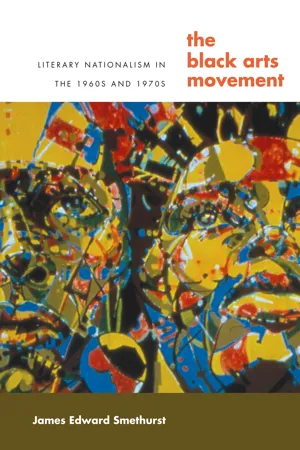
- 488 pages
- English
- ePUB (mobile friendly)
- Available on iOS & Android
eBook - ePub
About this book
Information
1 Foreground and Underground: The Left, Nationalism, and the Origins of the Black Arts Matrix
Literary expressions of nationalism by African American writers have a long foreground, going back to at least the portions of Martin Delaney's novel Blake that were published in serialized form in the late 1850s. While these published chapters of Delaney's novel did not circulate widely in the nineteenth century, certainly by the early twentieth century, black nationalist thought deeply marked the production of African American art, creating antecedents for the Black Arts movement that caught the attention of scholars from widely varying ideological positions. Tony Martin, for instance, has called our attention to the Garveyite literary circle around the magazine Negro World. Ernest Allen Jr. (Ernie Mkalimoto) and William Maxwell have investigated the impact of both Garveyism and the Left nationalism of the African Blood Brotherhood on the New Negro Renaissance. George Hutchinson, Barbara Foley, and Anthony Dawahare in their different ways have argued powerfully that the New Negro Renaissance was a form of cultural nationalism.1
However, a still relatively underconsidered period that is crucial for our understanding of the artistic nationalisms of the 1960s and 1970s is the left-wing arts subculture in the two decades following the New Negro Renaissance. The importance of this subculture (or overlapping subcultures) is not simply due to the enormous number of African American writers, playwrights, directors, actors, visual artists, composers, musicians, and dancers of the 1930s and 1940s who participated in the activities and organizations of the Left, especially the Communist Left. It also results from the circulation of a couple of Left paradigms, that of an alternative, folk-based avant-garde and that of a popular avant-garde, which were, in different forms, crucial to the development of black artistic nationalism during the 1960s and 1970s.
The first paradigm promoted by the Communist Left, particularly from the late 1920s on, was the notion of an oppositional culture that was both avant-garde, or vanguard, if you will, and rooted in a working-class or (in the case of African Americans) a proletarian-peasant national tradition that would exist outside of mass culture.2 In this view, a sort of homegrown version of the Frankfurt school, mass culture was a form of capitalist mind control that got workers (and African Americans, as an oppressed “nation” or “national minority” depending on whether they lived in the southern “Black Belt” or urban ghettos), literally to buy into the capitalist system against their own best interests. Where most Left artists and intellectuals who subscribed to this position differed from the Frankfurt school was that they did not generally see salvation in a “high” art experimentalist avant-garde as did, say, Theodor Adorno. Instead they tended to look for or imagine residual folk or worker cultures that lay outside mass consumer culture—though they were often influenced by the formal artistic radicalism of the early twentieth century as well. In short, they had what might be called a Utopian alternative culture vision of the working class and the folk. While this view might be derided as an unrealistic, reductive, and/or sentimental primitivism, it did promote the growth of a considerable network of left-wing alternative cultural institutions—theater groups, dance groups, film and photography groups, sports leagues, bookstores, reading circles, and writers’ groups and affiliated journals, forums, and so on, as well as a groundswell of efforts by radical folklorists and musicologists (both professional and “amateur”), such as Lawrence Gellert, Alan Lomax, Frank Marshall Davis, Langston Hughes, Sterling Brown, John Hammond, Meridel Le Sueur, Charles Seeger, Pete Seeger, Don West, and B. A. Botkin.
This alternative approach came to have a particular application for African Americans. The sixth congress of the Comintern in 1928 defined the “Negro Question” as a “national question” and declared it to be at the heart of the work carried on by Communists in the United States. For the next thirty years, with varying degrees of intensity, instead of opposing integrationism to nationalism or nationalism to internationalism, the CPUSA argued that African Americans in the rural South constituted an oppressed nation with the right to political and economic control. This theoretical right to self-determination included the option to form a separate political state in the so-called Black Belt region of the rural South, a group of more or less contiguous counties in which African Americans were the majority of the population. The Communists also held that African Americans in the ghettos of the urban North and West were members of a “national minority” that needed to be integrated into “mainstream” American society on the basis of full equality. An important corollary of the “Black Belt thesis,” as the Communist position became known, was that African Americans had a common history and a distinct national culture rooted among Southern black farmers, sharecroppers, farm laborers, and semi-industrial laborers in the countryside (“from blackbottom cornrows and lumber camps,” as Sterling Brown said).3
One can argue, and many have, the efficacy of the Black Belt thesis. And the leadership of the CPUSA often paid only lip service, if that, to the formulation—as was the case late in the tenure of Earl Browder as general secretary of the party. Nonetheless, it had tremendous influence as a model of cultural production that privileged this rural, southern, African American culture as the authentic culture of the black nation. This model is not the same as the dominant vision of Negro culture of the New Negro Renaissance, derived largely from nineteenth- and early twentieth-century European nationalism, in which “folk” culture would provide material for nationalist “high” artists to transform into a “high” national culture. Rather, in this Left paradigm, “folk” expressive culture is the national culture, at least on a formal level. The slogan of the Communist-initiated League of Struggle for Negro Rights (of which Langston Hughes was the president) sums up this stance well: “Promote Negro Culture in Its Original Form with Proletarian Content.” What was necessary, then, was not the transmuting of the folk culture into high art but rather the infusing of the old forms with a new consciousness of class and national self-interest. Not surprisingly, critics of the Communist Left strongly praised the work of the poet, scholar, and critic Sterling A. Brown, whose 1932 collection of poetry, Southern Road, often disparaged the popular culture of the emerging black neighborhoods of the urban North and instead located authentic African American culture in the historical experience and the blues, work songs, spirituals, and other folk expressions of the rural South.4
The other major paradigm of popular culture by Left artists and intellectuals during the 1930s and 1940s was that associated with the Popular Front. The policy of the Popular Front arose after the Nazis came to power in Germany in 1933 and other nativist, racist, and/or anti-Semitic fascist or semi-fascist movements took over (or threatened to take over) governments throughout Europe. Nazi rule in Germany saw the rapid destruction of what had been the largest Communist Party in the world outside the Soviet Union. As a result, the Comintern came to the conclusion that the threat of fascism was the paramount danger to social progress and required an alliance of all democratic forces, also known as “the people” (as opposed to “the working class” or “the proletariat”), and an emphasis on the particular democratic traditions and symbologies of individual countries. This notion of “the people” included, in the United States, various liberal or social democratic groups (such as the NAACP and the SP) and individuals (such as John L. Lewis, W. E. B. Du Bois, and A. Phillip Randolph) that the Communists had often derided previously as “misleaders” or even “social fascists.” Though the official period of the Popular Front as an international Comintern strategy runs from about 1935 to the Hitler-Stalin pact at the end of 1939, the Popular Front's approach to political organization, sociocultural symbology, and aesthetics characterized the domestic work of the Communist Left in the United States far beyond 1939. For example, the names of the left-wing Abraham Lincoln School in Chicago, the Jefferson School of Social Science in downtown Manhattan, and the George Washington Carver School in Harlem continued to stake symbolic claims to American democratic icons Popular Front-style in the 1940s and 1950s, whatever the ideological zigs and zags of the international Communist movement. This CPUSA vision of the democratic traditions of the United States was resolutely multiracial in the post-World War II era. It is worth noting that even though this period featured episodes of intense criticism of “nationalism” within the CPUSA, resulting in the resignations or expulsions of a substantial number of black party members, the party's version of multiracialism did allow for the celebration of distinct African American experiences and traditions. This can be seen in the promotion of Carter G. Woodson's Negro History Week (now African American History Month) as part of the public school curriculum, which became a major campaign of the CPUSA nationally and locally in the late 1940s and 1950s to a much greater degree than had been the case during the late 1930s.
The Popular Front was an extremely complex and far-reaching social formation, especially in the area of expressive culture.5 For the purposes of this study, its most important aspect is the approach to mass culture it generally promoted: instead of being a form of thought control, popular culture was seen as a sort of field or terrain in which “progressive” artists could battle what Franklin Delano Roosevelt called the “economic royalists” in his “A Rendezvous with Destiny” speech at the 1936 Democratic National Convention. So even “high” artists who wrote, composed, painted, directed, acted, danced, and so on infused their work with the themes, the cadences, the imagery, and the media of mass culture. The artists who took this approach for the most part did not see themselves as simply using popular culture but often celebrated what they saw as its progressive aspects as expressions of the American democratic spirit. Perhaps the most notable example of this approach is found in the work of Langston Hughes during the 1930 s and 1940s (and beyond). For instance, Hughes began publishing his “Simple” stories, focusing on the life of the “average” Harlemite, Jesse B. Semple, in early 1943 as a part of his “Here to Yonder” column in the Chicago Defender that was eventually syndicated throughout the black press, including (by the 1960s), the NOI'S MUHAMMAD SPEAKS. Not only do these stories celebrate African American popular culture (as well as such white popular artists as Bing Crosby) and incorporate blues, jazz, and pop music, vaudeville comedy routines, various “folk” practices (such as the dozens), and a huge range of literary, musical, folkloric, sociological, political, and historical allusions into the formal structure of the stories themselves, but the stories were in fact popular culture productions in that they were written for the mass-circulation African American press.
This raises one of the most notable, and most noted, features of Popular Front aesthetics: a cultural mixing—of the “high” and the “low,” of the “popular” and the “literary,” of Whitman and Eliot (formally, if not ideologically), of folk culture and mass culture, of literary and nonliterary documents, of different genres, of different media. Examples of this generic mixing include Langston Hughes's popular 1938 poetry play, Don't You Want to Be Free, in which Hughes's poems were interspersed among blues and gospel songs; Woody Guthrie's “Tom Joad,” a seven-minute adaptation of Steinbeck's Grapes of Wrath set to the tune of “Black Jack Davey” and released on record by RCA Victor in 1940; Muriel Rukeyser's poetic sequence “Book of the Dead,” which was filled with fragments of “nonliterary” documents, such as government records, court testimony, diary entries, and stock exchange listings; and Richard Wright's blues song “King Joe,” a minor jukebox hit in 1941 set to music by Count Basie and recorded by the Count Basie Orchestra, with Paul Robeson singing.
Another important feature of much Popular Front art is an interest in race and ethnicity and the relation of racial identity and ethnic identity to American identity. This aspect of the Popular Front has been often misunderstood in that Popular Front constructs of “the people” have sometimes been posed as sentimental or corny negations of particularized ethnic or racial affiliation. Examples of that sentimentality unquestionably exist. However, as Michael Denning puts it, the Popular Front was more often characterized by “an anti-racist ethnic pluralism imagining the United States as a ‘nation of nations.’”6 When one considers the poetry of Sterling Brown (whose popularity on the Left survived the onset of the Popular Front), Don West, Aaron Kramer, Frank Marshall Davis, Langston Hughes, Waring Cuney, and Margaret Walker; narratives such as Pietro di Donato's Christ in Concrete, Jerre Mangione's Mount Allegro, Daniel Fuchs's Low Company, Carlos Bulosan's America Is in the Heart, and Richard Wright's Native Son; the famous “Spirituals to Swing” concerts of 1939; and paintings by Jacob Lawrence, Ben Shahn, Aaron Douglas, Charles Alston, Elizabeth Catlett, Hale Woodruff, Charles White, and Jack Levine—to name but a few of the many examples —it is clear that race and ethnicity remained overriding concerns during the Popular Front, albeit concerns that were as much about transformation and, to employ a somewhat overused phrase, hybridity, as they were about tradition.
Finally, many of the artistic, literary, or quasi-literary works of the Popular Front are marked by an interest in place and its relation to American identity, an interest that is often closely connected to the above-mentioned concern with race and ethnicity. While the place represented, re-created, and dissected is most commonly a specific urban neighborhood —New York's Harlem, Brooklyn's Williamsburg, Chicago's South Side, Detroit's Paradise Valley, Boston's West End, and so on —such representations are frequently rural, as in Meridel Le Sueur's portrait of the Upper Midwest in North Star Country and Don West's poems of the southern mountains. Examples of this focus on place are legion: Woody Guthrie's Dust Bowl Ballads; singer and guitarist Josh White and poet Waring Cuney's recorded collaboration, Southern Exposure; the already noted work of such writers as Mangione, Hughes, Brown, Le Sueur, di Donato, Walker, West, Fuchs, and Wright; and perhaps most famously, the products of the WPA, notably the FWP'S American Guide Series, and the photographs taken under the auspices of the Farm Security Administration.
Generally speaking, the Utopian proletarian or folk-based approaches characterized the early 1930s, or what aficionados of Comintern periodization refer to as the “Third Period,” while the Popular Front's engagement with mass culture dominated the second half of the 1930s and the first half of the 1940s. However, one needs to be careful about drawing too sharp a line between the proletarian-folkloric period and the Popular Front. In practice, both approaches coexisted, especially from the middle 1930s on. The take on popular culture during the Popular Front, even by Left artists, was far from a monolithic optimism, as the biting (and often bitter) works of Nathanael West, Frank Marshall Davis, and Gwendolyn Brooks attest. In fact, a critique of mass culture and some awareness of the costs of using its resources was an important part of the work of even those artists who seemed most sanguine about such usage. This critique can be seen in Langston Hughes's well-known 1940 poem “Note on Commercial Theatre” (which begins “You've taken my blues and gone”), an indictment of “mainstream” popular theater appropriations of African American culture offered by an author who wrote prolifically for the commercial theater.7
At the same time, while there was an increased Left engagement with the forms and institutions of popular culture during the late 1930s and 1940s as compared with the 1920s and early 1930s, the notion of an alternative, “progressive,” or “people's” culture that might draw on mass culture but that was at least partially outside mass culture remained influential. Perhaps the most famous example of this continuing influence is the Left “folk” music movement of the 1940s that saw the promotion of the careers of such African American musicians as Huddie Ledbetter (Leadbelly), Josh White, Brownie McGhee, and Sonny Terry and that led to the People's Song movement, the Almanac Singers, the Weavers, Sing-Out magazine, hootenannies, and, eventually, the folk music boom of the 1950s and early 1960s (and, perhaps ironically, hit records on the Billboard Top Forty). Another example can be seen in the “traditionalist” revival of trumpeter Bunk Johnson and early New Orleans-style jazz that was in no small part instigated by the 1939 study Jazzmen, by leftists Frederic Ramsey and Charles Edward Smith (a one-time staffer at the Daily Worker).
The cultural Popular Front was largely swept away during the Cold War by a liberal-conservative anti-Communist consensus in much the same way that it was in other areas of American life. The intellectual spearhead of the attack on the Popular Front in the area of literature and the institutions that support literary production was a peculiar alliance of a group consisting of, for the most part, conservative, white, male, Christian, southern academics, who dominated what came to be called the New Criticism, and a group made up largely of Trotskyist and formerly Trotskyist Jewish New Yorkers associated with such journals as Partisan Review and Commentary, who formed the core of what became known as the New York Intellectuals. This, of course, is oversimplified, as will be my account of the New Critical-New York Intellectual alliance and its aesthetics...
Table of contents
- Cover Page
- The Black Arts Movement Literary Nationalism in the 1960s and 1970s
- Copyright Page
- contents
- illustrations
- acknowledgments
- introduction
- 1 Foreground and Underground:
- 2 Artists Imagine the Nation, the Nation Imagines Art:
- 3 New York Altar City:
- 4 Institutions for the People:
- 5 Bandung World:
- 6 Behold the Land:
- conclusion
- notes
- bibliography
- index
Trusted by 375,005 students
Access to over 1.5 million titles for a fair monthly price.
Study more efficiently using our study tools.
Frequently asked questions
Yes, you can cancel anytime from the Subscription tab in your account settings on the Perlego website. Your subscription will stay active until the end of your current billing period. Learn how to cancel your subscription
No, books cannot be downloaded as external files, such as PDFs, for use outside of Perlego. However, you can download books within the Perlego app for offline reading on mobile or tablet. Learn how to download books offline
Perlego offers two plans: Essential and Complete
- Essential is ideal for learners and professionals who enjoy exploring a wide range of subjects. Access the Essential Library with 800,000+ trusted titles and best-sellers across business, personal growth, and the humanities. Includes unlimited reading time and Standard Read Aloud voice.
- Complete: Perfect for advanced learners and researchers needing full, unrestricted access. Unlock 1.5M+ books across hundreds of subjects, including academic and specialized titles. The Complete Plan also includes advanced features like Premium Read Aloud and Research Assistant.
We are an online textbook subscription service, where you can get access to an entire online library for less than the price of a single book per month. With over 1.5 million books across 990+ topics, we’ve got you covered! Learn about our mission
Look out for the read-aloud symbol on your next book to see if you can listen to it. The read-aloud tool reads text aloud for you, highlighting the text as it is being read. You can pause it, speed it up and slow it down. Learn more about Read Aloud
Yes! You can use the Perlego app on both iOS and Android devices to read anytime, anywhere — even offline. Perfect for commutes or when you’re on the go.
Please note we cannot support devices running on iOS 13 and Android 7 or earlier. Learn more about using the app
Please note we cannot support devices running on iOS 13 and Android 7 or earlier. Learn more about using the app
Yes, you can access The Black Arts Movement by James Smethurst in PDF and/or ePUB format, as well as other popular books in Social Sciences & Art & Politics. We have over 1.5 million books available in our catalogue for you to explore.