- 128 pages
- English
- ePUB (mobile friendly)
- Available on iOS & Android
eBook - ePub
About this book
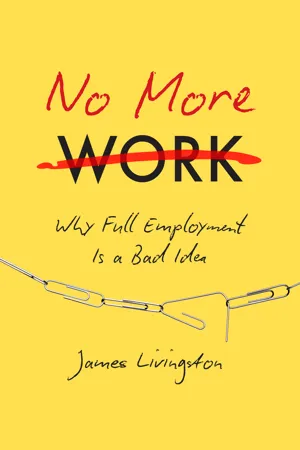
For centuries we've believed that work was where you learned discipline, initiative, honesty, self-reliance—in a word, character. A job was also, and not incidentally, the source of your income: if you didn’t work, you didn’t eat, or else you must be stealing from someone. According to such pieties, if you truly worked hard, you could earn your way and maybe even make something of yourself. In recent decades, through everyday experience, these beliefs have proven spectacularly false. Here, James Livingston explains why Americans still cling to work as a solution rather than a problem, resulting in a witty, stirring denunciation of the way we have always thought about why we labor. No More Work exhorts us to imagine a new way of finding meaning, character, and sustenance beyond our workaday world.
Information
Four
After Work
I
I said at the beginning of this book that the labor market had broken down along with all others. I meant that it doesn’t work as we expect and need it to—that it no longer allocates opportunities and incomes in ways we can understand or justify, unless we happen to be bankers or gangsters, occupational profiles that have recently become indistinguishable.
The Great Recession made this breakdown seem sudden; but in the case of the labor market, it’s been a slow-motion collapse since the 1950s, just as Daniel Bell, Hannah Arendt, Heather Ross, and Wassily Leontief predicted, and just as the sponsors of Nixon’s Family Assistance Program—Donald Rumsfeld and Dick Cheney—understood.
If I’m right about this breakdown—and of course I am, the evidence is by now overwhelming—the crisis we face is much more than economic. Because then productivity can no longer be the Measure of Man, or of men, or of anybody else. Because then our question becomes not whether but how to be our brother’s keeper. Can we love each other for real, by foregoing the principle of productivity and applying the criterion of need—from each according to his or her capacities, to each according to his or her needs?
If Freud was right about love and work as the essential components of human nature, what is to be done about the decline, and now the practical disappearance, of socially necessary labor? Put it this way: Can we love our neighbors as ourselves in the absence of work that supplies a living wage?
So our questions are these. How can we provide incomes for: (1) People who work hard but don’t produce value that has a marketable numerator, by which I mean a return on their investment of labor time, among them [a] fast-food workers, journalists, academics, filmmakers, and musicians, but also [b] people whose labor time has been historically undervalued or redlined due to race or gender. (2) People who don’t work because they can’t, for example elderly men and women, who constitute a growing proportion of every developed nation’s population. (3) People who don’t work—they don’t produce value the labor market might recognize—because they’ve got better things to do?
So conceived, the breakdown of the labor market is not just an economic crisis; it’s a moral opportunity to rethink our relation to work, and to think anew about what, and who, we can love. But for the moment, let me frame that opportunity as yet another question. Does this breakdown signify the failure or the success of capitalism?
II
Call it a failure. Eduardo Porter of the New York Times, not exactly a radical economist, did just that in a column of April 21, 2015, where he bracketed the question of corporate morality—is it fair to pay McDonald’s employees $8.00 an hour when the company’s executives “earn” about three hundred times that?—and said this:
The job market—that most critical institution of capitalist societies, the principal vehicle to distribute the nation’s wealth among its people—is not working properly. This raises a fundamental question: If the job market cannot keep hardworking people out of poverty and spread prosperity more broadly, how will it be done? Is public assistance our future?1
In a word, yes. The job market can provide neither enough work nor enough income to the vast majority of those who actually want a job, and yet the surfeit of goods available in the market just keeps growing. So our choices are limited. Either we expand transfer payments—“public assistance,” “entitlements,” call it what you will—to allow families and individuals to make ends meet and to buy those goods, or we watch as American society becomes an ugly oligarchy, the “rich and poor man fray” predicted by Herman Melville in 1876.
Either we detach income from work, or we kill ourselves, figuratively and literally. Either we guarantee everyone an income, regardless of their productivity, or we declare ourselves brain-dead.
But how did we get to this point of moral bankruptcy, where you can’t buy the right not to die unless you have two jobs or work on Wall Street—where you’re either on the dole or dead to the world? To answer that question, you have to switch sides with me and call the breakdown of the labor market not a failure but capitalism’s greatest success.
The signature feature of capitalism was the creation of a market in labor power—in other words, the invention of a working class, a social stratum unlike any before it, with no rights to the commons and no standing as citizens. Neither slaves nor serfs, these men and women owned only themselves, or rather their capacity to produce value through work. That was all they had to sell, and they made the most of it: they changed the world.
The creation of this new class took at least two hundred years in England, from the late sixteenth to the late eighteenth century. The same social process was recapitulated in North America more quickly, between the 1740s and the 1870s. Karl Marx called it “primitive accumulation.” By this he meant the dispossession and displacement of a peasantry with once customary rights to the commons—land nobody owned and nobody fenced off, where anybody could hunt or forage—and the conversion of every natural artifact, particularly land and labor power, to a fungible commodity with a market price. (In North America, this dispossession and displacement goes by the name of “Indian removal”—exterminating the indigenous people, or isolating them on “reservations.”)
The key word here is the commons, the place where legal possession, the assertion and enforcement of individual property rights—“enclosure,” they called it—was inconceivable until the sixteenth century, because everybody knew that without access to the common land, you couldn’t stay alive unless you started stealing or started working in the sense we moderns know, as a wage laborer.
So conceived, capitalism arrived when and where the universalization of the “commodity form,” as Marx liked to call it, was completed, when even the essence of human nature, work itself, was on sale—when your worth to the world could be measured by how much it cost to feed, clothe, and house you. When labor power became a commodity, your value as a worker was the cost of the inputs—food, clothing, shelter—that allowed you to stay alive. But Marx himself, a ferocious critic of capitalism, always emphasized that wages, the index of this value, included “a historical and moral element” that exceeded the market’s impersonal calibrations.
So he rejected the notion of an “iron law of wages,” which predicted that as the value of labor power declined in accordance with population growth—more supply + less demand = lower price—workers would inevitably be driven to a subsistence level of existence, into what we would now call poverty. There were too many countervailing forces, Marx thought, like trade unions, social movements, and the common sense of human decency, which stood athwart the market’s laws of supply and demand.
Moreover, and more important, he agreed with David Ricardo in thinking that the introduction of labor-saving machinery would of course displace skilled workers, but that overall demand for labor would nonetheless increase, because somebody had to build the machinery.
Still, the labor theory of value Marx perfected held that the wage rate was a mathematical function of the market costs of labor power, give or take the marginal effects of that “historical and moral element.” And in formulating his so-called law of capital accumulation, he predicted the gradual extrication of human labor from the process of goods production—to the point where labor time became worthless because the machines would build themselves. In this at least his prophecies came true.
III
But what if Marx was both wrong and right? Wrong in the sense that the iron law of wages seems to be working, after all—just look at how many people with jobs can collect food stamps—but right in the sense that the “historical and moral element” in the determination of wages seems now to be making a comeback, at the very moment that labor time has become worthless? Isn’t that exactly what the movement for a $15 minimum wage is about, this reassertion of a moral urge to reject the market’s equation between factors of production and human beings?
These sound like merely rhetorical questions, I know, but they’re not.
The development of capitalism has reached the point of what I have elsewhere called “primitive disaccumulation,” and what Jeremy Rifkin has called the “zero-marginal cost society.” He and I are describing pretty much the same thing, but our lexicons illuminate different pasts and determine different futures.2
By primitive disaccumulation, I mean that the commodity form regulates a diminishing proportion of socially necessary transactions, in a reversal of what Marx called primitive accumulation, so that the most basic requirement of postindustrial society—information—is fast becoming more or less free of charge. Think of what you don’t pay for anymore because you’ve uploaded some kind of file-sharing software, Napster once upon a time, now BitTorrent, tomorrow who knows? My students use Russian web sites to download books still under copyright, including mine.
Today you can download almost anything without cost, so the new commons encroaches on every sector’s business model, especially music and newspapers, but also movies. Soon even higher education, the last redoubt of debtors’ prison, will be free, not because the politicians will restore Pell Grants and fund state universities, but because MOOCs and YouTube will give everyone online access to the most influential academics on the planet—from Michael Sandel and Martha Nussbaum to David Harvey.
Rifkin and I agree that as the market registers fewer transactions—as we produce and distribute more goods without the mediation of money—our assessments of future economic growth, GDP and so forth, must begin to look bleak. Leading economists such as Robert Gordon and Tyler Cowen have, accordingly, predicted the decline of innovation and the end of growth. After all, the Commerce Department can’t measure what’s off the books. But that’s the thing about this new stage of economic development—it can’t be measured by the old quantitative criteria, even though we’re unquestionably producing more of what we need and want.
The creators and purveyors of information—journalists, educators, musicians, filmmakers, geeks in general—aren’t working any fewer hours than they used to. In fact, we’re all working harder. And we’re actually more productive than ever. There’s more information, more music, more movies, more images than ever, and we ourselves produce it, but without any rational expectation of remuneration.
We know that what we do is worthless as measured by the standards of the labor market, but we do it anyway.
How? When and why did “making a living” become impossible? Don’t say we exported all the good, unionized jobs in manufacturing (goods production). That’s not an answer, because in a postindustrial society like ours, almost all the jobs are “tertiary,” that is, devoted to the distribution or maintenance rather than the production of goods, and they have been since the 1950s, just as the intellectuals of that moment predicted. Repatriating those good old jobs is no different than reliving the good old days: it’s just stupid.
And don’t say “cheap labor” of the imported or exported kind—poor immigrants who flood the U.S. labor market or sweatshop workers elsewhere who work for nothing—because then you’ve already bought my argument. Now you agree with me, that the perfection of the labor market, the great success of capitalism, has made work useless, pointless, an unnecessary diversion from what is important. Labor-saving machinery is portable, as China’s workforce will soon discover.
IV
My answers to the question of how labor time became worthless are variations on themes Marx himself developed. To begin with, the working class has been abolished, not in its own name, and not with a bang—“the revolution”—but with the whisper of cybernation. You can’t have a working class in the absence of work, or rather work that has no value in the market, and thus creates no monetary claim on goods available through the market. And let’s face it, work without income is morally repugnant because it carries the connotation of slavery; it’s a great deal more repugnant, at any rate, than income without work.
So much for workers. The capitalist class we love to hate has meanwhile been abolished by other means. Primitive accumulation created a working class by driving peasants off the land and into the cities, where they would learn to work by the clock—or die trying. By the same token, it created capitalists, bourgeois individuals who would hire labor, invest in plant and equipment, save their profits, and advertise their abstemiousness as a virtue.
For three centuries they thrived, and then, at the end of the nineteenth century, they solved a fundamental crisis by sentencing themselves to social death.
The crisis consisted of working-class triumph in the Gilded Age. I know, that’s not what you learned in your history classes, but that’s what happened. Between 1873 and 1896, economic growth was spectacular, unprecedented, and yet its income benefits seemed to accrue mainly, or only, to workers. This was not a secret. By 1896, many leading economists (David Wells, Edward Atkinson, Charles Conant, Jeremiah Jenks) had said as much, and the Finance Committee of the U.S. Senate, chaired by Nelson W. Aldrich of Rhode Island, had convened hearings to verify and explain the anomaly.
The problem back then was the exact inverse of what we see today—ours is not a new Gilded Age. In our time, labor productivity keeps rising, real wages keep falling, and so inequality deepens. In the late nineteenth century, real wages rose while productivity stagnated (again, even though economic growth was spectacular). The measurable result, back then, was a shift of income shares from capital to labor—a profit squeeze that turned capitalists into public servants, by their own accounting and all others. Do the math. Between the early 1880s and the late 1890s, non-farm real wages rose roughly 35 percent, due mainly to price deflation; meanwhile, productivity rose only about 6 percent. This is the opposite of what has happened in the United States since 1975.
What was a capitalist to do? Bribe a senator, charter a trust, hire a private army, fall back on sport and culture—you know, get all athletic, and build museums in your spare time. Capitalists tried practically everything in the 1880s and 1890s: pools, trusts, Pinkertons, lockouts, armed violence, also wilderness resorts and monumental repositories of the visual arts bought in Paris, Rome, Florence, Madrid, maybe London . . . . What finally worked was the corporation, a bureaucratic solution to a social-economic crisis. By means of this impregnable legal device, capital was finally able to subject labor to real, as against formal, control, and productivity surged, to the point where, by the 1920s, the output of goods increased without any measurable increase of inputs, whether of labor or capital.
Notice: the corporation succeeded by reducing socially necessary labor—what the scientific managers called “the human element”—to nothing. Or almost nothing. The increase of productivity in automobile manufacturing was 400 percent between 1919 and 1929; the net loss of jobs in manufacturing for the decade was 2 million.
But the corporation was built on the separation of ownership and control. In effect, capitalists sentenced themselves to social death by turning basic decisions about production and distribution over to salaried managers who do not own the company’s assets—just as their aristocratic predecessors had rented out the land to commoners, mere peasants, when faced with the social crisis of late feudalism, and thereby had sentenced themselves to a similarly slow social death.
These salaried managers act in the name of capitalism, but they are not themselves capitalists. They’re functionaries, servants, courtiers, who will do anything their invisible masters decree because they ha...
Table of contents
- Cover Page
- Title Page
- Copyright Page
- Dedication
- Contents
- Preface
- Introduction
- One The Family Assistance Plan and the End of Work
- Two Labor and the Essence of Man
- Three Love and Work in the Shadow of the Reformation
- Four After Work
- Coda
- Acknowledgments
- Notes
Trusted by 375,005 students
Access to over 1.5 million titles for a fair monthly price.
Study more efficiently using our study tools.
Frequently asked questions
Yes, you can cancel anytime from the Subscription tab in your account settings on the Perlego website. Your subscription will stay active until the end of your current billing period. Learn how to cancel your subscription
No, books cannot be downloaded as external files, such as PDFs, for use outside of Perlego. However, you can download books within the Perlego app for offline reading on mobile or tablet. Learn how to download books offline
Perlego offers two plans: Essential and Complete
- Essential is ideal for learners and professionals who enjoy exploring a wide range of subjects. Access the Essential Library with 800,000+ trusted titles and best-sellers across business, personal growth, and the humanities. Includes unlimited reading time and Standard Read Aloud voice.
- Complete: Perfect for advanced learners and researchers needing full, unrestricted access. Unlock 1.5M+ books across hundreds of subjects, including academic and specialized titles. The Complete Plan also includes advanced features like Premium Read Aloud and Research Assistant.
We are an online textbook subscription service, where you can get access to an entire online library for less than the price of a single book per month. With over 1.5 million books across 990+ topics, we’ve got you covered! Learn about our mission
Look out for the read-aloud symbol on your next book to see if you can listen to it. The read-aloud tool reads text aloud for you, highlighting the text as it is being read. You can pause it, speed it up and slow it down. Learn more about Read Aloud
Yes! You can use the Perlego app on both iOS and Android devices to read anytime, anywhere — even offline. Perfect for commutes or when you’re on the go.
Please note we cannot support devices running on iOS 13 and Android 7 or earlier. Learn more about using the app
Please note we cannot support devices running on iOS 13 and Android 7 or earlier. Learn more about using the app
Yes, you can access No More Work by James Livingston in PDF and/or ePUB format, as well as other popular books in Economics & Economic History. We have over 1.5 million books available in our catalogue for you to explore.