Most scholarship on the mass migrations of African Americans and southern whites during and after the Great Depression treats those migrations as separate phenomena, strictly divided along racial lines. In this engaging interdisciplinary work, Erin Royston Battat argues instead that we should understand these Depression-era migrations as interconnected responses to the capitalist collapse and political upheavals of the early twentieth century. During the 1930s and 1940s, Battat shows, writers and artists of both races created migration stories specifically to bolster the black-white Left alliance. Defying rigid critical categories, Battat considers a wide variety of media, including literary classics by John Steinbeck and Ann Petry, “lost” novels by Sanora Babb and William Attaway, hobo novellas, images of migrant women by Dorothea Lange and Elizabeth Catlett, popular songs, and histories and ethnographies of migrant shipyard workers.
This vibrant rereading and recovering of the period’s literary and visual culture expands our understanding of the migration narrative by uniting the political and aesthetic goals of the black and white literary Left and illuminating the striking interrelationship between American populism and civil rights.
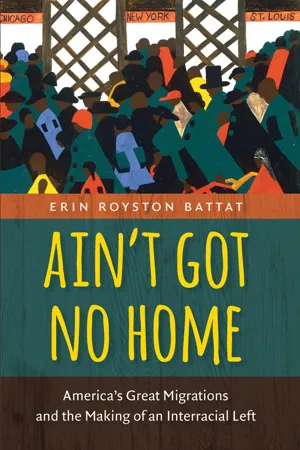
eBook - ePub
Ain’t Got No Home
America's Great Migrations and the Making of an Interracial Left
- 252 pages
- English
- ePUB (mobile friendly)
- Available on iOS & Android
eBook - ePub
Ain’t Got No Home
America's Great Migrations and the Making of an Interracial Left
About this book
Information
CHAPTER 1 RACE, SEX, AND THE HOBO
On 25 March 1931, a group of black boys got into a fight with some white boys on a Memphis-bound freight train. When the police rounded up the black youths near Scottsboro, Alabama, they found a couple of white girls hiding on the train and coerced them into filing rape charges. Although Alabama’s Governor Benjamin Meek Miller and the National Guard prevented a mass lynching, the outcome was just about the same: A white jury quickly convicted the boys, sentencing all but the youngest to death. The Communist-led ILD quickly took charge of the boys’ appeals. The speed with which the ILD responded to the case, the intensity and reach of its mass protests and publicity campaigns, its top-notch defense team, and the vocal support of the mothers and families of the Scottsboro boys convinced many African Americans that the CP was a trustworthy ally dedicated to their particular needs as black people. As Ada Wright, mother of two of the boys, attested, “We know our friends when we see them and we’re a goin’ to stick to the League of Struggle for Negro Rights and the International Labor Defense Committee.”1 Black schoolchildren carried pickets; African American Girl Scouts attended rallies; college students raised money; and ordinary people took to the streets.2 By 1935 the ranks of African Americans in the CP swelled from a few hundred to 2,500. The black membership of the ILD in Birmingham alone was 3,000, making it the largest Civil Rights organization in the city.3
Yet a closer inspection of the Scottsboro case reveals how complicated was the relationship between African Americans and the Communist Party in the 1930s. The CP championed the working-class and unemployed masses, but these were precisely the people who had terrorized the black boys on the train, falsely accused them of rape, and would have lynched them without the governor’s intervention. Antilynching activists, on one hand, and labor defenders, on the other, relied on diametrically opposed conceptions of the populist masses and the law. Whereas the antilynching movement called for the rule of law to quell mob hysteria, labor defense stood up for workers against a prejudicial legal system.4 These opposing views posed a challenge to the CP in attracting black members and sympathizers. While communists prophesied a future revolution led by an international proletariat, the most visible form of proletarian collective action in the South, according to some skeptical observers at the time, was the lynch mob. As African American editors I. Willis Cole of the Louisville Leader and William Kelley of the New York Amsterdam News pointed out, lynch mobs were driven by poor whites, while white advocates of black civil rights tended to be middle-class liberals.5 This vexing issue of white working-class racism led W. E. B. Du Bois to conclude in the early 1930s that “throughout the history of the Negro in America, white labor has been the black man’s enemy, his oppressor, his red murderer,” and therefore “imported Marxism . . . does not at all fit the situation.”6 Writers and activists who wanted to build an interracial coalition out of the ferment over Scottsboro had to deal with the contradiction between the “masses” and the “mob.”
According to James A. Miller, the ILD’s success in the Scottsboro case depended on its ability to disrupt the white South’s powerful rape-lynch myth by constructing a compelling counternarrative that debunked the stereotypes of the black rapist and the pure white victim.7 Accordingly, commentators at the time and subsequent historians have placed the Scottsboro protests in the political and aesthetic tradition of antilynching. African Americans such as Ada Wright saw the protest as a “fight goin’ on against lynchin’,” and the ILD had been using the term “legal lynching” to describe the southern courts’ liberal use of capital punishment for black males since at least 1929.8 Yet the ILD also had to create an alternative to the antilynch narrative that counterposed respectable, often middle-class African Americans and the white rabble, for this characterization was at odds with its Marxist outlook. The most powerful rhetorical tool in this arsenal of the literary Left was, in my view, the hobo narrative.
Left-wing journalists drew upon different hobo “types” to depict the Scottsboro boys as vulnerable workers, to discredit their accusers as promiscuous tramps, and to imagine a counternarrative of masculine proletarian unity. While this strategy inverted the “rape-lynch triangle” of the black male rapist, white female victim, and white male avenger, it still relied on conservative sexual and gender ideologies. The proletarian hobo was reconfigured during the Popular Front period as a symbol of “the people” but remained constrained by notions of manhood that relied on sexual access to white women. In his widely read sentimental novella Of Mice and Men (1937), John Steinbeck popularized the radical hobo narrative by depicting an interracial community of transient workers that resembled a family more than a union. However, its racial inclusiveness depended on the exclusion and demonization of white women and the emasculation of black men. In response, fledgling African American writer William Attaway self-consciously revised Steinbeck’s story in his novella Let Me Breathe Thunder, published two years later. Attaway draws upon this populist image of the masculine hobo family but explodes the tinderbox of race and sex that lingers in the background of Steinbeck’s story. Tracing the hobo narrative from radical Scottsboro journalism to Steinbeck’s popular version to Attaway’s response reveals how Left interracialism contended with the tangled thicket of race, sexuality, and gender.
The hobo had its origins in the rapid industrialization following the Civil War, which both dislocated single men in the urban Northeast and demanded a mobile, seasonal, and temporary workforce in western agriculture and construction industries.9 According to Marxist theory, capital created “an army of unemployed” as production became increasingly large in scale and mechanized.10 Although hoboes may call to mind carefree irresponsibility to modern readers, commentators in the 1910s and 1920s distinguished them from other “vagrants” by their willingness to work. For example, Ben Reitman, a medical doctor who cultivated an avant-garde “hobohemian” subculture in Chicago, differentiated between “the hobos who work and wander, the tramps who dream and wander, the bums who drink and wander.”11 Cultural images of these itinerant laborers contain a tension between what I call the “vulnerable” and “volitional” types—those who are unwilling members of the capitalist “army of unemployed” versus those “hobohemians” who reject wage work and bourgeois society in favor of the freedom of the road. As their definitions suggest, these character types do not divide easily along political lines and are highly unstable, melding into one another and creating fascinating contradictions within hobo narratives. It is also important to note that these are discursive categories describing cultural types rather than social realities. Scottsboro defense literature, I argue, strategically represented the nine black boys as vulnerable transient youth, while using the image of the volitional hobohemian to explain the reactionary behavior of the white female accusers. These competing hobo types accounted for racism within the underclass while providing a language for narrating interracial unity among the unemployed.
The hobo narratives of the 1930s built upon a tradition that originated in the first decades of the twentieth century with the Industrial Workers of the World (IWW), a radical labor organization also known as the Wobblies. The IWW was committed to organizing unemployed, itinerant, and unskilled workers along with skilled workers in “one big union.” Wobbly publications such as Hobo News and the Little Red Songbook projected a radical version of the volitional hobo who was willing to work but rejected the capitalist wage system and bourgeois domestic values. Instead, this hobo embraced a mutualistic ethic.12 An article in a 1914 issue of the IWW’s Solidarity magazine, for example, marvels at the masculine proletarian hero who “promptly shakes the dust of a locality from his feet whenever the board is bad, or the boss is too exacting, or the work unduly tiresome” and has “no wife or family to encumber him.”13 The Wobblies put this image of the volitional hobo to radical ends, using it to imagine a proletarian counterculture steeped in working-class notions of white masculinity. The Wobblies’ mythic hobo, according to historian Todd DePastino, was the “manly white pioneer of the industrial West.”14
Although hobo jungles and urban lodging house districts known as the “main stem” were often hostile to African Americans, the cultural imagery of transient labor became more diverse in the 1930s. Popular folklorist George Milburn, for example, championed the hobo as an antiracist folk hero, writing in the song collection Hobo’s Hornbook that “among the hoboes the Negro finds something approaching social equality. There is little, if any, discrimination against the dingy ’bo in the jungles.”15 Writing for the National Association of Colored People’s (NAACP’s) Crisis magazine in October 1932, Roy Wilkins similarly applauded the egalitarian ethic of the Bonus Marchers, a group of war veterans who, like hoboes, rode freights across the nation to demand insurance payments from the federal government. What is most striking to Wilkins is the absence of Jim Crow in eating and sleeping arrangements—domestic spaces where racial boundaries tended to be most stringently policed. He marvels sentimentally at “white toes and black toes sticking out from tent flaps” and at “Negroes and whites mixed together in line and grouped together eating.” The accompanying photographs show a pair of Whitmanesque ’boes, shirts unbuttoned and faces unshaven, standing arm in arm, and a mixed-race group seated together with their dinners on their laps, foot to foot and shoulder to shoulder, forks poised midbite.16 Woody Guthrie popularized this notion of interracial hobo fraternity in his postwar autobiographical novel Bound for Glory, which begins, “I could see men of all colors bouncing along in the boxcar. We stood up. We laid down. We piled around on each other. We used each other for pillows.”17 These images build upon the Wobbly mythology of the hobo jungle as a masculine, homosocial alternative to bourgeois domesticity, revising it to suit the racial inclusivity of the 1930s and postwar Left.
During the Depression, the romance of the road also called to the daring few who did not fit the almost exclusively white male profile of the hobohemian: women, lesbians and gay men, African Americans, and immigrants of color. The writers and artists among them revised the hobo figure accordingly. These new hoboes often sought work but also hoped to find in the boxcar freedom from the constraints of middle-class sexual mores, rigid gender roles, and strict racial segregation. Pauli Murray—an African American woman who became a Yale-educated civil rights lawyer and cofounded the National Organization for Women—rode the rails for adventure in the 1930s, often passing as a white boy. In 1931 Murray was discovered by Traveler’s Aid workers in Bridgeport, Connecticut, when she entered the men’s room at the railroad station while her female companion, also wearing boys’ clothes, went into the ladies’ room. Undaunted by police interrogators, Murray told them “it was real good fun while it lasted. It’ll make great material for the book we are going to write. It was a noble experiment.”18 Indeed, Murray’s story piqued the interest of Harlem Renaissance patron Nancy Cunard, who commissioned her to include a few pages of her “astounding career and all that marvelous journeying on foot and as a boy and the different jobs done.” She assured Murray that “we won’t tell the reader that you are a girl.” The article would be accompanied by a photo of Murray as “the BOY itself” and signed by “Pauli Murray, a name for boy or girl.”19 This story—a wild adventure about the narrator and “his” friend Pete’s hobo journey from California to New York—appeared in Cunard’s Negro: An Anthology in 1934.20
The implication that the hobo chooses the freedom of the road highlights his or her active resistance to capitalist economic and social structures, racial hierarchies, and rigid gender roles. At the same time, however, the rhetoric of choice obscures the human cost of unemployment and its basis in capitalist labor demands: Who would choose homelessness? Carey McWilliams, a left-leaning lawyer and New Deal official involved in the California Popular Front, argued that the image of the volitional hobo sustained an exploitative system of capitalist agriculture. “A theory was evolved at an early date to rationalize the existence of these countless tramps,” writes McWilliams in his scathing history of California agribusiness of 1939, Factories in the Field. “They were ‘tramps,’ shiftless fellows who actually preferred ‘the open road’ and the jolly camaraderie of the tramp jungle to a settled and decent life. . . . There was nothing you could do with these insouciant and light-hearted boys, you couldn’t even pay them a decent wage for they would ‘drink it up right away’”21 While the IWW’s Solidarity magazine championed the hobo’s rejection of wage work, McWilliams points out how easily this subversive tactic could be misconstrued to sustain an exploitative labor system.
A competing image of the “vulnerable” hobo emerged in the 1930s as cultural commentators dealt with the changing demographics of itinerancy, particularly the influx of women and children. Boxcar Bertha, the heroine of Ben Reitman’s “as-told-to” autobiography of a female hobo of 1930, noted that only a tiny fraction of female transients were “habitual hoboes” and announced the emergence of “a new order, certainly, from that of the old hardboiled sister of the road who chose the road for adventure and freedom in living and loving!”22 Journalists, social scientists, and government officials fretted that the older type of (white male) volitional hobo would corrupt women, children, and young, job-seeking male transients.23 In a sociological interview excerpted in a 1934 issue of American Mercury, for example, a “lady hobo” describes in graphic detail several instances of being violently raped and coerced into sex in exchange for food, transportation, shelter, and protection. Most hobo women “wear pants,” she reported, “so they won’t be molested and pass off for men in getting on and off the trains.”24 In response to the problem of itinerancy, the New Deal administration established the Transient Program under the Federal Emergency Relief Administration in 1933. Relief camps specifically targeted new transients, particularly young men and families, who were susceptible to the corruption of “men of the familiar hobo persuasion.”25
This dichotomy between the volitional hobo and the vulnerable hobo shaped film and literature as well. William A. Wellman’s film Wild Boys of the Road of 1933 dramatized for mainstream audiences the vulnerability of poor hobo youth—male and female—to predatory hobohemians. When a white female hobo is raped by a railroad worker, an interracial group of hobo teenagers avenges her.26 Over a decade later, Filipino American writer Carlos Bulosan described in agonizing detail the brutal gang rape of a young girl by “professional hoboes.”27 Like these texts, the Scottsboro stories were shaped by the tensions between the volitional hobohemian and the vulnerable hobo driven to the rails by the collapse of the capitalist economy. Although often placed in binary opposition, these categories overlapped. The hobohemian’s status as an unemployed worker belied his volition, wh...
Table of contents
- Cover Page
- Title Page
- Copyright Page
- Dedication
- CONTENTS
- ILLUSTRATIONS
- ACKNOWLEDGMENTS
- ABBREVIATIONS AND ACRONYMS
- INTRODUCTION
- CHAPTER 1 RACE, SEX, AND THE HOBO
- CHAPTER 2 AN OKIE IS ME
- CHAPTER 3 STEEL MILL BLUES
- CHAPTER 4 BEYOND THE MIGRANT MOTHER
- CHAPTER 5 WARTIME SHIPYARD
- CONCLUSION
- NOTES
- BIBLIOGRAPHY
- INDEX
Trusted by 375,005 students
Access to over 1.5 million titles for a fair monthly price.
Study more efficiently using our study tools.
Frequently asked questions
Yes, you can cancel anytime from the Subscription tab in your account settings on the Perlego website. Your subscription will stay active until the end of your current billing period. Learn how to cancel your subscription
No, books cannot be downloaded as external files, such as PDFs, for use outside of Perlego. However, you can download books within the Perlego app for offline reading on mobile or tablet. Learn how to download books offline
Perlego offers two plans: Essential and Complete
- Essential is ideal for learners and professionals who enjoy exploring a wide range of subjects. Access the Essential Library with 800,000+ trusted titles and best-sellers across business, personal growth, and the humanities. Includes unlimited reading time and Standard Read Aloud voice.
- Complete: Perfect for advanced learners and researchers needing full, unrestricted access. Unlock 1.5M+ books across hundreds of subjects, including academic and specialized titles. The Complete Plan also includes advanced features like Premium Read Aloud and Research Assistant.
We are an online textbook subscription service, where you can get access to an entire online library for less than the price of a single book per month. With over 1.5 million books across 990+ topics, we’ve got you covered! Learn about our mission
Look out for the read-aloud symbol on your next book to see if you can listen to it. The read-aloud tool reads text aloud for you, highlighting the text as it is being read. You can pause it, speed it up and slow it down. Learn more about Read Aloud
Yes! You can use the Perlego app on both iOS and Android devices to read anytime, anywhere — even offline. Perfect for commutes or when you’re on the go.
Please note we cannot support devices running on iOS 13 and Android 7 or earlier. Learn more about using the app
Please note we cannot support devices running on iOS 13 and Android 7 or earlier. Learn more about using the app
Yes, you can access Ain’t Got No Home by Erin Royston Battat in PDF and/or ePUB format, as well as other popular books in Literature & North American History. We have over 1.5 million books available in our catalogue for you to explore.