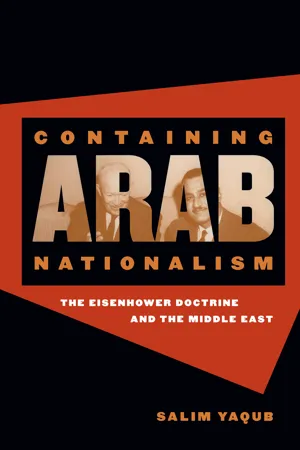
Under the Eisenhower Doctrine, the United States pledged to give increased economic and military aid to receptive Middle Eastern countries and to protect — with U.S. armed forces if necessary — the territorial integrity and political independence of these nations from the threat of “international Communism.” Salim Yaqub demonstrates that although the United States officially aimed to protect the Middle East from Soviet encroachment, the Eisenhower Doctrine had the unspoken mission of containing the radical Arab nationalism of Egyptian president Gamal Abdel Nasser, whom Eisenhower regarded as an unwitting agent of Soviet expansionism. By offering aid and protection, the Eisenhower administration hoped to convince a majority of Arab governments to side openly with the West in the Cold War, thus isolating Nasser and decreasing the likelihood that the Middle East would fall under Soviet domination.
Employing a wide range of recently declassified Egyptian, British, and American archival sources, Yaqub offers a dynamic and comprehensive account of Eisenhower’s efforts to counter Nasserism’s appeal throughout the Arab Middle East. Challenging interpretations of U.S.-Arab relations that emphasize cultural antipathies and clashing values, Yaqub instead argues that the political dispute between the United States and the Nasserist movement occurred within a shared moral framework — a pattern that continues to characterize U.S.-Arab controversies today.
- 392 pages
- English
- ePUB (mobile friendly)
- Available on iOS & Android
eBook - ePub
About this book
Information
1
THE UNITED STATES AND THE ARAB MIDDLE EAST, 1941–1956
Between late 1941, when the United States entered World War II, and late 1956, when it helped force an end to the Suez war, official American attitudes toward the Middle East underwent a radical transformation. In 1941 the United States had minimal political contact with Middle Eastern countries; by late 1956 American officials believed that only the United States could keep the region from falling under Soviet domination. During World War II, Americans first became convinced that the security of the United States depended on keeping the Middle East out of hostile hands. In the decade after the war, the U.S. government hoped that Britain would remain primarily responsible for this task. Two issues, however, Zionism and Western imperialism, aroused Arab resentment against the West and created opportunities for Soviet political encroachment, raising doubts in American minds about Britain’s long-term ability to hold the region for the West. In late 1956 Israel, France, and Britain—nations embodying the perceived threats of Zionism and European imperialism—invaded Egypt and dramatically increased anti-Western feeling in the Arab world. With the region’s political orientation now in doubt, the U.S. government decided it would have to take the lead in upholding the Western position in the Middle East.
Official U.S. concern over the political and strategic orientation of the Middle East began with America’s entry into World War II. Prior to that time, American interests in the region had been almost entirely missionary, philanthropic, educational, and commercial. After it entered the war, the United States shared its allies’ determination to prevent the Middle East from falling under Axis control. Should that happen, Germany and Japan would be able to link up with each other along Asia’s southern rim, cutting off Russia’s southern supply route through the Persian Gulf; they would also gain access to the region’s enormous oil reserves. To prevent the Axis powers from making significant military or diplomatic gains in the area, the United States participated in several wartime initiatives. It joined Britain and the Soviet Union in occupying Iran to keep that country from falling under German control. It joined Britain in using economic pressure to limit neutral Turkey’s dealings with Germany. It worked to keep Saudi Arabia well-disposed toward the Allies by opening a U.S. legation in Jidda and declaring the kingdom eligible for Lend-Lease aid. The overtures to Saudi Arabia caused friction with the British, who suspected the United States of seeking to monopolize Saudi oil opportunities, but Washington and London eventually worked out a modus vivendi for extracting and marketing Saudi oil.1
Harry S. Truman, president from 1945 to 1953, never saw Middle Eastern affairs as a priority in foreign policy, preoccupied as he was with the revival of Western Europe and the containment of Soviet communism. U.S. involvement in the Middle East had vastly increased during the war, but Britain remained the preeminent Western power in the area. Whether by treaty arrangement, by direct military occupation, or by protectorate status, most nations of the Arab Middle East were still under British domination as of 1945. British military bases dotted the region. Western European economic recovery, in which the United States had a vital stake, increasingly depended on continued Western access to Middle Eastern oil, but the United States itself was not dependent on that oil.2
Complications arising from Arab resentment against Zionism and imperialism, however, soon challenged American complacency. In February 1947 the British government, which had governed Palestine as a mandate since 1920, determined it could not resolve competing Zionist and Arab claims and turned the matter over to the United Nations (UN). That fall the UN General Assembly voted to partition Palestine into Jewish and Arab states, a move bitterly opposed by the Arabs, who saw the imposition of a Jewish state in Palestine as a usurpation of Arab national rights. Fighting broke out between Zionists and Palestinian Arabs. Following Israel’s declaration of independence in May 1948, Egypt, Syria, Jordan, Lebanon, and Iraq went to war against the new state, but the Zionists, better armed and better organized, fended off the attackers and acquired more territory than had originally been allotted to them. By the time armistices were concluded in 1949, some 750,000 Palestinians had fled or been driven from their homes; most of them settled in squalid refugee camps in neighboring Arab countries. Israel and the Arab states generally abided by the armistices, but they were far from peace. Israel refused to relinquish the additional territories it had seized or to permit large-scale repatriation of Palestinian refugees. The Arab states refused to make peace with Israel as long as it held to these positions.
Against the advice of most of his foreign policy advisers, Truman supported the creation of Israel, first by endorsing the partition plan and then by recognizing the newly proclaimed Jewish state.3 These actions had a corrosive effect on U.S.-Arab relations. The failure of Arab armies to prevent the uprooting of Palestinians was traumatic to Arabs everywhere. For many Arab commentators, the least painful way to explain this defeat was to portray Israel as a creation of Western imperialism designed to re-enslave the Arab world just as it was on the verge of gaining true political liberty. There was nothing new in criticizing Western imperialists; the novelty lay in including the United States in such company. Decades of philanthropy and political disinterestedness had given the United States a relatively benign reputation in the Arab world. U.S. support for Israel’s creation turned much of that goodwill into bitter resentment.4 For decades to come, such resentment would be an inescapable fact of life in Arab politics. Any Arab leader enjoying friendly relations with the United States could now be labeled “soft on Zionism” by his Arab rivals. In the 1950s President Eisenhower would sometimes blame the existence of Israel for the difficulty he was having in cultivating pro-American leadership in the Arab world. “Except for Israel,” he remarked in July 1958, “we could form a viable policy in the area.”5
Although Truman never regretted the creation of Israel, he was well aware of the complications resulting from that development. One consequence was the ever-present danger of a recurrence of Arab-Israeli hostilities, which could threaten Western access to Middle Eastern oil and give the Soviets an opportunity to make political and military inroads into the region. In the Tripartite Declaration of May 1950, the United States joined Britain and France in pledging to sell the Israelis and the Arabs only such arms as were necessary for internal security and self-defense. The three powers also resolved to intervene to prevent Israel or the Arab states from altering the territorial status quo by force. The Tripartite Declaration was intended not only to prevent another round of Arab-Israeli violence but to keep the antagonists oriented toward the West. An outright ban on Western arms sales might have prompted the Arabs or the Israelis to turn to the Soviet Union for arms. A limitation of such sales, the three powers hoped, would leave both parties sufficiently satisfied to remain loyal to Western suppliers while still denying them the means to engage in major hostilities.6
With the sudden increase in international tensions following the outbreak of the Korean War in June 1950, the Truman administration sought to organize Middle Eastern states to resist a possible Soviet attack. Egypt seemed the logical nucleus of such an effort: it was strategically located as the land bridge between Asia and Africa; it contained the Suez Canal, which linked the Mediterranean and Red Seas; it had a huge population and considerable cultural and political influence throughout the Arab world; and Britain already had an extensive military base in the Suez Canal zone. In 1951 the administration endorsed Britain’s proposal for an allied Middle East Command that would be based in Egypt and in which the Egyptians would participate.7
The effort to establish the Middle East Command only intensified anti-imperialist sentiment among Egyptians, who had endured British occupation since 1882. In late 1951 a wide segment of Egyptian society—workers, students, political activists, and even army and police units—rose up in rebellion against the British presence in Egypt, staging guerrilla attacks on British troops and acts of sabotage against British transportation and communications facilities in the Suez Canal zone. In early 1952 massive rioting and looting against British and European institutions in Cairo resulted in scores of deaths. Neither King Farouk nor the successive parliamentary governments with which he shared power were willing to suppress the popular uprising, so limited discipline was imposed by the British themselves, further inflaming the situation. The Egyptian crisis aroused opposition to the Middle East Command proposal throughout the Arab world. It also cleared the way for dynamic new leadership in Egypt.8
On 23 July 1952 a group of dissatisfied Egyptian officers known as the Free Officers seized control of the Egyptian army and government in a nearly bloodless coup.9 The Free Officers forced the abdication of King Farouk, who went into exile. The monarchy was formally abolished the following year. The Free Officers’ politics were obscure at first. Their proclaimed objectives were simply to stamp out corruption, compel Britain to withdraw from Egypt, and restore dignity to the nation. Yet even this vague program distinguished the Free Officers from Farouk and the established politicians, many of whom had been tainted by recent corruption scandals and all of whom stood accused of failing to oust the British. The Free Officers’ nominal leader was Muhammad Naguib, a respected general, but real power rested with a group of younger officers operating behind the scenes, especially a thirty-four-year-old lieutenant colonel named Gamal Abdel Nasser.10
The Truman administration was enthusiastic about the new regime.11 The Free Officers seemed dedicated and pragmatic, more interested in addressing Egypt’s domestic needs than in whipping up anti-British sentiment in the region. The new government expressed a desire for friendly relations with the United States and cracked down on communist activists who had taken part in the anti-British disturbances, prompting Moscow to denounce the regime as reactionary. There were even indications that Egypt might now be willing to join a Middle East defense organization. In September 1952 U.S. secretary of state Dean Acheson remarked that “in Egypt things are going so well ... there must be a catch in it.”12 It remained for the Eisenhower administration, which took office four months later, to discover just where the catch, or catches, lurked.
WHEN DWIGHT D. EISENHOWER was elected to the presidency in November 1952, much of his popular appeal lay in his status as a nonpolitician uncorrupted by the ways of Washington. He was, in fact, as savvy as they came. Garry Wills writes that Eisenhower’s years in the peacetime army, “where ambition is thwarted of its natural object (excellence in war) and falls back on jealousy and intrigue,” had been as rigorous a political training as any electoral career. Eisenhower did eventually attain “excellence in war,” but here, too, the achievement was largely political: working productively with vain and headstrong leaders and bringing harmony to an often discordant alliance. After the war Eisenhower continued to rub shoulders with powerful and influential men, serving as chief of staff of the U.S. Army, president of Columbia University, and supreme commander of the armed forces of NATO.13
Eisenhower’s secretary of state was John Foster Dulles. The grandson of one secretary of state and the nephew of another, Dulles had participated in international conferences since the first decade of the twentieth century. In the 1920s and 1930s he had been a partner at the New York law firm of Sullivan & Cromwell, specializing in European debt and reparations issues. In the 1940s Dulles served as a foreign policy adviser to Republican presidential candidate Thomas E. Dewey and as a U.S. delegate to the newly formed UN. In 1950 Truman appointed him chief U.S. negotiator for the peace treaty with Japan, which was concluded the following year. By 1952 Dulles was widely regarded as the Republican Party’s chief foreign policy adviser.14
Scholars have long noted that, while it seemed at the time that Dulles dominated the new administration’s foreign policy and Eisenhower followed his lead, just the opposite was true.15 One can, however, take the point too far. Diane B. Kunz provides a useful qualification when she writes that Eisenhower made foreign policy decisions “to the extent he wished it, which varied depending on the subject.”16 There were broad areas of foreign policy of which Eisenhower chose to remain only generally aware, content to let Dulles handle day-to-day operations. In Middle East affairs, it was usually only during major crises that Eisenhower took a direct, sustained interest in diplomacy.
Ultimately, though, Eisenhower was in charge of foreign policy, and the wide discretion he granted Dulles could always be taken back. No one knew this better than Dulles himself, who never forgot the bitter experience of his uncle Robert Lansing, Woodrow Wilson’s secretary of state. Lansing had sometimes behaved insubordinately, causing Wilson to ignore his advice and eventually dismiss him from the cabinet. “Lansing might as well have lived on the moon,” Dulles remarked in 1957, “as far as influencing Wilson’s decisions went.”17 Dulles was determined to avoid that fate.
Scholars have contrasted the optimism, pragmatism, and flexibility of Eisenhower with the pessimism, moralism, and rigidity of Dulles.18 This view, too, needs to be qualified. Of the two men, Eisenhower was more likely to advocate compromise with America’s adversaries, but he was also more easily talked out of his positions. On several occasions in the late 1950s, Eisenhower tentatively proposed seeking an accommodation with Nasser, only to yield to Dulles’s forceful rebuttals.19 Eisenhower’s unfamiliarity with the details of U.S. diplomacy made it difficult for him to prevail in such exchanges. Of course, on matters of sufficient importance to him, Eisenhower could and did get his way without argument.
Dulles’s rigid moralism, though real, was specific and limited. Some scholars have seen Dulles’s international approach as an extension of his unwavering Protestant faith,20 but a more convincing interpretation treats the legal profession as the overarching model for his diplomacy.21 Depending on the situation, a legal approach could encourage either flexibility or inflexibility. Dulles publicly extolled America’s alleged adherence to fixed principles of international behavior. One of the qualities that made the Soviets and their allies so contemptible, he maintained, was their refusal to adhere to any international standards. The vigorous repetition of such claims did make Dulles seem rigid and censorious, like some “international prosecuting attorney,” as Eisenhower privately complained. At the same time, Dulles prided himself on his ability to maneuver within internationa...
Table of contents
- Cover Page
- Title Page
- Copyright Page
- Dedication
- Contents
- Illustrations and Maps
- Abbreviations
- Introduction
- 1 The United States and the Arab Middle East, 1941–1956
- 2 Birth of a Doctrine, November 1956–January 1957
- 3 Launching the Doctrine, January–April 1957
- 4 The Conservative Moment, March–June 1957
- 5 The Syrian Crisis, July–December 1957
- 6 The Nasserist Onslaught, January–April 1958
- 7 The Lebanese Crisis, April–July 1958
- 8 Death of a Doctrine, July 1958–December 1960
- Epilogue
- Notes
- Bibliography
- Acknowledgments
- Index
Trusted by 375,005 students
Access to over 1.5 million titles for a fair monthly price.
Study more efficiently using our study tools.
Frequently asked questions
Yes, you can cancel anytime from the Subscription tab in your account settings on the Perlego website. Your subscription will stay active until the end of your current billing period. Learn how to cancel your subscription
No, books cannot be downloaded as external files, such as PDFs, for use outside of Perlego. However, you can download books within the Perlego app for offline reading on mobile or tablet. Learn how to download books offline
Perlego offers two plans: Essential and Complete
- Essential is ideal for learners and professionals who enjoy exploring a wide range of subjects. Access the Essential Library with 800,000+ trusted titles and best-sellers across business, personal growth, and the humanities. Includes unlimited reading time and Standard Read Aloud voice.
- Complete: Perfect for advanced learners and researchers needing full, unrestricted access. Unlock 1.5M+ books across hundreds of subjects, including academic and specialized titles. The Complete Plan also includes advanced features like Premium Read Aloud and Research Assistant.
We are an online textbook subscription service, where you can get access to an entire online library for less than the price of a single book per month. With over 1.5 million books across 990+ topics, we’ve got you covered! Learn about our mission
Look out for the read-aloud symbol on your next book to see if you can listen to it. The read-aloud tool reads text aloud for you, highlighting the text as it is being read. You can pause it, speed it up and slow it down. Learn more about Read Aloud
Yes! You can use the Perlego app on both iOS and Android devices to read anytime, anywhere — even offline. Perfect for commutes or when you’re on the go.
Please note we cannot support devices running on iOS 13 and Android 7 or earlier. Learn more about using the app
Please note we cannot support devices running on iOS 13 and Android 7 or earlier. Learn more about using the app
Yes, you can access Containing Arab Nationalism by Salim Yaqub in PDF and/or ePUB format, as well as other popular books in Politics & International Relations & 20th Century History. We have over 1.5 million books available in our catalogue for you to explore.