For half a century the Soviet economy was inefficient but stable. In the late 1980s, to the surprise of nearly everyone, it suddenly collapsed. Why did this happen? And what role did Soviet leader Mikhail Gorbachev’s economic reforms play in the country’s dissolution? In this groundbreaking study, Chris Miller shows that Gorbachev and his allies tried to learn from the great success story of transitions from socialism to capitalism, Deng Xiaoping’s China. Why, then, were efforts to revitalize Soviet socialism so much less successful than in China?
Making use of never-before-studied documents from the Soviet politburo and other archives, Miller argues that the difference between the Soviet Union and China — and the ultimate cause of the Soviet collapse — was not economics but politics. The Soviet government was divided by bitter conflict, and Gorbachev, the ostensible Soviet autocrat, was unable to outmaneuver the interest groups that were threatened by his economic reforms. Miller’s analysis settles long-standing debates about the politics and economics of perestroika, transforming our understanding of the causes of the Soviet Union’s rapid demise.
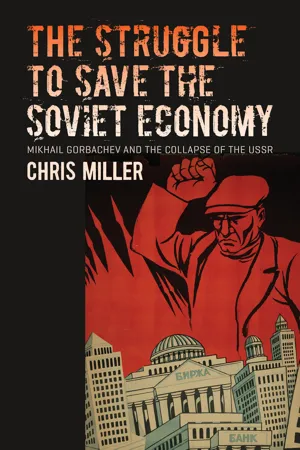
eBook - ePub
The Struggle to Save the Soviet Economy
Mikhail Gorbachev and the Collapse of the USSR
- 264 pages
- English
- ePUB (mobile friendly)
- Available on iOS & Android
eBook - ePub
About this book
Information
1 Asian Pivot
The Roots of Soviet Economic Reform
“Many are asking what perestroika was, where it has taken us,” wrote Georgy Shakhnazarov, one of Mikhail Gorbachev’s top advisers, in his memoir. “The answer is simple: it is yet another Russian march to the West.”1 After the collapse of the Warsaw Pact, the reunification of Germany, and cuts in the superpowers’ nuclear arsenals, it is easy to see why Shakhnazarov thought that perestroika heralded a new era of westernization in Russia. Some of the country’s most influential tsars, such as Peter the Great, whose military prowess established Russia as a great power, and Alexander II, who freed Russia’s peasants from serfdom, embraced the notion that their policies westernized Russia. As general secretary of the Communist Party, Gorbachev eagerly took up this mantle, publicly comparing himself to these famous predecessors and highlighting his westernizing credentials.2
Yet there is reason to be skeptical that perestroika was an attempt to copy the West, at least in terms of economics. To be sure, the liberal Soviet intelligentsia deeply admired the United States and Western Europe, and wished their country could become more tolerant, more sophisticated, and more—as they saw it—like the West.3 A handful of these scholars and academics even published their memoirs in English, shaping the West’s belief that perestroika and glasnost were an attempt at imitation.4 But the intelligentsia constituted just one part of Soviet society. The Communist Party leadership did not support perestroika because they thought it was a westernizing project. After all, the Red Army had spent the previous forty years preparing for war with the West, and many Soviet officials believed that westernization threatened the Soviet Union with international impotence and domestic dissent. The KGB had constructed elaborate layers of protection to ward off Western influence. Many top-party leaders were deeply skeptical of Western-style political competition and continued to see Stalin as a great leader.
Yegor Ligachev, Gorbachev’s second-in-command from 1985 to 1990, was typical of such conservative party leaders. Ligachev moved up the Communist Party ranks under Stalin, eventually becoming party head in the Siberian region of Tomsk. His family had some run-ins with Stalinist repression, and his wife’s father, a general, was executed during the purges of the late 1930s. Ligachev nonetheless admired Stalin’s leadership. He opposed efforts to critique Stalin’s legacy and stonewalled the introduction of market mechanisms into the Soviet economy.5 Nonetheless, Ligachev and others like him supported perestroika in its initial years. Perestroika ended as it did, Ligachev later argued, not because it was intended as a westernizing project, but because it was hijacked by radical capitalists in its later stages.6 If perestroika had been about westernization from the outset, traditionalist communists such as Ligachev would not have supported it.
In terms of its economics, however, the case for interpreting perestroika as a “march to the West” is usually seen as obvious. Surely, most historians have concluded, Soviet policymakers knew that they needed to make their economy more like that of Western countries if they wanted to approach Western standards of living. But the reality is more complex. The Soviet scholars and policymakers who shaped economic policy during the mid-1980s had a sophisticated understanding of the global economy. The Kremlin’s official ideology declared that the world was divided into two political camps—the imperialist West and the democratic socialist USSR—but Soviet economic analysts in the 1980s knew that there were several varieties of both socialism and capitalism, each of which placed different emphasis on planning, markets, trade, and industrialization. The new political openness of the 1980s meant that the applicability of these models to the Soviet Union was discussed freely, often for the first time, and Soviet intellectuals cast a wide net in searching for ways to improve their economy. The most natural place to look, at least at first, was toward the six countries of the Warsaw Pact.
Eastern Europe as a Laboratory for Reform
The Soviet Union’s Eastern European allies began tinkering with their centrally planned economies long before perestroika. In the first two decades after the communist takeover in the 1940s, the Warsaw Pact countries enacted economic policies modeled on the USSR.7 That began to change in the late 1960s and picked up pace after the Prague Spring uprising in 1968 threatened the foundations of Soviet power in Eastern Europe. Most Soviet leaders did not regret using the Red Army to overthrow Alexander Dubcek’s reformist government in Prague, but even Moscow’s hardliners recognized that the costs of intervention in 1968 were too high to repeat.8 Some of the USSR’s socialist allies were uneasy with deploying the Soviet military to “defend socialism,” and the intervention was condemned by the West. The invasion of Czechoslovakia was no less problematic within the Soviet Union, because it definitively disproved the notion that Eastern Europeans welcomed Soviet hegemony.9
Soviet leaders decided that the solution to political unpopularity in Eastern Europe was economic growth, even if that meant experimenting with ideologically questionable, market-based policies. This matched what some Eastern European leaders wanted to do anyway. Market reforms went furthest in Hungary. Even before Soviet troops invaded Czechoslovakia, Hungarian economists and policymakers recognized the need to modify their command economy, both because Hungary had exhausted the economic gains from moving peasants off into factory jobs, and because the country was unable to import sufficient consumer goods and technology from the West.10 The Hungarian government introduced a series of policy changes in 1968. State-controlled prices were increased, making them closer to where they would have been in a free market. By providing greater incentives for enterprises to supply goods, Hungary’s more market-based pricing system began to reduce the shortages of consumer goods that plagued all centrally planned economies.
At the same time, the Hungarian government cut the number of indicators it used to control enterprises. Hungarian leaders decreased the role of central planning, forcing enterprises to respond to market forces, which they were better able to assess than bureaucrats in Budapest.11 The basic effect was to move Hungary toward a market economy without formally jettisoning communist ideology. The results of these efforts were positive, at least in the 1970s. Other Eastern European countries followed with attempts to shake up their own economies.12 Hungary’s experience—and that of Yugoslavia, another leader in harnessing markets toward socialist aims—inspired those in the Soviet Union who hoped that their country might also embrace market mechanisms.13 Some Soviet economists believed that the market-based methods that Hungary used in agriculture, for example, could be implemented in the USSR and would increase output.14
By the late 1970s and early 1980s, however, when Soviet leaders began seriously searching for lessons about making central planning work, Eastern Europe looked far less impressive. The Warsaw Pact countries that embraced market socialism faced a pair of new challenges: debt and political upheaval. The two problems were linked. To deal with populations unhappy with their relative poverty, Eastern Europe’s governments began borrowing heavily to pay for imports of Western technology and consumer goods. When the bill came due and Eastern European governments tried to implement austerity measures, their populations pushed back, sometimes taking to the streets. Even more generous benefits were needed to placate protesters.15 Hungary, Poland, Romania, and East Germany soon all found themselves deep in debt. Between 1975 and 1980, East Germany’s net debt increased from $3.5 billion to $11.7 billion, while Poland’s jumped from $7.7 billion to $23.4 billion.16 Each country had to implement harsh austerity programs and reschedule debt payments to balance their books.
Soviet analysts watched with horror as Eastern Europe’s debt crisis began to spiral out of control during the 1980s. Soviet research institutes, most notably the Institute of the Economy of the World Socialist System, which focused on Eastern European affairs, conducted a series of reports on the subject for top policymakers, noting that even Hungary, one of the best-governed Warsaw Pact countries, was mired in debt.17 Other Soviet researchers examined the role of Western banks in creating Eastern Europe’s debt crises.18 The outlook was worrisome. In dollar terms, Poland accumulated twice as much foreign debt as the Soviet Union, even though the USSR’s population was many times larger.19 Poland’s debt burden was not unique: East Germany and Hungary had even higher levels of debt per person.20
Eastern Europe’s debt load increased despite the massive energy subsidies the Soviet Union provided during the 1970s and early 1980s, which at market prices amounted to a transfer of tens of billions of dollars each year.21 But many Eastern European countries borrowed so much from the West that they had to spend a third of their export earnings on interest payments.22 This was unsustainable. Poland defaulted on its debt to Western banks in March 1981, and Romania restructured several months later.23 Even the countries that did not default had to implement strict austerity programs to balance their budgets. The whole of Eastern Europe cut imports from the West by 25 percent between 1980 and 1983, squeezing consumers and reducing investment.24 Even then, Soviet analysts knew, Western banks would not be going away. One group of New York bankers told a top Soviet official in January 1982 that, regardless of the rescheduling of Poland’s debt, they had no plans to write off loans, and expected their $13 billion to be repaid.25
Soviet analysts understood the risks.26 Eastern European leaders regularly reminded Soviet interlocutors of their debt problems, hoping that Moscow might provide aid to stave off default. Hungarian leader Janos Kadar warned Soviet officials that “a financial crash in Hungary … would carry an extremely negative propaganda significance; it would sharpen still more the problem of cooperation between East and West; it would create diplomatic difficulties for the entire [socialist] camp.”27 Other Hungarian officials relayed a similar message, requesting expanded Soviet subsidies, especially in the form of cheap energy. Jozsef Marjai, vice president of Hungary’s Council of Ministers, insisted to Soviet colleagues that the threat was grave: “We are talking about the fate of the socialist system.”28
Soviet officials did not need a reminder of the risk. From the beginning of Eastern Europe’s economic experiments, Moscow worried that economic crisis might cause political liberalization. Loosening central planning, after all, threatened the core of the Soviet economic system. If communists didn’t keep a firm grip on the commanding heights of the economy, how could they control politics? After Karen Brutents, a top Soviet bureaucrat, visited Hungary, he told his friend and fellow bureaucrat Anatoly Chernyaev that the political ramifications of Hungary’s economic liberalization were deeply worrisome. “Impressions: vigorous economic activity, the store shelves are full of goods, the prosperity is evident and obvious. But the ‘middle class’ and intelligentsia profit from it mostly, the workers much less so. The gap is growing, as are internal tensions. Ideological ‘debauchery,’ though they clamped down on the striptease joints. The apparatus and...
Table of contents
- Cover
- Series Page
- Title Page
- Copyright
- Dedication
- Contents
- Charts and Table
- Dramatis Personae
- Chronology of Major Events
- Note on Statistics
- Introduction: The View from Tiananmen
- 1: Asian Pivot: The Roots of Soviet Economic Reform
- 2: Take Off or Leap Forward?: Soviet Assessments of China after Mao
- 3: Gorbachev’s Gamble: Interest Group Politics and Perestroika
- 4: Soviet Industry, Sichuan Style: Gorbachev’s Enterprise Reforms
- 5: A Soviet Shenzhen?: Copying China’s Special Economic Zones
- 6: Of Subsidies and Sovkhozes: Restructuring Soviet Agriculture
- 7: Fiscal Crisis, the Tiananmen Option, and the Dissolution of the USSR
- Conclusion: Paths Not Taken?
- Acknowledgments
- Notes
- Bibliography
- Index
Trusted by 375,005 students
Access to over 1.5 million titles for a fair monthly price.
Study more efficiently using our study tools.
Frequently asked questions
Yes, you can cancel anytime from the Subscription tab in your account settings on the Perlego website. Your subscription will stay active until the end of your current billing period. Learn how to cancel your subscription
No, books cannot be downloaded as external files, such as PDFs, for use outside of Perlego. However, you can download books within the Perlego app for offline reading on mobile or tablet. Learn how to download books offline
Perlego offers two plans: Essential and Complete
- Essential is ideal for learners and professionals who enjoy exploring a wide range of subjects. Access the Essential Library with 800,000+ trusted titles and best-sellers across business, personal growth, and the humanities. Includes unlimited reading time and Standard Read Aloud voice.
- Complete: Perfect for advanced learners and researchers needing full, unrestricted access. Unlock 1.5M+ books across hundreds of subjects, including academic and specialized titles. The Complete Plan also includes advanced features like Premium Read Aloud and Research Assistant.
We are an online textbook subscription service, where you can get access to an entire online library for less than the price of a single book per month. With over 1.5 million books across 990+ topics, we’ve got you covered! Learn about our mission
Look out for the read-aloud symbol on your next book to see if you can listen to it. The read-aloud tool reads text aloud for you, highlighting the text as it is being read. You can pause it, speed it up and slow it down. Learn more about Read Aloud
Yes! You can use the Perlego app on both iOS and Android devices to read anytime, anywhere — even offline. Perfect for commutes or when you’re on the go.
Please note we cannot support devices running on iOS 13 and Android 7 or earlier. Learn more about using the app
Please note we cannot support devices running on iOS 13 and Android 7 or earlier. Learn more about using the app
Yes, you can access The Struggle to Save the Soviet Economy by Chris Miller in PDF and/or ePUB format, as well as other popular books in History & Economic History. We have over 1.5 million books available in our catalogue for you to explore.