This first study to discuss the important ideological role of the military in the early political life of the nation examines the relationship between revolutionary doctrine and the practical considerations of military planning before and after the American Revolution. Americans wanted and effective army, but they realized that by its very nature the military could destroy freedom as well as preserve it. The security of the new nation was not in dispute but the nature of republicanism itself.
Originally published 1982.
A UNC Press Enduring Edition — UNC Press Enduring Editions use the latest in digital technology to make available again books from our distinguished backlist that were previously out of print. These editions are published unaltered from the original, and are presented in affordable paperback formats, bringing readers both historical and cultural value.
eBook - ePub
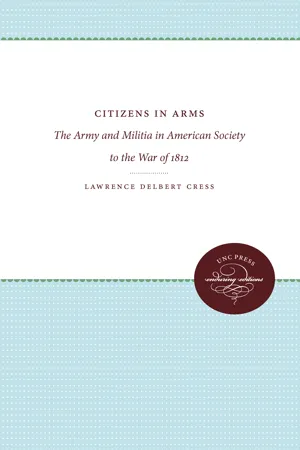
Citizens in Arms
The Army and Militia in American Society to the War of 1812
- 252 pages
- English
- ePUB (mobile friendly)
- Available on iOS & Android
eBook - ePub
About this book
Trusted by 375,005 students
Access to over 1.5 million titles for a fair monthly price.
Study more efficiently using our study tools.
Information
Part 1: Ideas and Institutions on the Eve of the American Revolution
No one concerned with the political liberties of Englishmen in the eighteenth century could ignore the relationship between military institutions and constitutional stability. Cromwell, the expanded army of Charles II, and the intrigues of James II had inspired concerns about the military structure of a free society that went to the core of English political theory. For many, though, the successes of the Glorious Revolution raised as many questions as they answered about the military needs of a free society. The accession of William and Mary to the throne had rid England of a tyrannical monarch, but had the constitutional guarantees of the Bill of Rights changed in any basic way the political theory and assumptions that had brought England to the Glorious Revolution? Was the citizen-soldier still the only certain guarantor against external attack and internal intrigue? Or were Parliament’s newly won controls over the nation’s regular army sufficient to prevent any abuse of the army’s inherent coercive powers? Indeed, had the growing complexity of English society and the continuing threat of the French army made a standing army necessary for the security of English liberties?
Englishmen wrestled with these questions in the years before the American Revolution, seeking a better understanding of the implications of military necessity for the constitutional structure of British society. Americans, too, addressed these issues, altering their own military institutions to meet the immediate military demands imposed by the intercolonial wars of the eighteenth century. The colonists asked yet another question, though, one that had far-reaching implications not only for the institutional development of the military in America but also for the British Empire itself. How did the political rights wrestled from the crown by Parliament affect the responsibilities and prerogatives of the colonial assemblies in North America? The tensions that question provoked and the lingering concerns in America about the military’s relationship to political freedom played an important role in the intellectual and political developments that produced the American Revolution.
1. The Military in American Colonial Society
[Ordered impressed for military service] all such able-bodied persons . . . as shall be found loitering and neglecting to labor for reasonable wages; all. . . [found] leaving wives or children without suitable means for their subsistence, and all other vagrant or dissolute persons, wandering abroad without betaking themselves to some lawful employment.—Virginia House of Burgesses (1757), in William W. Hening, ed., The Statutes at Large
As it is the essential property of a free government to depend on no other soldiery but its own citizens for its defence, so in all such free governments, every freeman and every freeholder should be a soldier.—Thomas Pownall, The Exercise for the Militia of the Province of Massachusetts Bay (1758)
Colonial military institutions developed in an atmosphere informed by military necessity and by a sensitivity to the implications of military power for the rights and liberties of a free people. By the middle of the eighteenth century, Americans no longer considered defense the responsibility of the entire community. The demands of the ongoing battle between Great Britain and France for hegemony in North America and the changing character of colonial society left the principal responsibility for the defense of British North America in the hands of professional British soldiers and the long-serving volunteers that filled the ranks of the armies raised in the colonies. The militia had not disappeared, but it had all but lost its military significance, becoming more a reflection of local political relationships and a lingering symbol of the responsibilities as well as the rights of a citizen in a free society. The growing reliance on military professionalism implicit in the evolution of colonial military institutions was predicated on the primacy of the colonial assemblies in military affairs. So long as military operations and policies remained a manifestation of the authority vested in the increasingly powerful assemblies, latent concerns about the political and social implications of military professionalism lay dormant. The primacy of the colonial assemblies, though, was critical. Any threat to that arrangement evoked questions about the political significance of the British army in North America as well as concerns about the viability of a free society that had ceased to include defense among the responsibilities of citizenship.
Soldiers and Militiamen
The early colonies were military outposts, replete with military men like Miles Standish and John Smith, all ready to defend their colonies against Spanish, French, or Indian intruders. But the expenses of maintaining a professional military force, the English militia tradition, and a desire, particularly in New England, for a more homogeneous community inspired every American colony except Pennsylvania to organize a militia system in one form or another during the seventeenth century. Virginia established a militia system during the 1620s that required all free white males to provide their own weapons, keep them in good repair, and attend frequent militia drills. Plymouth Plantation and Massachusetts Bay had established similar organizations by the 1630s. As it was in England, the militia in New England and the Chesapeake was functionally and organizationally a local institution. Legislative and executive committees periodically provided guidelines for military preparedness, but the internal operation of the militia fell almost entirely to local militia officers. They conducted drills and supervised local military construction. Fines for failure to attend musters or for unsatisfactory maintenance of weapons were levied, collected, and expended under their supervision.
Statutory limitations on militia service outside a unit’s locality underscored the militia’s role as a local institution. Exceptions were made in emergencies, but extended service away from home was usually limited to no more than two or three months. The prerogative of local militia officers to call out their units to meet civil and military emergencies further re-fleeted the local function and responsibilities of the militia. The threat of surprise attack and the isolation of many localities made that power essential, but it also undermined provincial military authority. Though the governor was the commander in chief and the legislature held the ultimate power to call out the militia, its real power rested in the hands of the local leadership—militia officers, whether elected by militia members, nominated by local civil authorities, or appointed by the colonial governor, who were indistinguishable from the local civil establishment.1
Nevertheless, by the last quarter of the seventeenth century, the militia had ceased to be the principal military arm of the colonies. The development of a buffer zone between Indian territory and most of the colonial population and the inclusion of North America as a battleground for the imperial struggles between Spain, France, and Great Britain significantly altered colonial military requirements. Colonial authorities found themselves in need of military institutions able to respond to demands beyond the capabilities of the local militia. Troops had to be willing to serve for extended periods of time, capable of traveling great distances, and prepared to face an enemy, more often than not a Frenchman or Spaniard, who fought in open fields or behind fortifications. Consequently, the militia in all the colonies came to function as an organizational unit designed to arm and train individual men, but not to fight. Volunteer expeditionary forces did the fighting. These units were raised by colonial authorities for extended military campaigns or for precautionary raids into the frontier. Colonial authorities appointed the officer corps for these expeditionary forces and established regular wages for troops in the ranks. As early as the 1620s, Virginians were finding it more convenient and economical to raise volunteer units to handle troublesome Indians. During the 1670s, colonies in both the Chesapeake region and New England raised volunteers with varying degrees of success to meet the last serious Indian threat to the eastern seaboard.2
Expeditionary forces were the principal instrument for colonial military operations during King William’s War. Virginia kept a small band of rangers in constant service on the frontier during the 1690s. This “standing force,” which already had a decade of service to its credit, was the creature of the colonial assembly. The House of Burgesses assigned each unit a particular part of the frontier to guard, encouraged experienced troops to continue in service, appropriated money for their maintenance, and provided pensions for the disabled. In New York, troops were raised to meet the French threat in and around Albany County; but these were not simply militia units called into the field. Bounties from twenty shillings to five pounds encouraged enlistments, while five pounds bought exemption from possible conscription. Service under the command of British regulars also distinguished these troops from the militia. Massachusetts also turned to volunteers during the 1690s. The Massachusetts assembly granted the governor power to use the militia outside colony boundaries during emergencies, but troops needed for extended service were made up of volunteers enlisted under the threat of conscription. As in New York, a five-pound fee bought exemption from personal service. This provision allowed propertied persons to avoid service with little difficulty and left the burden of military service on those unable to purchase exemptions. Noting that those “ablest and fittest for service” usually purchased deferments, leaving expeditionary units ineffective and demoralized, the Massachusetts assembly later required each militia unit to keep one-fourth of its men in readiness for royal service. Nevertheless, the five-pound exemption was not revoked.3
During the first half of the eighteenth century, Massachusetts continued to look beyond its franchised citizenry to meet its military manpower requirements. The threat of Indian warfare in 1721 and 1724 moved the Massachusetts assembly to pass legislation reminiscent of that during King William’s War, including enlistment bounties, pensions for the wounded, and purchasable deferments from personal service. The same legislation was passed again during King George’s War, with the addition of provisions to arm destitute volunteers and to allow the enlistment of minors and servants. These provisions enlarged the pool of persons eligible to serve as substitutes, making it easier for franchised citizens to avoid military service. The legislation was revived in the Seven Years’ War, but with a new twist. When sufficient volunteers for expeditions into Canada could not be raised with bounties and conscription, vagrants were ordered impressed. Service was mandatory unless those transients could provide a substitute or prove membership in another militia unit. Similar developments took place in New York. During King George’s War, “sojourners” were required to attend conscription musters. New York’s inability to generate enough volunteers for the Seven Years’ War caused the legislature to grant pardons to persons willing to enlist from their jail cells.4
Virginians were particularly alert to the possibility of using drifters, the economically dispossessed, and other social undersirables to meet military manpower needs. Throughout the intercolonial wars, Virginia exempted soldiers from taxes and granted them immunity from civil suits, which included the exemption of property from all “executions, attachments, and distresses whatsoever” during actual service and for a limited time afterward, to encourage military service by the poor and financially distressed. In 1740, the House of Burgesses ordered justices of the peace to search out and impress “such able-bodied men as do not follow or exercise any lawful calling or employment, or have not some other lawful and sufficient support and maintenance, to serve his majesty, as soldiers” in the expedition against Cartagena in the West Indies. An act levying troops for the 1754 Ohio Valley expedition made the same persons available to recruitment officers. The burgesses, though, warned recruiters that no one “who hath any vote in the election of a Burgess” was subject to impressment. These acts provided troops for royal service outside the boundaries of the colony. But even when recruits were needed for service within the colony, the burgesses did not look to the landed citizenry for military manpower. Frontier military requirements in 1757 produced an order to impress transients and the unemployed. Again, no “freeholder or housekeeper qualified to vote at an election of burgesses” was to be impressed.5
The colonial militia, however, had not disappeared, though demographic, social, and military developments had significantly altered its original function. It still occasionally functioned in a military role, most often in a rather primitive, usually retaliatory, capacity. More characteristically, the militia served as a local police force. Throughout the colonies, militia units were used in conjunction with the posse comitatus to quell civil disorder. When the militia was not called out in times of domestic discord, it was usually because too many militiamen were involved in the disturbances. As John Shy has pointed out, the militia was gradually becoming less a means of defense and more an “instrument of either order or insurrection depending on the circumstances.”6 The fear of slave insurrection made the police functions of the militia particularly important in the South.7 The New York City militia, acting within the bounds of its civil police function, was largely responsible for putting down the slave insurrection of 1741. In New England, as in New York, the militia was connected to local police functions through the institution of the night watch. Though operating under civil authority, except during emergencies, the night watch merged in form and function with the militia. In many statutes, the militia was used as the organizational base for distributing night-watch duty among the citizenry.8 The use of expeditionary forces to meet provincial military needs reinforced the localism that pervaded the seventeenth-century militia, allowing the eighteenth-century militia to evolve as a civil institution responsible for the security of property and the maintenance of civil order. Its original function had changed, but the militia remained very much the armed embodiment of the civil constitution.9
Defense had ceased to be a function of the community in colonial America by the middle of the eighteenth century. The militia’s continued association with the preservation of order and authority at the local level made its utilization for external defense improbable and, in some cases, particularly in the South, undesirable. Instead of a citizen army, colonists relied on special fighting forces manned by draftees and volunteers and officered by British regulars or American colonists holding commissions outside the militia establishment. The application of martial law to expeditionary troops (militiamen normally served under civil law) underscored the growing separation of the colonial military establishment from the rest of society. Indeed, the near total reliance on expeditionary forces by colonial authorities and the presence of British regulars in some of the colonies, notably New York and South Carolina, combined to give the colonial military establishment a professional cast. In their composition, at least, colonial armies had more in common with the mercenary forces serving the monarchs of Europe than they did with the citizen armies glorified by classical republican theorists.
The separation of citizenship from soldiering reflected important social and military developments in the colonies. The same factors that made a landless poor available also made militia mobilization inconvenient, if not intolerable. The growing density of the seaboard population and the expansion of the nonagricultural sector of the colonial economy generated a social atmosphere conducive to the use of the expeditionary forces recruited during the colonial period. At the same time, warfare was becoming increasingly complex, rendering the haphazardly trained and poorly disciplined militia useful only for short-term emergency duty. Like the Englishmen of the same period, Americans faced trained regulars on the battlefield, and they looked to skilled and long-serving soldiers to meet their military needs. The disfranchised and often impoverished volunteers who were willing or could be compelled to serve in the expeditionary forces raised by the colonial assemblies both allowed most Americans to avoid military service and provided the degree of military expertise necessary for successful campaigns against the hardened regulars serving in the armies of Europe.10
Questions of Control
This defense establishment was supported by a fairly clear sense of the function and place of the military in the colonial constitutional order. Americans, like Englishmen, had come a long way toward recognizing the value of regular and expeditionary forces, but their appreciation was founded on the colonial legislative control that they had come to demand over troops serving within their jurisdictions. British regulars in the colonies served under the command of the colonial governors and were housed at the discretion of the colonial assemblies. Expeditionary forces were creatures of the colonial assemblies. They were paid, supplied, and often armed under the appropriation powers exercised by the assemblies. Indeed, the astute manipulation of the power of the purse had allowed assemblies to make inroads into such traditional executive prerogatives as the appointment of commanding officers, the planning of military operations, and even the deployment of forces. The colonial governor’s position as commander in chief balanced the fiscal control of the legislature against the prerogatives of military command. This insured that no branch of the civil establishment could use its military powers to upset the constitutional balance of the government.
The militia also had an important role in the preservation of constitutional balance. Although it had ceased to be an effective means of external defense, it remained a basic instrument of civil control and continued to be identified with the preservation of liberty and property. A militia muster could mobilize the body politic to preserve civil order, effectively cutting off the popular basis for any movement against the established political order. On the other hand, if the citizenry supported the unrest en masse, the militia had the potential of being an armed arbiter in the resolution of domestic grievances. The militia had the dual funct...
Table of contents
- Cover Page
- Halftitle Page
- Title Page
- Copyright Page
- Dedication
- Contents
- Acknowledgments
- Introduction
- Part One Ideas and Institutions on the Eve of the American Revolution
- Part Two Society, Arms, and the Republican Constitution
- Part Three Creating a Peace Establishment
- Notes
- Bibliography
- Index
Frequently asked questions
Yes, you can cancel anytime from the Subscription tab in your account settings on the Perlego website. Your subscription will stay active until the end of your current billing period. Learn how to cancel your subscription
No, books cannot be downloaded as external files, such as PDFs, for use outside of Perlego. However, you can download books within the Perlego app for offline reading on mobile or tablet. Learn how to download books offline
Perlego offers two plans: Essential and Complete
- Essential is ideal for learners and professionals who enjoy exploring a wide range of subjects. Access the Essential Library with 800,000+ trusted titles and best-sellers across business, personal growth, and the humanities. Includes unlimited reading time and Standard Read Aloud voice.
- Complete: Perfect for advanced learners and researchers needing full, unrestricted access. Unlock 1.5M+ books across hundreds of subjects, including academic and specialized titles. The Complete Plan also includes advanced features like Premium Read Aloud and Research Assistant.
We are an online textbook subscription service, where you can get access to an entire online library for less than the price of a single book per month. With over 1.5 million books across 990+ topics, we’ve got you covered! Learn about our mission
Look out for the read-aloud symbol on your next book to see if you can listen to it. The read-aloud tool reads text aloud for you, highlighting the text as it is being read. You can pause it, speed it up and slow it down. Learn more about Read Aloud
Yes! You can use the Perlego app on both iOS and Android devices to read anytime, anywhere — even offline. Perfect for commutes or when you’re on the go.
Please note we cannot support devices running on iOS 13 and Android 7 or earlier. Learn more about using the app
Please note we cannot support devices running on iOS 13 and Android 7 or earlier. Learn more about using the app
Yes, you can access Citizens in Arms by Lawrence Delbert Cress in PDF and/or ePUB format, as well as other popular books in History & Military & Maritime History. We have over 1.5 million books available in our catalogue for you to explore.