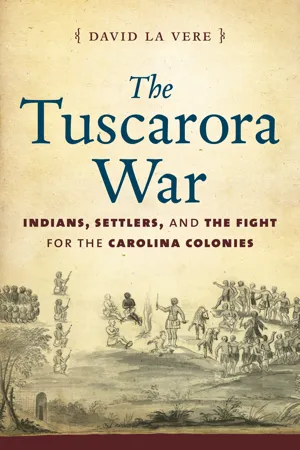
At dawn on September 22, 1711, more than 500 Tuscarora, Core, Neuse, Pamlico, Weetock, Machapunga, and Bear River Indian warriors swept down on the unsuspecting European settlers living along the Neuse and Pamlico Rivers of North Carolina. Over the following days, they destroyed hundreds of farms, killed at least 140 men, women, and children, and took about 40 captives. So began the Tuscarora War, North Carolina’s bloodiest colonial war and surely one of its most brutal. In his gripping account, David La Vere examines the war through the lens of key players in the conflict, reveals the events that led to it, and traces its far-reaching consequences.
La Vere details the innovative fortifications produced by the Tuscaroras, chronicles the colony’s new practice of enslaving all captives and selling them out of country, and shows how both sides drew support from forces far outside the colony’s borders. In these ways and others, La Vere concludes, this merciless war pointed a new direction in the development of the future state of North Carolina.
eBook - ePub
The Tuscarora War
Indians, Settlers, and the Fight for the Carolina Colonies
- 272 pages
- English
- ePUB (mobile friendly)
- Available on iOS & Android
eBook - ePub
About this book
Information
CHAPTER ONE
Christopher de Graffenried
The Dreamer
It was a pleasant late-summer day, around the eleventh or twelfth of September 1711. Baron Christopher de Graffenried, John Lawson, the surveyor general for the colony of North Carolina, and Christopher Gale, its chief justice, had decided to make a trip up the Neuse River.1 Since De Graffenried’s colony of Swiss and German Palatines at the mouth of the Neuse River was thriving, expansion up the Neuse seemed a real possibility. Gale begged out at the last minute due to sickness in his family. So De Graffenried and Lawson, along with two black slaves and a couple of Indian guides, set out with both boat and horse up the Neuse River.
They were well into their third day of the trip, maybe thirty miles upriver from New Bern, when everything changed. Suddenly from the forest appeared a large party of Indians. They seemed to come out of nowhere and quickly disarmed De Graffenried and Lawson, taking them as prisoners. Though the two men begged to be allowed to return downriver, in short order the baron, Lawson and the black slaves were forcibly marched away to Catchena, the main town of King Hancock of the Tuscaroras. Suddenly the late-summer days did not seem so promising.

Born on November 15, 1661, in the town of Worb, canton of Bern, Switzerland, De Graffenried was the son of Anton, Lord of Worb, a minor Swiss nobleman and government official. They could not be considered a wealthy family, but they were certainly not poor. Proficient in French, German, and English, De Graffenried attended the University of Heidelberg, but his professors saw him as a mediocre student. He caroused, fought a duel, got into trouble for it, and eventually left the university. He next enrolled at the University of Leyden in the Netherlands, where he studied law, history, and math, but he was still an average student. On graduation and hoping to make his own fortune, he struck out for London, where he believed he had a job as an aide to the Duke of Carlyle. In London, the job fell through and suddenly De Graffenried found himself in a foreign city with no money. He survived by hitting up his father for funds, but he also made some connections that would serve him well, such as with Christopher Monck, the Second Duke of Albemarle, and with Sir John Colleton, both of them Lords Proprietors of Carolina. In fact, the Duke of Albemarle pulled strings to get De Graffenried an honorary Master of Arts degree from Cambridge University. But master’s degrees alone did not generate income. His father, tired of paying for his son’s spendthrift ways, now pressured De Graffenried to come home. In 1683, the wastrel returned to Bern.2
He married Regina Tscharner of Worb in 1684 and in 1691 the couple had their first child, a son also named Christopher. A bequest from his mother helped the family financially and De Graffenried and Regina soon had more children. But the money did not last and the costs of supporting his family put him into heavy debt. In 1702 De Graffenried was elected as the governor of Yverdon in Neuchâtel province. He had expected to receive a hefty income, but the duties of governor came with great expenses. When his term ended in 1708, he found himself poorer than when he started. The family moved to Bern trailed by a gaggle of creditors. Desperate to find financial security, De Graffenried’s mind turned back to London and his old friends the Duke of Albemarle and Sir John Colleton; the latter De Graffenried once called “my special friend.”3 Though both were long dead, De Graffenried had the outlines of a plan that might well interest the then current Lords Proprietors of North Carolina.
In his original idea, he planned to relocate Swiss paupers and religious dissidents to someplace in England’s North American colonies. He would find a financial sponsor, maybe the Swiss government who wanted to be rid of undesirables, or someone in London who wanted to spur immigration to a certain colony. Then De Graffenried would set up the immigration and settlement, being paid so much per head and receiving generous tracts of land as well. It all seemed feasible. Chance encounters over the following few months would make it a reality.
In late 1708 or early 1709, De Graffenried traveled to London. There he was shocked to see refugees from the German Palatinate pouring into the English capital. The “poor Palatines” were Lutherans, along with a few Catholics, from the Palatinate region in present-day southwest Germany. A series of wars during the past century had left the Palatinate in bad shape. French armies had invaded as recently as May 1707. Destruction, famine, and higher taxes trailed the invasion, while the especially hard winter of 1708–9 only worsened Palatinate misery as now many starved. Wanting to help fellow Protestants in need, Queen Anne and the English government encouraged many poor Palatines to immigrate to England. Eventually thirteen thousand Palatines abandoned their homes in the Palatine and headed for London. The city soon teemed with German refugees, many camping out in parks and squares, and most fed at Queen Anne’s expense. English authorities began tossing around the idea of relocating these refugees to America. Seeing this, De Graffenried believed his relocation idea would get a much better reception if he centered it on the “poor Palatines.”4
At about this time, De Graffenried met Franz Ludwig “Louis” Michel, an adventurer who had made several trips to North America in the early 1700s, including to the Carolinas. Michel represented Georg Ritter and Company of Bern, which was already pursuing similar plans to relocate Swiss paupers and religious dissenters to North America. With De Graffenried’s connections and Michel’s backing of a stable Swiss company, it was natural they should join forces and so De Graffenried became a partner in the company. Up to this point, Georg Ritter and Company, founded by Georg Ritter, a Bern apothecary and member of Bern’s city government, and Johan Rudolf Ochs, a stone engraver, had imagined Pennsylvania or Virginia as a place for relocation. But at some point, while De Graffenried was visiting the Lords Proprietors, he met John Lawson, the surveyor general of North Carolina. Back in 1701, Lawson had made a lengthy journey across the Carolinas and had written a book on his travels that included a natural history of the colony. Now he was in London to meet with the Proprietors and get his book, A New Voyage to Carolina, published, which served as very favorable propaganda for the struggling colony. Lawson gushed about the possibilities North Carolina offered. He convinced De Graffenried and Michel that North Carolina was the only place for their proposed settlement.5
The Lords Proprietors, wanting to spur settlement to a colony with plenty of land but few people, seemed receptive to the idea. So in April 1709, De Graffenried and Michel negotiated a very detailed contract with the Proprietors to create a colony in North Carolina for German Palatine refugees in England, Swiss paupers, as well as for Swiss Anabaptists, an offshoot sect of the Protestant Reformation that did not believe in the baptism of infants. In return, De Graffenried and Michel received land in North Carolina for them and their colony. De Graffenried said he received 15,000 acres at the confluence of the Neuse and Trent Rivers and 25,000 acres further south on the White Oak River. For these lands he was to pay £10 sterling per thousand acres, then after that an annual quitrent of six pence per hundred acres. De Graffenried said he paid £175 sterling cash up front. He also received a reserve of 100,000 acres at the place of his choice between the Neuse and Cape Fear Rivers at the same price of £10 sterling per thousand acres with twelve years to pay it in full. The Lords Proprietors also granted the company a thirty-year lease on all mines and minerals they found, split fifty-fifty between the company and the Proprietors for the first five years, then three-eighths for the company after that.6
In return, the Proprietors demanded that De Graffenried and Michel relocate a total of 650 Palatines to their Neuse River lands. Queen Anne would provide 20 shillings worth of clothes to each Palatine and pay De Graffenried and Michel £5 10s. for each migrant to cover transportation and the cost of setting them up in North Carolina. The Proprietors would order the North Carolina receiver general to have supplies ready for the Palatines when they arrived to get them settled on the Neuse. De Graffenried and Michel were to repay the cost of these provisions to the Proprietors at the end of two years. The Proprietors ordered Surveyor General Lawson, once he returned home, to begin immediately laying out the colony’s lands on the Neuse River. Once the Palatines reached the Neuse, De Graffenried and Michel had three months to have 250-acre tracts ready for each Palatine family. These would be assigned by lots to the head of family, for whom it would be his and his heirs forever. For the first five years, the landowners would pay nothing, but after that, they should pay De Graffenried and Michel two pence per acre per year. The two men were supposed to provide whatever food, supplies, tools and utensils the Palatines needed, with the Palatines repaying these outlays at the end of three years. Incredibly, the Proprietors also instructed the two men that by the end of the settlers’ fourth month after arrival, De Graffenried and Michel should supply each family with two cows, two calves, two sows with their litters, two lambs, a male and female of each. At the end of seven years, the Palatines were to pay De Graffenried and Michel the cost of this cattle and 50 percent of the increase from the original stock.7 On paper, it looked like a paradise.
The Palatines in England certainly thought so and quickly signed up for a chance to receive a free farm in America with almost everything paid for. One could be a prosperous planter within months after arrival. All this thrilled the Bern city government, the original backer of the relocation idea. It had citizens it wanted to get rid of and was willing to pay forty-five thalers for every Mennonite or Anabaptist who went to North Carolina; it would also pay five hundred thalers for De Graffenried and Michel to take a hundred Swiss paupers off their hands.8
In truth, it was a fantasy and a dangerous one at that. The contract shows that neither the Proprietors nor De Graffenried had any sense of what North Carolina was really like or what the colonists would face. One wonders if Lawson saw the contract. Surely he could have set them straight about having unreal expectations. Or maybe Lawson actually imagined it the same way. He was in London, after all, to promote his book on North Carolina, which he believed was ripe for additional settlement.
Just as fanciful, the Lords Proprietors, as did De Graffenried, saw the Neuse River colony as a throwback to a medieval fiefdom. One of the perquisites King Charles II had given the original Proprietors was the right to set up a Carolina hereditary nobility, though the positions could not have the same name as those in England. So now the Proprietors named De Graffenried as a landgrave of Carolina, the peer equivalent of an English baron. For good measure, they also brevetted him as the English Baron of Benberg and a Knight of the Purple Ribbon, and issued him a medal and a set of crimson robes to wear on ceremonial occasions. But titles were cheap and De Graffenried soon realized that no money came with them. Still, as the new baron saw it, he would be their liege lord and his German and Swiss colonists would obey him, repay the money he laid out for them, and look to him as their leader. As their landgrave, he would settle their disputes, marry and baptize them, punish wrongdoers, and protect them. This last—protect them—De Graffenried took seriously. To solidify their relationship to the English, De Graffenried offered to have himself and his Swiss and Palatines convert to the Anglican Church. The Bishop of London agreed and asked the Society for the Propagation of the Gospel to send a chaplain to the Neuse River who could read the Book of Common Prayer in High German. As De Graffenried would eventually learn, his colonists did not necessarily see themselves as his serfs nor bound to the land. Most expected to quickly become free landholders themselves.9
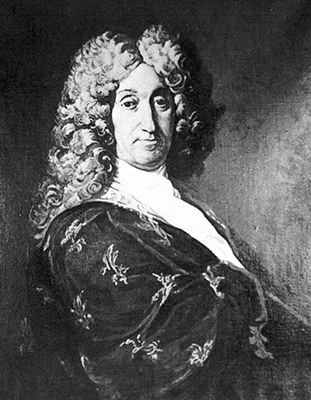
Christopher de Graffenried. Courtesy of the State Archives of North Carolina (N.71.2.136)
Still, De Graffenried felt confident. The only image we have of him, though some dispute it, may have come from this time. It shows a long-faced, long-nosed middle-aged man wearing a poofy, powdered wig parted in the middle. There appears an assured look to his eyes and a hint of a smile on his mouth, as if he was certain that all would be well. It was just a matter of crossing the Atlantic, docking at Virginia, and then making an overland trek south to the Neuse River at the far reaches of North Carolina. Then the dream would become reality. Not many realized that leaving England was just the beginning of a nightmare.
In January 1710, the Palatines sailed from Gravesend, England, east of London, on the Thames River. It is unclear exactly how many settlers left in this first contingent, but it seemed close to the agreed-on 650. Neither are we sure how many ships it took to carry 650 settlers, their baggage, equipment, and food to tide them over during the trip, but probably several. At the docks, De Graffenried gave a rousing speech while a pastor from the Reformed Church of Gravesend preached a sermon. Then the ships cast off to be escorted part of the way by a squadron of English warships.11
Things quickly went sour for the Palatines. The crossing was particularly rough and storms kept the ships at sea for an unusual thirteen weeks. Seasickness, bad sanitation, rotten food, and close quarters took their toll. Ship fever, what sailors called “typhus,” hit the Palatines and they died in extraordinary numbers, almost three or four a day. Morale plummeted. Then, just as they arrived at the Virginia coast, at the mouth of the James River, a French privateer attacked them. A British warship sat nearby but was undergoing repairs, so its crew looked on helplessly as the French plundered the Palatines. They took everything, the food and tools designated to get the colony started, all the Palatines’ possessions, including their clothes. The Palatines finally limped into port at Hampton, Virginia, a sad, destitute group. A quick count showed that only about half of the 650 who began the journey were still alive. They spent several weeks recuperating in Virginia, but even then the dying did not stop.12
Still, the Palatines needed to get from Virginia to their lands down on the Neuse. After recovering as best they could, Lawson and Gale led them on an overland trek south through the Great Dismal Swamp to Thomas Pollock’s plantation on the Chowan River. Pollock provi...
Table of contents
- Cover Page
- The Tuscarora War
- Copyright Page
- Dedication
- Contents
- Illustrations and Maps
- Prologue
- INTRODUCTION
- CHAPTER ONE: Christopher de Graffenried
- CHAPTER TWO: King Hancock and Core Tom
- CHAPTER THREE: William Brice
- CHAPTER FOUR: Col. John Barnwell
- CHAPTER FIVE: Thomas Pollock
- CHAPTER SIX: King Tom Blount
- CHAPTER SEVEN: Col. James Moore
- CHAPTER EIGHT: Aftermath
- A Note from the Author
- Notes
- Bibliography
- Acknowledgments
- Index
Trusted by 375,005 students
Access to over 1.5 million titles for a fair monthly price.
Study more efficiently using our study tools.
Frequently asked questions
Yes, you can cancel anytime from the Subscription tab in your account settings on the Perlego website. Your subscription will stay active until the end of your current billing period. Learn how to cancel your subscription
No, books cannot be downloaded as external files, such as PDFs, for use outside of Perlego. However, you can download books within the Perlego app for offline reading on mobile or tablet. Learn how to download books offline
Perlego offers two plans: Essential and Complete
- Essential is ideal for learners and professionals who enjoy exploring a wide range of subjects. Access the Essential Library with 800,000+ trusted titles and best-sellers across business, personal growth, and the humanities. Includes unlimited reading time and Standard Read Aloud voice.
- Complete: Perfect for advanced learners and researchers needing full, unrestricted access. Unlock 1.5M+ books across hundreds of subjects, including academic and specialized titles. The Complete Plan also includes advanced features like Premium Read Aloud and Research Assistant.
We are an online textbook subscription service, where you can get access to an entire online library for less than the price of a single book per month. With over 1.5 million books across 990+ topics, we’ve got you covered! Learn about our mission
Look out for the read-aloud symbol on your next book to see if you can listen to it. The read-aloud tool reads text aloud for you, highlighting the text as it is being read. You can pause it, speed it up and slow it down. Learn more about Read Aloud
Yes! You can use the Perlego app on both iOS and Android devices to read anytime, anywhere — even offline. Perfect for commutes or when you’re on the go.
Please note we cannot support devices running on iOS 13 and Android 7 or earlier. Learn more about using the app
Please note we cannot support devices running on iOS 13 and Android 7 or earlier. Learn more about using the app
Yes, you can access The Tuscarora War by David La Vere in PDF and/or ePUB format, as well as other popular books in History & North American History. We have over 1.5 million books available in our catalogue for you to explore.