Peru’s indigenous peoples played a key role in the tortured tale of Shining Path guerrillas from the 1960s through the first decade of the twenty-first century. The villagers of Chuschi and Huaychao, high in the mountains of the department of Ayacucho, have an iconic place in this violent history. Emphasizing the years leading up to the peak period of violence from 1980 to 2000, when 69,000 people lost their lives, Miguel La Serna asks why some Andean peasants chose to embrace Shining Path ideology and others did not.
Drawing on archival materials and ethnographic field work, La Serna argues that historically rooted and locally specific power relations, social conflicts, and cultural understandings shaped the responses of indigenous peasants to the insurgency. In Chuschi, the guerrillas found indigenous support for the movement and dreamed of sparking a worldwide Maoist revolution. In Huaychao, by contrast, villagers rose up against Shining Path forces, precipitating more violence and feeding an international uproar that took on political significance for Peru during the Cold War. The Corner of the Living illuminates both the stark realities of life for the rural poor everywhere and why they may or may not choose to mobilize around a revolutionary cause.
eBook - ePub
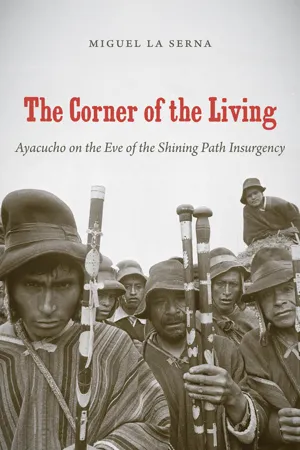
The Corner of the Living
Ayacucho on the Eve of the Shining Path Insurgency
- 304 pages
- English
- ePUB (mobile friendly)
- Available on iOS & Android
eBook - ePub
About this book
Information
CHAPTER ONE
To Trace the Tracks
Internal Conflict and Resolution
TWO INDIGENOUS PEASANTS—one from Peru and the other from Bolivia—are talking one day about the similarities and differences between their two countries. At some point in the conversation, the Peruvian turns to the Bolivian and asks, “Why is it that you have a navy when in Bolivia there is no sea?” The Bolivian scratches his head for a moment and replies, “Why is that you have a Ministry of Justice when in Peru there is no justice?”
I heard different iterations of this joke throughout my stay in Ayacucho. The punch line invariably caused everyone present to chuckle heartily, then sigh, then fade into awkward silence. The joke hit home for me as a historian, for I had spent countless hours reviewing written records on Ayacuchan indigenous peasants who had invested all their time, money, and energy into seeking justice from a state juridical system that rarely worked in their favor. But the worst of it was that I had consulted many of these records in Lima’s National Archive, which, by some cruel twist of fate, was located in the basement of the Palace of Justice.
BY THE MID-TWENTIETH CENTURY, many peasant communities had already turned to grassroots or customary justice to counteract what they perceived as an incompetent state juridical system. Some of these localized systems were more effective than others. Nowhere is this disparity more apparent than in the cases of Chuschi and Huaychao. As we will see, indigenous peasants from both communities held similar views when it came to condemning social trespasses such as abigeato (livestock theft), domestic impropriety (incest, adultery, spousal abuse, and the abandonment of one’s paternal duties), and “free-riding” (neglecting one’s duties toward the collective).1 Indigenous peasants seemed willing to tolerate their neighbors’ occasional slippages with respect to these moral transgressions provided that they made a concerted effort to correct these behaviors, for these deviants threatened the public order of the community.
Where Chuschi’s and Huaychao’s histories diverge is in the extent to which local systems of justice curbed this degenerate behavior. In Chuschi and neighboring Quispillaccta, we find the same individuals committing one or more of these social infractions throughout most of their adult life—some even before that. This was a direct consequence of a breakdown in the local administration of justice in the district. Not only did the customary law of the varayoqs, the indigenous authorities of the traditional civil-religious prestige hierarchy, fail to correct these individuals’ behavior, but so did the penal system of the Peruvian state.2 By contrast, customary justice in Huaychao, which was administered by local authorities, had succeeded in dissuading individuals from habitually subverting local values. Thus, even though these authorities were sometimes at odds with their subalterns, Huaychainos saw their power as legitimate and necessary because of their actual and symbolic role in safeguarding communal mores.
Chuschi’s and Huaychao’s local experiences speak to a greater incapacity of the Peruvian state to administer justice in the countryside. This is not to say that the state was absent in the rural highlands. Peasants in the most remote communities had access to at least one channel of the state’s judicial apparatus—be it appointed officials, judges, or policemen. The problem for Quechua-speaking peasants was not one of accessibility but one of reliability.
Community, Justice, and the State
Peru was not the only Latin American country with an ineffective judicial apparatus during the mid-twentieth century. In El Salvador, judges often deflected their responsibilities onto their untrained staff. Nor was it uncommon for justices of the lower courts to solicit bribes or confiscate valuable evidence such as vehicles for personal use. One reason for this was that Salvadoran judges received miserable salaries and often only worked part time. Equally troublesome was the inability of the Salvadoran system to convict prisoners. Before the 1980s, 90 percent of all Salvadoran prisoners remained unsentenced.3 Faced with similar crises, some Latin Americans, particularly those living in impoverished areas where crime was rampant and justice scarce, turned to extralegal measures to restore a sense of order in their communities. The political violence in 1940s and 1950s Colombia offers a fitting example. During that period, Colombia’s political parties held considerable sway over both the judicial and policing systems, effectively turning them into partisan machines. As a result, many of the armed civilian groups (guerrillas and paramilitaries) that emerged at this time began targeting individuals who had eluded justice at the local level.4 Nor was this strictly a rural problem. Brazil, a country where the urban poor complained that the justice system did not work in their favor, experienced a rise in mob lynching during the 1970s and 1980s.5 Indeed, state-administered justice was so unreliable during the middle of the century that most Latin American countries overhauled their entire judicial and policing systems during the 1980s and 1990s.6 Peru was among those countries.
The judicial official with whom Andean peasants had the most direct contact was (and remains) the juez de paz, the justice of the peace. While some peasant notables received these titles, justices of the peace were usually men from powerful mestizo families who, despite possessing minimal education, received virtually no judicial oversight from the superior courts that appointed them. They alone decided how to resolve local disputes. A justice might imprison one suspected abigeo (livestock rustler) in the village holding cell while setting another free under similar charges and with similar evidence. Justices used the same discretion when determining which cases to send to higher authorities and courts in the provincial, departmental, and national capitals. Indeed, many peasants believed that the most effective way to get a justice of the peace to send a case to the upper courts was to bribe the justice with money, goods, or services.7
Even if a justice of the peace did advance a peasant’s case to the higher courts, there were no guarantees that it would ever be resolved. For starters, litigants had to contend with the tremendous financial burden that bringing a case before the Peruvian courts entailed. In addition to paying fees for just about every transaction and procedure, litigants had to pay for the services of scribes, clerks, and attorneys, who themselves were known for their price gauging, foot-dragging, professional ineptitude, and general alignment with the landowning class.8 Add to this the costs plaintiffs accrued traveling to district, provincial, and departmental capitals to have their cases heard, and one can appreciate why peasants sometimes elected to drop their original charges.9 In many cases, however, the courts were the ones to abandon the case. The very language highlanders used to describe the judicial process illustrates their awareness of this reality. Using the Spanish term derivar (to drift) to refer to the act of submitting litigation through judicial channels, Quechua speakers voiced their uncertainty as to whether their cases would be heard at all.10
Outside of the courts, peasants could turn to the political hierarchy of the state. At the communal level, the central political authority was the lieutenant governor. In district capitals such as Chuschi, the lieutenant governor was outranked by the governor, who in turn was outranked by the mayor. The extent of these officials’ authority and duties varied widely from community to community, as did their social, racial, and educational backgrounds. In most cases, however, these leaders settled local disputes between villagers and reported serious cases to the provincial subprefects, who responded directly to the departmental prefects. Some villages also had officials who represented the community in disputes with external communities and landowners. This job was originally reserved for the personero, a popularly elected communal representative. After 1969, however, the position of personero was replaced with that of the communal president (also known as the president of administration) as part of the reform measures adopted by the Revolutionary Government of the Armed Forces (GRFA).11
The problems with this political hierarchy mirrored those of the judicial system. The men who held these posts were typically mestizos with considerable power at the local level. They usually came from the same social strata as the justices of the peace, and many had even served as justices at one point. Local authorities received virtually no oversight from the provincial subprefects and departmental prefects, leaving disciplinary measures up to their own discretion. Personal authority aside, peasants were subject to the same financial burdens they endured when dealing with the Peruvian courts. In many instances, peasants had to travel to district, provincial, and departmental capitals to have their cases heard, and once they got there they were often showered with clerical fees. Nor was it uncommon for peasants’ petitions to go unanswered or unresolved. Thus, while the state political hierarchy offered peasants some recourse when it came to voicing complaints, it did little to establish a sense of justice in the countryside.
The final state institution to which Andean peasants turned for the resolution of local conflicts was the Civil Guard, created in 1922 as a sort of police force. As with many justices, police guards tended to be uneducated mestizos. Few, if any, were from the districts under their jurisdiction. Civil Guard posts were seriously understaffed, manned by only an officer or two. Moreover, they were responsible for a vast geographic jurisdiction. This forced peasants to travel long distances to report crimes and then wait several days for a response. Peasants found this particularly frustrating when it came to crimes such as livestock theft, as the thieves usually fled or disposed of the stolen animals long before the police showed up to investigate.12 Besides, many peasants believed that police did more harm than good whenever they visited rural towns. During their visits, officers sometimes confiscated goods, issued random arrests under trumped-up charges, and sequestered youths for their obligatory military service. All this led peasants to believe that the police were in bed with the landed elite.13 Others felt that the officers were in cahoots with the thieves, doing everything from ignoring theft to aiding and abetting livestock rustlers.14 Still others accused the police of compelling illiterate peasants to endorse documents of whose contents they were unaware, only to find out later that they had unwittingly confessed to crimes they did not commit.15
Considering the systemic unreliability of the state’s judicial, political, and policing systems, it should come as no surprise that petty crime—particularly livestock theft—ran rampant in certain parts of the highlands at various historical junctures.16 Some believed that this broken system would improve when the Peruvian armed forces, led by General Juan Velasco Alvarado, seized executive power in 1968, promising an array of sweeping reforms designed to address peasant grievances. Among the measures enacted under Velasco was an overhaul of the judicial system, including the replacement of Supreme Court justices and the creation of a special body, the Consejo Nacional de Justicia (National Council of Justice), to appoint justices at various levels. Additionally, the GRFA created the Juzgado de Tierras (Agrarian Tribunal, or Land Court), to deal exclusively with agrarian disputes.17 Unfortunately for many peasants, the judicial reforms did little to address the structural problems outlined above. This is not to say that the Peruvian countryside was a criminal cesspool. On the contrary, communities developed a wide range of strategies to combat delinquency and preserve internal order.
A noteworthy example is the rondas campesinas (peasant patrols) of northern Peru.18 Even after the implementation of Velasco’s reforms, communities in Cajamarca and Piura continued to experience rampant theft. In the absence of a strong police force, peasants organized vigilante patrols to capture, interrogate, and punish suspected vandals. In time, the disciplinary function of the rondas campesinas went beyond repressing cattle rustling, as ronderos (patrollers) began working with their communities to discipline everyone from corrupt authorities to quarrelling spouses. The movement for rural justice caught on quickly, and by the 1980s the rondas campesinas patrolled virtually every community in northern Peru.19
Although the rondas campesinas remained concentrated in the north, peasants in the southern Andes developed their own grassroots mechanisms of communal justice. Between 1975 and 1977, Aymara peasants in the community of Calahuyo (Puno Department) stopped using the state judicial apparatus altogether, opting to resolve all local conflicts internally via the communal assembly. The punishments meted out by the Calahuyo assembly included the imposition of fines, public censorship, flogging, forced labor, loss of access to communal resources, demotion (in cases involving communal authorities), or even expulsion from the community.20 Other communities relied on the civil-religious hierarchy of the varayoqs. Typically, these customary indigenous authorities ensured that comuneros fulfill their communal obligations, such as the payment of communal taxes and participation in public works projects and religious festivities. These authorities also served as a sort of informal police force, investigating comunero disputes and punishing alleged wrongdoers. While perhaps arbitrary, this authority structure offered a form of customary justice for cultural trespasses that did not necessarily constitute crimes in the eyes of the state. The disciplinary power and reach of the varayoqs varied from community to community. In some villages, the hierarchy served as a sort of indigenous p...
Table of contents
- Cover Page
- The Corner of the Living
- Copyright Page
- Dedication
- CONTENTS
- ILLUSTRATIONS AND MAPS
- ACKNOWLEDGMENTS
- Introduction
- CHAPTER ONE: To Trace the Tracks
- CHAPTER TWO: To Venture Out
- CHAPTER THREE: To Walk in Shoes
- CHAPTER FOUR: To Cross the River
- CHAPTER FIVE: To Defend the Mountaintop
- CHAPTER SIX: To Turn the Corner
- Conclusion
- NOTES
- BIBLIOGRAPHY
- INDEX
Trusted by 375,005 students
Access to over 1.5 million titles for a fair monthly price.
Study more efficiently using our study tools.
Frequently asked questions
Yes, you can cancel anytime from the Subscription tab in your account settings on the Perlego website. Your subscription will stay active until the end of your current billing period. Learn how to cancel your subscription
No, books cannot be downloaded as external files, such as PDFs, for use outside of Perlego. However, you can download books within the Perlego app for offline reading on mobile or tablet. Learn how to download books offline
We are an online textbook subscription service, where you can get access to an entire online library for less than the price of a single book per month. With over 1.5 million books across 990+ topics, we’ve got you covered! Learn about our mission
Look out for the read-aloud symbol on your next book to see if you can listen to it. The read-aloud tool reads text aloud for you, highlighting the text as it is being read. You can pause it, speed it up and slow it down. Learn more about Read Aloud
Yes! You can use the Perlego app on both iOS and Android devices to read anytime, anywhere — even offline. Perfect for commutes or when you’re on the go.
Please note we cannot support devices running on iOS 13 and Android 7 or earlier. Learn more about using the app
Please note we cannot support devices running on iOS 13 and Android 7 or earlier. Learn more about using the app
Yes, you can access The Corner of the Living by Miguel La Serna in PDF and/or ePUB format, as well as other popular books in History & Latin American & Caribbean History. We have over 1.5 million books available in our catalogue for you to explore.