eBook - ePub
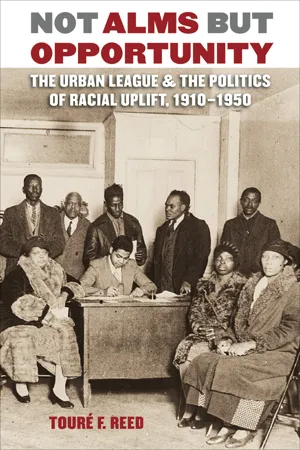
Not Alms but Opportunity
The Urban League and the Politics of Racial Uplift, 1910-1950
- 272 pages
- English
- ePUB (mobile friendly)
- Available on iOS & Android
eBook - ePub
Information
Topic
Ciencias socialesSubtopic
Historia de Norteamérica1. The Ideological Origins of the Urban League
Interracial Goodwill Through Social Service. —CUL, 1928
This chapter examines the issues surrounding the Urban League’s creation as well as the background of key personnel in order to draw out the ideological forces shaping the League’s approach. While some have traced the Urban League’s philosophical lineage to Booker T. Washington, this chapter contends that the League’s uplift project owed more to models of assimilation advanced by sociologists such as W. I. Thomas and Robert Park than the Wizard of Tuskegee.1 Applying concepts such as social disorganization and reorganization, ethnic cycle, and urban ecology to the Negro problem, Leaguers devoted particular attention to the relationship between blacks’ behavior and racial and economic inequality. As a result, the Urban League’s work would come to reflect many of the biases associated with Progressive Era social science theory.

In response to the growing tumult in New York, a number of black and white reformers banded together to address the problems confronting and allegedly created by black migrants. Though the League would eventually play a major role in such endeavors, prior to 1911 its activities were carried out by three separate organizations: the National League for the Protection of Colored Women (NLPCW), the Committee for Improving Industrial Conditions of Negroes in New York (CIICN), and the Committee on Urban Conditions Among Negroes (CUCAN). The Urban League and its parent organizations shared the view that rural migrants bore much of the blame for recent social upheavals. But while Afro-American leaders such as Booker T. Washington discouraged black migration, arguing that the south was the Negro’s natural home, the League and its predecessors attempted to redress issues such as crime, delinquency, unemployment, overcrowded housing, and even race riots by facilitating black migrants’ adjustment to the city. In practical terms these activities consisted largely of projects intended to provide migrants both moral guidance and assistance in acquiring decent homes and jobs. The Urban League, along with the NLPCW, the CIICN, and the CUCAN, thus embraced a common faith in the ability of reform endeavors to ease the social decay accompanying migration.
The NLPCW was the first of the League’s parent organizations to appear in Gotham. Officially established in 1906, the NLPCW’s founder, Frances A. Kellor, actually initiated its basic program one year earlier as director of the Inter-Municipal Committee on Household Research (IMCHR) of New York and Philadelphia. The principal goal of both the IMCHR and the NLPCW was to facilitate southern black women’s adjustment to the northern cities by directing migrant women to respectable housing and employment. To this end, the NLPCW concentrated on two basic areas of service. First, it discouraged southern girls from migrating to the north unless they had either definite work opportunities or specialized skills. Second, it offered those who had already migrated assistance in finding respectable employment and housing.3
Ultimately, the NLPCW endeavored to remedy the sources of crime and immorality that Kellor had identified as outgrowths of migration. Chief among the organization’s objectives was the elimination of causes of prostitution.4 Kellor, a trained social worker, rejected biological explanations for the wanton behavior said to afflict New York’s black belts. Instead, she attributed the growing sex trade within the city’s ghetto communities to migrant women’s vulnerability and ignorance of urban life. Traveling alone, migrant women were often cut off from institutions such as family and church. As a result, they were both deprived of community resources and freed of important behavioral checks.5 By directing migrant women to reputable employers and boardinghouses that might look after them, the NLPCW hoped to provide women with a social grounding that could insulate them from unsavory influences.6 Such efforts, Kellor’s organization believed, might not only save migrant women from lives characterized by improbity and degradation but also soothe race relations by eliminating a major source of racial animosity.
The CIICN and the CUCAN engaged in related campaigns against the causes of personal demoralization. Established in spring 1906, the CIICN was founded by William H. Bulkley, one of New York City’s most influential black educators.7 Like Kellor’s group, Bulkley’s committee focused on two tasks. It assisted blacks in acquiring useful skills while simultaneously negotiating with potential employers to open new occupations to Afro-Americans. The committee’s overarching aim was to demonstrate the versatility and efficiency of black workers. In so doing, the CIICN hoped to mitigate employer prejudice, thereby expanding the opportunities available to Afro-American workers. This is not to suggest that Bulkley believed that workplace efficiency was a panacea. In fact, the CIICN’s program presumed that vigorous efforts were needed to persuade employers to hire blacks. Nevertheless, Bulkley wanted to ensure that Afro-Americans were well poised to seize opportunities when they presented themselves.8
The committee’s emphasis on vocational guidance reflected a common fear that race prejudice fueled criminal and immoral conduct among Afro-Americans. In 1906, Bulkley asserted that the CIICN’s efforts were motivated by humanitarian concerns as well as a self-interested desire to reduce the causes of maladjustment within the city’s ghetto communities. Racism, he argued, made it all but impossible for New York’s black migrants to “find wholesome housing conditions or helpful vocations.” Bulkley went on to warn that lack of opportunity would “stifle laudable aspirations, provoke discouragement and invite all the evils that an idle brain can conceive.”9 Bulkley, therefore, identified training as a means of both improving blacks’ economic prospects and providing constructive outlets for restless minds.10
The activities of George E. Haynes’s CUCAN overlapped the CIICN’s. A former member of Bulkley’s group, Haynes created the CUCAN in May 1910 after a failed attempt to reform the CIICN. Like Kellor and Bulkley, Haynes proceeded from the view that Afro-American migration held the potential to erode blacks’ status in the north.11 Haynes was especially concerned that maladjustment, that is black migrants’ ignorance of urban life, had compounded the difficulties Afro-Americans encountered as a result of race discrimination. In his doctoral thesis at Columbia University, for example, Haynes observed that black crime rates in the north increased at pace with the growth of a city’s migrant population. While he believed that discrimination in both the workplace and the judicial system were partly to blame, Haynes implied that the cultural traits possessed by black newcomers contributed to this problem. Crime rates, he declared, declined “as the Negro becomes adjusted to the urban environment.”12 Maladjustment, according to Haynes, likewise undermined blacks’ employment prospects. The combination of inadequate training and excessive mobility among migrant workers led to inefficiency at the job, resulting in high levels of joblessness and poverty.13 Although Haynes concluded that workplace competence alone could not remedy the problem of black unemployment, he believed that job efficiency was one of the few means at blacks’ disposal of combating employment discrimination.14
While Haynes’s organization shared the NLPCW and CIICN’s commitment to improving black New Yorkers’ housing and employment prospects, the CUCAN’s approach differed significantly from its predecessors. As a social-work organization, the CUCAN’s uplift project relied heavily on social science methods and training. Haynes’s organization thus emphasized the importance of field research, placing particular importance on the compilation of data pertaining to blacks’ living and working conditions in order to target its efforts. The CUCAN also encouraged Afro-Americans to pursue studies in social work and the social sciences in an attempt “to prepare them for leadership in urban centers.”15
Haynes was a central figure in the creation of the National Urban League. In order to enhance the CUCAN’s efficiency, Haynes sought cooperation with other social service organizations. Due perhaps to Haynes’s decision to expand upon the work of existing associations, the CUCAN’s membership overlapped the NLPCW’s and the CIICN’s. In fact, Frances Kellor and William H. Bulkley were among the first to join the CUCAN. Sharing both their base of support and membership, the CUCAN, the NLPCW, and the CIICN discussed consolidating their activities as early as April 1911. By October, the three organizations merged to form the National League on Urban Conditions Among Negroes (NLUCAN), the NUL’s moniker until 1916.16
Like its predecessors, the National Urban League set out to redress the sources of social decay precipitated by migration. The association therefore incorporated all of the activities of its parent organizations. Though the Urban League was unquestionably the product of three groups, Haynes’s CUCAN exerted the greatest influence over the agency. In fact, the League’s program extended directly from the activities of the CUCAN, a contention that is affirmed by the fact that the National Urban League itself has long identified the creation of the CUCAN in 1910 as its birth. Haynes’s committee and the National Urban League shared both a common leadership and focus.17 Haynes served as the League’s executive secretary from 1911 until his formal resignation in 1918. Under his leadership the Urban League’s program centered on social work, placing particular emphasis on training. In its first annual report, for example, the NLUCAN listed among its chief objectives the promotion of “constructive and preventive social work,” the training and utilization of black social workers, and the design and implementation of field research in cities. These activities were ultimately intended to assist the League in improving “the social and economic conditions of Negroes in urban centers.”18
Haynes identified the training of social workers as an indispensable component of the Urban League’s work. During his tenure, the League initiated a fellowship program, providing financial support to black college students majoring in the social sciences, and began efforts to create a social-work training center in Nashville, Tennessee. League fellows took up course work at Fisk University in Tennessee and at Columbia University’s New York School of Philanthropy. Haynes was personally responsible for supervising the fieldwork of Urban League Fellows at Fisk, and he played an important, though less direct, part in its operation at Columbia. The “New York School of Philanthropy provided grants for two League Fellows, accredited their field work and arranged enrollment and study privileges at Columbia University.” Urban League Fellows affiliated with the New York School of Philanthropy were supervised by either Haynes or his deputy, Eugene Kinckle Jones.19
The League’s emphasis on social-work training did not preclude efforts to cooperate with Booker T. Washington. Indeed, the centrality of education in Haynes and the League’s uplift vision led the agency to court the Wizard of Tuskegee. As head of the CUCAN, Haynes corresponded regularly with Washington in order to obtain his official endorsement. The National League likewise extended several invitations to him to join the organization. Though Washington initially declined the League’s overtures, he nonetheless acknowledged the NUL’s importance by formally endorsing its program in April 1914. At the start of the new year, Washington finally accepted a place on the Urban League’s board. His tenure with the League was cut short, however, by his death in November 1915. Serving as a board member for less than one year, Washington likely exerted little direct influence over the League’s basic approach.20 Social work thus remained at the core of NUL’s activities in its formative years.
To be sure, Haynes was more invested in training black social workers than most Leaguers. Indeed, Haynes spent much of his tenure with the NUL pursuing this goal as an instructor at Fisk University. In addition to supervising Urban League fellows, Haynes taught graduate and undergraduate courses in social work, sociology, and economics at Fisk. His overarching objective was to transform the university into a model center for training blacks in social science methods and theories, which other institutions might “emulate and draw experience from.”21 While yielding some rewards, Haynes’s efforts to create a training center in Nashville eventually placed him at odds with the National Urban League’s executive board. As black migrant populations surged across the north following the outbreak of the First World War, the NUL’s executive board decided that the creation of local branches was of greater necessity than Haynes’s social-work center. Believing his activities at Fisk distracted him from more pressing issues, the board demoted Haynes to a “consultant” in 1917 and then forced him to resign the next year.22
Haynes’s replacement, Eugene K. Jones, shifted the League’s focus to more tangible matters such as housing and employment. But while the League devoted less attention to training black social workers after Haynes’s departure, it did not give up these activities altogether. Rather, it actually expanded its fellowship program after abandoning Haynes’s training center concept. Hiring a full-time recruiter of black college youth in 1919, the NUL launched a campaign to encourage Afro-American students to pursue studies in social work and the social sciences. Alexander L. Jackson, the League’s recruiter, engaged in a related effort to widen the Urban League’s fellowship program. Meeting with college administrators and faculty, Jackson set out to extend the program beyond Columbia. By the conclusion of the 1920s, Jackson and the League had secured openings for League fellows in graduate programs at Simmons College, the University of Pennsylvania, the University of Pittsburgh, the Carnegie Institute of Technology, Bryn Mawr, Mount Holyoke, Ohio State, New York University, and the University of Chicago. Due in no small part to Jackson’s efforts, “the actual number of League fellows expanded” during the 1930s “to as many as six in one year, plus an unrecorded number of ‘broken’ Fellows—that is, college students doing their field work under local League direction.”23
The Urban League also stepped up its presence in professional social-work associations. From its inception, ...
Table of contents
- Cover Page
- NOT ALMS BUT OPPORTUNITY
- Copyright Page
- Dedication
- Contents
- Illustrations
- Preface
- Acknowledgments
- Introduction
- 1. The Ideological Origins of the Urban League
- 2. Community Development and Housing, 1910–1932
- 3. Vocational Training, Employment, and Job Placements, 1910–1932
- 4. Labor Unions, Social Reorganization, and the Acculturation of Black Workers, 1910–1932
- 5. Vocational Guidance and Organized Labor during the New Deal, 1933–1940
- 6. Employment from the March on Washington to the Pilot Placement Project, 1940–1950
- 7. Housing and Neighborhood Work in the Age of the Welfare State, 1933–1950
- Conclusion
- Notes
- Bibliography
- Index
Trusted by 375,005 students
Access to over 1.5 million titles for a fair monthly price.
Study more efficiently using our study tools.
Frequently asked questions
Yes, you can cancel anytime from the Subscription tab in your account settings on the Perlego website. Your subscription will stay active until the end of your current billing period. Learn how to cancel your subscription
No, books cannot be downloaded as external files, such as PDFs, for use outside of Perlego. However, you can download books within the Perlego app for offline reading on mobile or tablet. Learn how to download books offline
Perlego offers two plans: Essential and Complete
- Essential is ideal for learners and professionals who enjoy exploring a wide range of subjects. Access the Essential Library with 800,000+ trusted titles and best-sellers across business, personal growth, and the humanities. Includes unlimited reading time and Standard Read Aloud voice.
- Complete: Perfect for advanced learners and researchers needing full, unrestricted access. Unlock 1.5M+ books across hundreds of subjects, including academic and specialized titles. The Complete Plan also includes advanced features like Premium Read Aloud and Research Assistant.
We are an online textbook subscription service, where you can get access to an entire online library for less than the price of a single book per month. With over 1.5 million books across 990+ topics, we’ve got you covered! Learn about our mission
Look out for the read-aloud symbol on your next book to see if you can listen to it. The read-aloud tool reads text aloud for you, highlighting the text as it is being read. You can pause it, speed it up and slow it down. Learn more about Read Aloud
Yes! You can use the Perlego app on both iOS and Android devices to read anytime, anywhere — even offline. Perfect for commutes or when you’re on the go.
Please note we cannot support devices running on iOS 13 and Android 7 or earlier. Learn more about using the app
Please note we cannot support devices running on iOS 13 and Android 7 or earlier. Learn more about using the app
Yes, you can access Not Alms but Opportunity by Touré F. Reed in PDF and/or ePUB format, as well as other popular books in Ciencias sociales & Historia de Norteamérica. We have over 1.5 million books available in our catalogue for you to explore.