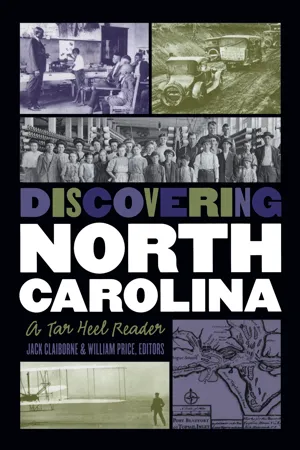
eBook - ePub
Discovering North Carolina
A Tar Heel Reader
- 390 pages
- English
- ePUB (mobile friendly)
- Available on iOS & Android
eBook - ePub
Discovering North Carolina
A Tar Heel Reader
About this book
This splendid anthology offers an engaging journey through four centuries of North Carolina life. It draws on a wealth of sources — histories, biographies, diaries, novels, short stories, newspapers, and magazines — to show how North Carolina's rich history and remarkable literary achievements cut across economic and racial lines in often surprising ways. There are selections by or about some of the state's best-known sons and daughters, from Daniel Boone and Andrew Jackson to Ava Gardner, Doris Betts, and Tom Wicker; and topics covered include politics, sports, business, family life, education, race, religion, and war.
Information
People
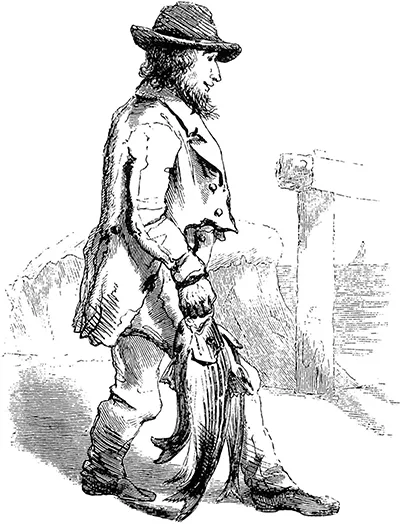
“Native,” Harper’s New Monthly Magazine, May 1858, Porte Crayon, illustrator. Courtesy North Carolina Collection, Wilson Library, University of North Carolina at Chapel Hill.
Tar Heels All
Jonathan Daniels
The contrasts and contradictions among North Carolina’s landscapes are surpassed by those among its people. As this essay by Raleigh editor and author Jonathan Daniels asserts, North Carolinians are humble but also proud, poor but also rich, riven by regional loyalties yet unified.
Daniels himself was one of North Carolina’s more fascinating citizens. A vigorous critic, he was also a staunch defender of his native state and exerted a strong influence on its politics and race relations. Born in Raleigh, he grew up on the News and Observer, a newspaper edited by his father, Josephus Daniels, and in time succeeded his father as editor. He also served as administrative assistant and press secretary to President Franklin Roosevelt. In addition, he was the author of more than fifteen books.
This essay appeared as the preface to North Carolina: A Guide to the Old North State, published by the Writers’ Project of the Works Progress Administration and reissued by the University of North Carolina Press in 1939.
As old William Byrd of Virginia told it, the line between North Carolina and Virginia was drawn across the map with much bickering and boozing. And when the line between the two Carolinas was drawn, legend insists that the South Carolina commissioners, being low-country gentlemen, were concerned with little more than keeping Charleston in South Carolina. Between the lines, between William Byrd’s aristocratic contempt and the Charleston gentlemen’s aristocratic unconcern, was left an area which for years on end rejoiced in the generalization that it was a vale of humility between two mountains of conceit. The generalization is useful, as most generalizations are. A modicum of truth lies in it, a persisting modicum, borne out in the report of a modern North Carolinian that among his State’s neighbors there were only two classes of people, those who never had worn shoes and those who made you feel that you never had. His report is important as reflecting, in a North Carolina recently more proud than humble, a continuing conviction that one man is as good as another and that if you don’t believe it he’ll show you he’s a damn sight better. . . .
Such a generalization certainly can indicate nothing about the fact that between the fishermen of Manteo and the men in the coves beyond Murphy there are at least three areas, different not only in the geography of Coastal Plain, Piedmont, and Mountain Regions, but different in the men and their preoccupations within them. Over roads and taxes, representation and offices, they have fought and quarreled and still fight and quarrel. The East, which once angrily insisted on political preference because it paid most of the taxes, now resists the Piedmont, which today does most of the paying. The greater part of the tobacco crop is raised in the East but all tobacco is manufactured in the Piedmont, and growers have shouted in anger both at tobacco prices and corporation politics. The East, conventional old agricultural plantation South of cash crops, Negro labor, and a straight Democratic ticket, remains socially conservative while it grows politically liberal. The Piedmont is the New South, up-and-coming, in which the cleavages of industry have flung up, out of the same small farmer class, the class-conscious worker and the property-conscious millionaire. And beyond them both the Mountain Region, still politically divided in memory of Union and Confederate division in the War between the States, remains more divided too in its desire for industry like the Piedmont’s and preoccupation with its precipitate earth—rich, if sometimes difficult, for farming for living, and magnificent in its appeal to those able to come up from the physically undramatic lowlands. . . .
The East remains expansive, leisurely, interminably and excellently conversational, concerned with good living, devoted to pleasure, politically fixed but also politically philosophical. Perhaps the absence of any large cities has contributed to the fact that the easterner’s neighborliness is little short of Gargantuan. Gregarious in an area not thickly settled, he finds it a trifle to go a hundred miles for a dance—and found it a trifle even when traveling meant trains and not the simplicity of automobile movement. His social life is restricted to no county or town. His “social set” is a whole population. . . .
The Piedmont is another land. It has always been a more serious-minded land. Somehow, the Episcopalians, though they are relatively few in number, seem to have marked the East, not as a church but as a people. In contrast, the Piedmont seems more directly to have grown from the stern spirits of the Quakers of Guilford, the Moravians of Forsyth, the Calvinists of Mecklenburg, the ubiquitous Baptists, and that practical Methodism from which the Dukes emerged. The plantation disappeared at the fall line. Labor became increasingly white. Leisure was less highly regarded, and practical concerns were paramount above philosophy, even above pleasure. Furthermore, where there was little Negro labor, there was water falling in the streams. And, long before the hydroelectric plants of Duke, it did not fall in vain. Hard-working, hard-headed men, with no foreknowledge of the inevitable change in relationship from money and land to money and machinery, attached themselves and their region to the change. Doing so long ago, they took the Carolina Piedmont into the direct stream of modern mechanical America and built the Piedmont in North Carolina into an area less distinguished for its differences from than its similarities to American industrial areas elsewhere. Its people are stirring or struggling. Wealth here has more sharply stratified society than in the older and more aristocratic East. But unlike some other industrial areas, its people are homogeneous. There are more foreign corporations than there are foreign workers. . . .
Perhaps the mountains meet the Piedmont in those towns where folk have come from the difficulties of scratching a living out of the steep sides of tough hills to the promised ease and regularity and generosity of the mills. The meeting has not always been a happy one. Sometimes it has been as violent as might be expected in the collision of the Elizabethan and electricity. The mountain man is by no means so quaint as some of the novelists have made him. His isolation is seldom so complete as it has been pictured; indeed, some sentimentalists spend themselves weeping over its disappearance. There are movies in every mountain town. Good roads run into a great many mountain coves. The boys and girls have gone out of the valleys to the schools. And now a good many simple mountaineers are waiting in hopefulness for some simple tourists. But the characteristics of the mountaineer remain. An individual may emerge from isolation swiftly, but a people does not immediately lose the characteristics created by long dwelling apart. The tourist is now to be welcomed, but to come to trust the stranger wholly is a more gradual process. . . . The divided mountaineers in the War between the States received the undivided and indistinguishable attentions of undisciplined bands of soldiers on both sides. . . . The antagonism . . . was more personal and immediate than elsewhere. There the division between the Union and the Confederacy might be no wider than the creek between two men’s houses. A man learned to trust in himself, to share his deeper thinking slowly, to welcome warily, to mind his own business, and to vote as his granddaddy fought. He still does.
But to reduce the North Carolinian to three North Carolinians is only the first step in the reduction of generalization to particular fact. There are diverse men among mountaineers. Certainly there are plenty of different types and classes and people in the Piedmont. In the East they are a different folk who fish on Harkers Island from those who plant peanuts in Bertie. . . .
There are, however, in North Carolina interesting groups which, without losing the characteristics of section, yet create a unity that— beyond the uniformity of taxes and laws—may very well be called North Carolina. Strongest of all, perhaps, is the alumni of the University of North Carolina. This of course does not mean the body of enthusiasts articulate over football. Far more importantly it means a group of men in every section of the State who have something more than a provincial’s sense of the meaning of his native land. From Battle and Winston through Alderman and Venable and Graham and Chase to another Graham, a series of able presidents has made the institution in a very real sense the center for an aristocracy of intelligence that in half a century has transformed the State. In no sense are these men everywhere in North Carolina steadily agreed on the directions that the State should take. Personal and sectional interests move them as they do other men. But in a broad and diverse State they know each other and have together a sense of the importance of their university and the schools that lead to its doors. They were chiefly responsible for North Carolina’s educational advance. They are responsible now for their university’s high integrity in freedom. And that institution, more than the capital at Raleigh, is the center for the progressive idealism of the State.
The university at Chapel Hill serves as a symbol for unity in aspiration as do few other institutions in the country. Sometimes regarded with suspicion, sometimes attacked with bitterness, the university nevertheless is more often held in an almost pathetic affection by the State. North Carolina was so long in ignorance, so long in poverty! Its people today are restless in the consciousness of their former stagnation. Chapel Hill, no longer remote, embodies their aspiration that the vale may become the mountain (if, indeed, already it has not!)—that the inconsiderable people between the two aristocracies may yet accomplish a greater destiny than either.
A Well-Shaped, Clean-Made People
John Lawson
Explorer-historian John Lawson’s observations of Indians in colonial North Carolina are keenly written and full of interesting detail. This account, excerpted from his 1709 book, A New Voyage to Carolina, reminds us that the Indians’ use of tobacco predated the coming of white settlers. Like many Europeans in the New World, Lawson viewed Indians as “noble savages.” In an ironic twist of fate, Lawson was killed by the Tuscarora tribe in the early days of their war against whites in 1711.
The Indians of North-Carolina are a well-shap’d clean-made People, of different Staturies, as the Europeans are, yet chiefly inclin’d to be tall. They are a very streight People, and never bend forwards, or stoop in the Shoulders, unless much overpower’d by old Age. Their Limbs are exceeding well-shap’d. As for their Legs and Feet, they are generally the handsomest in the World. Their Bodies are a little flat, which is occasion’d, by being laced hard down to a Board, in their Infancy. This is all the Cradle they have, which I shall describe at large elsewhere. Their Eyes are black, or of a dark Hazle; The White is marbled with red Streaks, which is ever common to these People, unless when sprung from a white Father or Mother. Their Colour is of a tawny, which would not be so dark, did they not dawb themselves with Bears Oil, and a Colour like burnt Cork. This is begun in their Infancy, and continued for a long time, which fills the Pores, and enables them better to endure the Extremity of the Weather. They are never bald on their Heads, although never so old, which, I believe, proceeds from their Heads being always uncover’d, and the greasing their Hair (so often as they do) with Bears Fat, which is a great Nourisher of the Hair, and causes it to grow very fast. Amongst the Bears Oil (when they intend to be fine) they mix a certain red Powder, that comes from a Scarlet Root which they get in the hilly Country, near the Foot of the great Ridge of Mountains, and it is no where else to be found. They have this Scarlet Root in great Esteem, and sell it for a very great Price, one to another. The Reason of its Value is, because they not only go a long way for it, but are in great Danger of the Sinnagars or Iroquois, who are mortal Enemies to all our Indians, and very often take them Captives, or kill them, before they return from this Voyage. The Tuskeruros and other Indians have often brought this Seed with them from the Mountains; but it would never grow in our Land. With this and Bears Grease they anoint their Heads and Temples, which is esteem’d as ornamental, as sweet Powder to our Hair. Besides, this Root has the Virtue of killing Lice, and suffers none to abide or breed in their Heads. For want of this Root, they sometimes use Pecoon [probably Pecan]-Root, which is of a Crimson Colour, but it is apt to die the Hair of an ugly Hue.
Their Eyes are commonly full and manly, and their Gate sedate and majestick. They never walk backward and forward as we do, nor contemplate on the Affairs of Loss and Gain; the things which daily perplex us. They are dexterous and steady both as to their Hands and Feet, to Admiration. They will walk over deep Brooks, and Creeks, on the smallest Poles, and that without any Fear or Concern. Nay, an Indian will walk on the Ridge of a Barn or House and look down the Gable-end, and spit upon the Ground, as unconcern’d, as if he was walking on Terra firma. In Running, Leaping, or any such other Exercise, their Legs seldom miscarry, and give them a Fall; and as for letting any thing fall out of their Hands, I never yet knew one Example. They are no Inventers of any Arts or Trades worthy mention; the Reason of which I take to be, that they are not possess’d with that Care and Thoughtfulness, how to provide for the Necessaries of Life, as the Europeans are; yet they will learn any thing very soon. I have known an Indian stock Guns better than most of our Joiners, although he never saw one stock’d before; and besides, his Working-Tool was only a sorry Knife. I have also known several of them that were Slaves to the English, learn Handicraft-Trades very well and speedily. I never saw a Dwarf amongst them, nor but one that was Hump-back’d. Their Teeth are yellow with Smoaking Tobacco, which both Men and Women are much addicted to. They tell us, that they had Tobacco amongst them, before the Europeans made any Discovery of that Continent. It differs in the Leaf from the sweet-scented, and Oroonoko, which are the Plants we raise and cultivate in America. Theirs differs likewise much in the Smell, when green, from our Tobacco, before cured. They do not use the same way to cure it as we do; and therefore, the Difference must be very considerable in Taste; for all Men (that know Tobacco) must allow, that it is the Ordering thereof which gives a Hogoo [relish] to that Weed, rather than any Natural Relish it possesses, when green. Although they are great Smokers, yet they never are seen to take it in Snuff, or chew it.
An Unquieted Passion for Adventure
Robert E. Lee
North Carolina’s jagged coast, treacherous ocean currents, and shifting channels made its hidden inlets a perfect refuge for eighteenth-century pirates. Not every coastal resident thought the pirates were evil, as this profile of Blackbeard reveals. A century and a half later, the pirates’ elusive seamanship would be a model for southern sailors trying to run the Union blockade and keep the Confederacy alive.
This account of Blackbeard’s life was taken from the Dictionary of North Carolina Biography and was written by Dr. Robert E. Lee, a law professor at Wake Forest University who also authored a 1975 biography of Blackbeard.
Blackbeard the Pirate, picturesque colonial pirate, is usually said to have been born in Bristol, England. The circumstances of his early life are not known. Pirates rarely wrote about themselves or their families: each hoped to acquire a vast fortune and return to his former home without having tarnished his family name.
Because pirates tended to adopt one or more fictitious surnames while engaging in piracy there is no absolute certainty of Blackbeard’s real surname. In all the records made during the period in which he was committing his sea robberies, he was identified as either Blackbeard or Edward Teach. Numerous spellings of the latter name include Thatch, Thack, Thatche, and Theach, but Teach is the form most commonly encountered, and most historians have identified him by that name.
Captain Charles Johnson (recently thought to be a pseudonym for Daniel Defoe), a recognized authority on the pirates of the era, states emphatically in A General History of the Robberies and Murders of the Most Notorious Pyrates, originally published in 1724, that Edward Teach sailed for some time out of Jamaica on the ships of privateers during Queen Anne’s War and that “he had often distinguished himself for his uncommon boldness and personal courage.”
Sometime in 1716, Teach transferred the base of his operations from Jamaica to New Providence in the Bahama Islands. He served an apprenticeship under Captain Benjamin Hornigold, who was the fiercest and ablest of all pirates regularly operating out of the island of New Providence. Jointly they captured and looted a number of large merchant vessels. Having amassed a sizeable fortune and recognizing that the profitable days of piracy were nearing an end, Hornigold in early 1718 retired from piracy and took up the honest life of a planter on New Providence. He took full advantage of the king’s pardon when Woodes Rogers arrived in Nassau on 27 July 1718 as the newly appointed governor of the Bahama Islands.
Teach converted a large French ship, Concord, which he and Captain Hornigold had captured, into a pirate ship of his own design. He renamed her the Queen Anne’s Revenge and mounted upon her forty guns. The vessel was eventually manned by a crew of three hundred, some of whom had been members of her crew when she sailed under the French flag.
Most men of this period did not wear beards, but Teach discovered that he could grow a coarse, coal-black beard that covered the whole of his face. He allowed his monstrous mane to grow to an extravagant length, and he was accustomed to braiding it into little pigtails, tied with ribbons of va...
Table of contents
- Cover Page
- Title Page
- Copyright Page
- Table of Contents
- Dedication
- Preface
- Acknowledgments
- Environment: Physical, Historical, Attitudinal
- People
- Events
- Social Fabric
- Sources
Trusted by 375,005 students
Access to over 1.5 million titles for a fair monthly price.
Study more efficiently using our study tools.
Frequently asked questions
Yes, you can cancel anytime from the Subscription tab in your account settings on the Perlego website. Your subscription will stay active until the end of your current billing period. Learn how to cancel your subscription
No, books cannot be downloaded as external files, such as PDFs, for use outside of Perlego. However, you can download books within the Perlego app for offline reading on mobile or tablet. Learn how to download books offline
Perlego offers two plans: Essential and Complete
- Essential is ideal for learners and professionals who enjoy exploring a wide range of subjects. Access the Essential Library with 800,000+ trusted titles and best-sellers across business, personal growth, and the humanities. Includes unlimited reading time and Standard Read Aloud voice.
- Complete: Perfect for advanced learners and researchers needing full, unrestricted access. Unlock 1.5M+ books across hundreds of subjects, including academic and specialized titles. The Complete Plan also includes advanced features like Premium Read Aloud and Research Assistant.
We are an online textbook subscription service, where you can get access to an entire online library for less than the price of a single book per month. With over 1.5 million books across 990+ topics, we’ve got you covered! Learn about our mission
Look out for the read-aloud symbol on your next book to see if you can listen to it. The read-aloud tool reads text aloud for you, highlighting the text as it is being read. You can pause it, speed it up and slow it down. Learn more about Read Aloud
Yes! You can use the Perlego app on both iOS and Android devices to read anytime, anywhere — even offline. Perfect for commutes or when you’re on the go.
Please note we cannot support devices running on iOS 13 and Android 7 or earlier. Learn more about using the app
Please note we cannot support devices running on iOS 13 and Android 7 or earlier. Learn more about using the app
Yes, you can access Discovering North Carolina by Jack Claiborne, William Price, Jack Claiborne,William Price in PDF and/or ePUB format, as well as other popular books in History & North American History. We have over 1.5 million books available in our catalogue for you to explore.