Studies of public finance, as traditionally developed, have analyzed the effects of fiscal institutions on the market-choice behavior of individuals and firms, but this book takes a different approach. It analyzes the effects of fiscal institutions on the political-choice behavior of individuals as they participate variously in the decision-making processes of democracies.
What effect will the form of a new tax have on individuals' attitudes toward more or less public spending? To what extent does the private sector — public sector mix depend on the way in which tax payments are made? How do the various taxes affect the fiscal consciousness of individual citizens? These are questions that have been ignored for the most part. They are, nonetheless, important and worthy of examination. This book is an attempt to provide some provisional answers. By the use of simplified models of existing tax institutions, Buchanan predicts the effects that these exert on individual behavior in the area of political choice. The relative effects of direct and indirect taxes, the “old tax — new tax” distinction, the effects of fiscal earmarking, the effects of unbalanced budgets — these are a few of the topics examined.
Before these questions can be fully answered, research must be conducted to find out just how much individuals know about the taxes they pay and the benefits they receive. Comparatively little research of this kind has been completed, but the author devotes a chapter to a careful review of the present state of this sort of research.
Individuals' choice among alternative fiscal institutions is examined in the second part of the book. If given the opportunity, how would the individual choose to pay his or her taxes? Progressive income taxes, excise taxes, and public debt are analyzed in terms of this question.
Because of its interdisciplinary approach, this imaginative study will be of interest to both economists and political scientists.
eBook - ePub
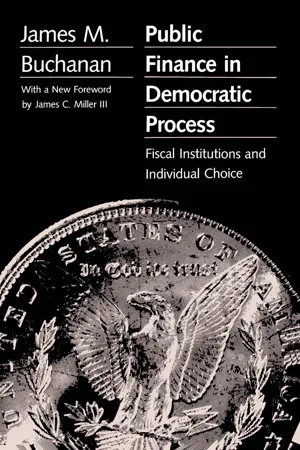
Public Finance in Democratic Process
Fiscal Institutions and Individual Choice
- 321 pages
- English
- ePUB (mobile friendly)
- Available on iOS & Android
eBook - ePub
About this book
Information
PART I
THE EFFECTS OF INSTITUTIONS ON FISCAL CHOICE
I am ready to admit that much of my discussion may be classified as arm-chair speculation. I accept the title gladly, for this is, in fact, the manner in which everything may be taken into account, and an inclusive, internally consistent system constructed. For this reason, I never worry about the external consequences of carrying out my theory. How much of it—or whether any at all—may be practically applied in the near future, practical men may decide. I become the same as they if I try to take into account every conceivable practical criticism.
Knut Wicksell, in the Preface to Finanztheoretische Untersuchungen (Jena: Gustav Fischer, 1896).
1. Introduction
Individuals, separately and in groups, make decisions concerning the use of economic resources. They do so in at least two capacities: first, as purchasers (sellers) of goods and services in organized markets, and, secondly, as “purchasers” (“sellers”) of goods and services through organized political processes. Economic theory has been developed largely to explain the workings of organized markets, and the trained economist understands how decentralized decisions are mutually co-ordinated so as to produce allocative results that are internally consistent. Economists, especially English and American, have devoted little time and effort to an explanation of individual behavior in the second decision process.1 Individual participation in collective decision-making has not been thoroughly analyzed, and the means through which the separate private choices are combined to produce “social” or “collective” outcomes have not been subject to careful and critical research. This relative emphasis on the interaction process in private markets was, to some degree, justifiable so long as organized markets retained overwhelming allocative importance. But when more than one-fourth of all products, even in those economies that are presumably noncollectivist, is destined to be used for collective rather than for private purposes, some modification in the emphasis seems in order.
There exists no “theory of collective choice,” no “theory of demand for collective goods,” that is analogous to the familiar theorems and propositions in neoclassical economics. We know little about how individuals behave as they participate in collective choice. In societies that are organized democratically, even in the broadest sense of this highly ambiguous term, individuals must be assumed to participate in the formation of “public” decisions. They may, of course, do so indirectly and at several stages removed from specific allocative choices. They may be motivated by group rather than individual interest, and they may remain indifferent over wide margins of public choices. The complexities of modern politics and bureaucracy should not, however, conceal the underlying realities, and gross misunderstanding can result if individual participation in, and reaction to, public decisions is either neglected or assumed away. The omniscient and benevolent despot does not exist, despite the genuine love for him sometimes espoused, and, scientifically, he is not a noble construction. To assume that he does exist, for the purpose of making analysis agreeable, serves to confound the issues and to guarantee frustration for the scientist who seeks to understand and to explain.
Political decision-making is a complex and intricate process, much more complicated than is the nonpolitical decision-making in market institutions. The rules constraining individual choice are necessarily different in the two cases, and because of the nature, both of these rules and the underlying objectives, simple correspondence between private cost and benefit, a basic feature of market choice, cannot exist in politics. Nevertheless, at some ultimate stage or level, the individual must, somehow, “choose” how his resources are to be used collectively as well as privately. In the final analysis, the individual must “decide” on the appropriate size of the government budget, and on the breakdown of this budget among component items. Despite his acknowledged ignorance, the individual citizen must, ultimately, choose the size of outlay on public education as well as number of veterans’ hospitals.
This is not to suggest that the individual makes collective choices only, or even primarily, in his role as a voter in elective processes. He exerts influences on public choices through professional organizations to which he belongs, through the publications that he supports, through the public and private bureaucracies that employ his talents. Collective outcomes emerge out of the utility-maximizing behavior of many persons acting in many separate capacities.
These outcomes are not independent of or divorced from the activities of individuals even if there is little consciousness on the part of any particular person that he is choosing for the community, save in specific and isolated cases. Even here, he is perhaps conscious of opting for or against a highly uncertain package; rarely is he given the opportunity to make specific indications of preference for or against tax or expenditure proposals. Nonetheless, analysis that cuts through the maze and examines the cost and benefit calculus of the individual as if he makes specific choices seems necessary as a starting point.
How can the private “costs” that the individual takes into account in such decisions be isolated and identified? How can the private “benefits” that are expected to balance off these costs be determined? Even to raise such questions as these suggests that research objectives here must be modest. Common sense indicates that the institutions through which costs and benefits are presented to the private citizen may influence his decision. The direct costs of governmental services appear to the citizen as taxes, and the manner in which these are levied may significantly affect his attitudes toward the extension or the contraction of such services. This study has as its purpose the development of some rudimentary predictions concerning the effects of the various fiscal institutions on the decision calculus of the individual, as citizen-voter-taxpayer-beneficiary. The limitations of this purpose should be stressed. When the study is completed, we shall remain a long way from an integrated “theory of fiscal choice.” But some of the essential elements will, hopefully, have been provided, some crude hypotheses will have been tested, and some normative implications for reform in the existing fiscal structure may have emerged in the process.
THE TRADITIONAL APPROACH TO PUBLIC FINANCE
Public finance, as a subdiscipline of classical, neo-classical, and even Keynesian political economy, has consisted primarily in the analysis of the effects of alternative fiscal institutions on individual and group behavior in the private economy. Taxes and expenditures, separately or in the aggregate, have been studied, both analytically and empirically, with a view toward determining their effects on the activities of persons, families, firms, and other voluntary organizations. The influence of income taxation on the individual’s choice between work and leisure, the effects of business taxation on managerial efficiency, the effects of agricultural subsidies on output, the impact of highway spending programs on transportation development, the effects of budget deficits or surpluses on income, employment, and prices: all these, and many more similar topics, are familiar chapters in the treatise written in the traditional framework.
These subjects are important, and past research has yielded fruitful results. Current and future research promises to add still more to our analytical capital stock. The absence of an important aspect of public finance must be noted nonetheless. The individual does choose how to allocate his income-earning power between earning and not-earning, and he is surely influenced in this choice by fiscal institutions. But he also chooses, as a citizen in a democratically organized political community, how to allocate his potential income between private uses and public or collective uses. The structure of fiscal institutions must also affect this choice, and in important ways, even if participation in such choice by the individual seems remote and indirect. Public finance, as traditionally developed, studies individual behavior in the private sphere of his activity. It has not, sufficiently, examined behavior in the public sphere of activity, although here, too, the choices must remain individual in the final analysis, regardless of the decision-making rules.
SPECIFIC PURPOSE
This study is not aimed at developing a comprehensive “theory of fiscal choice,” even at the level of individual participation. Its primary purpose is that of analyzing the effects of designated fiscal institutions on individual behavior in collective choice situations. Attempts will be made to predict the effects of such institutions as the income tax on the individual’s behavior as he confronts decisions on the public usage of economic resources.
There are two parts to the study. In the first, Part I, we shall assume that the various fiscal institutions are exogenously imposed on the individual. That is to say, he is assumed to adjust his behavior under a set of institutions that he considers to be beyond his power to alter or to modify. In this initial stage of inquiry, we leave aside the more difficult and complex problems that arise when the individual is allowed some power of selection among these institutions themselves. Part II is devoted to this extension.
ANALOGUES FROM ECONOMIC THEORY
There are no readily applicable analogues that can be drawn from orthodox economic theory. In the latter, the one-to-one or direct correspondence between cost and benefit for the choosing individual is normally considered to be sufficiently in evidence to allow the assumption that choice is made on the full knowledge of alternatives. Institutional variations in the manner of implementing ordinary market transactions are not held to be significant in affecting choice behavior. To the chooser, price reflects private cost, and price is price and that is that. In a certain broad, and usefully conceptual, sense any tax is also a “price” paid by an individual or by the community of individuals for the public services that are provided collectively. Quite apart from the difficulties of disaggregating a community total into “individual or private prices,” however, the forms of taxation affect choice behavior. And, also differently from market choice, the individual is not allowed to choose his most preferred means of payment. Normally he must meet his fiscal obligations through the means laid down for everyone.
It is as if we should ask, in our analysis of consumer behavior, how the institution of payment itself modifies choice patterns. Suppose that an individual may purchase commodity A in unlimited amounts for cash but that access to credit is denied by law. Now compare his behavior with that which would emerge when he is confronted with an alternative institution of payment that requires him to purchase the commodity only on credit. The “price” computed in present value terms is, we may assume, identical, and the same physical commodity is available. However, the behavior of the average or representative consumer may be quite different in the two cases, as has been empirically demonstrated by the effects of legally imposed constraints on the installment purchase of consumer durables.
When we begin to look at the fiscal structure within this frame of reference, it seems evident that the institutions through which the costs and the benefits of collective action are presented to the individual can significantly influence his evaluation of, and his own reactions to, the flow of such costs and benefits.
INDIVIDUAL RATIONALITY IN FISCAL CHOICE
To what extent shall individual behavior in fiscal choice processes be assumed “rational”? Clearly, terms must be defined here. We might, at the one extreme, conceive of some omniscient individual who is able, without cost, to determine precisely and immediately the costs and the benefits of any proposed collective decision, both for himself and for all other members of the collective group. Accepting this as a sort of benchmark, it would then be possible to define behavior arising out of such a calculus as ideally “rational” and all departures from such behavior as “irrational.” Individuals are not, of course, omniscient, even those who think themselves to be. The securing of information about the predicted effects of alternatives is a costly process, even in a world with reasonable certainty. Recognizing this, individual utility-maximizing behavior remains “rational” when choices are made on the basis of less-thanperfect information. There is some “optimal” investment in factfinding and analysis for the deciding individual at each stage of his deliberation.
The institutions of payment may modify this “optimal” level of investment in information gathering and analyzing; “rational” behavior under one set of institutions may require that the individual accept a greater degree of ignorance than he does under some other set. Fiscal choice is constrained in the sense that, normally, the individual is allowed to reach decisions only under one set of institutions. He cannot, therefore, choose the particular means of payment that seems most convenient or most efficient.
Behavior based on “rational ignorance” is not, of course, “irrational,” except in the rarified comparison with the sort of benchmark noted above, that of “costlessly computed rationality” of the omniscient. But behavior that is based on such ignorance and uncertainty as may be rationally accepted cannot be readily distinguished from behavior that arises because of the presence of illusions and false conceptions of the actual alternatives existing. It will be necessary, therefore, to examine institutions, not only in terms of the degree of information presented to the ultimate individual participant in collective choice, but also in terms of their predicted ability to foster illusion or false beliefs. The “fiscal illusion,” a concept that has been stressed by certain Italian scholars in public finance, becomes highly relevant to the analysis.
Despite these acknowledged difficulties, it will be convenient, in the initial stages of inquiry, to make the assumption that illusion is absent. That is to say, the individual will be assumed able to measure costs and benefits accurately within the limits of the uncertainty inherent in the choice that he confronts. He will be assumed “rational” in the sense that his behavior will be directed toward maximizing his own utility.
AN OUTLINE OF THE STUDY
The approach will become clear only after the discussion of the model developed in Chapter 2 where the demand for public goods is considered. Following this preliminary model, abstracted models of actual tax institutions are examined in Chapters 3 and 4, divided, roughly, as between direct and indirect tax instruments. Chapter 5 introduces the temporal aspects of fiscal institutions, and the familiar adage “an old tax is a good tax” is examined. The decision process of the individual is obviously affected by the degree to which the tax choice is tied to the spending choice. This is treated in Chapter 6, which includes a formal analysis of earmarked taxes.
This fragmentation of the fiscal decision into tax choices and expenditure choices and the institutional means by which these apparently isolated sides may be reconciled is discussed in Chapter 7. There is a direct relationship between taxing decisions and spending decisions only in a regime that requires strict budget balance. Since such balance need not characterize the fiscal structure, it becomes helpful to examine the effects of potential unbalance on the type of decisions that emerge. This is attempted in Chapter 8.
For the most part, public services are aimed at providing “general” benefits to all members of the collective group. Individualized shares in these benefits are difficult to isolate. To what extent does this very generality, this indivisibility, make the individual reluctant to give up private goods for public goods? To what extent does the “free rider” problem inhibit the reaching of rational fiscal choices? This is examined in some detail in Chapter 9.
The tendency of fiscal institutions to generate illusions for the individual taxpayer-beneficiary is discussed in Chapter 10. This chapter presents the most extensive summary to be found in English of the major Italian contributions on this topic.
The individual participates, directly or indirectly, in the formation of collective decisions. But he does not, individually, determine the outcome of the decision process. The analysis remains incomplete, therefore, until and unless some discussion of decision rules is introduced. This opens up a different area of analysis, one that cannot be thoroughly explored. At best, certain very simple decision models can be presented; this is done in Chapter 11.
Chapter 12 provides a methodological discussion of some of the problems encountered in any attempts to move from theory to the real world. Chapter 13 summarizes the research results that seem to be relevant to the approach to fiscal institutions developed.
The second part of the book opens up a second-level choice problem. Here the individua...
Table of contents
- Cover Page
- Public Finance in Democratic Process
- Copyright Page
- Contents
- Foreword
- Preface
- Part I The Effects of Institutions on Fiscal Choice
- Part II The Choice Among Fiscal Institutions
- Index of Authors
- Index of Subjects
Trusted by 375,005 students
Access to over 1.5 million titles for a fair monthly price.
Study more efficiently using our study tools.
Frequently asked questions
Yes, you can cancel anytime from the Subscription tab in your account settings on the Perlego website. Your subscription will stay active until the end of your current billing period. Learn how to cancel your subscription
No, books cannot be downloaded as external files, such as PDFs, for use outside of Perlego. However, you can download books within the Perlego app for offline reading on mobile or tablet. Learn how to download books offline
Perlego offers two plans: Essential and Complete
- Essential is ideal for learners and professionals who enjoy exploring a wide range of subjects. Access the Essential Library with 800,000+ trusted titles and best-sellers across business, personal growth, and the humanities. Includes unlimited reading time and Standard Read Aloud voice.
- Complete: Perfect for advanced learners and researchers needing full, unrestricted access. Unlock 1.5M+ books across hundreds of subjects, including academic and specialized titles. The Complete Plan also includes advanced features like Premium Read Aloud and Research Assistant.
We are an online textbook subscription service, where you can get access to an entire online library for less than the price of a single book per month. With over 1.5 million books across 990+ topics, we’ve got you covered! Learn about our mission
Look out for the read-aloud symbol on your next book to see if you can listen to it. The read-aloud tool reads text aloud for you, highlighting the text as it is being read. You can pause it, speed it up and slow it down. Learn more about Read Aloud
Yes! You can use the Perlego app on both iOS and Android devices to read anytime, anywhere — even offline. Perfect for commutes or when you’re on the go.
Please note we cannot support devices running on iOS 13 and Android 7 or earlier. Learn more about using the app
Please note we cannot support devices running on iOS 13 and Android 7 or earlier. Learn more about using the app
Yes, you can access Public Finance in Democratic Process by James M. Buchanan in PDF and/or ePUB format, as well as other popular books in Economics & Economic Theory. We have over 1.5 million books available in our catalogue for you to explore.