eBook - ePub
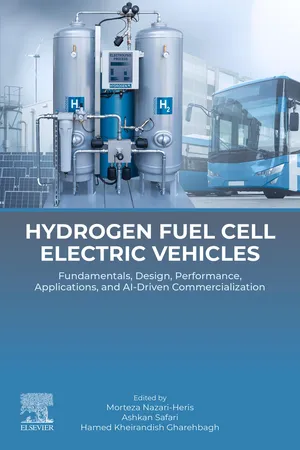
Hydrogen Fuel Cell Electric Vehicles
Fundamentals, Design, Performance, Applications, and AI-Driven Commercialization
- English
- ePUB (mobile friendly)
- Available on iOS & Android
eBook - ePub
Hydrogen Fuel Cell Electric Vehicles
Fundamentals, Design, Performance, Applications, and AI-Driven Commercialization
About this book
Hydrogen Fuel Cell Electric Vehicles: Fundamentals, Design, Performance, Applications, and AI-Driven Commercialization provides an authoritative resource on hydrogen fuel cell electric vehicles (HFCEVs), covering fundamentals, methods, and applications, and addressing the latest advances and changes in related technologies, and in the market. This book aims to serve as a comprehensive and interdisciplinary resource for understanding HFCEVs and their role in achieving net-zero electrification. It investigates HFCEVs from multiple dimensions, beginning with the fundamentals of HFCEV operation, their environmental benefits, and their principles. In addition, it presents a detailed strengths, weaknesses, opportunities, and threats analysis, examining the intricacies of hydrogen production and infrastructure development. It further assesses the techno-economic feasibility of green hydrogen-powered HFCEVs through levelized cost analyses, providing insights into their economic viability. In addition, the book covers the design, performance, and applications of HFCEVs, alongside the role of hydrogen fueling stations, their technologies, and prognostic management. The integration of artificial intelligence (AI) and machine learning in optimizing energy management is explored, highlighting innovative approaches to enhancing efficiency. The book also addresses industrial and commercial gaps, identifying opportunities for startups and entrepreneurs in this field. In addition, it reviews international standards governing HFCEVs and aligns their advancements with the United Nations Sustainable Development Goals (UN-SDGs), emphasizing their broader techno-socio-economic impact. Finally, the challenges and future work are considered, including technological, infrastructural, and economic obstacles, and their possible solutions.This is a valuable book for all those with an interest in hydrogen fuel cells, clean energy technologies, electric vehicles, sustainable transportation, and energy storage, including researchers, students, faculty, engineers, Research & Development professionals, scientists, industry professionals, and policymakers.
- Explains fundamental principles and working mechanisms of hydrogen fuel cells
- Covers hydrogen production methods, storage, and distribution infrastructures
- Offers detailed analyses of HFCEV components, performance, efficiency, and environmental impacts
- Discusses challenges, future research, and alignment with UN-SDGs, providing gaps as opportunities for startups and AI-driven commercialization
Information
Topic
Physical SciencesSubtopic
EnergyTable of contents
- Title of Book
- Chapter 1 An introduction to hydrogen fuel cell electric vehicles: An eco-friendly technology
- Chapter 2 Strengths, weaknesses, opportunities, and threats (SWOT) analysis of hydrogen production and infrastructure
- Chapter 3 Techno-economic analysis of green hydrogen-powered fuel cell-based sustainable e-mobility solution
- Chapter 4 Hydrogen fuel cell electric vehicles: A comprehensive review
- Chapter 5 Levelized cost of hydrogen impact on economic viability of hydrogen fuel cell electric vehicles
- Chapter 6 Hydrogen fueling vehicle stations: Introduction, types, technologies, prognostics, and health management
- Chapter 7 Role of machine learning in energy management of hydrogen fuel cell electric vehicles
- Chapter 8 Industrial and commercial gaps of hydrogen fuel cell electric vehicles for startup opportunities
- Chapter 9 International standards for hydrogen fuel cell electric vehicles
- Chapter 10 Challenges and future perspectives to hydrogen fuel cell electric vehicles: From cost reduction to United Nations Sustainable Development Goals
- Index
Trusted by 375,005 students
Access to over 1.5 million titles for a fair monthly price.
Study more efficiently using our study tools.
Frequently asked questions
Yes, you can cancel anytime from the Subscription tab in your account settings on the Perlego website. Your subscription will stay active until the end of your current billing period. Learn how to cancel your subscription
No, books cannot be downloaded as external files, such as PDFs, for use outside of Perlego. However, you can download books within the Perlego app for offline reading on mobile or tablet. Learn how to download books offline
Perlego offers two plans: Essential and Complete
- Essential is ideal for learners and professionals who enjoy exploring a wide range of subjects. Access the Essential Library with 800,000+ trusted titles and best-sellers across business, personal growth, and the humanities. Includes unlimited reading time and Standard Read Aloud voice.
- Complete: Perfect for advanced learners and researchers needing full, unrestricted access. Unlock 1.5M+ books across hundreds of subjects, including academic and specialized titles. The Complete Plan also includes advanced features like Premium Read Aloud and Research Assistant.
We are an online textbook subscription service, where you can get access to an entire online library for less than the price of a single book per month. With over 1.5 million books across 990+ topics, we’ve got you covered! Learn about our mission
Look out for the read-aloud symbol on your next book to see if you can listen to it. The read-aloud tool reads text aloud for you, highlighting the text as it is being read. You can pause it, speed it up and slow it down. Learn more about Read Aloud
Yes! You can use the Perlego app on both iOS and Android devices to read anytime, anywhere — even offline. Perfect for commutes or when you’re on the go.
Please note we cannot support devices running on iOS 13 and Android 7 or earlier. Learn more about using the app
Please note we cannot support devices running on iOS 13 and Android 7 or earlier. Learn more about using the app
Yes, you can access Hydrogen Fuel Cell Electric Vehicles by Morteza Nazari-Heris,Ashkan Safari,Hamed Kheirandish Gharehbagh in PDF and/or ePUB format, as well as other popular books in Physical Sciences & Energy. We have over 1.5 million books available in our catalogue for you to explore.