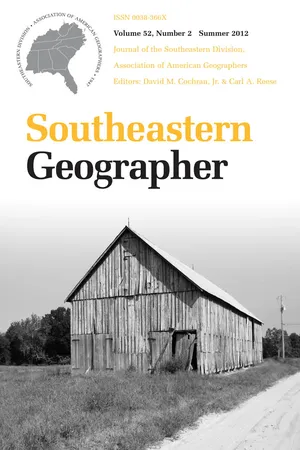
Table of Contents for Volume 52, Number 2 (Summer 2012) Cover Art: Southern Maryland Tobacco Barn
Richard A. Russo Introduction
David M. Cochran, Jr. and Carl A. Reese Part I: Papers ''Where Can I Build My Student Housing?'': The Politics of Studentification in Athens-Clarke County, Georgia
Graham Pickren The Making of the Piano Bar: Landscape, Art, and Discourse in Biscayne Bay
Robert J. Kruse, II An Analysis of Differential Migration Patterns in the Black Belt and the New South
Shrinidhi Ambinakudige, Domenico Parisi, and Steven M. Grice An Examination of Municipal Annexation Methods in North Carolina, 1990–2009
Russell M. Smith The 16 April 2011 EF3 Tornado in Greene County, Eastern North Carolina
Thomas M. Rickenbach Transforming Mount Airy into Mayberry: Film-Induced Tourism as Place-Making
Derek H. Alderman, Stefanie K. Benjamin, and Paige P. Schneider Part II: Reviews Bicycle Diaries by David Byrne
Reviewed by Scott Brady The Battle for North Carolina's Coast: Evolutionary History, Present Crisis, and Vision for the Future by Stanley R. Riggs, Dorothea V. Ames, Stephen J. Culver, and David J. Mallinson
Reviewed by Douglas W. Gamble
- 160 pages
- English
- ePUB (mobile friendly)
- Available on iOS & Android
eBook - ePub
About this book
Information
Subtopic
Human GeographyIndex
Social SciencesTransforming Mount Airy into Mayberry
Film-Induced Tourism as Place-Making
Film-induced tourism is increasingly popular in the United States and globally. Scholars have tended to emphasize the effect of movies and television in forming the image of tourist destinations and thus influencing traveler motivation and experience. In this article, we shift discussion of film tourism beyond simply place image formation to consider it in the broader context of place-making. Such a perspective offers a fuller recognition of the material, social, and symbolic effects and practices that underlie the construction of film tourism destinations and their place identities as well as the ideologies, power relations and inequalities that become inscribed into the place transformation process. We focus on film tourism in Mount Airy, North Carolina, the birth place of television actor Andy Griffith, and delve into the remaking of his home town into a simulated version of Mayberry. Griffith popularized the fictional town of Mayberry in his 1960s television series and it continues to resonate with fans of the show. Mount Airy is marketed to visitors as the “real life Mayberry,” despite what Griffith has said to the contrary, and the city hosts an annual Mayberry Days Festival, which we visited and photographed in 2010. A preliminary interpretation is offered of the landscape changes, bodily performances, and social tensions and contradictions associated with the remaking of Mount Airy into Mayberry. We also assert the need to address the social responsibility and sustainability of this transformation, particularly in light of the competing senses of place in Mount Airy, generational and racial changes in the travel market, and the way in which African Americans are potentially marginalized in this conflation of the “real” and the “reel.”
El turismo inducido por el cine es cada vez más popular en los Estados Unidos y el mundo. Los académicos han tendido a enfatizar el efecto de las películas y la televisión en la formación de la imagen de los destinos turísticos, los cuales influyen en la motivación y la experiencia de viajero. En este artículo, movemos la discusión sobre el turismo de cine más allá de simplemente la formación de imágenes de lugares para considerar en el contexto más amplio la formación de lugares. Tal perspectiva ofrece un reconocimiento más completo de los efectos y prácticas materiales, sociales, y simbólicas que subyace la construcción de los destinos turísticos de cine y sus identidades de lugar, así como las ideologías, las relaciones de poder y las desigualdades que se inscriben en el proceso de transformación de lugares. Nos centramos en el turismo de cine en Mount Airy, Carolina del Norte, el lugar de nacimiento del actor de televisión Andy Griffith, y profundizamos en la reconstrucción de su ciudad natal en una versión simulada de Mayberry.Griffith popularizó la ciudad ficticia de Mayberry en su serie de televisión de 1960, quién continua resonando entre los fans de la serie. Mount Airy se comercializa a los visitantes como “el Mayberry de la vida real,” a pesar de que Griffith ha dicho lo contrario, y la ciudad organiza anualmente el Festival de los Tiempos de Mayberry, el cual hemos visitado y fotografiado en 2010. Una interpretación preliminar se ofrece de los cambios en el paisaje, comportamientos corporales, y las tensiones y contradicciones sociales asociadas con la reconstrucción de Mount Airy en Mayberry. También afirmamos la necesidad de abordar la responsabilidad social y la sostenibilidad de esta transformación, especialmente en términos de los sentidos de lugar en competencia en Mount Airy, cambios generacionales y raciales en el mercado de viajes, y la forma en que los afroamericanos son potencialmente marginados en esta fusión de lo “real” y el “guión.”
KEY WORDS: film-induced tourism, Mayberry, Mount Airy, place-making, sustainability, African American
PALABRAS CLAVES: turismo inducido por el cine, Mayberry, Mount Airy, construcción de lugar, sostenibilidad, afro-americanos
INTRODUCTION
Geographers have not studied film-induced tourism to a great extent. This is surprising given the iconic role played by place in movie-making and the considerable amount of scholarship that has investigated the relationship between geography and the mass media (e.g., Burgess and Gold 1985; Zonn 1990; Aitken and Zonn 1994; Cresswell and Dixon 2002; Adams 2009). Meanwhile, a growing number of people are traveling to destinations to recapture the distinctive sense of place portrayed on screen, and film-induced tourism is increasingly promoted in the United States and globally as a marketing and economic development tool (Roesch 2009; Beeton 2010; Kim 2010). As Edensor (2009, p 311) observed, “there are now a plethora of destinations which have become associated with mediated imagery in film and television, with celebrities, cinematic scenes, and landscapes.”
Film-induced tourism can take at least three forms (Riley et al. 1998; Butler 2011). The first involves people visiting places where film and television productions were shot or captured on film. For example, some avid fans of the Lord of the Rings trilogy travel to New Zealand as Tolkien tourists and seek out sites used as backdrops in those films (Carl et al. 2007). The second form of film tourism involves people visiting places represented in the plot or storyline of media productions, although the production may or may not have been shot there. The small town of Forks, Washington is the setting for the Twilight movie franchise about a young-adult vampire romance. Although no actual filming took place in Forks, this fact has not stopped thousands of tourists from visiting or townspeople from capitalizing on the newly found fame (Garofoli 2010). The third form of tourism involves people traveling to places that simulate or mimic film and television representations and allow tourists to re-experience those images vicariously. Universal Studios in Orlando, Florida, for example, is a large theme park with rides, shows, and other experiences that allow visitors to feel as if they are on the set of several popular television shows and feature films. It is worth pointing out that a certain measure of simulation can be found at most film tourism destinations. For example, in the case of Twilight’s town of Forks and those portions of New Zealand related to Lord of the Rings, local business owners have created special film-themed attractions and tours, and it is not uncommon to see some tourists dressing up as movie characters or re-enacting film scenes at these destinations.
Much of the existing research on film-induced tourism has measured the impact of media productions on people’s perceptions of places while also determining the nature and extent to which these images shape the travel decisions and experiences of tourists (e.g., Young and Young 2008; Hahm and Wang 2011; Hudson et al. 2011). Underlying many of these studies is the belief that film tourism can significantly benefit local economies, increase publicity and recognition of destinations, expand infrastructure, and revitalize communities. Another avenue of research, led by scholars such as Beeton (2005; 2006b), has advocated for a more critical appraisal of the drawbacks as well as advantages of film-induced tourism within communities. The popularity of film tourism can compromise the social and environmental quality of life of destinations, especially if local communities are unprepared for the tourist influx. In addition, ambiguity and tension can arise from ensuring that the “real” or actual place lives up to the “reel” or imagined place as created through film (Beeton 2001). Of particular concern to us is how the marketing and development of film tourism can potentially marginalize other types of travelers and some members of the resident community. Few studies have addressed the social equity of film-induced tourism, particularly in terms of its impact on sense of place and belonging.
Whether scholars have touted benefits or problems, they have tended to characterize film tourism as a tool in destination marketing and place image formation and alteration (Hudson and Ritchie 2006; O’Connor et al. 2010). They emphasize “the power of film on creating awareness, enhancing images, changing images, and igniting a motivation to visit a place” (Hahm and Wang 2011, p 176). Yet, the impact of media and film tourism on place is not simply perceptual. Missing from many studies is a wider discussion of the involvement of film tourism in the social and material production of place and place identity (but see Jewell and McKinnon 2008). Indeed, as geographers Hanna and Del Casino have argued, place representation and embodied social and spatial practices are not binary opposites but mutually constitutive. According to them, representation can be conceived of as work and as part of the material process by which tourist places are made (Hanna et al. 2004). By the same virtue, material changes to places do not happen outside the context of how we perceive, think about, and talk about place. Places, according to Davis (2005, p 610), are “discursive-material formations,” in which the representation of place enables and “legitimizes the performance of certain activities in those places as well as directs the social practices that actively shape the landscape.” Rosati (2007) has contended that the study of media geographies must move beyond simply interpreting images and representations to consider the built environment and social contexts that make the power of these images realized and tangible. Although not in the context of film-induced tourism, Bandyopadhyay and Nascimento (2010) argued that tourism representations affect how the people and places of destinations are consumed by tourists. According to them, even fantasies and myths in marketing images can strongly shape tourist expectations and thus have real and denigrating repercussions for marginalized populations.
In this article, we shift discussion of film tourism beyond simply place image formation to consider it in the broader context of place-making. Such a perspective offers a fuller recognition of the material, social, and symbolic effects and practices that underlie construction of film tourism destinations and their place identities as well as the ideologies, power relations, and inequalities that become inscribed into the place transformation process. Perhaps no community better illustrates the significant place transformations that accompany film tourism than Mount Airy, North Carolina, where promoters have actively remade portions of the town into a simulated version of Mayberry. Mount Airy is the birth place and boyhood home of television actor Andy Griffith, who popularized the fictional town of Mayberry in his 1960s television series. The television show created a place ideal that still greatly resonates with portions of the viewing public as a form of nostalgia. Mount Airy is marketed to visitors as the “real life Mayberry,” despite what Griffith has said to the contrary, and the city hosts an annual Mayberry Days Festival, which we visited in 2010.
Using participant observation and photography at the festival, archival newspaper research, and discussions with residents and visitors, we offer a preliminary interpretation of the landscape changes, bodily performances, and social tensions and contradictions that underlie the remaking of Mount Airy into Mayberry. As we suggest, identifying Mount Airy as Mayberry is not simply a marketing tool, but represents a fundamental reconstruction of place that, while creating entertainment and a sense of belonging for some, can also be interpreted and experienced differently, if not negatively, by others. We assert the need to address the social responsibility and sustainability of this transformation, particularly in light of competing senses of place in Mount Airy, generational and racial changes in the travel market, and the way in which African Americans are potentially marginalized in this conflation of the “real” and the “reel.”
Finding the promotion of a place identity in Mount Airy that seemingly disenfranchises African Americans is not necessarily a unique occurrence, especially in the American South. Indeed, the larger trajectory of our work inside and outside of Mount Airy is to conduct a critique of how southern hospitality is constructed in socially selective ways. Other aspects of the region’s tourism industry—from plantation heritage tours to welcome center brochures—make African Americans invisible and presumably unimportant (e.g., Alderman and Modlin 2008; Alderman and Modlin forthcoming). The research reported here contributes to a new initiative called RESET (Race, Ethnicity, and Social Equity in Tourism), which recognizes the highly discriminatory history of travel in the region and the continuing obstacles to full inclusion of African Americans within the southern tourism experience.
MOUNT AIRY AS SIMULATED MAYBERRY
Mount Airy, North Carolina (2010 population: 10,388) is located in Surry County at the foothills of the Blue Ridge Mountains near the Virginia border. Not far from major flows of travelers along the Blue Ridge Parkway and reeling from significant job losses, Mount Airy has aggressively worked since the 1980s to develop tourism that capitalizes on the popularity of the television series The Andy Griffith Show (1960–1968) and the program’s imaginary hamlet of Mayberry (Janiskee and Drews 1998). The Andy Griffith Show was never filmed in Mount Airy (it was shot in California) and the town was never mentioned by name on television. Nevertheless, Mount Airy identifies itself as Mayberry, producing a tourist landscape designed to reference, and at times recreate, people, places, and experiences from the show. While Mount Airy has other viable development avenues, including non-Andy Griffith tourism, the town’s close identification with Mayberry has received the most national and international attention (e.g., Sack 1997; Becker 2002; Bly 2010).
For those unfamiliar with The Andy Griffith Show, Mayberry is television’s quintessential utopian community, where social cooperation, egalitarianism, and good will always win out over conflict, elitism, and self-interest. Townspeople know and help each other, regardless of social position, personal failing, or eccentricity. And Mayberry is filled with its share of eccentrics—such as Otis Campbell (played by Hal Smith), the town drunk who voluntarily locks himself in the city jail to sleep off a bender; Barney Fife (Don Knotts), the hyper-vigilant yet bumbling deputy sheriff who often discharges his gun by accident and is only allowed to have a single bullet that he carries in his front shirt pocket; and Floyd Lawson (Howard McNear), the absentminded barber who cannot cut sideburns evenly and inadvertently allows a bookie to set up business in the barber shop. Watching Andy Griffith, according to Sanes (2010), “vicariously places us in a benevolent social world in which human foibles are forgivable and . . . where even foolishness can feel at home.”
When The Andy Griffith Show originally aired, Mayberry was purposely represented as a world away from the major challenges of the time, such as the Vietnam War, the Civil Rights Movement, student demo...
Table of contents
- Cover Page
- Southeastern Geographer
- Copyright Page
- Contents
- COVER ART Southern Maryland Tobacco Barn
- INTRODUCTION
- “Where Can I Build My Student Housing?”
- The Making of the Piano Bar
- An Analysis of Differential Migration Patterns in the Black Belt and the New South
- An Examination of Municipal Annexation Methods in North Carolina, 1990–2009
- The 16 April 2011 EF3 Tornado in Greene County, Eastern North Carolina
- Transforming Mount Airy into Mayberry
- REVIEWS
Trusted by 375,005 students
Access to over 1.5 million titles for a fair monthly price.
Study more efficiently using our study tools.
Frequently asked questions
Yes, you can cancel anytime from the Subscription tab in your account settings on the Perlego website. Your subscription will stay active until the end of your current billing period. Learn how to cancel your subscription
No, books cannot be downloaded as external files, such as PDFs, for use outside of Perlego. However, you can download books within the Perlego app for offline reading on mobile or tablet. Learn how to download books offline
We are an online textbook subscription service, where you can get access to an entire online library for less than the price of a single book per month. With over 1.5 million books across 990+ topics, we’ve got you covered! Learn about our mission
Look out for the read-aloud symbol on your next book to see if you can listen to it. The read-aloud tool reads text aloud for you, highlighting the text as it is being read. You can pause it, speed it up and slow it down. Learn more about Read Aloud
Yes! You can use the Perlego app on both iOS and Android devices to read anytime, anywhere — even offline. Perfect for commutes or when you’re on the go.
Please note we cannot support devices running on iOS 13 and Android 7 or earlier. Learn more about using the app
Please note we cannot support devices running on iOS 13 and Android 7 or earlier. Learn more about using the app
Yes, you can access Southeastern Geographer by David M. Cochran, Carl A. Reese in PDF and/or ePUB format, as well as other popular books in Social Sciences & Human Geography. We have over 1.5 million books available in our catalogue for you to explore.