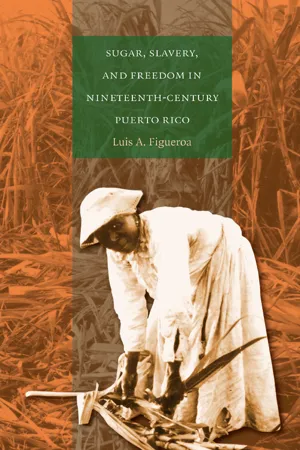
The contributions of the black population to the history and economic development of Puerto Rico have long been distorted and underplayed, Luis A. Figueroa contends. Focusing on the southeastern coastal region of Guayama, one of Puerto Rico’s three leading centers of sugarcane agriculture, Figueroa examines the transition from slavery and slave labor to freedom and free labor after the 1873 abolition of slavery in colonial Puerto Rico. He corrects misconceptions about how ex-slaves went about building their lives and livelihoods after emancipation and debunks standing myths about race relations in Puerto Rico.
Historians have assumed that after emancipation in Puerto Rico, as in other parts of the Caribbean and the U.S. South, former slaves acquired some land of their own and became subsistence farmers. Figueroa finds that in Puerto Rico, however, this was not an option because both capital and land available for sale to the Afro–Puerto Rican population were scarce. Paying particular attention to class, gender, and race, his account of how these libertos joined the labor market profoundly revises our understanding of the emancipation process and the evolution of the working class in Puerto Rico.
- 304 pages
- English
- ePUB (mobile friendly)
- Available on iOS & Android
eBook - ePub
Sugar, Slavery, and Freedom in Nineteenth-Century Puerto Rico
About this book
Information
[CHAPTER 1]
RACIAL PROJECTS AND RACIAL FORMATIONS IN A FRONTIER CARIBBEAN SOCIETY
In introducing his 1972 book, Guayama: Sus hombres y sus instituciones, local historian Adolfo Porrata-Doria tells readers that the principal stimulus for his endeavor was a 1848 description of Guayama written by Don José Antonio Vázquez. Vázquez was a prominent sugarcane planter (hacendado), mayor (alcalde) of Guayama at the time, and member of one of the region’s elite creole (criollo) families. Guayama, said Vázquez, “is not the motherland of anyone distinguished by his hierarchy, education, or feats of arms.”1 Porrata-Doria concedes that by the middle of the nineteenth century, after some three and a half centuries of Spanish rule, Guayama had indeed failed to produce any men prominent in the annals of Puerto Rican history. Porrata-Doria goes on, however, to point out a great period of progress that began, significantly, after 1870—that is, when the dismantling of slavery in Puerto Rico began. Until the mid-1800s, says Porrata-Doria, Guayameses were “living a pastoral life dedicated to the noble goal of organizing a solid economy that could guarantee the future of the community. [Yet w]hat had not happened during the first centuries was shaped into reality and admirable progress during the last century [1870- 1970]. Much good has come since the chronicle of Señor Vázquez. New horizons and perspectives have widened the cultural and industrial life of this municipio.”2
Reflecting on Porrata-Doria’s work from the vantage point of the early twenty-first century, one cannot help but feel stunned that such views of Guayama’s past could be held and that they could pass until quite recently as the authoritative interpretation. My original response to this interpretation was based largely on childhood tales of Guayama’s slave and racially oppressive past told by elderly relatives as well as the findings of more recent Puerto Rican historiography and my research into the municipio ’s past. I began to wonder why such views would come to pass as history. Indeed, since the late 1970s, new works on nineteenth-century Puerto Rico in general and Guayama in particular have presented a view of this municipio and its region sharply at odds with Porrata-Doria’s. The works of historians Guillermo Baralt, Andrés Ramos Mattei, and Francisco Scarano, among others, have repeatedly mentioned Guayama as one of Puerto Rico’s leading slavery-based, sugar-producing centers during the first seven decades of the nineteenth century and as the setting of one of the most remarkable slave conspiracies in the island’s history.3 Moreover, Jalil Sued Badillo’s brief general history of the municipio, published a decade after Porrata-Doria’s book, portrayed a Guayama of sugar haciendas, worked mostly by slaves and owned by wealthy Puerto Rican, Spanish, and French planters, that rivaled those of the rest of the island.4
How, then, to explain Vázquez’s and Porrata-Doria’s visions of Guayama? Why this gesture of silence, this refusal to represent some crucial experiences in nineteenth-century Guayama? Vázquez’s remarks can perhaps be understood as the product of a rich creole hacendado complaining about what he sees as the disparity between Guayama’s leading economic position in mid-nineteenth-century Puerto Rico and the municipio ’s lack of military, political, and cultural heroes, an argument that might reveal much about the configurations of power at that time in the Spanish colonial space called Puerto Rico. Vázquez was one of the region’s leading sugar planters and slave owners, and his essay obliterates the contributions of enslaved Africans and Afro-Puerto Ricans to the development of sugar production in Guayama—that is, their role as the producers of the wealth enjoyed by Vázquez and his peers, which he seems to complain did not translate into the grandeur of military and political power and the exercise of cultural leadership.
Porrata-Doria’s glossing over of the crucial period of sugar and slavery in Guayama’s history, however, presents what might seem a different set of interpretative hurdles. On the one hand, Porrata-Doria was the descendant of a nineteenth-century Guayama slaveholding family whose moment of economic glory came and passed around the years of Váz-quez’s leadership position in local affairs. Curiously, Porrata-Doria consistently avoids discussing Guayama’s economic and social history for the period between 1810 and 1870.5 His failure, for example, even to mention the apogee of sugar production in the first half of the nineteenth century is quite stunning, especially since he otherwise made extensive use of Vázquez’s 1848 description, which discusses—if only briefly—the emergence of sugar haciendas.
In striking contrast, Vázquez points out, for example, that Guayameses “have, nevertheless, a right to some celebrity for having increased their wealth by very hard work in little more than twenty years, to the rise and apogee in which it is today, with the peculiarity that less than a dozen hacendados started their haciendas with sufficient capital. Many of them, possessing almost nothing the day that they planned the establishment of their estates, today could aspire to be counted among the top landlords of the island.” He even described, although very briefly, how this prominence came into being: “Until the year of 1815, the residents [of Guayama] were limited to raising large and small cattle in communal hatos [ranches], without any other agriculture than the tala or the conuco [provision grounds] and some tobacco for their consumption. Later, foreigners began to establish themselves here, stimulated by the advantages offered by the Real Cédula de Gracias of that year. In 1825, their products were so insignificant that they were loaded into four brigantines by the only North American merchant who existed at that time, while today more than 100 large ships sail loaded from its port. The number of these ships in 1845 was 125, plus 79 coasting-trade vessels.”6 But how did these haciendas produce sugar? That is, what labor system did these prominent hacendados employ? Vázquez conveniently failed to address this question, perhaps an unsurprising move given that, as chapter 2 will demonstrate, the bulk of the African slaves who toiled in Guayama’s sugar plantations had been smuggled into the region after Spanish imperial authorities outlawed the slave trade in 1817 (effective 1820), 1835, and 1845.
Porrata-Doria also rarely discusses slavery in his 320-page book, and he never even hints that slavery flourished in Guayama as it did in very few places in Puerto Rico.7 For example, one of his few comments on the subject describes slavery as an “archaic and rancid system of centuries past, [that has] disappeared for the glory of we who live together in constant struggle to smooth over racial prejudices.”8 In an effort to “smooth over racial prejudices,” Porrata-Doria painstakingly glosses over the painful history of slavery and in so doing achieves another purpose: depriving today’s Guayameses and other Puerto Ricans of a work of local history that could help them come to grips with their heritage, as painful as it might be.9 To that extent, Porrata-Doria’s book represents another example of that genre of elitist Puerto Rican historiography and literary writing that since the nineteenth century has sought to create a myth of racial and class harmony and to erect a scholarly monument to Guayama’s image as an exceptional case in Caribbean history.10
One of the goals of this study is precisely to offer some insights into that history. This is a history painfully shaped by broken memories yet filled with testimonials of struggle not to smooth over race, class, and gender oppression but rather to overcome them. In that context, a central aim of this chapter and the next is to examine the historical processes that Porrata-Doria failed to address: the emergence of Guayama as a leading Puerto Rican slave and sugar region during the first half of the nineteenth century, a period that is soft-pedaled and characterized as a “pastoral” way of life. What was Guayama like during the late eighteenth and the early nineteenth centuries, before the flourishing of the “archaic and rancid system” of slavery?
In answering this broad question, I will consider Guayama’s and Puerto Rico’s history in two separate moments. This chapter explores Porrata-Doria’s trope of a “pastoral life,” but doing so requires displacing his time frame by focusing first on the final decades of the eighteenth century and the first decade of the nineteenth century—that is, the time before the boom of sugar and slavery swept across the island’s southern coast. In this sense, this chapter has four main goals. I first describe Guayama’s physical environment, a region I call “greater Guayama,” stretching along southeastern Puerto Rico from the arid lowlands and piedmont of Salinas in the west to the more fertile lowlands and piedmont of Patillas in the east. The ecology of this physical environment both helped and constrained the sustained development of sugar plantation agriculture. And, very importantly, the ecology constrained even more severely the ability of free subalterns, either peasants or workers, including free blacks and mulattoes, to establish a viable and flourishing subsistence or cash-crop peasant economy that their peers in other regions of the island used to eke out a living. This specific feature of greater Guayama would also prove crucial in the aftermath of emancipation.
Precisely because much of the scholarly discussion on the fate of slaves revolves around issues of peasantization versus proletarianization, the chapter turns next to a brief examination of land tenure issues before the development of the region’s sugar and slavery economy—that is, during the crucial late-eighteenth-century period of imperial reformist policies. This reformist thrust was intimately linked to efforts to impose a “second colonization” of Puerto Rico that was itself part of the advent of a “second empire” period based largely on the insertion of Puerto Rico, via a “second slavery,” into the Atlantic world’s vast trade networks.11 I briefly discuss some of the initial moments of this imperial shift as a prelude to more closely examining a discursive instance produced by local elites at the moment when they seemed to sense that the island was ready to take off as a new zone of plantation agriculture. I will focus on petitions by the cabildos (town councils) of San Juan and Coamo, which had jurisdiction over greater Guayama at the start of the nineteenth century.
Local elites of the generation that preceded José Antonio Vázquez, including some notables who may have been his forebears, saw the possibility of leaving behind Porrata-Doria’s quaint “pastoral way of life” by basing a new economy on the production of export crops using newly imported African slaves. This amounted to no less than the elaboration of a particular class and racial project that would seal the fate of lowland peasant life and would reconfigure Guayama’s society along lines closer to its Caribbean neighbors than had previously been the case, intimately linking greater Guayama with Caribbean networks of finance, commerce, and slave trading during the first half of the nineteenth century.12 A veritable human hurricane would ensue, as chapter 2 will demonstrate: fierce winds cut through the terrain of a “pastoral” frontier society, blazing a path on which the storm’s torrential clouds rained down enslaved people from Africa and the surrounding Caribbean islands as well as settlers from as far away as Denmark, Barcelona, and New Orleans.13
A Corner of the Caribbean Known as Guayama, Puerto Rico
In his often-moving portrait of Guyanese society in the late nineteenth century, Walter Rodney describes brilliantly how the ecological setting of British Guiana’s frequently flooded coastal plain represented a major constraint on the lives of Guyanese people from aspiring peasants to indentured East Indians and of course struggling planters.14 In Guayama, at a distant, opposite corner of the Caribbean region, local ecological conditions could not have been more different from those of Guyana’s coastal plain. While the latter region received water from the ocean or from overflowing rivers and canals, in Guayama the hazards of low rainfall and the deforestation created by demographic expansion and the need for timber fuel exacerbated the problem of rivers and smaller streams that for most of the year were merely dry, stony gutters. These rivers and streams crisscross an otherwise fertile alluvial plain, squeezed between the Caribbean Sea to the south and a belt of hills to the north, that could barely sustain the production of foodstuffs. The terrain then quickly rises to the highlands of the humid and lush Sierra de Cayey Mountains, where, to the chagrin of coastal sugar planters, most of the heavier rainfall flows not toward Guayama’s plantation cane fields to the south but to the north. This combination of terrain and contrasting climatological conditions created the ecological predicament faced by planters, peasants, slaves, and laborers living and working on a mosaic of plantations, cattle ranches, subsistence farms, and small freehold lots during and after the era of sugar and slavery.
The municipio of Guayama is located on Puerto Rico’s southeastern coast, thirty-three miles south of San Juan and thirty-three miles east of Ponce, on the eastern side of the Ponce-Patillas alluvial plain (see maps 1 and 2). This coastal plain is the island’s second-largest, smaller only than its north coast counterpart. The Ponce-Patillas plain encompasses 162.5 square miles in a narrow east-west coastal belt with an average width of three to four miles. For almost a century and a half beginning around 1820, the plain’s predominant agricultural use was the growing and grinding of sugarcane to produce raw sugar to be refined in North Atlantic countries. As geographer Rafael Picó put it in 1938, “everything from Ponce to Patillas is connected with sugar.”15
The most important ecological variations in Puerto Rico are related to the island’s topography, rainfall, and soil types, since temperature variation is minimal. The Ponce-Patillas plain is characterized by scarcity of rainfall and by good-quality soil. This coastal plain is the second-most arid region in Puerto Rico, after the island’s southwestern corner. Indeed, during the 1920s and 1930s, annual mean rainfall increased traveling east from Ponce toward Guayama, rising from about forty inches per year in the vicinity of Ponce to seventy inches per year in Patillas.16
High temperatures work in combination with high evaporation rates, relatively low humidity levels, and steady winds to produce semiarid geographical regions such as the Ponce-Patillas coastal plain.17 Both rainfall and the carrying capacity of local streams are believed to have been somewhat higher at the start of the sugar boom early in the nineteenth century and to have decreased in quantity and regularity as deforestation, stimulated by population and economic growth, increased the acreage dedicated to agriculture and as the fuel needs of the coast’s sugar mills took their toll. As average annual rainfall declined and severe droughts became more common, sugar planters began to devise means for irrigating their lands, from private, rudimentary dams and groundwater pumps built by slave and nonslave workers during the 1840s to more ambitious and extensive irrigation projects constructed from the 1860s through the end of the century. In the early twentieth century, the island’s new U.S. colonial government created extensive irrigation systems strikingly similar to those proposed as early as the 1860s to supply the Ponce-Patillas coastal plain with increased water for the newly booming capitalist plantation complex.18
The plain’s soil has elicited much praise.19 The soil’s alluvial origin gives it its quality, and the otherwise detrimental dryness of the climate prevents heavy erosion. Physical and other chemical characteristics made the soil very suitable for agricultural production and allowed relatively high yields per acre of sugarcane. The alluvial plains slope gently toward the sea or toward rivers and creeks, providing generally good natural drainage. The soil that attracted attention and investment from dozens of Puerto Rican and foreign planters beginning in the late eighteenth century was the natural product of material washed down from the uplands by various rivers and creeks. In Guayama in particular, the most important bodies of water that replenished the plain during seasonal floods were the Guamaní River, which served as a natural border between rural barrios Jobos and Machete and was the most important river in the municipio; the Río Seco in barrio Jobos; the Piedra Gorda and Corazón quebradas (creeks) in barrio Algarrobos; and quebradas Guayabo Dulce and Quebrada Honda in barrios Machete and Jobos, respectively.20
At the northern edge of the coastal plain, the semiarid southern foothills constitute a narrow piedmont zone that parallels the coastal plain and provides a buffer betwee...
Table of contents
- Title Page
- Copyright Page
- Table of Contents
- TABLES
- Introduction
- [CHAPTER 1] - RACIAL PROJECTS AND RACIAL FORMATIONS IN A FRONTIER CARIBBEAN SOCIETY
- [CHAPTER 2] - THE HURRICANE OF SUGAR AND SLAVERY AND THE BROKEN MEMORIES IT ...
- [CHAPTER 3] - SEEKING FREEDOM BEFORE ABOLITION STRATEGIES OF ADAPTIVE ...
- [CHAPTER 4] - THE GALE-FORCE WINDS OF 1868 - 1873 TEARING DOWN SLAVERY
- [CHAPTER 5] - THE CONTESTED TERRAIN OF “FREE” LABOR, 1873 - 1876
- [CHAPTER 6] - LABOR MOBILITY, PEONIZATION, AND THE PEASANT WAY THAT NEVER WAS
- [CHAPTER 7] - CONFLICTS AND SOLIDARITIES ON THE PATH TO PROLETARIANIZATION
- CONCLUSION
- NOTES
- BIBLIOGRAPHY
Trusted by 375,005 students
Access to over 1.5 million titles for a fair monthly price.
Study more efficiently using our study tools.
Frequently asked questions
Yes, you can cancel anytime from the Subscription tab in your account settings on the Perlego website. Your subscription will stay active until the end of your current billing period. Learn how to cancel your subscription
No, books cannot be downloaded as external files, such as PDFs, for use outside of Perlego. However, you can download books within the Perlego app for offline reading on mobile or tablet. Learn how to download books offline
We are an online textbook subscription service, where you can get access to an entire online library for less than the price of a single book per month. With over 1.5 million books across 990+ topics, we’ve got you covered! Learn about our mission
Look out for the read-aloud symbol on your next book to see if you can listen to it. The read-aloud tool reads text aloud for you, highlighting the text as it is being read. You can pause it, speed it up and slow it down. Learn more about Read Aloud
Yes! You can use the Perlego app on both iOS and Android devices to read anytime, anywhere — even offline. Perfect for commutes or when you’re on the go.
Please note we cannot support devices running on iOS 13 and Android 7 or earlier. Learn more about using the app
Please note we cannot support devices running on iOS 13 and Android 7 or earlier. Learn more about using the app
Yes, you can access Sugar, Slavery, and Freedom in Nineteenth-Century Puerto Rico by Luis A. Figueroa in PDF and/or ePUB format, as well as other popular books in History & Latin American & Caribbean History. We have over 1.5 million books available in our catalogue for you to explore.