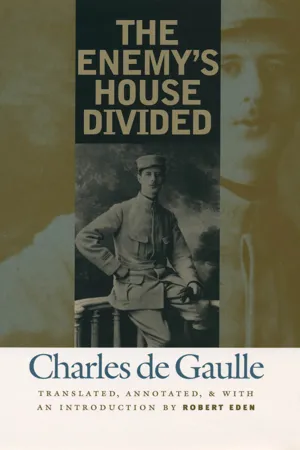
Originally published in 1924 and available here in English for the first time, The Enemy’s House Divided is Charles de Gaulle’s analysis of the major errors that led the Germans to disaster in World War I. Based partly on observations made during his internment as a prisoner of war from 1916 to 1918, it can be seen as the foundation for everything he wrote in the 1920s and 1930s in the shadow of German resurgence and for much of what he said and did after the Nazi victory in June of 1940.
To de Gaulle, the German conduct of the Great War and the debacle of 1918 was the greatest moral disaster ever to befall a modern civilized political community. He seeks to identify the internecine causes of the collapse of the German war effort in 1918 and of the subsequent dissolution of the German Empire. His diagnosis of the profound moral crisis that unfolded in Germany during World War I points forward to 1940, for de Gaulle understood the fall of France, above all, as a moral catastrophe for the French. His first book, it is also a key document of de Gaulle’s “philosophy of action,” introducing his statesmanship to the world with its deliberate and studied critique of the perils of Nietzsche’s philosophical initiative.
Trusted by 375,005 students
Access to over 1 million titles for a fair monthly price.
Returning to Berlin an emperor1 and victorious,2 and receiving in the name of Germany his subjects’ congratulations, Wilhelm I declared publicly, “You, Moltke—thanks to your labor in time of peace, and your methods in time of war—have conducted our armies to victory.”3
Military Germany thenceforth consecrated an unreserved admiration to [Marshal] Moltke and his system of command. All the German commanders trained themselves by studying the “manner” of the marshal and his glorious subordinates.4 In 1914, they went off to battle animated by the will to imitate their great predecessors, not only in their success but also in their procedures.
That obsession, that superstition about the past, was recognized by Kaiser Wilhelm II and was encouraged.5 All his proclamations at the outbreak of the war called it to mind. And for such sentimental reasons, he was determined that he too should have a Moltke as chief of staff.6
On the two days during which Prussia’s fortune was determined, the 1st of July 1866 and the 15th of August 1870, the application of Moltke’s system had, at the decisive times and places, brought success.7
On the days that determined the result of the Great War, the 4th and 5th of September 1914, General von Kluck was charged with the principal mission.8 This commander, who was justly and universally respected, imitated in a striking fashion the conduct of the great victors of Königgrätz and Metz [see Figure 1].9 That was the origin of the disaster. … There is a clear analogy between the doctrine and procedure of the Prussian commanders in the earlier victories and those of the German generals in the defeat. This manifest analogy serves to prove that in war—save for some few essential principles—there is no universal system, but only circumstances and personalities.
I
The personality of Field Marshal von Moltke was perfectly suited to preparation but was systematically self-effacing when it came to execution. It was the marshal who had chosen and molded the entire General Staff. It was he who assigned the officers to each post in it, according to their talents and the confidence he placed in them. Owing to him, the whole Prussian army embodied a unity of doctrine that has rightly evoked such astonishment and admiration. He prescribed the thorough study of enemy arms carried out by the General Staff. It was he who drew from that study the famous hypotheses, concerning enemy calculations, which he made the basis of his initial strategic conceptions. It was under his immediate, attentive, scrupulously careful direction that the plans for mobilization, concentration, and transport were studied, settled, and drafted.10
But once the campaign began, Moltke refused on principle to determine anything beyond extremely general intentions, expressed in a few very broad directives. It was to subordinates that he confided the execution in its entirety, admitting a priori that they would be better and more quickly informed than he would of changes in the situation. And he left them, most often, to coordinate their efforts themselves, in the light of his unified doctrine.
A crown prince,11 a Frederick-Karl,12 a Steinmetz,13 superb leaders, seeking responsibilities, could thus give free rein to their initiative. They never lacked it. Moreover, they became accustomed to act exclusively by their own conceptions and to consider those of the chief of the General Staff, literally, as secondary. Besides, Moltke, consistent with himself, did not fail to approve them after the fact, disdaining all authorial vanity and concerning himself only with results.
This manner [of doing things] had two consequences that, in their turn, became causes.
Moltke did not maintain independent means of keeping himself informed: all the cavalry went to the commanders, none to the generalissimo. Consequently, the field commanders were better informed than the supreme commander most of the time, and believed themselves to be so in all cases. Even more reason for them to judge their own conceptions better justified than judgments from higher echelons.
FIGURE 1. The Disobedience of von Kluck, First Battle of the Marne, September 1914
Disobeying orders from Moltke, Kluck marches south, exposing his right flank, and the entire German line of battle, to envelopment by Maunoury’s newly formed Sixth French Army.
Sources: For this figure and Figures 4a–e, I have drawn information from the maps in Bülow, Hausen, Kluck, Kuhl, Moltke, and Tappen, all cited in the Appendix. Since even the maps in these memoirs are apologetic and tendentious, I have also drawn from plates in sources that de Gaulle does not cite: Wilhelm Muller-Loebnitz, Der Wendepunkt des Weltkrieges: Beitrage zur Marne-Schlacht am 5. bis 9. September 1914. Kritische Beitrage zur Geschichte des Weltkrieges (Berlin: E. S. Mittler & Sohn, 1921); George Herbert Perris, The Battle of the Marne (London: Methuen, 1920); and Frederick Ernest Whitton, The Marne Campaign (London: Constable and Co., 1917).
Moreover, transmissions between General Headquarters and the armies were entirely neglected. On 1 July 1866, Moltke gave his directive for the decisive battle against Benedek.14 He himself was at Gitschin; Frederick-Karl was at Horitz, twelve kilometers distant, and the crown prince was at Königinhof, a distance of forty kilometers [see Figure 2a]. No one had thought to connect these three command posts by telegraph. They had not even set up a chain of cavalry riders. It fell to colonels from General Headquarters, who galloped all night through the rain, to carry the orders. …
On 18 August 1870, Moltke passed the whole day at the side of the king, near “La Point du Jour” behind his right flank.15 He saw his right flank beaten and almost put to flight. It was with his left that he had mounted his operation. It was from his left that he anxiously awaited news. That left flank, under the crown prince of Saxony, attacked Saint-Privat at 6:00 P.M, eight kilometers away from Moltke’s command post. A simple relay of riders would have brought blow-by-blow intelligence, barely an hour old, to the commander in chief. Instead, he would know nothing. No one even thought to keep him up to date. Not until 11:00 P.M did he learn what had happened.
Due to this system and its consequences for means of information and communication, Moltke’s army commanders acted by themselves, and against the intentions expressed by the High Command, at the decisive moments in their victorious campaigns.
On July 1, 1866, Benedek was occupied in concentrating his army corps between the Elbe River to the south of Josephstadt and the Bistritz River facing to the west and the north. The Prussian Army of the Elbe (commanded by Herwarth von Bittenfeld), placed under the orders of Frederick-Karl, was toward Chlumetz.
The First Army (Frederick-Karl) was to the south of Horitz.
The Second Army (Crown Prince of Prussia) was toward Königinhof. [See Figure 2a.]
Moltke had been at Gitschin only a dozen hours. The evening before, he was still at Berlin with the King.
Furthermore, he had no cavalry at his disposal. In fact, the armies momentarily lost contact with the enemy. Behold the chief of the General Staff without military intelligence! He was going to base his conception for the battle upon an hypothesis, and that hypothesis was false.
FIGURES 2A–C. The Battle of Königgrätz/Sadowa, 3–5 July 1866
By placing his headquarters (
) at Gitschin and neglecting communications with his commanders, Moltke encouraged them in “an exaggerated independence.” His false hypothesis is shown in Figure 2a. Moltke believed the Austrian forces were east of the Elbe River, between Josephstadt and Königgrätz; they were actually ten kilometers west. Moltke’s conception for the battle is shown in Figure 2b: the First Army and the Elbe Army were to circle to the south of Benedek and attack him from the south and southeast. But had Frederick-Karl obeyed Moltke’s orders to March south along the Bistritz River, his army would have been exposed to a mortal threat from Benedek’s entire army, as shown in Figure 2b. Had the Austrian commander seized the opportunity exhibited in the figure, he could have destroyed the Prussian First Army. Alerted to Benedek’s actual position, Frederick-Karl ignored Moltke’s command, and marched straight toward Benedek, asking the Crown Prince of Prussia to attack from the north. As shown in Figure 2c, the Prussian armies converged on the Austrian position from three sides, winning a victory that gave Prussia immense prestige and hegemony among the German states.
In 1866, the result of following orders would thus have been disastrous. Yet the cause could have been removed. Had headquarters been moved and communications to the supreme command secured, Moltke’s information could have been as reliable as that of his commanders; or Frederick-Karl could have apprised Moltke quickly of the Austrian location.
Sources: Figures 2a–c are based on Henri Bonnal, Sadowa; étude de stratégie et de tactique générale. L’esprit de la guerre moderne. (Paris: R. Chapelot, 1901); the label of 2a is taken from one of Bonnal’s maps.
FIGURE 2A. Dispositions ordered by von Moltke for 3 July
FIGURE 2B. Outcome had Frederick-Karl obeyed von Moltke’s orders
FIGURE 2C. Actual result of Frederick-Karl’s disobedience
He supposed that the enemy was to the east of the Elbe River, between Königgrätz and Josephstadt, and his orders for 2 July stipulated that
the Army of the Elbe was to cross the Elbe at Pardubitz to turn Benedek’s left.
the First Army was to follow the movement of the Army of the Elbe, and to detach a flank-guard between the Bistritz and the Elbe. If that flank-guard encountered few significant Austrian forces east of the Elbe, it was to attack them.
the Second Army was to remain in place. [See Figure 2a.]
However, on the morning of July 2nd, the cavalry of Frederick-Karl spotted very considerable masses of Austrian forces (at least four army corps), on the east bank of the Bistritz. The commander of the First Army immediately took it upon himself
not to execute the movement ordered by Moltke, which would result in making the Army of the Elbe and the First Army march in file, exposing its flank to the concentrated Austrian forces [see Figure 2b];
to bring himself with all his forces against the enemy masses east of the Bistritz River, and to engage them there in battle;
to call directly for the assistance of the Crown Prince of Pruss...
Table of contents
Cover Page
The Enemy’s House Divided
Copyright Page
Dedication
Contents
Figures
Acknowledgments
Translator’s Note
Introduction
Foreword to the First Edition (1924)
1 The Disobedience of General von Kluck
2 The Declaration of Unlimited Submarine Warfare
3 The Relations with the Allies
4 The Fall of Chancellor Bethmann-Hollweg
5 The Debacle of the German People
Documentation
Appendix: Augmented Version of Documentation
Translator’s Notes
Index of Minor Characters
General Index
Frequently asked questions
Yes, you can cancel anytime from the Subscription tab in your account settings on the Perlego website. Your subscription will stay active until the end of your current billing period. Learn how to cancel your subscription
No, books cannot be downloaded as external files, such as PDFs, for use outside of Perlego. However, you can download books within the Perlego app for offline reading on mobile or tablet. Learn how to download books offline
Perlego offers two plans: Essential and Complete
Essential is ideal for learners and professionals who enjoy exploring a wide range of subjects. Access the Essential Library with 800,000+ trusted titles and best-sellers across business, personal growth, and the humanities. Includes unlimited reading time and Standard Read Aloud voice.
Complete: Perfect for advanced learners and researchers needing full, unrestricted access. Unlock 1.4M+ books across hundreds of subjects, including academic and specialized titles. The Complete Plan also includes advanced features like Premium Read Aloud and Research Assistant.
Both plans are available with monthly, semester, or annual billing cycles.
We are an online textbook subscription service, where you can get access to an entire online library for less than the price of a single book per month. With over 1 million books across 990+ topics, we’ve got you covered! Learn about our mission
Look out for the read-aloud symbol on your next book to see if you can listen to it. The read-aloud tool reads text aloud for you, highlighting the text as it is being read. You can pause it, speed it up and slow it down. Learn more about Read Aloud
Yes! You can use the Perlego app on both iOS and Android devices to read anytime, anywhere — even offline. Perfect for commutes or when you’re on the go. Please note we cannot support devices running on iOS 13 and Android 7 or earlier. Learn more about using the app
Yes, you can access The Enemy's House Divided by Charles De Gaulle,Charles de Gaulle, Robert Eden in PDF and/or ePUB format, as well as other popular books in History & Military Biographies. We have over one million books available in our catalogue for you to explore.