In this book Alfred Mierzejewski describes how the German economy collapsed under Allied bombing in the last year of World War II. He presents a broad-based, original study of German wartime industry and transportation, and of Allied air force planning and intelligence, including the first complete analysis in English of the German National Railway.
The German industrial economy was extraordinarily dependent on the timely, adequate distribution of coal by railroad and inland waterway. The German National Railway in particular was the pivot of the finely balanced armaments production and distribution system created by Albert Speer. But Allied strategists did not immediately recognize this. Only in late 1944, when Deputy Supreme Allied Commander Sir Arthur Tedder built a new strategic consensus, was this vital coal/transport nexus severed. The result was the rapid paralysis of the Nazi war economy.
Mierzejewski measures the economic consequences of the bombing by considering broad indices such as armaments and coal production, railway performance, and weapons deliveries to the armed forces. In addition, he shows how individual companies in each of Germany’s major economic regions fared. By drawing on previously unexamined files of private German manufacturing companies, the Reich Transportation Ministry, and Allied air intelligence agencies, Mierzejewski creates a rare combination of economic analysis and military history that provides new perspectives on the German war economy and Allied air intelligence.
eBook - ePub
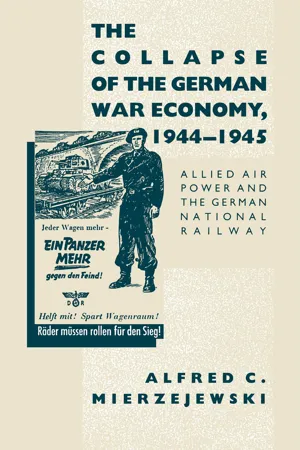
The Collapse of the German War Economy, 1944-1945
Allied Air Power and the German National Railway
- 306 pages
- English
- ePUB (mobile friendly)
- Available on iOS & Android
eBook - ePub
The Collapse of the German War Economy, 1944-1945
Allied Air Power and the German National Railway
About this book
Information
1 Albert Speer’s System of Industrial Efficiency
On New Year’s Day 1945, Albert Ganzenmüller, the young, dynamic head of the German National Railway, the Deutsehe Reichsbahn (DR), addressed an inspirational message to his subordinates.1 He praised their efforts during the preceding twelve months and promised them that they would be rewarded with success for German arms during the coming year. But nothing that Ganzenmüller could write could conceal the rapid decline that his railway had suffered during the preceding three and a half months. Because of merciless Allied air attacks, the Reichsbahn was reeling and could no longer perform its economic role. The Reich economy was spiralling downward toward the abyss in spite of Ganzenmül1er’s and his friend Albert Speer’s efforts. Ganzenmüller and Speer had assumed office during a similar though less severe emergency three years before. Speer had instituted a series of economic reforms that encompassed the Reichsbahn and enabled Germany to increase its armaments output spectacularly. To understand the crisis facing Ganzenmüller and the Reichsbahn in January 1945, we must trace the course of Speer’s reforms and see how they fit into the history of the German economy under Hitler.
The economic history of Germany during Nazi rule may be divided into three periods The first stretched from the seizure of power in January 1933 to September 1936. A dual policy of labor creation and expansion of armaments production was followed. It was predicated on Hitler’s fears of domestic political unrest stemming from high unemployment and from his need for a measure of military power to back his diplomatic intentions. Unemployment was reduced to pre-Depression levels, the GNP neared that of 1929, and government expenditure was shifted decisively toward armaments.2
The second period began in September 1936. In response to a foreign exchange shortage and the opposition of the minister of economics, Hjalmar Schacht, Hitler modified his economic policy by enunciating the second Four Year Plan under Hermann Göring. He called upon industry to make Germany ready for war within four years. To this end the government would sponsor the expansion of the synthetic fuel industry and promote the greater use of low-grade domestic iron ore. For some years the Air Ministry, moving independently, had been expanding the capacity of the aviation industry.3
Due to the technical immaturity of the hydrogénation and Fischer-Tropsch processes and shortages of certain components made from steel, synthetic fuel production lagged badly behind expectations.4 Resistance by heavy industry centered in the Ruhr stymied progress in exploiting domestic iron ore. In response, the government sharpened its intervention in economic affairs. On 15 July 1937 Göring decreed the formation of the gigantic Reichswerke Hermann Göring AG (RWHG), using forced loans and drafts of engineers from existing iron and steel companies to create a management staff overnight.5 The complex would exploit the low-quality iron ores located near Salzgitter in central Germany.6 Named to lead the new combine was Paul Pleiger, an energetic manager cum technocrat from the Ruhr and a member of the Nazi Party.7
A further acceleration of rearmament followed in 1938. Production of most armaments had risen but nevertheless failed to meet Hitler’s ambitious demands, primarily due to the inefficiency of Göring’s organization.8 The synthetic fuel program had yet to yield appreciable results and the RWHG was still almost two years away from smelting its first ton of iron.9 Schacht resigned as minister of economics and plenipotentiary for the war economy in November 1937. He was replaced by the political nonentity Walther Funk on 7 February 1938.10 Göring was given control over the Ministry of Economics in the interim. He used this opportunity to merge his diffuse Four Year Plan organization with the ministry and to cut back on projects, including a few in the synthetic fuel sector that promised only long-term benefits. He also set a drastically shortened timetable for the first appearance of significant quantities of synthetic gasoline.11 The whole scheme worked toward the realization of gains that would enable Germany to embark upon the first stage of a career of military conquest in the near future. By the outbreak of hostilities, then, the German economy as a whole had not been prepared for a prolonged war. But significant changes had been made in the allocation of resources. Private consumption had fallen from 78 percent of the GNP in 1933 to 52 percent in 1938.12 Armaments spending rose from 4 to 22 percent of GNP which itself had risen by 16 percent compared to 1928.13 A significant increase in the size in arms spending had occurred, but the economy had not been prepared for “total war” on the model of the First World War.14 Twenty-nine percent of total industrial output still served consumer needs.15 The increase in military strength had been won primarily by exploiting capacity idled by the Great Depression, and by concentrating on producing finished armaments. It was complemented by a hurried effort: to build new capital facilities that would render Germany temporarily less dependent on imports of militarily important raw materials in selected industries and would be located in areas less vulnerable to air attack.16 The largest prewar increase in the share of national income devoted to the military buildup occurred only in 1938 and 1939, too late to create significant reserves of armaments.17 The basic structure of German industry was not altered.18 Advanced production methods were not employed and the demands made on both capital and labor, with a few critical exceptions, were modest compared to Hitler’s ambitions.
The Reich’s economic preparations for war bore the imprint of Nazi ideology and the corrosive internal bureaucratic competition fostered by Hitler. Five groups emerged hoping to shape Germany’s economic destiny. One, the weakest, was centered in the Nazi Party. It sought to restructure German society on corporatist lines deemphasizing urbanization and industrialization. But it was abandoned early by Hitler since it opposed his rearmament goals and the concomitant alliance with industry.19 However it did not disappear. It simply bided its time secure in its own power base in the Party’s regional Gau structure.
A second group, the military was weakened by internal divisions. Each branch of the three services had its own weapons procurement office which set production targets and raw material requirements without reference to either of the others. Nominally above these bodies was the War Economics and Armaments Office (Wi-Rü Amt) of the Armed Forces High Command (Oberkommando der Wehrmacht, OKW) commanded by General Georg Thomas. Hitler’s policy of rapid rearmament, which eschewed the creation of reserves and avoided major reshaping of the economy, found no favor with Thomas.20 During the 1930s his shrill calls for thorough industrial preparations not only went unheeded but cost him political influence. In spite of his political isolation he did possess an asset of inestimable importance. Thomas had laboriously fashioned a local reporting organization consisting of military economics officers (Wehrwirtschafstoffiziere) and armaments officers (Rüstungsoffiziere). Germany was divided into fifteen military regions (Wehrkreise) each of which was also subdivided into commands. A defense economics or armaments officer or both were assigned to all of these areas.21 They were responsible for the allocation of contracts and raw materials, and for preparing quarterly reports that were submitted to headquarters in Berlin.22 Thomas, therefore, possessed the most comprehensive economic control and reporting network in the Reich. He simply lacked sufficient bureaucratic power to use it effectively.
Approaching the Wi-Rü Amt in organizational development and matching it in political impotence after 1937 was the Reich Ministry of Economics (Reichswirtschaftsministerium, RWM). The RWM attempted to influence economic affairs through its ministerial offices and a complicated series of compulsory organizations that grouped all economic activities geographically and functionally. The ministerial apparatus was the simplest. It consisted of seven main sections in Berlin supported by regional State Economic Offices (Landeswirtschaftsämter). In addition, the ministry also operated Reich Offices (Reichsstellen) that attempted to ration selected raw materials. Atop the geographical organization was the Reich Economic Chamber (Reichswirtschaftskammer). Its subordinate branches were composed of regional Economic Chambers (Wirtschaftskammern) and local Chambers of Industry and Commerce (Industrie- und Handelskammern). The functional structure was composed of National Groups (Reichsgruppen), of which there were seven in 1938, regional Economic Groups (Wirtschaftsgruppen), and the Specialty Groups (Fachgruppen).23 The middle and lower levels of the functional structure as well as the entire geographical edifice had been co-opted by big business, especially heavy industry, to serve its own purposes. The interest groups and cartels simply used the chambers and groups as cloaks behind which they pursued their customary goals. Industry, the fourth entity, therefore played a de facto independent role.
In 1936 the poorly managed Four Year Plan organization was created to focus the energies of these groups on the expansionist aims laid down by Hitler. Göring hoped to use segments of existing bureaucracies to serve his purposes and so began by creating only a very small office. But over the months it mushroomed until finally in 1938, he meshed it with the RWM. Subsequently both for this reason and because Göring began to turn his attentions elsewhere, the Four Year Plan faded into virtual insignificance.24
When the war began, these power centers were competing with each other causing the utmost confusion in the management of the economy. While many proposals had been made to name an economic dictator to impose order, nothing had been done. No tightly organized economic control structure had been created and no effort to prepare the economy for a long war had been made because Nazi ideology either dismissed these things as unnecessary or forbade them as harmful.
Nazi ideology was the product of tensions that grew out of the peculiar political and economic development of Germany during the preceding sixty years. It crystallized after defeat in 1918, which it attributed to the collapse of popular morale due to economic hardship, and gained political strength and broad popular acceptance thereafter. It advocated the rejection of industrialization and liberalism and a flight to folkish forms of romanticism.25 The concomitant was the denigration of bureaucratic organization and the discounting of the role of the state.26 From this flowed an irrational conception of social mobilization as a fanatical burst of national emotional energy. Hitler visualized it as an imperialist war that would either conquer the territory needed for Germany’s survival or lead to the Volk’s utter ruin.27 Economic reality would be compelled to serve the adventure by the force of indomitable will.28 Hitler expressed the latter idea when he asserted that, “The state orders and the economy meets the requirements of the state.”29 The state, in this formulation, was seen as the tool of the Nazi Party.
The specific form of economic organization that issued from this conception was the “Leadership Principle.”30 Dynamic individuals would master problems through the application of energy and resourcefulness. Bureaucracy would be kept to a minimum by means of “industrial self-responsibility” the voluntary management of the economy by businessmen to serve folkish needs.31
These economic ideas were intertwined with similar military and political notions. Concepts of mobile warfare stressing speed and the innovative use of combined arms were developed by others and were adopted by the Nazis. Hitler applied them to his imperialist dreams by conceiving of a series of short, sharp wars of territorial conquest culminating in the final titanic confrontation with the Soviet Union.32 At the outset, the economy would generate only the military power necessary to defeat Germany’s initial opponents, who would be weak and isolated. The preliminary conquests would not only clear Germany’s strategic rear but also enhance its economic position.33
No formal statement was drawn up outlining this design. But each of its components—mobile warfare, conquest of territory, and economic stimulation—had long been topics of public discussion in Germany Hitler himself spoke so often on these subjects that there can be no doubt that he was aware of them.34 Hitler was not only the embodiment of the anxieties of the German people; he had also assimilated the historic German preference for rapid wars and combined it with ...
Table of contents
- Cover Page
- Title Page
- Copyright Page
- Contents
- Preface
- Abbreviations
- Chapter 1. Albert Speer’s System of Industrial Efficiency
- Chapter 2. The Geographical Division of Labor
- Chapter 3. Wheels Must Roll for Victory: The Deutsche Reichsbahn
- Chapter 4. Controversy and Compromise
- Chapter 5. Living for the Present
- Chapter 6. Debilitation
- Chapter 7. Spades against Bombs
- Chapter 8. The Wheels Stop Rolling
- Chapter 9. Conclusions
- Appendix
- Notes
- Bibliography
- Index
Trusted by 375,005 students
Access to over 1.5 million titles for a fair monthly price.
Study more efficiently using our study tools.
Frequently asked questions
Yes, you can cancel anytime from the Subscription tab in your account settings on the Perlego website. Your subscription will stay active until the end of your current billing period. Learn how to cancel your subscription
No, books cannot be downloaded as external files, such as PDFs, for use outside of Perlego. However, you can download books within the Perlego app for offline reading on mobile or tablet. Learn how to download books offline
We are an online textbook subscription service, where you can get access to an entire online library for less than the price of a single book per month. With over 1.5 million books across 990+ topics, we’ve got you covered! Learn about our mission
Look out for the read-aloud symbol on your next book to see if you can listen to it. The read-aloud tool reads text aloud for you, highlighting the text as it is being read. You can pause it, speed it up and slow it down. Learn more about Read Aloud
Yes! You can use the Perlego app on both iOS and Android devices to read anytime, anywhere — even offline. Perfect for commutes or when you’re on the go.
Please note we cannot support devices running on iOS 13 and Android 7 or earlier. Learn more about using the app
Please note we cannot support devices running on iOS 13 and Android 7 or earlier. Learn more about using the app
Yes, you can access The Collapse of the German War Economy, 1944-1945 by Alfred C. Mierzejewski in PDF and/or ePUB format, as well as other popular books in History & German History. We have over 1.5 million books available in our catalogue for you to explore.