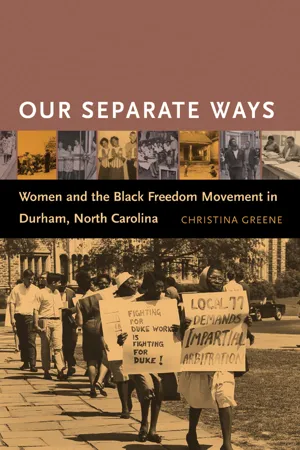
In an in-depth community study of women in the civil rights movement, Christina Greene examines how several generations of black and white women, low-income as well as more affluent, shaped the struggle for black freedom in Durham, North Carolina. In the city long known as “the capital of the black middle class,” Greene finds that, in fact, low-income African American women were the sustaining force for change.
Greene demonstrates that women activists frequently were more organized, more militant, and more numerous than their male counterparts. They brought new approaches and strategies to protest, leadership, and racial politics. Arguing that race was not automatically a unifying force, Greene sheds new light on the class and gender fault lines within Durham’s black community. While middle-class black leaders cautiously negotiated with whites in the boardroom, low-income black women were coordinating direct action in hair salons and neighborhood meetings.
Greene’s analysis challenges scholars and activists to rethink the contours of grassroots activism in the struggle for racial and economic justice in postwar America. She provides fresh insight into the changing nature of southern white liberalism and interracial alliances, the desegregation of schools and public accommodations, and the battle to end employment discrimination and urban poverty.
eBook - ePub
Our Separate Ways
Women and the Black Freedom Movement in Durham, North Carolina
- 384 pages
- English
- ePUB (mobile friendly)
- Available on iOS & Android
eBook - ePub
About this book
Information
1
If You Want Anything Done,
Get the Women and the Children
Fighting Jim Crow in the 1940s and 1950s
Ersalene Williams must have jumped at the chance to earn a few dollars that summer day in July of 1952. Simply living in Durham, the capital of the black middle class, did not put money in the pockets of an unemployed African American woman. Little of the post–World War II prosperity that swept the nation had found its way to the inhabitants of the unpaved streets and dilapidated houses that made up most of black Durham. So when Thomas Wilbert Clark, a white resident, asked Mrs. Williams if she could help his wife with some household chores, she readily agreed.1
When Mrs. Williams arrived at the Clark home, however, Clark’s wife was nowhere in sight. Without warning, Thomas Clark pounced on the unsuspecting Williams. When she rebuffed his “pawing,” he offered her money for what the press called “immoral purposes.” The horrified Williams kicked and screamed as Clark dragged her into the bedroom, tossed her on the bed, and “got on top of her.” During a “frantic struggle,” Mrs. Williams managed to free herself and escape. Thomas Clark soon appeared at her door to apologize. He had been drinking, he explained. Couldn’t they just forget the whole thing? When Williams refused, Clark returned with two white detectives, perhaps hoping to intimidate her; but the ploy backfired, and Ersalene Williams swore out a warrant for Clark’s arrest.2 White male privilege was not so easily curtailed, however. “Later on in the day, two other white men came to my home and offered me money to compromise,” Williams reported. “They stated that I would gain nothing because [Clark] would probably [not get more] than 30 days.”3
The assault on Ersalene Williams typified the sexualized racial violence that had plagued African American women for centuries. Slavery had maintained its grip by abrogating black women’s control of their own bodies while simultaneously denying black men both the ability to protect black women and any other claims to conventional notions of masculinity. The end of slavery had not eradicated these arrangements, and black women too often were forced to rely upon their own efforts for protection and redress of grievances.4 Tellingly, Durham’s traditional black male leadership—perhaps out of class snobbery, but undoubtedly wary of the volatile mixture of race, sex, and violence in the case—remained silent in the wake of the attack on Ersalene Williams. The Carolina Times, Durham’s black weekly, denounced black men’s “lethargy” and “excuses” while praising a small local group of African American women, the Sojourners for Truth and Justice, for rallying behind the unemployed Ersalene Williams.5 Headed by a Duke Hospital worker and the wife of a local tobacco worker, the left-leaning Sojourners for Truth pointed to a renewed organizational impulse among black women that had emerged during World War II and its aftermath.6
It was not the first time that the Carolina Times’s fiery editor, Louis Austin, had castigated Durham’s black male elite for its timidity. Nor was it the first time that black men recognized women’s collective abilities. “If you want anything done, get the women and the children,” a local NAACP official had declared two years earlier.7 Sojourners for Truth itself may have yielded little sway among Bull City power brokers, yet its public support for Ersalene Williams symbolized both the legacy of African American women’s community work and the growing importance of black women’s organizations in Durham’s burgeoning African American freedom movement. Usually invisible to the white public and too often unappreciated within the black community, African American women’s wartime activity laid the foundation for the freedom struggle of the 1960s, in which female activists frequently outnumbered men.8
World War II and Black Women’s Organized Activity
Indeed, during World War II, Durham witnessed an upsurge in black women’s organized activity, a response to both the hardships and the opportunities created by the war. Throughout the 1940s and 1950s, African American women increasingly added both their voices and their numbers to the growing demand for black freedom. The experiences of the war, both at home and abroad—and especially the racially motivated murder of a black soldier on a Durham bus in 1944—exacerbated class and ideological divisions among Durham’s black leaders. Much of the conflict centered in the local NAACP. The question became which brand of leadership would ascend in the postwar years, the old accommodationist brand exemplified by the traditional black business elite or the new militancy spurred by the exigencies of war. Although the battle between the old guard and the militants usually did not involve African American women directly, it provided space for women’s organizations to join the new black insurgency.9
Class and political divisions among Durham’s black residents were hardly a new phenomenon, despite the fact that class lines among African Americans were always somewhat permeable.10 Durham’s reputation as a center for the black bourgeoisie reflected the remarkable success of the North Carolina Mutual Life Insurance Company, the largest black financial institution in the world, and the host of African American businesses that grew up around the Mutual. Within the constraints of Jim Crow, Durham’s black business elite frequently negotiated behind the scenes with white power brokers on behalf of the larger black community.11 Embedded in this arrangement was an element of social control; white largesse was offered in exchange for racial peace and quiescence among the black masses.12
While significant numbers of African Americans had never been comfortable with this arrangement of quasi-paternalism, World War II both aggravated differences of opinion about race strategy and enhanced black women’s organizational base. The war strengthened existing women’s groups and spurred the creation of new organizations, though this expansion drew on a historic tradition of black women’s community work.13 “Organized activity” included not only formal organizations but more informal settings—family and community gatherings and even leisure activities—in which women established social and political networks. Black women’s group activity throughout the 1940s and 1950s, whether benevolent, social, or overtly political, strengthened personal bonds and provided critical space for the development of a collective identity.14 As the freedom movement swelled, women’s networks furnished a crucial organizational base for mobilizing mass protests.15
Black women’s organized activity was also class based. Although class lines were somewhat fluid in Durham’s black community, the middle class had a more formal style of organizing, especially through voluntary associations. Middle-class women formed the Harriet Tubman branch of the Young Women’s Christian Association, a local chapter of the National Council of Negro Women, the links Incorporated, and a branch of the National Housewives League, along with church groups, sororities, literary societies, social clubs, and mothers’ clubs.16
Notwithstanding these middle-class organizational bastions, an exclusively female organizational base may have been even more pronounced in working-class neighborhoods, where both men and women frequently perceived community work as “women’s work.” For example, black women tobacco workers in Durham often lived in the same neighborhoods and attended the same churches, where they formed a majority of their congregations and led usher boards, missionary circles, and Sunday schools. These networks established a basis for female solidarity and a form of black “sisterhood” within Durham’s African American communities.17 Although women tobacco workers were active in union locals in Durham—even holding leadership positions in the early years—they remained ambivalent about the Tobacco Workers International Union (TWIU), an American Federation of Labor (AFL) union.18 Unlike nearby Winston-Salem’s less hierarchical CIO tobacco union, where black women were a dominant force, the Durham TWIU remained male dominated and male centered. White male union officials in the national TWIU office were especially patronizing toward black women.19 But the most decisive factor in black women’s ambivalence toward the union was the men’s failure to address their concerns. Black women refused to back a 1939 tobacco workers’ strike after black male tobacco workers chose to form an alliance with white male workers and then failed to include black women’s grievances in the strike demands. The women’s complaints were echoed repeatedly by the Carolina Times, which accused African American labor leaders of complacency and ineptitude in behalf of their members. Black working-class women were equally dismissive of the “pious attitudes” of middle-class black women at the Tubman Y who tried unsuccessfully to develop programs for women tobacco workers in the 1940s.20 Despite these difficulties, working-class women organized in neighborhood and church groups and strengthened community bonds at social gathering places including beauty parlors, corner grocery stores, and even drink houses and “piccolo” joints.21 Such networks in turn formed an important foundation for black community and church support of civil rights protest.
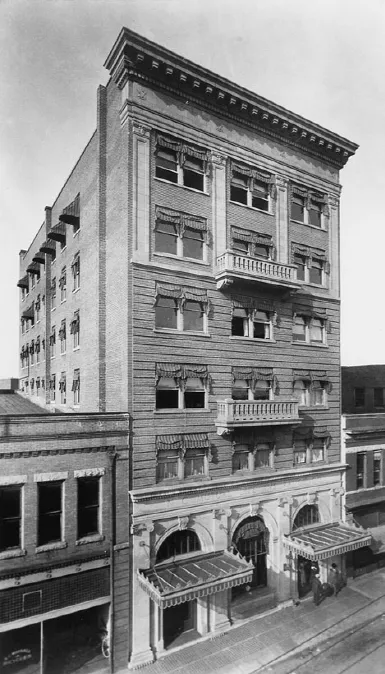
The North Carolina Mutual Life Insurance Company, established in 1899, was the largest black-owned financial institution in the nation, and it helped give Durham its reputation as the “capital of the black middle class.” This was the home office building from 1921 to 1966. (Courtesy North Carolina State Archives)
By the 1950s, a wide array of women’s organizations in Durham had begun to take organizational memberships in the NAACP. When direct action protest broke out in 1960, the local NAACP had a majority female membership and large numbers of working-class members. In Durham, the NAACP, notably its youth and college chapters, galvanized the new direct action movement.22 Two decades of women’s community activism had laid the foundation. The origins of the 1960s direct action movement, therefore, can be found not simply in the more visible public demonstrations of black discontent or in the activities of black men in labor unions, churches, and the military but also among African American women in neighborhoods, community organizations, and NAACP branches throughout the South during the 1940s and 1950s.23
Camp Butner and the Double-V Campaign
The federal government’s decision to construct Camp Butner, a 40,000-acre military training facility twelve miles north of Durham, had a dramatic impact on the Bull City.24 When Butner opened in August 1942 with a population of 35,000—including about 7,500 African Americans—it was like a city within a city. Thousands of young soldiers and their families streamed into the area, intensifying the housing crunch but also providing a boost to the local economy. Bus routes were set up to transport soldiers between Butner and Durham, and on any given day close to 4,000 soldiers could be found strolling the streets of the city.25 Durham’s black Hayti section, with its entertainment outlets—movie theaters, pool halls, juke joints—and its businesses, attracted many a gi black and white alike, looking for a good time.26
At its height, Hayti (pronounced “hay-tie”)—named after the black Caribbean republic, Haiti—boasted over one hundred independent black businesses, schools, restaurants, hotels, and theaters. Many of Durham’s African American lawyers, doctors, politicians, and athletes lived or worked in Hayti. As a local historian described the area, “[moonshine liquor], chitterling dinners, high class prostitutes, and crap games rounded out the menu of attractions that extended a warm welcome to plain and not-so-plain folk alike.”27 Hayti also supported a thriving musical tradition and was the center of the Piedmont blues—a genre that differentiated itself from the “sultry music of the Mississippi Delta” by its “enthusiastic foottapping . . . [and] ragtime energy accentuated by the rhythmic rapping of a washboard and punctuated by the whoops and calls of the harmonica.”28 Many of the nation’s top blues, jazz, and big band performers were drawn to Hayti, including the “‘hottest’ women’s jazz band of the 1940s,” the first all-female, multiracial (but predominantly black) band, the International Sweethearts of Rhythm.29 One black resident recalled: “The place was jumping because there were clubs and joints of all descriptions everywhere. It turned into a Vegas strip almost. . . . The soldiers made business better in every category, licensed or unlicensed. If you get a bunch of guys that will only be here for a little while, they’ll pay double for everything they get, only they want it right now . . . whatever it was from booze to women. The mpshad to patrol all the time, cause it was hairy.”30
Middle-class black women frequently recoiled at the spectacle of wartime Hayti, championing more wholesome recreation for black servicemen. The Harriet Tubman YWCA took the lead in recruiting volunteers for the black usoand carefully screened local young women to entertain black GIS. There were practical needs to be met as well, and black women eagerly stepped up to the tasks at hand. They set up guesthouses for the families of black soldiers and launched salvage drives for scrap metal. Local teachers such as Mrs. Bessie McLaurin volunteered to teach literacy classes for black soldiers, while another Durham woman directed a Colored Travelers Aid Society in the black section of the local train station. A local Alpha Kappa Alpha sorority sponsored a soldiers’ aid project, doing minor sewing repairs, and the Daughters of Dorcas made curtains for the club room at Camp Butner.31
As they attended to the needs of African American soldiers and their families, black women in Durham struggled to balance their own family and work pressures. Before the war, over 40 percent of black and white Durham women were employed—among the highest rates in the country. World War II drew even greater ...
Table of contents
- Table of Contents
- List of Illustrations
- Title Page
- Copyright Page
- Dedication
- Acknowledgments
- Abbreviations
- Introduction
- Chapter 1 - If You Want Anything Done, Get the Women and the Children: Fighting Jim Crow in the 1940s and 1950s
- Chapter 2 - A Few Still, Small Voices: Black Freedom and White Allies in the Doldrums
- Chapter 3 - The Sisters behind the Brothers: The Durham Movement, 1957–1963
- Chapter 4 - The Uninhibited Voice of the Poor: African American Women and Neighborhood Organizing
- Chapter 5 - Someday, . . . the Colored and White Will Stand Together: Organizing Poor Whites
- Chapter 6 - I Can’t Catch Everybody, but I Can Try: Black Power Politics, the Boycott, and the Decline of Neighborhood Organizing
- Chapter 7 - Visiting Ladies: Interracial Sisterhood and the Politics of Respectability
- Conclusion
- Epilogue
- Notes
- Bibliography
Trusted by 375,005 students
Access to over 1.5 million titles for a fair monthly price.
Study more efficiently using our study tools.
Frequently asked questions
Yes, you can cancel anytime from the Subscription tab in your account settings on the Perlego website. Your subscription will stay active until the end of your current billing period. Learn how to cancel your subscription
No, books cannot be downloaded as external files, such as PDFs, for use outside of Perlego. However, you can download books within the Perlego app for offline reading on mobile or tablet. Learn how to download books offline
Perlego offers two plans: Essential and Complete
- Essential is ideal for learners and professionals who enjoy exploring a wide range of subjects. Access the Essential Library with 800,000+ trusted titles and best-sellers across business, personal growth, and the humanities. Includes unlimited reading time and Standard Read Aloud voice.
- Complete: Perfect for advanced learners and researchers needing full, unrestricted access. Unlock 1.5M+ books across hundreds of subjects, including academic and specialized titles. The Complete Plan also includes advanced features like Premium Read Aloud and Research Assistant.
We are an online textbook subscription service, where you can get access to an entire online library for less than the price of a single book per month. With over 1.5 million books across 990+ topics, we’ve got you covered! Learn about our mission
Look out for the read-aloud symbol on your next book to see if you can listen to it. The read-aloud tool reads text aloud for you, highlighting the text as it is being read. You can pause it, speed it up and slow it down. Learn more about Read Aloud
Yes! You can use the Perlego app on both iOS and Android devices to read anytime, anywhere — even offline. Perfect for commutes or when you’re on the go.
Please note we cannot support devices running on iOS 13 and Android 7 or earlier. Learn more about using the app
Please note we cannot support devices running on iOS 13 and Android 7 or earlier. Learn more about using the app
Yes, you can access Our Separate Ways by Christina Greene in PDF and/or ePUB format, as well as other popular books in Politics & International Relations & Civil Rights in Politics. We have over 1.5 million books available in our catalogue for you to explore.