In the early twentieth century, an elite group of modern-minded scientists in Germany, led by the eminent organic chemist Emil Fischer, set out to create new centers and open new sources of funding for chemical research. Their efforts led to the establishment in 1911 of the chemical institues of the Kaiser Wilhelm Society for the Advancement of the Sciences, whose original staff included several future Nobel laureates. Although these institutes were designed to promote “free research” that would uphold German Leadership in international science, they also came to promote the integration of science in the German war effort after 1914. According to Jeffrey Johnson, the development of the Kaiser Wilhelm Institutes exemplifies the origins and dilemmas of one of the most significant innovations in modern science: the creation of institutions for basic research, both theoretical and practical.
The Kaiser Wilhelm Society was a quasi-official institution under the “protection” of Kaiser Wilhelm II, but it received most of its funding from German industry rather than the Imperial Treasury. After 1914, however, the Kaiser’s chemists and their institutes provided key support to the German war effort. Within a few months of the outbreak of World War I, the institutes had been integrated into war mobilization activities. They conducted research both in weapons, such as poison gas, and in strategic resources, especially synthetics to replace naturally produced goods cut off by Britain’s blockade of German ports.
By examining the Kaiser Wilhelm Society in the framework of both scientific and social change, Johnson is able to answer questions that seem puzzling if not viewed from this dual perspective, such as why German chemists pushed for institutional change at this particular time. Johnson argues that the new institutes arose from a characteristically modern tension between internationally set scientific goals and the competing national priorities of a country headed for war. Johnson’s sources include the papers of Emil Fischer; the archives of several major German corporations, including Bayer, Hoechst, and Krupp; government records; and the archives of the Max Planck Society, which grew out of the Kaiser Wilhelm Society after World War II.
Originally published in 1990.
A UNC Press Enduring Edition — UNC Press Enduring Editions use the latest in digital technology to make available again books from our distinguished backlist that were previously out of print. These editions are published unaltered from the original, and are presented in affordable paperback formats, bringing readers both historical and cultural value.
eBook - ePub
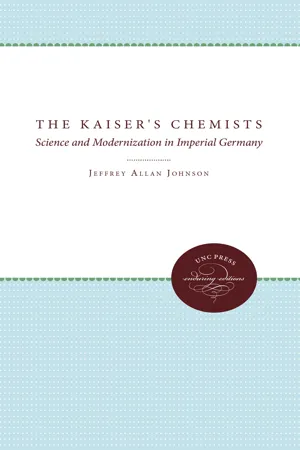
The Kaiser's Chemists
Science and Modernization in Imperial Germany
- 296 pages
- English
- ePUB (mobile friendly)
- Available on iOS & Android
eBook - ePub
About this book
Information
1
The True Land of Unlimited Possibilities: International Competition, German Modernization, and the Dynamism of Science
We [Germans] do not possess, as do America and Russia, almost all the raw materials that we refine. Germany's greatest riches are undoubtedly the intelligence and industriousness of its population, and with this we must reckon.
—Karl Goldschmidt, manufacturer, 1904
Chemistry and with it all natural science is the true land of unlimited possibilities.
—Emil Fischer, organic chemist, 1911
The Problem
In 1911 Emil Fischer, Germany's leading organic chemist, addressed the inaugural meeting of the Kaiser Wilhelm Society for the Advancement of the Sciences, an organization composed mainly of businessmen who had provided substantial sums for the founding of new research laboratories. In a speech entitled “Recent Successes and Problems of Chemistry,” he asserted that “chemistry and with it all natural science is the true land of unlimited possibilities.”1 Fischer backed these words by myriad examples of new scientific perceptions in all fields, but above all of chemical research being translated into practical uses. In particular, Germany could now replace expensive, naturally occurring substances, formerly imported from abroad, with synthetics and artificially produced substitutes based on cheaper, domestically available substances. His speech that day, with the Kaiser himself present in the audience, climaxed more than half a decade of effort directed toward getting the Imperial German government to recognize the economic and political value of chemistry by providing financial support for a new chemical research institution. Fischer's friend Carl Duisberg, one of the directors of the Bayer dye corporation, was “extraordinarily pleased”; at last the “highest authorities” had a “clear and comprehensible” picture of “the significance of our science and industry.”2
And yet Fischer, Duisberg, and their allies among the most prominent German chemists and chemical industry had failed, and were to continue to fail, to win the Imperial government's support. The Imperial bureaucracy had rejected their proposal for an Imperial Institute for Chemistry, both in its original form in 1905–6 as well as the version that emerged from the Imperial Chemical Institute Association they founded in 1908. Instead, their efforts had culminated in the establishment of the Kaiser Wilhelm Society, which was in 1912 to open its first two research institutes, one for chemistry and one for physical chemistry.3 Unlike the planned Imperial Institute, however, these institutes were funded almost wholly by private contributions, albeit orchestrated by the Prusso-German bureaucracy under the “protection” of Wilhelm II. One year later the society opened a third major institute for experimental therapy, including a section headed by a biochemist. Then on July 27, 1914, it opened an institute for coal research, directed by yet another chemist. In this case the director had been hand-picked by Emil Fischer, who was by this time the most influential scientist in the society. On the following day, the First World War broke out. Within a few months all four of these institutes had been integrated into the German war effort. They conducted research both in the area of weapons such as poison gas and in strategic resources, especially synthetics to replace naturally produced goods cut off by the British blockade.
How does one evaluate these events and the negative attitude of the Imperial government in view of the significance claimed for chemistry by scientists like Fischer and eventually demonstrated during the First World War? Several related issues need to be raised in this connection. First, one must establish a historical frame of reference within which to place the various arguments for and against an Imperial Chemical Institute. There is, as yet, no generally accepted historical model of the origins of modern scientific institutions or of the interaction between changes in science and changes in modern society as a whole.4 What is required is an approach that will look at the modification of institutions that results from the emergence of modern science in two senses: the changing relationship between science and its social context on the one hand, and the changing character of scientific theory and practice on the other. This chapter is intended to provide a suitable perspective for viewing both aspects of the changes that affected the development of academic and industrial chemical research institutions in Imperial Germany. The two chapters that follow examine in detail how these changes brought Emil Fischer and his colleagues to advocate an Imperial Chemical Institute, why they proposed the plan they did, and where they sought their initial support.
Second, one must understand the forces that brought about successive transformations in the original plan, ultimately leading the chemists into an alliance with the Kaiser Wilhelm Society and producing the Kaiser Wilhelm Institutes. These changes present a case study in the pattern of institutional innovation during the final prewar decade of Imperial Germany, which will be examined in the fourth through seventh chapters from the perspective of German “conservative modernization” as defined in the first chapter.
Third, one must consider how well the institutes in their final form achieved the original scientific and social goals of Fischer and his allies. None of the previous historical studies of the Kaiser Wilhelm Society as an institution has closely examined what the institutes meant for the development of scientific research in Germany. Through a detailed examination of the single discipline of chemistry, a more precise assessment can be made. The eighth chapter addresses this issue in connection with the general institutional problems of chemistry in Imperial Germany discussed in the earlier chapters.
Finally, one must consider the degree of continuity between the events that preceded the outbreak of war and those that followed. The problem of continuity between the peacetime and wartime policies of the German government, and ultimately between the policies and institutions of Imperial Germany and those of the Third Reich, is one that goes back at least two decades, to the controversy over Fritz Fischer's Griff nach der Weltmacht.5 Under the influence of Fischer, Hans-Ulrich Wehler, and their supporters, the pendulum of German historiography swung during the seventies from an excessive emphasis on discontinuity to an equally excessive emphasis on the fundamental continuities from 1871 to 1933, or even 1848 to 1945.6 It is well, however, to examine the problem of continuity in a different context, that of the continuity between the peacetime and wartime development of scientific institutions. The tendency among scientists who participated in the war was to emphasize the discontinuities—the breaking off of normal research projects under the new pressures of war.7 Yet was it only a coincidence that the scientists who were most closely involved in the effort to create the institutes also provided the most influential participants in the chemists’ war? Although wartime scientific service for their emperor may be said to have defined the group I shall call the “Kaiser's chemists,” it was their previous peacetime struggles to get increased support for science under the circumstances of Imperial Germany that set them in place and shaped their thinking. The Kaiser's chemists and their institutes may thus serve as models of the institutional and intellectual continuities between peace and war that have been ever more sharply delineated in twentieth-century science, above all in those nations giving highest priority to military strength. The concluding chapter addresses these issues, which also underlie much of the discussion in the earlier parts of the book.
Between Two Competitions: The Institutional Dilemma of Modern Science
Within what historical framework, then, can the emergence of a plan for an Imperial Chemical Institute best be understood? The point here is to provide general motivations for institutional innovation in science, and to connect this to a larger pattern of institutional change during the late nineteenth and early twentieth centuries. From this perspective it will be possible to clarify the commonly assumed, but still vaguely understood, role of science in “modernization.” One of the most historically sophisticated case studies of modernization describes it as “the process by which societies have been and are being transformed under the impact of the scientific and technological revolution,” whose central phenomenon is defined as “an increase in the ratio of inanimate to animate sources of power to and past a point of no return as far as the accompanying social patterns are concerned.” In regard to science, the authors postulate that “widespread belief in rational inquiry is a primary characteristic of modernity, and the advancement of knowledge and its dissemination through education are essential in the process of modernization.” Finally, they list “the scientific revolution of the sixteenth and seventeenth centuries” first among “the immediate antecedents of the process of modernization in Western Europe.”8 Thus science appears to be a prime mover; but what moves science?
According to one Western sociological perspective, “traditional” societies could not provide a continuously increasing flow of natural knowledge, and their technology could rarely use that knowledge without destroying the basis for further scientific innovation. Innovations that did occur were quickly integrated into religious or magical systems of belief, which tended to dogmatize the innovation and conceal its actual origin. This promoted social stability and discouraged further tinkering or questioning, but it could also lead to cultural stagnation.9 Modern societies have been able to solve these problems; thus science's modernity may spring from the same source as its dynamism. Isaac Newton came close to a modern view of the prospects for science with his well-known image of himself as a child playing beside the vast ocean of undiscovered truth, but that also implied that science might eventually navigate to its farthest shores. Since the advent of a Darwinian evolutionary consciousness, however, science has come to look more like an open-ended quest.10 That was one of the ideas captured in Emil Fischer's vision of “unlimited possibilities.” What then is the source of this dynamism, especially in regard to institutions?
In part it has to do with the modern world's ability to break down the barriers between rational and practical knowledge, as suggested in Francis Bacon's aphorism, “knowledge is power,” which became a popular slogan in later centuries among boosters of science-based industry.11 Marxists too, whether orthodox or revisionist, have tended to focus on the symbiotic relationship between science and first commercial capitalism, then monopolistic industry or “organized capitalism.” Capitalism harnessed science as a “productive force” or served as a “stimulus to scientific progress,” creating new scientific institutions to serve the needs of industrial development.12 While there is certainly much truth in this picture, the analysis still does not get at the sources of dynamism within science itself.
Alan Beyerchen's recent study of the “stimulation of excellence in Wilhelmian science” provides a more penetrating view of institutional dynamism in Imperial Germany. “If competitiveness at the forefront of science and technology is one of the hallmarks of modernity,” he begins, “then Germany at the opening of the twentieth century was one of the most modern countries in the world.” He finds the source of this competitiveness not in “any one institution or even set of institutions,” but rather in the “complex dynamic arrangement” of interacting and innovating institutions, which blurred the distinctions between “pure science, applied science, and technology” and which were fostered by modern-minded scientists, businessmen, and government officials. One of the key elements in the German “arrangement” was a very effective institutionalization of “the dynamic interaction between applied science and pure science in the form of a dual legitimation of basic research—‘applied science’ when directed and ‘pure science’ when undirected.” In other words, the methods could be the same in each case, and only the motivations would differ. Bypassing “institutions moving too slowly for the times,” chiefly the universities, the Germans were able to create institutions like the Kaiser Wilhelm Society in which this kind of research could go forward in close connection with actual or potential technological applications, yet without impairing the quality of the science. Quite the contrary: the connection itself improved the science.13
Beyerchen's focus on the new institutions for “basic research” highlights a central, but still problematic, aspect of the changing relationship between science and technology during this period. The origins of the Kaiser Wilhelm Institutes for chemistry can be discerned in this light, but it also suggests the need to focus more sharply on the character of the new institutions, their relationship to the older parts of the German scientific system, and their impact on scientific research. For while the new institutions certainly helped to “stimulate excellence” in Imperial Germany, the very complexity and dynamism of their interactions brought to the forefront new social problems that were henceforth to characterize the enterprise of modern science. This book examines these problems. It is perhaps best to begin, however, with another aspect highlighted in Beyerchen's analysis: the essential role played by the “competitiveness” that the new institutions so clearly manifested and that is also an inherent element in the dynamism of modern science.
One way to examine the connection between competition and institutional innovations is to recall that science has both a national and an international character. Adolf von Harnack, first president of the Kaiser Wilhelm Society, pointed out during the 1920s that “education is national, but scholarship is international. What does this imply? Two things: first, that we are in a constant competition with other civilized peoples; second, that we must exchange our scholarship with theirs.” This required, among other things, “getting insight into the methods and way of working of other [nations’ scholars].”14 From Harnack's dual perspective it is clear that scientists, caught between the national institutions that gave them material support and the international disciplinary group that set their intellectual standards, could become a means of bringing innovative ideas and institutional forms across national boundaries. Thus, international scientific competition, like political, economic, and other forms of competition, could promote modernization in individual nations and induce in them the periods of exponential growth that some quantitative studies have shown to be a regular feature in the history of science.15 Of course, one might ask, competition for what? A scientist would probably answer that the goal is to win respect and authority among one's scientific peers by being the first to give them acceptable answers to as many “interesting” questions as possible—interesting to them, of course, not necessarily to anyone else.16
It appears that by the end of the nineteenth century, internationality was most pronounced in the mathematical and experimental sciences such as physics, where the basic intellectual content and methodology did not significantly differ from one Western nation to another. Physics, and probably chemistry and mathematics as well, had truly become international enterprises.17
The international character of these sciences stemmed partly from a long-standing European tradition of the supranational republic of letters and science. Late-nineteenth-century intellectual and organizational developments placed this tradition on a new footing by making the physical and mathematical sciences international in structure as well as in spirit. Vestiges of Latin and Greek, the old international scholarly languages, remained in scientific nomenclature, whose real basis by the turn of the century was a new international language of discourse based on shared principles of mathematics and mechanism. International unity within each discipline was reinforced by the establishment of formal networks—international congresses, associations, and standing committees to set standards or fix nomenclature, and international journals and scholarly exchanges to disseminate the latest results of research—as well as informal connections between scholars in various countries pursuing similar interests.18
If it is accepted that these international patterns characterize “mature scientific communities” in the sense defined by Thomas Kuhn, then they would also have achieved an “unparalleled insulation . . . from the demands of the laity,” so that the criteria for the acceptability of scientific work could to some extent override personal, national, and other kinds of prejudices.19 Indeed, Kuhn's ar...
Table of contents
- Cover Page
- Title Page
- Copyright Page
- Contents
- Preface
- 1 The True Land of Unlimited Possibilities: International Competition, German Modernization, and the Dynamism of Science
- 2 We Must Do More for Inorganic and General Chemistry: The Making of Three Institutional Reformers
- 3 The Reich Must Join In with Us: The Plan for an Imperial Chemical Institute
- 4 Must There Be a “President” for Every Science?: Sources of Opposition to the Plan
- 5 How and Where Are We Going to Collect Such Great Sums?: The Imperial Institute Association as Investment in Research
- 6 The Kaiser's Call Resounds: The Kaiser Wilhelm Society for the Advancement of the Sciences as Orchestrated Philanthropy
- 7 The Prussianization of the Imperial Institute: Shaping Chemical Research Institutions through the Kaiser Wilhelm Society
- 8 The Promises Were Not Kept: Limits to the Development of the New Institutes before the War
- 9 Military Strength and Science Come Together: The Kaiser's Chemists at War
- Conclusion: Reflections on a “Most Instructive Case”
- Notes
- Bibliography
- Index
Trusted by 375,005 students
Access to over 1.5 million titles for a fair monthly price.
Study more efficiently using our study tools.
Frequently asked questions
Yes, you can cancel anytime from the Subscription tab in your account settings on the Perlego website. Your subscription will stay active until the end of your current billing period. Learn how to cancel your subscription
No, books cannot be downloaded as external files, such as PDFs, for use outside of Perlego. However, you can download books within the Perlego app for offline reading on mobile or tablet. Learn how to download books offline
Perlego offers two plans: Essential and Complete
- Essential is ideal for learners and professionals who enjoy exploring a wide range of subjects. Access the Essential Library with 800,000+ trusted titles and best-sellers across business, personal growth, and the humanities. Includes unlimited reading time and Standard Read Aloud voice.
- Complete: Perfect for advanced learners and researchers needing full, unrestricted access. Unlock 1.5M+ books across hundreds of subjects, including academic and specialized titles. The Complete Plan also includes advanced features like Premium Read Aloud and Research Assistant.
We are an online textbook subscription service, where you can get access to an entire online library for less than the price of a single book per month. With over 1.5 million books across 990+ topics, we’ve got you covered! Learn about our mission
Look out for the read-aloud symbol on your next book to see if you can listen to it. The read-aloud tool reads text aloud for you, highlighting the text as it is being read. You can pause it, speed it up and slow it down. Learn more about Read Aloud
Yes! You can use the Perlego app on both iOS and Android devices to read anytime, anywhere — even offline. Perfect for commutes or when you’re on the go.
Please note we cannot support devices running on iOS 13 and Android 7 or earlier. Learn more about using the app
Please note we cannot support devices running on iOS 13 and Android 7 or earlier. Learn more about using the app
Yes, you can access The Kaiser's Chemists by Jeffrey Allan Johnson in PDF and/or ePUB format, as well as other popular books in History & German History. We have over 1.5 million books available in our catalogue for you to explore.