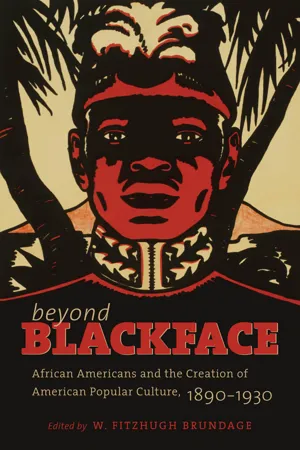
This collection of thirteen essays, edited by historian W. Fitzhugh Brundage, brings together original work from sixteen scholars in various disciplines, ranging from theater and literature to history and music, to address the complex roles of black performers, entrepreneurs, and consumers in American mass culture during the early twentieth century.
Moving beyond the familiar territory of blackface and minstrelsy, these essays present a fresh look at the history of African Americans and mass culture. With subjects ranging from representations of race in sheet music illustrations to African American interest in Haitian culture, Beyond Blackface recovers the history of forgotten or obscure cultural figures and shows how these historical actors played a role in the creation of American mass culture. The essays explore the predicament that blacks faced at a time when white supremacy crested and innovations in consumption, technology, and leisure made mass culture possible. Underscoring the importance and complexity of race in the emergence of mass culture, Beyond Blackface depicts popular culture as a crucial arena in which African Americans struggled to secure a foothold as masters of their own representation and architects of the nation’s emerging consumer society.
The contributors are:
Davarian L. Baldwin, Trinity College
W. Fitzhugh Brundage, University of North Carolina at Chapel Hill
Clare Corbould, University of Sydney
Susan Curtis, Purdue University
Stephanie Dunson, Williams College
Lewis A. Erenberg, Loyola University Chicago
Stephen Garton, University of Sydney
John M. Giggie, University of Alabama
Grace Elizabeth Hale, University of Virginia
Robert Jackson, University of Tulsa
David Krasner, Emerson College
Thomas Riis, University of Colorado at Boulder
Stephen Robertson, University of Sydney
John Stauffer, Harvard University
Graham White, University of Sydney
Shane White, University of Sydney
eBook - ePub
Beyond Blackface
African Americans and the Creation of American Popular Culture, 1890-1930
- 384 pages
- English
- ePUB (mobile friendly)
- Available on iOS & Android
eBook - ePub
Beyond Blackface
African Americans and the Creation of American Popular Culture, 1890-1930
About this book
Information
second coda
The Marketplace for Black Performance
David Krasner charts the important role that black performers played in the advent of “realism” in American popular culture. That dance provided the opening for black performers to contribute to cultural innovation was a testament to the newfound popularity of social dance in the United States. Before the late nineteenth century, social dancing was circumscribed to specific settings. It was reserved chiefly for private functions, such as formal balls, or for disreputable dance halls where prostitution and gambling took place. But starting with the cakewalk, a lengthening list of new dances attracted ever-increasing numbers of Americans onto the dance floor. By the end of the first decade of the new century, even casual observers recognized the transformation in the popularity of dance. “The decade between 1910 and 1920,” one observer wrote, “can be identified primarily as the period in which America went dance mad.” This new popularity of social dance signaled a significant development in American life. It transformed how audiences listened to music; it redirected the composition and performance of popular music; and it altered the public spaces where Americans experienced music. This new departure in American popular dance was bound up in the popularity of ragtime and other dance-suited music.
Like ragtime, the dance craze of the early twentieth century was a consequence of cultural cross-fertilization. While the formal elements of European dance were relaxed to adapt to syncopated dance rhythms, the improvisational elements of African American dance were simultaneously formalized to adjust to the more regular rhythms of dance music. For whites eager to master the new dances, “real” black performers, as opposed to whites masquerading in blackface, acquired new prestige and career opportunities. The appeal of black dancers and dance mirrored the enthusiasm for the “real” and “authentic” that became pronounced in an era of mass production. Black performers, as Krasner points out, were not only beneficiaries but also instigators of these cultural developments.
In her essay on the music that propelled the dance craze, Susan Curtis highlights the changes in tastes and technology that made black musical forms not only acceptable but ascendant in popular culture. She underscores the importance of black popular music in propelling the shift from the Victorian ethos to a modern consumer culture. That this shift provoked howls of outrage from critics of the new cultural forms is hardly surprising. But the evolution of ragtime and the popular music industry, Curtis reminds us, also disappointed the very black composers and performers who were its originators. They discovered that ragtime’s cultural associations—with hedonism and leisure—precluded adequate recognition or compensation for their cultural and business innovations. Perhaps no musician of the era more fully exemplified this simultaneous elevation and marginalization than Scott Joplin.
Tom Riis reveals the “boundary jumping” that was pervasive in music during the era. Directing our gaze beyond the bright lights of the nation’s urban centers, Riis recovers the world of black entertainers who were jacks of all trades, handling snakes one minute, singing soprano the next, and cakewalking a moment later. Riis not only demonstrates that there were literally thousands of these now-nameless performers but also that at least some of them were unapologetic about their craft. These musicians and performers took advantage of any opening to secure a foothold in the emergent popular culture industry of the age.
Davarian Baldwin’s essay shifts the focus to black Chicagoans’ role as consumers of popular culture. He enables us to see the diversity of actors in the cosmopolitan cultural spaces that grew in Chicago in the wake of the Great Migration. Rather than a monolithic “community of consumption,” the South Side of Chicago was home to a diverse array of consumers. Most important, popular culture emerged as one of the most important forums for debates over public behavior, community values, and modernity among both long-time residents and newcomers. In short, popular culture was a realm in which black Chicagoans debated and contested diverse ideas of race and community. At the center of this debate were the recent migrants from the Deep South, whom Baldwin restores to their proper place as catalysts of modern mass culture.
Like Baldwin, John Giggie draws our attention to how blacks participated in the consumer marketplace and the meanings they attached to their consumption. From our contemporary vantage point in a mature consumer society, it may be difficult to imagine a time when consuming mass-produced goods was not second nature but rather something that had to learned. As Giggie demonstrates, southern blacks had ample reasons to be wary of the market; they, after all, had been commodities themselves before the Civil War and were frequently its victims during the Jim Crow era. Moreover, black consumerism had to be reconciled with black spiritual values. Ministers, he explains, played a crucial role in stoking, channeling, and legitimating the consumer desires of their congregations. To do so complemented the ministers’ efforts to promote modernity, respectability, and wealth accumulation among their flock. Thus, when black ministers hawked records of their sermons and other domestic commodities, they helped fashion an enduring alternative black culture of consumption that acknowledged the imperatives of faith as well as those of the market.
The Real Thing
I’m the real thing
I dance and sing.
—AIDA OVERTON WALKER,
“I Wants to Be an Actor Lady”
(1903)
“We finally decided that as white men with blackfaces were billing themselves ‘coons,’” wrote the performer George Walker of the Williams and Walker Theatrical Company in 1906, “Williams and Walker would do well to bill themselves the ‘Two Real Coons,’ and so we did.”1 Walker and his partner, Bert Williams, did indeed “do well,” becoming the dominant black theatrical company from 1899 to 1909. Their productions of In Dahomey , (1902–5), Abyssinia (1905–7), and Bandanna Land (1907–9) were among the most bankable musical vaudeville shows on Broadway.2 At the peak of their career, George Walker reported the company’s payroll at $2,300 per week, making them one of the most successful companies of the time.3In Dahomey attained success in London during its 1903 tour, and the company maintained successful engagements from there.4 Capitalizing on the “coon song” craze, Williams and Walker appropriated the term “coon” and applied it to their show. The script for Two Real Coons has been lost, but the idea of being the “real coons” was not lost on black performers. Williams and Walker, and their friend and rival Robert “Bob” Cole and his company, Cole and Johnson, displayed throughout their writings and actions an acute awareness of the “real” as a cultural signifier and marketing tool.
For Williams and Walker and Cole and Johnson, interest in the real as a commercial device made it possible to break mainstream show business’s color barrier. The real enticed white audiences because realism was in vogue. For the educated white bourgeoisie of the late nineteenth century, historian T. J. Jackson Lears contends, “authentic experience of any sort seemed ever more elusive; life seemed increasingly confined to the airless parlor of material comfort and moral complacency. Many yearned to smash the glass and breathe freely—to experience ‘real life’ in all its intensity.”5 Being quite cognizant of this fact, black performers sought to contrast their “realness” with white imitation. White minstrelsy’s “seeming counterfeit,” Eric Lott’s coinage describing a “contradictory popular construction that was not so much true or false as more or less pleasurable or politically efficacious in the culture that braced it,”6 was dissolving. Although blackface would be revived in Hollywood from the 1920s to the 1940s, by the turn of the century America’s interest in racial “counterfeiting” waned, replaced by an obsession with the real. The “real thing”to co-opt the period’s jargon—signified what Miles Orvell calls the “tension between imitation and authenticity,” which “has been a key constituent in American culture since the Industrial Revolution and assumes critical importance in the shift from the nineteenth to the twentieth centuries that we have called—in all its encompassing multiplicity—modernism.” Orvell adds that the emphasis on realism eventuated popular productions that “catered increasingly to a taste for lifelike imitation that floated easily over the border between life and art. It was an excess of such theatrical representation—which might include everything from real food eaten on stage to real horses used to enact battle scenes”that reflected “the taste for realism in literature.”7 When black performers created “life and art” by putting on the “coon” mask and attaching the term “real” to it, they complicated (and contributed to) the semiotics of realism in American culture.
Following Toni Morrison’s call for a “re-interpretation of the American canon,”8 I hope to show that African American performers played a critical role in defining American culture at the turn of the century. Emphasis on realism in America at the time was certainly broad, but the significance of black performers’ contributions to this cultural event has largely gone unnoticed. Black performers are rarely mentioned in studies of how American realism took root.9 This disparity is due at least in part to the negative value judgment labeling realism retrograde. Such condemnation is exemplified by Amy Kaplan, who remarks that from “a progressive force exposing the conditions of industrial society, realism has turned into a conservative force whose very act of exposure reveals its complicity with structures of power.”10 I shall argue, however, that realism by black performers was a tactic used to dismantle the structures of power.
Not all black performers opposed what was then the status quo; in fact, the use of the blackface mask by black performers perpetuated the accepted stereotype. But some performers, especially George Walker’s wife, Aida Overton Walker, skillfully manipulated the prevailing reality and in doing so contributed to the creation of a revised American realism. She countered hegemonic and racist depictions by exploiting the desire for the real among whites. The notion of “authenticity” displayed in her cakewalking dance deserves recognition as an imaginative and constructive employment of cultural paradigms.
In this essay I will attempt to shed light on Walker’s role in shaping American culture. First I will provide background by accounting for how the real came to be a cultural signifier and marketing tactic. Then I will examine Walker’s success in marketing herself as the “real” cakewalker. Walker contributed significantly to an enduring strategy that has come to be known in contemporary parlance as “crossover appeal.” The goal here is to locate and analyze some of the roots of this appeal.
The new “realism” at the turn of the century was paradoxical in its appeal to both what was real and what was not. The theatrical companies of Williams and Walker and Cole and Johnson were black, but the fixture of the stage “coon” that they embodied was a theatricalized portrayal made commonplace by nonblack actors. Minstrelsy was the nineteenth-century white performer’s attempt to create a slippery reality superficially related at best to black culture. By the end of the nineteenth century black performers had to adopt the stage convention—especially the debasing yet indispensable use of blackface makeup—in order to attract audiences demanding minstrel traditions. To function successfully, even to survive, black performers had to don blackface and satisfy white expectations of black buffoonery. While pandering to their audiences, black performers negotiated ways of undermining the derogatory image.11 Still the price was high, given the perpetuation of the blackface stereotype even among those who found it offensive. As a result of this complex mixture of the real and unreal, of complicity in stereotyping and subverting it, African American performers not only joined in the creation of a new “realism” in American art and culture, they were a force in making realism a major component of American aesthetics. However much this realism might be unreal—even surreal—it does not detract from their cultural contributions.
For black performers, the real was commodified in order to lead the challenge against minstrel theater. At a time when African Americans had been denied participation in a growing economy, blacks sold one of the few commodities they owned: “realness.” Like the Buffalo Bill Wild West shows of the 1890s, blacks jumped on the bandwagon of the “authenticity” phenomena while exploiting the euphoria over realness. Buffalo Bill Cody had enticed the masses with his extravaganza replete with “real” cowboys and Indians, rodeo, and reenactments of battle scenes onstage that recreated the adventures of the Great Plains. Most of all, Cody advertised the productions as not merely Wild West shows, but as resurrections of the Wild West itself. Cody and his producing partner, Nate Salsbury, realized that audiences would pay to see dramatized portrayals of the “real” West, provided that what passed for real was a carefully chosen performance that concealed much of the truth.12 Following Cody’s success Salsbury produced another “reality” show, Black America , a reenactment of the plantation that opened in Brooklyn in 1895.13 Although it was hardly as successful as his Wild West endeavor, Salsbury followed the same promotional strategy: resurrect the “real.” Savvy marketers took advantage of the “authentic” by turning entertainment into big business and the real into something appealing. Thomas Postlewait writes that “both entertainment and advertising learned how to deliver the hyperreal, the domain of desires.”14 Producers Salsbury, P. T. Barnum, B. F. Keith, Florenz Ziegfeld, the Shubert brothers, and the Frohman brothers, along with film moguls Samuel Goldwyn and the rising department store empires of Walgreens, Woolworth’s, Macy’s, Jordan Marsh, Marshall Field’s, and the Sears, Roebuck and Montgomery Ward catalogues, created visual splendor and commercial spectacle that merged theater and the marketplace during the Gilded Age. Robert Ogden, Wanamaker’s partner and superintendent of the New York department store, put it best when in 1897 he said, “I have no doubt whatever that the high priests of art would sneer at the statement that art in advertising is art for humanity’s sake; but, nevertheless, such is the case, and humanity benefits by the art that is expended upon advertising, and the benefits include the artist himself and the audience to which he appeals.” Jettisoning “art for art’s sake,” he averred: “art belongs to commerc...
Table of contents
- Cover Page
- beyond BLACKFACE
- Copyright Page
- Contents
- Acknowledgments
- Working in the “Kingdom of Culture”
- first coda Representations of Blackness in Nineteenth-Century Culture
- second coda The Marketplace for Black Performance
- third coda The Meanings and Uses of Popular Culture
- fourth coda Spectacle, Celebrity, and the Black Body
- Contributors
- INDEX
Trusted by 375,005 students
Access to over 1.5 million titles for a fair monthly price.
Study more efficiently using our study tools.
Frequently asked questions
Yes, you can cancel anytime from the Subscription tab in your account settings on the Perlego website. Your subscription will stay active until the end of your current billing period. Learn how to cancel your subscription
No, books cannot be downloaded as external files, such as PDFs, for use outside of Perlego. However, you can download books within the Perlego app for offline reading on mobile or tablet. Learn how to download books offline
Perlego offers two plans: Essential and Complete
- Essential is ideal for learners and professionals who enjoy exploring a wide range of subjects. Access the Essential Library with 800,000+ trusted titles and best-sellers across business, personal growth, and the humanities. Includes unlimited reading time and Standard Read Aloud voice.
- Complete: Perfect for advanced learners and researchers needing full, unrestricted access. Unlock 1.5M+ books across hundreds of subjects, including academic and specialized titles. The Complete Plan also includes advanced features like Premium Read Aloud and Research Assistant.
We are an online textbook subscription service, where you can get access to an entire online library for less than the price of a single book per month. With over 1.5 million books across 990+ topics, we’ve got you covered! Learn about our mission
Look out for the read-aloud symbol on your next book to see if you can listen to it. The read-aloud tool reads text aloud for you, highlighting the text as it is being read. You can pause it, speed it up and slow it down. Learn more about Read Aloud
Yes! You can use the Perlego app on both iOS and Android devices to read anytime, anywhere — even offline. Perfect for commutes or when you’re on the go.
Please note we cannot support devices running on iOS 13 and Android 7 or earlier. Learn more about using the app
Please note we cannot support devices running on iOS 13 and Android 7 or earlier. Learn more about using the app
Yes, you can access Beyond Blackface by W. Fitzhugh Brundage in PDF and/or ePUB format, as well as other popular books in Social Sciences & North American History. We have over 1.5 million books available in our catalogue for you to explore.