eBook - ePub
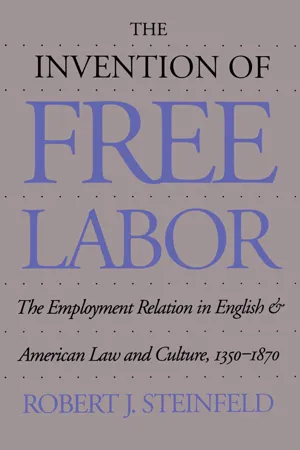
The Invention of Free Labor
The Employment Relation in English and American Law and Culture, 1350-1870
- 286 pages
- English
- ePUB (mobile friendly)
- Available on iOS & Android
eBook - ePub
The Invention of Free Labor
The Employment Relation in English and American Law and Culture, 1350-1870
About this book
Examining the emergence of the modern conception of free labor — labor that could not be legally compelled, even though voluntarily agreed upon — Steinfeld explains how English law dominated the early American colonies, making violation of al labor agreements punishable by imprisonment. By the eighteenth century, traditional legal restrictions no longer applied to many kinds of colonial workers, but it was not until the nineteenth century that indentured servitude came to be regarded as similar to slavery.
Information
Chapter 1 Introduction
Most histories of the English and American employment relationship1 operate from the implicit assumption that “free” labor has always represented the norm in the wage-labor relationship. “Unfree labor,” it is widely recognized, of course, occupied a central position in the medieval labor system. When villeinage grew rare in England, however, and the provision of labor came to be based primarily on consensual transactions in which individuals exchanged their labor for wages or other compensation, free labor, it is commonly assumed, was the form these transactions took. Over the last decade, to be sure, a number of historians have demonstrated just how quantitatively important one form of contractual but unfree labor, indentured servitude, was in colonial America. Even their work, however, has not substantially altered the sense that indentured servitude was somehow special, limited, and a deviation from contemporary norms. English labor of the period was heavily regulated; the public authorities, for example, were entitled to fix wages. Nevertheless, the ordinary wage work of the time is thought to have been nothing like indentured servitude. Today, the history of the labor relationship in England and America continues to be shaped by a basic image that has rarely been called into question: pockets of indentured servitude artificially created and maintained in a landscape in which contractual labor was otherwise free labor.
The argument and evidence presented in the following pages overturn this implicit framework. They show that in seventeenth-century England, the nearly universal legal form of consensual manual labor was not free labor but unfree labor. English law made the violation of most labor agreements punishable by imprisonment: a worker who agreed to work for a period of time or to perform some particular piece of work in exchange either for wages, for training, or for transatlantic transportation expenses was subject to imprisonment for failure to fulfill the agreement. Workers could be imprisoned until they were willing to return to their employers to complete the service they had agreed upon. These legal restrictions on departure applied not only to servants and apprentices but also to laborers and artificers. The early law of the American colonies followed the basic pattern of this English law in making labor agreements specifically enforceable or in subjecting workers to criminal penalties for failing to perform their undertakings.2 In the seventeenth century, English and American law did not unambiguously recognize any form of free labor in the modern sense of the term. Free labor as a self-conscious set of legal and social practices simply did not exist.
In the seventeenth century, unfree labor represented the “normal” legal form that contractual labor took in the Anglo-American world. Free labor—labor undertaken under legal rules that did not give employers either the right to invoke criminal penalties for departure or the right to specific performance—represented, when it first appeared in the American colonies early in the eighteenth century, a special rather than universal form of contractual labor. For more than a century thereafter, free labor continued to be restricted to certain forms of the labor relationship. Not until the nineteenth century did it become the paradigm for normal employment.
Early modern English and American labor law gave employers considerable legal control over the persons of their workers. Contemporaries conceived of this legal control in two distinct ways. On the one hand, they looked on it as a kind of jurisdiction or personal government that one person exercised over another. On the other, they viewed it as a kind of property that employers enjoyed in the services of their workers, a legal right to the exclusive use and enjoyment of their workers’ energies for the period or purposes specified in the agreement. These two ways of understanding a master’s legal authority over his workers held different implications for the future of the labor relationship. Beginning in the second half of the seventeenth century, the tradition that viewed the master’s legal control as property became an important constituent of the new market society just then emerging.
It is commonly assumed that the development of market society in England (and the American colonies) during the eighteenth century inevitably entailed the elimination of unfree labor. This book argues, by contrast, that in a social universe composed of individuals who freely buy and sell goods, it is possible for the transaction in which one individual “sells” the property in his labor to another to be conceptualized and legally constructed in a number of different ways. Such a transaction, for example, may be understood and legally constructed as a form of lease giving the lessee (employer) the enforceable legal right to possession and control of the leased “property” for the term of the lease. Or it is possible to construct such a transaction as a purely contractual relationship, in which the parties have specific performance or criminal penalties among their legal remedies for breach. The core assumptions of individualist market society—that the social universe is composed of numerous, independent individuals all of whom have a natural property in their own persons and all of whom are naturally disposed to exchange their goods with one another—leave ample scope for different legal and social specifications of what the sale of labor by one individual to another will entail.3 In themselves, these core assumptions do not require a particular definition of that transaction, such as the one associated with free labor.
By the eighteenth century, contractual unfree labor had in fact come to be viewed in the Anglo-American world primarily as the product of a voluntary bargain between two individuals. Rather than a medieval relic doomed to inevitable extinction by the spread of markets, contractual unfree labor had come to represent one way of operationally defining a regime of property and contract in labor. In England, the medieval tradition of prohibiting workers from leaving the work they had agreed to perform was recast. New statutes were enacted at intervals over the eighteenth century making breaches of labor contracts punishable by imprisonment, and throughout the century English workers who departed from their work were brought before local magistrates and imprisoned for violations of their agreements. In the American colonies, indentured servitude persisted as a common form of the sale of labor by one individual to another. Less and less did these legal forms of the employment relationship rest on antiquated medieval assumptions that labor was a resource of the community. More and more they rested on a particular legal construction of the idea that individuals owned themselves and were free to dispose of their energies in the marketplace. Over the century and a half following the English Revolution, the rights to performance that masters had long enjoyed were reconceived as the product of a transaction in which one perfectly free individual sold the property he held in his own energies to another individual for a term or for a particular purpose. Thereafter, that property was the employer’s, not the worker’s, for the term or purpose stipulated.
Other legal and social specifications of a regime of property and contract in labor were possible, of course, and free labor was one of these. But as such, it was no less “artificial” than the others. It merely represented the choice of a particular set of legal rules that withheld from masters certain remedies for breach they might otherwise have enjoyed, as part of a particular definition and legal construction of a transaction between two individuals. One legal specification of the transaction or another had to be consciously chosen since the generic sale of labor by one individual to another has no intrinsic legal definition of its own.
Because the qualities of the relationships produced under these alternative sets of legal rules were so different, it has been assumed that unfree contractual labor and free labor continued to be rooted in the logic of two quite different social and economic systems, one in medieval economy and society, the other in market economy and society. By the eighteenth century, on the contrary, the substantially different qualities of the two forms of contractual labor were the result primarily of the alternative legal incidents incorporated into the conveyance of property in labor. A few changes in the legal incidents by which such a transaction is operationally defined may completely transform the resulting relationship between the parties. Merely by making particular legal remedies available to masters, or by not making them available, a regime of property and contract in labor can produce institutions as different as indentured servitude and free labor.
When free labor first began to appear in the American colonies early in the eighteenth century, it did not displace indentured servitude. Rather, the two forms of contractual labor flourished alongside one another. A regime of property and contract in labor had come to be defined in the eighteenth-century colonies by these two alternative legal forms. Neither was considered the natural form of the labor relationship; both were equally norms for contractual labor in this period. The two merely represented alternative legal expressions of the idea that individuals owned and could freely sell the property in their own energies. In England in the same period, contractual labor was normally unfree labor. Most manual wage workers continued to be subject to criminal punishment for failure to perform their agreements. Workers could be committed and recommitted to jail or to the house of correction until they were willing to perform the service they had agreed upon. A definitive selection between these alternative ways of defining a regime of property and contract in labor did not take place either in England or America until the nineteenth century. In the end, it was not the inexorable logic of the market but a complex process of contingent social, cultural, and economic struggle in each place that led to the collective repudiation of unfree contractual labor.
In America, the last stages in this process occurred during the early decades of the nineteenth century. From its inception, indentured servitude had primarily been considered a form of contractual freedom. Following the American Revolution, however, its history became entangled with American efforts to abolish black slavery. Within a short time, Americans began to think about indentured servitude quite differently, as a form of involuntary rather than voluntary servitude and as essentially indistinguishable from slavery. Only after contractual servitude had been redefined in this way, surprisingly late in the game, did it begin to run directly afoul of the centuries-old English, and later American, antislavery tradition. In the wake of the redefinition of contractual servitude as a form of involuntary servitude, free labor gradually assumed its position as the sole legitimate form of the employment relationship among white adults. Forms of labor like indentured servitude came to be regarded with deep suspicion, and for the first time, free wage labor began to emerge as the unregulated, natural form of the employment relationship.
The argument of this book also bears on another basic historiographical issue. One tradition of historical writing has customarily portrayed the history of England and America as a story of the growth of personal liberty. Work in this tradition generally emphasizes the repressive side of medieval legal and political arrangements, celebrates the various struggles for liberty that took place over the centuries, and concludes by applauding the modern liberal achievement of individual legal and political rights. Other historiographical traditions have offered a quite different picture of the trajectory of Anglo-American civilization. Before markets came completely to dominate English social and economic life, and in particular before the commons were enclosed, the laboring poor ordinarily enjoyed some access to land. Access to land guaranteed them a measure of personal autonomy and economic independence from the wealthy. But by the end of the eighteenth century, succeeding enclosure movements had reduced the laboring poor to the status of propertyless wage workers. Their lives became increasingly wretched as they were subjected to harsher and harsher forms of economic exploitation. Some historians of colonial American society have detected a similar process at work in this country from the mid-seventeenth to the end of the eighteenth century. In New England, and in the urban colonial centers of New York and Philadelphia, tax and probate records have revealed a significant growth in the number of the poor and landless during this period. Without access to land or other productive capital of their own, members of this expanding segment of the population could not hope to enjoy the economic independence of their seventeenth-century forebears. By the end of the eighteenth century, the propertyless, especially in urban centers in America, constituted a considerable pool of economically vulnerable free-floating wage workers.
This book offers a different, more mixed picture of both earlier and later periods. By the middle of the fourteenth century, wage labor was common in England, though a good deal of it was performed on a casual, intermittent basis by people who also had some access to land. The English laboring poor of this period, however, were subject to an oppressive regime of legal regulation. The statutes of laborers and later the Statute of Artificers, which were enforced throughout the realm, represented a pervasive form of legal intervention in the lives of ordinary laboring people. A much less comprehensive system of legal regulation of employment was imported into the American colonies in the seventeenth century. But in institutions like indentured servitude, the laboring poor continued to be subjected to harsh forms of legal coercion. After the American Revolution, wage workers mounted a broad struggle and were ultimately successful in redefining the labor relationship as a relationship between juridical equals. By the 1820s, adult indentured servitude had come primarily to be viewed as involuntary servitude and by the 1830s had disappeared in the United States. These developments were genuinely liberatory, and whig historians have been right to portray them in that way. But they are only half the story.
The other half of the story is that the employment relationship continued to give employers enormous economic power in most cases over those who worked for them. Law continued to play an important role in this new regime of labor. In effect, the direct legal control that employers had previously enjoyed over employees gave way to another form of legal regulation that offered workers greater formal autonomy but continued indirectly to place them at the disposal of those who owned productive assets. Direct legal control gave way to indirect control. This story is neither one of a preindustrial golden age of wholeness and autonomy giving way to an era of nightmarish commercial and industrial exploitation nor one of a repressive medieval civilization giving way to a world of free markets, personal liberty, and political democracy. It is, rather, a story of one set of historical practices with one mix of kinds of freedom and unfreedom for laboring people replacing another set of historical practices with a different mix of kinds of freedom and unfreedom. Achieving legal autonomy represented a real gain for laboring people, but it also helped to obscure the systemic ways in which law continued to contribute to their oppression through the operation of the ordinary rules of property and contract in a world in which productive assets were unequally distributed.
Reversing Perspectives: Using Indentured Servitude to Rethink the History of the Employment Relationship
The argument of this book grows out of a particular approach to the history of the employment relationship. The normal field of perspective is reversed here. Indentured servitude is placed in the foreground rather than the background, and ordinary employment is examined from the resulting vantage point. In what relationship did indentured servitude stand to ordinary employment at different times? Did indentured servitude always represent the binary opposite of normal employment, as it does today? Or was there a time when it was considered to be among the practices that comprised normal employment?
This way of approaching the subject rests on the view that contractual servitude, which is ordinarily taken to be of only subsidiary importance in the history of employment, actually played (and continues to play) a structurally integral role in defining the shifting content and boundaries of normal contractual employment. The modern practice of free labor is defined as much by the institution of indentured servitude, with which it is contrasted, as by the normal labor practices it is taken to include. To understand modern free labor, it is not sufficient to know that it includes work voluntarily undertaken, for a specified period or purpose, in exchange for wages or other compensation, or even that it also stands in absolute contrast to slavery. If this were all we knew about free labor, it would not be clear whether a practice like indentured servitude constituted free labor. In indentured servitude, individuals voluntarily contract to s...
Table of contents
- Cover Page
- The Invention of Free Labor
- Copyright Page
- Contents
- Acknowledgments
- Chapter 1 Introduction
- Chapter 2 The Master-Servant Relationship in Early Modern England and the American Colonies
- Chapter 3 Labor Imagined
- Chapter 4 The Freeborn Englishman and the Persistence of Traditional Service
- Chapter 5 The Ambiguous Impact of the American Revolution
- Chapter 6 Working Out the Idea and Practice of Free Labor
- Chapter 7 The Federal Anti-Peonage Act of 1867
- Conclusion Self-Ownership and Self-Government in the Nineteenth Century
- Appendix Habeas Corpus File of Runaway Laborers, Chesapeake and Ohio Canal Company (1829)
- Notes
- Bibliography
- Index
Trusted by 375,005 students
Access to over 1.5 million titles for a fair monthly price.
Study more efficiently using our study tools.
Frequently asked questions
Yes, you can cancel anytime from the Subscription tab in your account settings on the Perlego website. Your subscription will stay active until the end of your current billing period. Learn how to cancel your subscription
No, books cannot be downloaded as external files, such as PDFs, for use outside of Perlego. However, you can download books within the Perlego app for offline reading on mobile or tablet. Learn how to download books offline
Perlego offers two plans: Essential and Complete
- Essential is ideal for learners and professionals who enjoy exploring a wide range of subjects. Access the Essential Library with 800,000+ trusted titles and best-sellers across business, personal growth, and the humanities. Includes unlimited reading time and Standard Read Aloud voice.
- Complete: Perfect for advanced learners and researchers needing full, unrestricted access. Unlock 1.5M+ books across hundreds of subjects, including academic and specialized titles. The Complete Plan also includes advanced features like Premium Read Aloud and Research Assistant.
We are an online textbook subscription service, where you can get access to an entire online library for less than the price of a single book per month. With over 1.5 million books across 990+ topics, we’ve got you covered! Learn about our mission
Look out for the read-aloud symbol on your next book to see if you can listen to it. The read-aloud tool reads text aloud for you, highlighting the text as it is being read. You can pause it, speed it up and slow it down. Learn more about Read Aloud
Yes! You can use the Perlego app on both iOS and Android devices to read anytime, anywhere — even offline. Perfect for commutes or when you’re on the go.
Please note we cannot support devices running on iOS 13 and Android 7 or earlier. Learn more about using the app
Please note we cannot support devices running on iOS 13 and Android 7 or earlier. Learn more about using the app
Yes, you can access The Invention of Free Labor by Robert J. Steinfeld in PDF and/or ePUB format, as well as other popular books in Law & British History. We have over 1.5 million books available in our catalogue for you to explore.