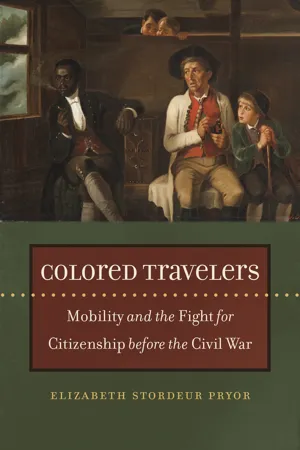
Americans have long regarded the freedom of travel a central tenet of citizenship. Yet, in the United States, freedom of movement has historically been a right reserved for whites. In this book, Elizabeth Stordeur Pryor shows that African Americans fought obstructions to their mobility over 100 years before Rosa Parks refused to give up her seat on a Montgomery bus. These were “colored travelers,” activists who relied on steamships, stagecoaches, and railroads to expand their networks and to fight slavery and racism. They refused to ride in “Jim Crow” railroad cars, fought for the right to hold a U.S. passport (and citizenship), and during their transatlantic voyages, demonstrated their radical abolitionism. By focusing on the myriad strategies of black protest, including the assertions of gendered freedom and citizenship, this book tells the story of how the basic act of traveling emerged as a front line in the battle for African American equal rights before the Civil War.
Drawing on exhaustive research from U.S. and British newspapers, journals, narratives, and letters, as well as firsthand accounts of such figures as Frederick Douglass, Harriet Jacobs, and William Wells Brown, Pryor illustrates how, in the quest for citizenship, colored travelers constructed ideas about respectability and challenged racist ideologies that made black mobility a crime.
eBook - ePub
Colored Travelers
Mobility and the Fight for Citizenship before the Civil War
- 240 pages
- English
- ePUB (mobile friendly)
- Available on iOS & Android
eBook - ePub
Colored Travelers
Mobility and the Fight for Citizenship before the Civil War
About this book
Information
CHAPTER ONE
Nigger and Home
An Etymology
In 1837, Hosea Easton, a black minister from Hartford, Connecticut, was one of the earliest black intellectuals to write about the word nigger. In several pages, he documented how it was an omnipresent refrain in the streets of the antebellum North, where it was used by whites to terrorize colored travelers. Reflecting on the ways in which the word nigger impacted African Americans, Easton painted a picture of an urban landscape in which “little urchins of Christian villagers” pestered black men and women as they passed. He said white parents and teachers used the word to instruct children that blacks were deficient but also to show how their own racial status was precarious. These adults disciplined white children with stories of nigger bogeymen and promised them that they would “have no more credit than a nigger” if they misbehaved. Children absorbed their racial lessons and reacted with open hostility when they saw real black people. White children taunted, “see nigger’s thick lips—see his flat nose—nigger eye shine—that slick looking nigger—nigger, where you get so much coat?—that’s a nigger priest.” As he moved throughout the North, Easton experienced a cacophony of children’s voices that “continually infest[ed] the feelings of colored travellers, like the pestiferous breath of young devils.” White adults were “heard to join in the concert.”1 Also in 1837, a white abolitionist concurred and highlighted how whites deployed the word nigger to hamper black mobility, noting that “if a negro walked the street, he was often hailed by men and boys with ‘Cuffee—nigger!’ or the like.”2
In the antebellum United States, colored travelers were acutely aware that travel at home—not the houses in which they lived but the streets, towns, and cities they traversed—was fundamentally inhospitable. Going out in public meant confronting the verbal assault nigger. This single word captured the magnitude of antiblack feeling and was unleashed on free people as they moved through urban space, rode public vehicles, and even ventured abroad. For free African Americans, independent travel within their hometowns and beyond was stressful, dangerous, and sometimes even deadly, and the ubiquity of the word nigger illuminated the limits of their freedom. Despite the fact that, by 1800, Vermont, New Hampshire, and Massachusetts were ostensibly free states, and that between 1780 and 1804, New York, Connecticut, Rhode Island, Pennsylvania, and New Jersey had passed a series of gradual abolition laws to end enslavement, the institution still left an indelible mark on the region.3 Without the racial control that slavery ensured, antiblack violence increased in the 1820s North.4
Before the 1770s, the labels “nigger” and “slave” were interchangeable, each describing an actual social category of involuntary black laborers. As African Americans became free in the North, however, nigger latched on like a shackle. White Americans of all classes and ages hissed out the word, branding free black people as foul smelling, unproductive, licentious, and unfit for self-rule. By the 1820s, blackness, not slavery, marked people of color as occupying a fixed social class. Most significantly, the word nigger became a slur in conversation with black social aspiration. In the early nineteenth century, a small but influential black middle class—a group characterized by education and activism, not necessarily prosperity—began to defy their prescribed roles as laborers.5 They asserted their right to have equal access to the goods and services designed for public consumption, including entrée into vehicles of transportation, theaters, taverns, and inns. To prevent such freedom of mobility, nigger emerged as a weapon of racial containment, a barometer against which to measure the increasingly rigid boundaries of whiteness as well as a mechanism used to police and cleanse public space.
Colored travelers such as Hosea Easton, David Walker, Frederick Douglass, J. W. C. Pennington, William Wells Brown, and Harriet Jacobs used the word nigger in their lectures and literary productions to expose and protest the complex relationship they had with the place they called home. An etymology of the word from descriptor to epithet shows how and why black activists designated it a verbal symbol of U.S. racial repression, even as African American laborers continued to use it.6 Indeed, the word became virulent precisely because black laborers integrated it into their own vocabularies, a practice that is an understudied and overlooked aspect of African American history. In other words, the label carried so much discursive weight because black laborers spoke it; self-identified with it as such; and thus, subverted notions of race and class identity in the United States. In turn, whites disavowed the word’s traceable European origins and by the 1820s were using it largely to mock black speech. In so doing, they placed the onus of black subordination on black people themselves, using African American vernacular to make inequality appear both logical and natural. By the 1830s, the transatlantic abolitionist movement was under way, and black activists unmasked the venomous dialectics of nigger. They elevated the word to an epithet, uttering it publicly with reluctance and only to demonstrate the oppressive inequality and political hypocrisy endemic to the country of their birth.
Making Sense of Nigger
By the 1830s, the term nigger reverberated with white belonging and black exile. To presume that it was always a white-only epithet, however, misses the point of its virulence. Instead, it was a word with multiple vantage points, a word whose meanings were complicated by the race and class of the person who spoke it. This is a fact exemplified by a close look at how David Walker used it in his famous 1829 manifesto Appeal: To the Coloured Citizens of the World.… Walker, a free man of color who penned his abolitionist pamphlet when he lived in Boston, used his writing as a forum to indict U.S. whites for slavery and their demeaning treatment of free people of color in the North. In Appeal, he invoked the word nigger four times, twice in the body of the work and twice in separate footnotes. Walker’s most familiar description confirms what modern readers already know. The word, he said, had Latin roots and had once designated “inanimate beings … such as soot, pot, wood, house, &c,” as well as animals. But Walker argued that by 1829 it had become the purview of U.S. whites, who spat it out at “Africans, by way of reproach for our colour, to aggravate and heighten our miseries, because they have their feet on our throats.”7 With this description, Walker signaled that nigger had become a powerful antiblack epithet, that whites used it with intention, and that its essence could only be illuminated through the use of a violent metaphor.
Even as Walker’s definition of nigger held whites solely accountable, when the word surfaced three more times in the pamphlet, each instance inadvertently revealed that black people used the word too. In one instance, the black abolitionist blurted it after a several-page diatribe. In his typical radical style, he debunked the prevailing white notion that in truth black men who sought equality wanted nothing more than to marry white women. Walker found such a proposition preposterous and, to prove his point, raged that any black man who wanted to marry a white woman “just because she was white, ought to be treated by her as he surely will be, VIZ: as a NIGER [sic]!!!!”8 At first glance, it seems that Walker was simply repeating the language of antiblack whites. If you fetishize whiteness, he declared, you deserve to be treated as badly as whites are sure to treat you. But whether ironically or not, Walker also unabashedly conjured an image of subservience to rebuke black men who sought intimacy with white women. In so doing, he himself actively called other black men niggers.
It might sound jarring to modern ears to hear a nineteenth-century black intellectual use nigger both unapologetically and against black people, but two more illustrations from the pamphlet illustrate that Walker was not the only person of color to do so. Walker devoted a large section of the provocative manifesto to analyzing the effects of slavery’s trauma on people of African descent.9 He argued that one of the most debilitating aspects of this trauma was that some African American men and women openly resisted a militant strategy for change. These were black folks who Walker dubbed the “ignorant ones,” meaning people he believed were satisfied not with slavery necessarily, but with its legacy, calling themselves “free and happy” in the face of their “wretchedness.”10 In the South, those he called the ignorant ones were slaves; in the North, Walker thought they were people who worked in service to whites without complaint, shining shoes, barbering, and laundering. To illustrate this subservience, Walker said he met an enslaved man in North Carolina who reasoned “a Nigar [sic], ought not to have any more sense than enough to work for his master.”11 Walker saw this particular self-naming and self-description as demeaning and obsequious. In an attempt to rectify such ignorance, Walker urged his proselytes to educate these black laborers, particularly in the North. He also warned that their conversion would not be an easy one. It seemed that the laboring poor did not think of themselves as ignorant and instead defied and dismissed other people of color who insisted they were. Walker cautioned, “when you speak to them for their own good, and try to enlighten their minds, [they] laugh at you, and perhaps tell you plump to your face, that they want no instruction from you or any other Niger [sic].”12 Here is another example of African Americans conjuring the word nigger, but this time it was poor men who deployed it as a social leveler. It was as if to say, “you are not better than us.” In her study of pre–Civil War New York City, historian Leslie Harris has identified similar instances where African Americans refused to privilege “middle-class, educated blacks and their tactics for racial improvement above more grass-roots political efforts that involved working-class blacks.”13 Like the subjects of Harris’s study, black laborers in Walker’s Boston similarly refused to assume that there was only one viable strategy for liberation, and they called out Walker and his followers for insisting there was. Still, of all the names they might have called Walker, why did they choose nigger? Moreover, if nigger had been white-only English, why would Walker portray African Americans who spoke it? And if the word was only an antiblack epithet, why might a free person of color rely on language meant to subjugate him?
These questions remain unanswered because even though David Walker’s Appeal offers just one of many instances in which African Americans used the word nigger in the nineteenth century, scholars have yet to fully analyze this practice. The idea that nigger was a seminal antiblack term that gained virulence as a slur in the 1820s and 1830s is a fact on which scholars agree. Cultural theorists such as Randall Kennedy and Jabari Asim and, for the early nineteenth century, historians David Roediger and Patrick Rael have done marvelous work demonstrating that white northerners became invested in wielding the word precisely at the moment when gradual abolition and emancipation began to free people of color in the North, a development that deeply impacted African American understandings of public space and mobility in the United States. Moreover, in an important observation, Rael even argues that, by the end of the antebellum period, middle-class whites and some southern gentlemen refused to use the word, not because they were antiracists but because they recognized nigger as the vocabulary of the lower classes.14 If Rael is correct that white people of a certain class felt too superior to utter (or at least admit to uttering) the word, it seems more likely that their aversion stemmed from African American usage rather than that of vulgar whites. Nevertheless, because scholars have shied away from the discussion, questions remain about the process by which nigger was transformed from a harsh descriptor to a violent epithet. Perhaps scholars fear that doing so might detract from social histories that foreground black agency and resistance.15 Ultimately, this avoidance diminishes understandings of the profound impact such language had on people of color in public space.
Notwithstanding scholarly reticence on the subject, there is ample evidence to suggest that from at least the early part of the eighteenth century, if not before, nigger was a multifaceted and complex part of black English that some people of colo...
Table of contents
- Cover
- Series Page
- Title Page
- Copyright
- Dedication
- Contents
- List of Figures
- Acknowledgments
- Introduction
- Chapter One: Nigger and Home: An Etymology
- Chapter Two: Becoming Mobile in the Age of Segregation
- Chapter Three: Activist Respectability and the Birth of the “Jim Crow Car”
- Chapter Four: Documenting Citizenship: Colored Travelers and the Passport
- Chapter Five: The Atlantic Voyage and Black Radicalism
- Epilogue: Abroad: Sensing Freedom
- Notes
- Bibliography
- Index
Trusted by 375,005 students
Access to over 1.5 million titles for a fair monthly price.
Study more efficiently using our study tools.
Frequently asked questions
Yes, you can cancel anytime from the Subscription tab in your account settings on the Perlego website. Your subscription will stay active until the end of your current billing period. Learn how to cancel your subscription
No, books cannot be downloaded as external files, such as PDFs, for use outside of Perlego. However, you can download books within the Perlego app for offline reading on mobile or tablet. Learn how to download books offline
Perlego offers two plans: Essential and Complete
- Essential is ideal for learners and professionals who enjoy exploring a wide range of subjects. Access the Essential Library with 800,000+ trusted titles and best-sellers across business, personal growth, and the humanities. Includes unlimited reading time and Standard Read Aloud voice.
- Complete: Perfect for advanced learners and researchers needing full, unrestricted access. Unlock 1.5M+ books across hundreds of subjects, including academic and specialized titles. The Complete Plan also includes advanced features like Premium Read Aloud and Research Assistant.
We are an online textbook subscription service, where you can get access to an entire online library for less than the price of a single book per month. With over 1.5 million books across 990+ topics, we’ve got you covered! Learn about our mission
Look out for the read-aloud symbol on your next book to see if you can listen to it. The read-aloud tool reads text aloud for you, highlighting the text as it is being read. You can pause it, speed it up and slow it down. Learn more about Read Aloud
Yes! You can use the Perlego app on both iOS and Android devices to read anytime, anywhere — even offline. Perfect for commutes or when you’re on the go.
Please note we cannot support devices running on iOS 13 and Android 7 or earlier. Learn more about using the app
Please note we cannot support devices running on iOS 13 and Android 7 or earlier. Learn more about using the app
Yes, you can access Colored Travelers by Elizabeth Stordeur Pryor in PDF and/or ePUB format, as well as other popular books in Social Sciences & North American History. We have over 1.5 million books available in our catalogue for you to explore.