This book is a carefully argued study of peasants and labor during the Somoza regime, focusing on popular movements in the economically strategic department of Chinandega in western Nicaragua. Jeffrey Gould traces the evolution of group consciousness among peasants and workers as they moved away from extreme dependency on the patron to achieve an autonomous social and political ideology. In doing so, he makes important contributions to peasant studies and theories of revolution, as well as our understanding of Nicaraguan history.
According to Gould, when Anastasio Somoza first came to power in 1936, workers and peasants took the Somocista reform program seriously. Their initial acceptance of Somocismo and its early promises of labor rights and later ones of land redistribution accounts for one of the most peculiar features of the pre–Sandinista political landscape: the wide gulf separating popular movements and middle–class opposition to the government. Only the alliance of the Frente Sandinista (FSLN) and the peasant movement would knock down the wall of silence between the two forces.
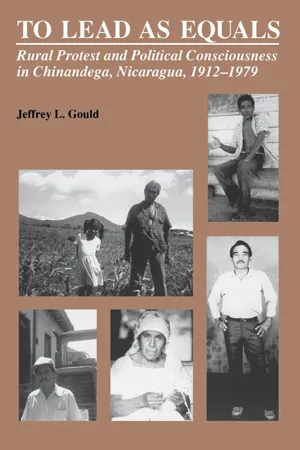
eBook - ePub
To Lead As Equals
Rural Protest and Political Consciousness in Chinandega, Nicaragua, 1912-1979
- 392 pages
- English
- ePUB (mobile friendly)
- Available on iOS & Android
eBook - ePub
To Lead As Equals
Rural Protest and Political Consciousness in Chinandega, Nicaragua, 1912-1979
About this book
Information
Part I
Labor and Politics, 1912–1949
1
We All Remember Joaquín: State, Capital, and Labor Relations in the Ingenio San Antonio, 1890–1936
Our company has always taken a great interest in the welfare of its workers, even before the introduction of the Labor code.
—El Ingenio San Antonio, 1953
Era un hombre muy fregado.
—Veteran worker recalling Constantino Lacayo, administrator of ISA, 1920–26
Since the 1920s, the San Antonio sugar mill in Chichigalpa, Nicaragua, has been that country’s largest manufacturing establishment. The sugar mill/plantation complex employed close to two thousand workers in 1920 and has since consistently employed far more workers than any other single enterprise. The owners of San Antonio were—and continue to be—the most economically powerful group in the Nicaraguan elite (the revolutionary government expropriated the sugar mill in 1988).
Any consideration of the development of Nicaraguan capitalism must take into account the history of the Ingenio San Antonio (ISA). Politics and economics have always been inseparable for its workers. Particularly after the U.S. Marines occupied Nicaragua in 1912 and bolstered the Conservative regime, the political Liberalism of the San Antonio workers was something of a popular revolutionary ideology—an elastic body of ideas that identified the economic and political antagonist, ISA, as the Conservative, capitalist oligarchy.
San Antonio laborers forged a highly politicized consciousness, not because of an adverse labor market, but because of the Conservative-owned sugar mill’s peculiarly tight relationship with the state. ISA depended on the state for antilabor repression, tariff protection, and high domestic prices. Politics and economics were inseparable for the San Antonio workers precisely because they also were inseparable for the company. Hence, sugar mill workers always seized opportunities presented by national political crises to gain support from elite sectors in undermining management’s political and economic domination. Workers rebelled against the company during the Liberal revolutions of 1912 and 1926, and in 1936 workers greeted Anastasio Somoza Garcia’s rise to power by organizing a union and declaring a general strike.
But despite their adherence to Liberal revolutionary ideology and their periodic outbursts of fierce opposition to San Antonio, sugar workers remained unorganized and quiescent for long periods of time. While part of this passivity was clearly due to the fear of repression, management’s paternalism also tended to promote quiescence. Thus San Antonio workers, who objectively had little chance of forging a successful union organization, developed what Juan Martinez-Alier has called a “double consciousness,” at once revolutionary and conservative.1
“There’s the Blackmail!”: San Antonio Under Zelaya
The history of San Antonio is definitely not a rags-to-riches story. In 1890, two Italians, Alfredo Pellas and Luis Palazio, who had accumulated sizable fortunes in the steamboat, mining, and import-export businesses, joined with three oligarchic families from the city of Granada and founded Nicaragua Sugar Estates, Limited. The company purchased 8,500 acres of land in Chichigalpa, in northwestern Nicaragua. Pellas journeyed to Scotland to buy sugar manufacturing equipment capable of producing 5,000 tons of sugar a year. He also obtained credit from English investors in the enterprise. The company, in fact, incorporated itself as an English firm. English capital may have accounted for up to one-third of the stock, whose total value was approximately 120,000 pounds sterling, remarkably high by Nicaraguan standards.2
British interest in the Nicaraguan sugar industry was a small part of its heavy commercial involvement in the region. Between 1886 and 1890, Central America exported over six million pounds sterling worth of goods to the United Kingdom. During the same period, the Central American republics imported over four million pounds sterling worth of goods from the United Kingdom.3 Sugar was a good investment in 1890, primarily because more than half of the sugar consumed in Nicaragua was imported from El Salvador. San Antonio planned to both supply the domestic market and export one-half of its production to neighboring countries.4
However, within two years of the first zafra (harvest) at San Antonio, the Liberal José Santos Zelaya came to power through a revolution. Zelaya ordered reprisals against his political enemies that ranged from public whippings to the confiscation of major haciendas. The Conservative stockholders of San Antonio were not spared this punishment.5 In 1897, his government prohibited the company from manufacturing aguardiente (cheap rum), claiming that it had awarded monopoly rights to new distilleries in León and Masaya. In the words of Diego Manuel Chamorro, future Nicaraguan president and close friend of the San Antonio group, “Allí está el chantage!” (There’s the blackmail!). “The situation was very serious for San Antonio since it meant losing large deposits of molasses. And then a saviour introduced himself to the Company’s directors: a representative of a Managua-based syndicate offered to lift the restriction if San Antonio would sell one-quarter of its sugar production, ten thousand quintals [approximately five hundred tons], at four pesos less than the going price. . . . The stockholders accepted the deal after many discussions.”6
San Antonio not only bowed to the demands, but also eventually joined the Zelaya-backed syndicate. It is possible that English investment in the company may have paved the way for San Antonio’s harmonious relationship with the Zelaya regime. Although the U.S. consul did not directly implicate San Antonio, he underscored British influence in the Nicaraguan sugar industry in 1897 when he wrote, “Believing that the free import of sugar would break the sugar trust existing in Nicaragua in the hands of English capitalists and it would open a magnificent field for the export of the surplus of sugar manufactured, in the United States, I called on President Zelaya and interviewed him about the probability of his approval.”7
President Zelaya refused the United States its request, arguing that he wished to protect “home industries.” Whether or not the merger between San Antonio and the Zelaya-backed syndicate took place in 1897, it is clear that by 1903 San Antonio formed an integral part of an extremely profitable, state-sponsored aguardiente monopoly, backed by English and Italian investors.8 Zelaya’s stand in favor of protectionism must be understood in the context of policies designed to create production and/or distribution monopolies. Similarly, San Antonio’s positive response to Zelayista extortion and trust-building must be seen as pragmatic business responses. By joining the local sugar-alcohol trust, Nicaragua Sugar Estates profitably swam with the dominant political tide.9
Zelaya believed that monopolies and tariff protection were essential aspects of an industrialization program. In the case of sugar, the domestic market amounted to only three thousand tons annually in the 1890s. Moreover, ISA faced stiff competition in the liquor trade. Nascent soap, cooking oil, shoe, beverage, and ice factories faced the same market restrictions, and, with the exception of the ice factory, all of these industries needed tariff protection.
Nonetheless, Zelaya’s monopoly concessions to new industrialists were often corrupt. San Antonio reportedly had to pay off the president annually. In the case of rubber, banana, mining, and lumber export industries, the governmental concessions involved grants of tens of thousands of acres in eastern Nicaragua, usually to foreign companies.10 The extent of Zelaya’s corruption is perhaps less important, however, than the way he began stimulating industrial growth where only imports existed before. Given the size of the domestic market, Zelaya’s monopolistic policy was quite rational and, at least with regard to nascent home industry, somewhat successful. For example, brick, soap, and oil factories, all employing over fifty workers, began operations under Zelaya.
San Antonio also expanded greatly during Zelaya’s rule. Its territorial size doubled, while its sugar production increased from 2,486 to 3,698 tons between 1899 and 1909. During these years, San Antonio established a sales connection with canneries in San Francisco, California, supplying them with more than 300 tons of sugar in 1901.11 The liquor monopoly was also extremely profitable. San Antonio and three smaller distilleries, partially owned by British and Italian investors, formed the liquor monopoly in 1904. The cartel rented the distribution rights from the government for $250,000. In 1903, once granted the monopoly, San Antonio and the other distilleries increased production and increased prices by an estimated 400 percent. The syndicate’s profits were extraordinary. Despite the increased government revenue, the very profitability of the monopoly angered a variety of social groups. Some people morally opposed the increased consumption of liquor, while others resented the monopoly price increase.12 The liquor cartel epitomized the political nature of the economy during the Zelaya era. When a United States-backed revolt drove out Zelaya in 1909, the new government’s first decree was the abolition of the cartel.
During the Zelaya years, politics dominated the economy in two distinct ways. First, the state intervened in the economy. Such intervention ranged from forced labor recruitment for coffee and sugar plantations to tariff protection.13 Second, since so much of the government’s program involved the creation of monopolies, politicized economics became quite personalized and by definition a matter of government favoritism. This latter form of political economy alienated a large sector of the elite who felt discriminated against by the Zelaya regime.
Following Zelaya’s fall, ISA managed to avoid political retaliation. San Antonio’s powerful connections in the Conservative party allowed it to avoid the economic reprisals that other Zelaya collaborators had to endure. On the contrary, ISA even received a $200,000 rebate on its liquor monopoly rent in 1911.14 Moreover, the Conservative regime did not abolish sugar tariffs, and thus San Antonio continued to dominate the domestic market.
Despite political turmoil, between 1909 and 1912 San Antonio’s sugar production increased by 26 percent.15 Politically, the San Antonio group’s reputation was damaged in some Conservative quarters, but their unparalleled economic power and their social prestige allowed them quickly to recover a dominant position in the party of the oligarchy. By 1912, when a Liberal revolution broke out, San Antonio was firmly identified with the Conservative government and its U. S. allies.
“For Their Skill and Strength”
On August 18, 1912, Liberal revolutionary forces occupied the town of Chichigalpa. Local residents, including San Antonio plantation workers, aided in the successful military operation against the governmental troops. The attack against Chichigalpa signaled the beginning of a revolutionary offensive against the United States-supported Conservative regime. During the next few days Liberal troops captured the nearby cities of León and Chinandega. Frightened by the revolutionary advance, and perhaps fearing for their lives, a group of foreigners connected to San Antonio sent an urgent message on September 3, 1912, to the U.S. Consul in Corinto, asking for military assistance. Within ten days, the U.S. government sent marines to occupy western Nicaragua.16 The military occupation of Chichigalpa was not an easy operation since the large majority of its two thousand inhabitants sympathized with the Liberal revolutionaries. Two months later, Chichigalpa residents staged a protest against the U.S. occupation. An official report dated October 4 evaluated the events in the following terms. “Lieutenant Long, in attempting to seize arms and some dynamite bombs early this morning, was closed in on by a considerable mob of rebel soldiers and others armed with rifles and machetes. Several rebels, disregarding orders of their officers, fired upon our marines, which fire was promptly returned and a skirmish ensued during which 13 rebels were killed and quite a number wounded and five of our men were slightly wounded. . . . Lieutenant Long . . . obtained possession of four dynamite bombs, which it is reasonable to believe were intended for use either against the railroad or our forces.”17
In 1983, eighty-two-year-old Alberto Cortés claimed to remember the events quite well. “The Chichigalpino rebels fought with machetes and one or two pistols,” he stated assuredly, as if he were discussing last Saturday’s barroom brawl. Don Alberto also remembered that when the battle ended, Lieutenant Long and his soldiers tied up thirteen insurgents and marched them to the steps of San Bias Cathedral, in the center of town. There, marines shot the rebels dead, including Don Alberto’s father. Several Chichigalpino residents share Don Alberto’s version of the events.18 Whether or not the local or the marines’ version is correct, the San Bias Massacre became part of local popular consciousness. This incident reinforced anti-oligarchic sentiments among Chichigalpinos who would begin to link their opposition to the Conservatives with their repudiation of U. S. activities in Nicaragua. These ideological developments, in turn, influenced the development of the social relations of production in San Antonio. For, following the U.S. defeat of the revolution, ISA had to face the political antagonism of its workers.
The territorial expansion of San Antonio from eighty-five hundred to seventeen thousand acres between 1890 and 1910 had forced local peasants off ejidal, indigenous, and individually owned land.19 Few of the expropriated peasants, however, had become permanent wage laborers. On the contrary, more than five hundred seasonal sugar workers maintained access to a peasant economy through kinship ties.20 Nevertheless, laborer resentment against ISA’s land expropriations deepened their political opposition to the company.
Despite worker antagonism, ISA did not suffer any serious labor conflicts between 1912 and 1926. Through a combination of repressive and paternalistic measures, ISA was able to achieve substantial control over its work force. Indeed, ISA increased its sugar production during that same period from 4,400 to 12,750 tons, with a comparable rise in profit. In 1920 and 1925, with favorab...
Table of contents
- Cover Page
- TO LEAD AS EQUALS
- Copyright Page
- Dedication
- Contents
- Acknowledgments
- Introduction
- Part I Labor and Politics, 1912–1949
- Part II The Campesino Movement and Somocismo, 1950–1964
- Part III Campesinos and the Sandinista Revolution, 1964–1979
- Conclusion
- Appendix 1 Chronology
- Appendix 2 Characters and Places
- Notes
- Bibliographical Essay
- Index
Trusted by 375,005 students
Access to over 1.5 million titles for a fair monthly price.
Study more efficiently using our study tools.
Frequently asked questions
Yes, you can cancel anytime from the Subscription tab in your account settings on the Perlego website. Your subscription will stay active until the end of your current billing period. Learn how to cancel your subscription
No, books cannot be downloaded as external files, such as PDFs, for use outside of Perlego. However, you can download books within the Perlego app for offline reading on mobile or tablet. Learn how to download books offline
Perlego offers two plans: Essential and Complete
- Essential is ideal for learners and professionals who enjoy exploring a wide range of subjects. Access the Essential Library with 800,000+ trusted titles and best-sellers across business, personal growth, and the humanities. Includes unlimited reading time and Standard Read Aloud voice.
- Complete: Perfect for advanced learners and researchers needing full, unrestricted access. Unlock 1.5M+ books across hundreds of subjects, including academic and specialized titles. The Complete Plan also includes advanced features like Premium Read Aloud and Research Assistant.
We are an online textbook subscription service, where you can get access to an entire online library for less than the price of a single book per month. With over 1.5 million books across 990+ topics, we’ve got you covered! Learn about our mission
Look out for the read-aloud symbol on your next book to see if you can listen to it. The read-aloud tool reads text aloud for you, highlighting the text as it is being read. You can pause it, speed it up and slow it down. Learn more about Read Aloud
Yes! You can use the Perlego app on both iOS and Android devices to read anytime, anywhere — even offline. Perfect for commutes or when you’re on the go.
Please note we cannot support devices running on iOS 13 and Android 7 or earlier. Learn more about using the app
Please note we cannot support devices running on iOS 13 and Android 7 or earlier. Learn more about using the app
Yes, you can access To Lead As Equals by Jeffrey L. Gould in PDF and/or ePUB format, as well as other popular books in History & British History. We have over 1.5 million books available in our catalogue for you to explore.