Throughout the Civil War, soldiers and civilians on both sides of the conflict saw the hand of God in the terrible events of the day, but the standard narratives of the period pay scant attention to religion. Now, in God’s Almost Chosen Peoples, Lincoln Prize–winning historian George C. Rable offers a groundbreaking account of how Americans of all political and religious persuasions used faith to interpret the course of the war.
Examining a wide range of published and unpublished documents — including sermons, official statements from various churches, denominational papers and periodicals, and letters, diaries, and newspaper articles — Rable illuminates the broad role of religion during the Civil War, giving attention to often-neglected groups such as Mormons, Catholics, blacks, and people from the Trans-Mississippi region. The book underscores religion’s presence in the everyday lives of Americans north and south struggling to understand the meaning of the conflict, from the tragedy of individual death to victory and defeat in battle and even the ultimate outcome of the war. Rable shows that themes of providence, sin, and judgment pervaded both public and private writings about the conflict. Perhaps most important, this volume — the only comprehensive religious history of the war — highlights the resilience of religious faith in the face of political and military storms the likes of which Americans had never before endured.
eBook - ePub
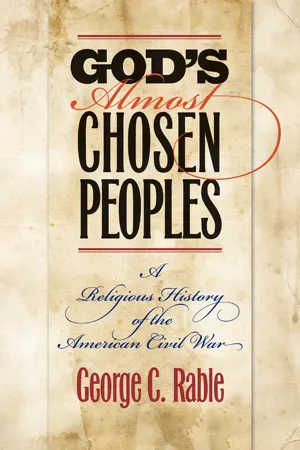
God's Almost Chosen Peoples
A Religious History of the American Civil War
- 586 pages
- English
- ePUB (mobile friendly)
- Available on iOS & Android
eBook - ePub
About this book
Information
Topic
EducationSubtopic
Teaching HistoryChapter 1 CRISES OF FAITH
As the Lord commanded Moses, so he numbered them in the wilderness of Sinai.
—Numbers 1:19
Therefore all things whatsoever ye would that men should do to you, do ye even so to them: for this is the law and the prophets.
—Matthew 7:12
Righteousness exalteth a nation: but sin is a reproach to any people.
—Proverbs 14:34
Ėmigré theologian and church historian Philip Schaff returned to Berlin in September 1854 to deliver two important lectures on the state of religion in his adopted country. Schaff's European background, American experiences, and ecumenical theology made him acutely sensitive to the relationship between religious practices and national character. Be it Sabbath observance, church schools, Bible societies, foreign missions, or worship attendance, he found Americans “already in advance of the old Christian nations of Europe.” In the United States, there were “probably more awakened souls, and more individual efforts and self-sacrifice for religious purposes... than in any other country in the world.”1
Such a comparison sounded more quantitative than qualitative, and that was no accident because Americans increasingly calculated ways to improve their lives and tried to measure such improvement precisely. This attribute had developed slowly, but even in matters of faith, what counted was often defined as what could be counted.2 Yet it was not until 1850 that the census offered the first crude numerical assessment of religion's central place in the United States. By then an estimated one in seven Americans was a church member; fifty years earlier it had been no more than one in fifteen. Some four to five million Americans adhered to some form of evangelical Protestantism, and if one counts children and adults who attended a church without joining, those numbers jump much higher.3 The religious mix of the population had changed radically. Congregationalists and Episcopalians had lost ground, and Presbyterians had more or less held their own. Baptists and especially Methodists had enjoyed explosive growth, and Catholics had steadily gained adherents in both eastern cities and the Midwest. During the final decade before the Civil War, the number of Jews roughly tripled.4
And any such estimates undercounted religious strength. Especially in the more evangelical groups, people who either doubted they had experienced a “second birth” or hesitated to proclaim it in front of a congregation nevertheless attended services. Without joining a church, thousands of Americans remained religious. During the Civil War, English journalist Edward Dicey reported that in New York the number of “churchgoers” is “larger in the proportion to the population than it would be in London.”5 All such generalizations revealed nothing about the depth of individual faith, the vitality of the churches, or the meaning of all this apparent spirituality for the wider society. And Dicey's statement paid no attention to the substantial number of Americans who remained outside any religious tradition.
The numbers of the faithful, however, were both striking and ironic. The steady erosion of established religion during the eighteenth century and the birth of an American republic conceived during the Enlightenment's heyday had launched an experiment in religious voluntarism. There may not have been a “wall” separating church and state under the Constitution but there was at least a fairly sturdy fence roping off public life from religious control. Yet at the same time, and especially with the revivalism of the so-called Second Great Awakening during the early decades of the nineteenth century, religion deeply influenced American society and culture. Religious and social life became intertwined for many Americans, and so even overblown estimates of conversions show how churches enticed the indifferent or merely curious into their orbit at least for a time.6
The growing power of organized and barely organized religion in American life extended well beyond the churches as cooperation in benevolent enterprises created any number of mission groups and reform societies. Campaigns against various sins, the desire to build holy communities, and a sense of God's presence in daily life produced not only a willingness to tackle social problems such as alcoholism and poverty but a conviction that such problems could ultimately be solved by human efforts aided by divine grace.7 Missionary, Bible, tract, and Sunday school societies embodied this organized benevolence: forming committees, raising money, and proselytizing across the nation. Much of this activity reflected expectations about an advancing Kingdom of God in America, a millennial optimism that became ever more prominent as religion assumed a larger role in American society and culture.8
Only one thing appeared to stand in the way of a glorious future: slavery. By the 1830s, equivocation and conservatism on the issue seemed utterly spineless to antislavery ministers and many of the laity for that matter. Abolitionists declared slavery a sin against God and man that demanded immediate action. In renouncing gradualism, colonization, and other halfway measures, abolitionists embraced a vision of America, its people, and its churches reborn free of sin. Whatever their differences over the legitimacy and efficacy of political action, William Lloyd Garrison and his fellow abolitionists believed the nation faced a clear choice between damnation and salvation. For some abolitionists, especially those who had lost their youthful spiritual fervor, the crusade against slavery became a substitute for religion. And in the calls for immediate emancipation, one could hear echoes of perfectionism and millennialism.9 Then, too, abolitionists took aim at southern churches that buttressed an unjust social order; what passed for religion there only mocked genuine Christianity. In the view of Garrison and countless others, southern ministers had become pawns of wealthy slaveholders and southern theologians apologists for oppression.10
The targets of such attacks responded swiftly and unequivocally. So far as defenders of slavery were concerned, the abolitionists assailed religion itself. The “parties in the conflict are not merely abolitionists and slaveholders,” declared James Henley Thornwell. “They are atheists, socialists, communists, red republicans, jacobins, on the one side, and friends of order and regulated freedom on the other. In one word, the world is the battle ground—Christianity and Atheism the combatants; and the progress of humanity at stake.”11 That this son of a poor overseer growing up without a father but also experiencing the nurturing kindness of a cousin and a teacher should view the conflict in such Manichaean terms and long for the protection of family and hierarchy in a cruel world is hardly surprising. His linking of slavery to human progress jars the modern reader but became common enough as southern intellectuals and politicians shifted from necessary evil to positive good arguments.
Stoop-shouldered and hollow-chested, the diminutive Thornwell sometimes seemed to be all intellect. He could lecture students on moral character, condemn novel reading, and declare social dancing immoral as readily as he could debate fine points of reformed doctrine. Wedded to theological abstractions but also drawn to creature comforts, Thornwell defended slavery as the linchpin of the southern social order. Many of his fellow Presbyterians owned human property, and like most apologists for slavery, Thornwell never commented much on particular slaveholders or slaves. Although readily acknowledging abuses in the master-slave relationship, Thornwell adopted an idealist approach to social problems that seldom examined the messiness, the conflicts, the fears, or the violence that were part and parcel of slave society. For example, he argued that slavery was not in fact property in man because slaveholders owned only the slaves’ labor and therefore slaveholder and slave could live harmoniously. Like John C. Calhoun, Thorn well reveled in such philosophical propositions without bothering to address the practical difficulties, much less the injustices inherent in a system of class and racial domination.12
Thornwell's literal reading of the scriptures turned into an intellectual trap, but then that was true for southerners and northerners of various theological stripes. Americans favored a commonsense understanding of the Bible that ripped passages out of context and applied them to all people at all times. Sola scriptura both set and limited the terms for discussing slavery and gave apologists for the institution great advantages. The patriarchs of the Old Testament had owned slaves, Mosaic Law had upheld slavery, Jesus had not condemned slavery, and the apostles had advised slaves to obey their masters — these points both summed up and closed the case for many southerners and no small number of northerners. Catholics, Episcopalians, Lutherans, African Americans, and even some Presbyterians might offer alternative ways of reading and applying scriptures to the slavery question, but none were convincing or influential enough to force the debate out of the rut of an often slavish (pun intended) literalism. Abolitionists vainly appealed to the spirit of the Gospel in an age that preferred citations to chapter and verse, and because they seemed to be losing the biblical argument, some decided to abandon religious appeals altogether.13
So long as the controversy centered on the Bible and slavery in the abstract as opposed to religion and slavery in practice, southern defenders of the institution felt confident. According to Robert Lewis Dabney, the “masses” plainly understood the matter—that “we must go before the nation with the Bible as the text, and ’Thus saith the Lord’ as the answer.... we know that on the Bible argument the abolition party will be driven to unveil their true infidel tendencies. The Bible being bound to stand on our side, they have to come out and array themselves against the Bible. And then the whole body of sincere believers at the North will have to array themselves, though unwillingly, on our side. They will prefer the Bible to abolitionism.” The appeal of such reasoning extended well beyond Presbyterian theologians such as Dabney and Thornwell. On the basis of their reading of the Hebrew scriptures, some American Jews found the case for slavery persuasive and suspected New England abolitionists of being anti-Semitic.14
Racial considerations underlay some religious arguments and certainly shaped popular thinking. Those church leaders who emphasized the biblical foundations for servitude often added that slavery was necessary to govern supposedly primitive Africans and was well adapted to their character. Even northern Episcopalians doubted that darker-skinned people would ever be capable of self-government, and one of their leading church papers declared that the Caucasian was “morally and intellectually superior to all other races, black, brown, red, or yellow.” The biblical curse of Ham that consigned Africans to permanent inferiority—an idea that could be traced back not only to rabbinical teachings but to the early church fathers—rested on thin textual evidence and required a great leap of logic to tie the incident involving Noah's son to any race at all, but that hardly prevented everyone from Brigham Young to conservative Presbyterians from trotting it out when needed.15
The absence of any consensus on slavery mirrored the country's religious diversity, despite the great success of evangelical revivals. Disagreements grew out of particular religious traditions or denominational divisions. Most notably, the “confessional” or “liturgical” churches were often more cautious and reticent in dealing with slavery, especially in contrast to evangelicals. Lutherans, for instance, often fought over doctrinal issues but avoided taking stands on political questions, though largely independent synods could chart their own course.16 Unitarians devoted far more energy to promoting liberal theology, genteel reform, and social respectability than to worrying about slavery. Their clergy—with some notable exceptions such as William Ellery Channing and Theodore Parker—had little stomach for angry confrontations with slaveholding southerners, and their churches depended on wealthy, conservative supporters who deplored political agitation.17
In Hartford, Connecticut, with its strong economic ties to the South, Con-gregationalist Horace Bushnell sounded a similar note. He tempered opposition to slavery and his own romantic idealism with concern for social stability. His evolving idea of Christian nurture stemmed from a belief in the organic but increasingly fragile unity of church and family. To Bushnell, the debates over slavery above all else threatened to destroy the sacred Union. As for slaveholders, he advised them to prevent the breakup of slave families, hoping they would ultimately see the wisdom of emancipation. Like all too many moderates, Bushnell saw little future for freed blacks in the United States, though the whole question of territorial expansion eventually pushed him into declaring slavery a national curse. Even then, however, he never gave up searching for an ever more elusive middle ground.18
In many ways the most agonizing quest for answers to the slavery question occurred among the already fractured Presbyterians. The 1801 Plan of Union between the Presbyterians and Congregationalists had marked an alliance between evangelical religion and moral reform, but theological fissures soon appeared. The “Old School” Presbyterians remained staunch Calvinists, skeptical about the younger revivalists and reformers. The slowly developing and theologically heterodox “New School” faction espoused cooperation with Con-gregationalists and interdenominational societies. By 1838 the New School forces had been driven out or withdrawn (depending on one's theological perspective) from the General Assembly and, in effect, formed their own denomination.19
The Presbyterian schism did not grow directly out of divisions over slavery, though southerners went largely with the Old School faction. Like many religious conservatives and moderates, Presbyterian leaders struggled mightily to prevent the slavery question from disturbing their churches. A faculty member at Princeton Theological Seminary for more than half a century, editor and theologian Charles Hodge rejected Thornwell's biblical defense of slavery but denied that slavery was a sin in itself. In 1844 he wrote to a British friend deploring recent criticism of American churches. Pilate-like, he absolved them of any responsibility for the evils of slavery: “It cannot do us any good to tell us that it is wrong to be cruel, to be unjust, to separate husbands and wives, parents and children, or to keep servants in ignorance. Our churches do not sanction any of these things, though our laws often do.” Kentuckian Robert J. Breckinridge partly agreed with Hodge but had freed his own slaves and denied that slavery as practiced in the southern states was sanctioned by the Bible. Indeed, he believed that God had created everyone free (though hardly equal). Ironically, his antislavery convictions waned after the 1830s, even though he remained a staunch and prickly Unionist.20
The desire for peace and order (and not solely among Presbyterians) ran deep and grew out of real concern for the churches’ mission in the world. Keeping mum about slavery often became the price for evangelical success, especially for interdenominational organizations. The American Bible Society, the American Tract Society, and the American Sunday School Union had all thrived by steering clear of sectional questions.
Yet increasingly charge and countercharge became the pattern as churches, ministers, and the laity battled over slavery. Disputes over the Bible divided the clergy and sometimes denominations, but there was very little real discussion and hardly any give-and-take. Abolitionists and proslavery ideologues staked out uncompromising positions, though moderates could be equally dogmatic. Almost everyone talked past one another. People tossed around terms such as infidelity, corruption, and sin carelessly and self-righteously. Some cast themselves with the apostles in the book of Acts, preaching divine truth and letting the consequences take care of themselves. Those seeking peaceful accommodation faced great difficulties but always placed a premium on order and especially on union in church and state. At stake was the mission of the churches and seemingly their very souls.
The steady decline of antislavery sentiment in southern churches, most dramatically among the Methodists and Baptists, helped solidify the position of clergymen and their flocks in the southern social order. Patriarchy, hierarchy, and subordination in household, congregation, and community all exalted the authority of Christian masters and not coincidentally their clerical allies. Therefore, it was easy for proslavery clergy to spurn the Enlightenment legacy of equality and natural rights. Responding to abolitionist charges that slave-holding violated the golden rule, leading southern Baptist Richard Furman maintained that this law of love did not overturn the “order of things, which the divine government has established.” A father wished his son to obey his instructions, but that hardly meant that the father should also obey the son. Creditors could not simply forgive debtors, nor would rich men distribute property to their poor neighbors. Rather all people must be treated under the law of the Gospel according to their station in life. Fellow Baptist Basil Manly agreed that the master-slave rel...
Table of contents
- Cover Page
- GOD'S ALMOST CHOSEN PEOPLES
- Copyright Page
- CONTENTS
- ILLUSTRATIONS
- PROLOGUE
- Chapter 1 CRISES OF FAITH
- Chapter 2 REAPING THE WHIRLWIND
- Chapter 3 HOLY WAR
- Chapter 4 FIGHTING FOR GOD AND COUNTRY
- Chapter 5 TEMPTATIONS OF THE CAMP
- Chapter 6 THE SHEPHERDS AND THEIR SHEEP
- Chapter 7 CHRISTIAN SOLDIERS
- Chapter 8 THE GOD OF BATTLES
- Chapter 9 CARNAGE
- Chapter 10 WAR'S PURPOSE
- Chapter 11 THE LORD'S WORK
- Chapter 12 TESTING FAITH
- Chapter 13 DECLENSION
- Chapter 14 WRATH
- Chapter 15 JUBILO
- Chapter 16 ARMIES OF THE LORD
- Chapter 17 WAR COMES TO THE CHURCHES
- Chapter 18 CITIZENS, SAINTS, AND SOLDIERS
- Chapter 19 THANKSGIVING AND DESPERATION
- Chapter 20 THE FINAL DECREES OF PROVIDENCE
- EPILOGUE
- NOTES
- BIBLIOGRAPHY
- ACKNOWLEDGMENTS
- INDEX
Trusted by 375,005 students
Access to over 1.5 million titles for a fair monthly price.
Study more efficiently using our study tools.
Frequently asked questions
Yes, you can cancel anytime from the Subscription tab in your account settings on the Perlego website. Your subscription will stay active until the end of your current billing period. Learn how to cancel your subscription
No, books cannot be downloaded as external files, such as PDFs, for use outside of Perlego. However, you can download books within the Perlego app for offline reading on mobile or tablet. Learn how to download books offline
Perlego offers two plans: Essential and Complete
- Essential is ideal for learners and professionals who enjoy exploring a wide range of subjects. Access the Essential Library with 800,000+ trusted titles and best-sellers across business, personal growth, and the humanities. Includes unlimited reading time and Standard Read Aloud voice.
- Complete: Perfect for advanced learners and researchers needing full, unrestricted access. Unlock 1.5M+ books across hundreds of subjects, including academic and specialized titles. The Complete Plan also includes advanced features like Premium Read Aloud and Research Assistant.
We are an online textbook subscription service, where you can get access to an entire online library for less than the price of a single book per month. With over 1.5 million books across 990+ topics, we’ve got you covered! Learn about our mission
Look out for the read-aloud symbol on your next book to see if you can listen to it. The read-aloud tool reads text aloud for you, highlighting the text as it is being read. You can pause it, speed it up and slow it down. Learn more about Read Aloud
Yes! You can use the Perlego app on both iOS and Android devices to read anytime, anywhere — even offline. Perfect for commutes or when you’re on the go.
Please note we cannot support devices running on iOS 13 and Android 7 or earlier. Learn more about using the app
Please note we cannot support devices running on iOS 13 and Android 7 or earlier. Learn more about using the app
Yes, you can access God's Almost Chosen Peoples by George C. Rable in PDF and/or ePUB format, as well as other popular books in Education & Teaching History. We have over 1.5 million books available in our catalogue for you to explore.