Challenging recent trends both in historical scholarship and in Supreme Court decisions on civil rights, J. Morgan Kousser criticizes the Court’s “postmodern equal protection” and demonstrates that legislative and judicial history still matter for public policy.
Offering an original interpretation of the failure of the First Reconstruction (after the Civil War) by comparing it with the relative success of the Second (after World War II), Kousser argues that institutions and institutional rules — not customs, ideas, attitudes, culture, or individual behavior — have been the primary forces shaping American race relations throughout the country’s history. Using detailed case studies of redistricting decisions and the tailoring of electoral laws from Los Angeles to the Deep South, he documents how such rules were designed to discriminate against African Americans and Latinos.
Kousser contends that far from being colorblind, Shaw v. Reno (1993) and subsequent “racial gerrymandering” decisions of the Supreme Court are intensely color-conscious. Far from being conservative, he argues, the five majority justices and their academic supporters are unreconstructed radicals who twist history and ignore current realities. A more balanced view of that history, he insists, dictates a reversal of Shaw and a return to the promise of both Reconstructions.
eBook - ePub
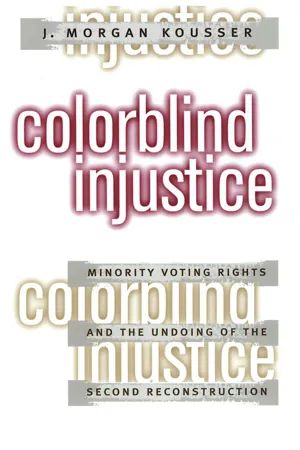
Colorblind Injustice
Minority Voting Rights and the Undoing of the Second Reconstruction
- 608 pages
- English
- ePUB (mobile friendly)
- Available on iOS & Android
eBook - ePub
Colorblind Injustice
Minority Voting Rights and the Undoing of the Second Reconstruction
About this book
Information
CHAPTER ONE
The Voting Rights Act and the Two Reconstructions
It is not only historians who name eras, make analogies, draw lessons from the past. As the Selma March was approaching Montgomery, Alabama, in 1965, and as Congress was pushing House Resolution 6400 toward passage, the Montgomery Advertiser, sensing the strong national current, remarked, “It is almost certain that President Johnson’s reconstruction bill will be enacted” (MA, Mar. 17, 1965, quoted in Lawson 1976, 314). The President Johnson referred to was not Andrew, but Lyndon; the “reconstruction” was not the First, but the Second; and the bill was not the “Force” or “Ku Klux” laws, but the Voting Rights Act. Renewed in 1970, 1975, and 1982, the Voting Rights Act (VRA) has been repeatedly attacked as antisouthern, as an infringement on matters better left to state and local governments, as unconstitutionally color-conscious, and, most important, as unnecessary. It is therefore both desirable and safe, according to VRA opponents, to dismantle this last vestige of the Second Reconstruction.
Such critics endanger the gains of the Second Reconstruction by ignoring or misunderstanding the history of the First. Despite the constitutional guarantees of equal protection of the laws and racially impartial suffrage established by the Fourteenth and Fifteenth Amendments, which were ratified in 1868 and 1870, African-Americans gradually lost political power and the right to vote in the late nineteenth century. Twenty-five years after the passage of the Fifteenth Amendment, for instance, Ben Tillman’s faction of the Democratic Party of South Carolina passed a temporary registration law to prevent blacks from voting in a referendum on calling a disfranchising convention, insured that the convention would be held by stuffing the ballot box, struck a deal with the faction’s upper-class opponents to disfranchise many poor whites along with nearly all blacks, and proclaimed the new constitution without offering the voters a chance to reject it. The Palmetto State was not alone. By the time the South Carolina convention met in 1895, the Democratic leadership of Mississippi had jammed through a similar constitutional disfranchising scheme without holding any referenda at all; Georgia, Florida, Tennessee, and Arkansas had buttressed white Democratic supremacy with poll tax qualifications; and every other ex-Confederate state except North Carolina had enacted some direct restriction on voting with the predominant intent and effect of disproportionately disadvantaging African-Americans. By the end of the year 1900, thirty years after the enactment of the Fifteenth Amendment, Louisiana and North Carolina had amended their state constitutions to disfranchise the vast majority of blacks, and Alabama and Virginia were in the process of calling or holding disfranchising conventions (Kousser 1974). It would be sixty-five years before African-Americans could vote freely throughout the country, seventy-two before a southern state would elect another black member of Congress.
What a contrast with the situation a generation after the passage of the Voting Rights Act, when notable anniversaries of its passage became the occasions for celebratory conferences! By 1990, when the VRA was the same age as the Fifteenth Amendment had been in 1895, Virginia had become the first state in the nation to elect a black governor, 24 blacks and 10 Latinos sat in Congress, there were 417 black and 124 Latino state legislators and 4,388 black and 1,425 Latino officers of city or county governments, six of the ten largest cities in the country had had black mayors, and nationally, 59 percent of blacks and 64 percent of whites were registered to vote. By 1995, on the VRA’s thirtieth birthday, the politics of race were both more and less favorable to minorities, and the joy was mixed with trepidation. On the one hand, the 1990s round of redistricting had fully realized the promise of the 1982 amendments to the Voting Rights Act that minorities should enjoy the same opportunities as whites “to participate [in elections] and to elect candidates of their choice” (U.S. Senate 1982b, 31). In 1993, the number of African-American and Latino elected officials totaled 57 in Congress, 686 in state legislatures, and 6,842 in city or county governments. Voter registration percentages—which stood at 30 percent for Latinos, 58 percent for blacks, and 64 percent for whites in 1994—seemed sure to rise substantially as a result of the 1993 passage of the National Voter Registration Act, or “Motor Voter” Act (U.S. Department of Commerce 1990, 257, 260–61, 264; 1993, 283; 1995, 281, 287). On the other hand, the conservative majority on the U.S. Supreme Court had broadened its assault on guarantees of educational and economic opportunities for minorities to include the electoral arena, attacking “racial gerrymandering” that benefited minorities, a move that threatened ultimately to unseat as many as half of the nation’s elected minority officials. The present was bright, but the future was threatening.
Why the contrast between the two Reconstructions? I will argue in this chapter that a detailed comparison of certain aspects of the two Reconstructions will help us to understand both of them more adequately and that such lessons, if absorbed, may allow the nation to avoid the deepest parts of a racist reaction like the one that followed the First Reconstruction, a reaction that currently seems well advanced.1 On the one hand, by making us more conscious of the problematic nature of outcomes that are too often taken for granted, the comparison provides a new approach to the classic question of why the First Reconstruction failed. On the other hand, the analogy throws a different light on controversies over the intent, development, consequences, and desirability of the Voting Rights Act, its interpretations, amendments, proposed relaxation, and undermining by the courts, and perhaps, in the future, by Congress.
HISTORIANS have spent much more energy in documenting than in explaining the collapse of the First Reconstruction, and there have been almost no serious attempts to explain the reasons for the strange career of the Second Reconstruction. In a 1989 essay, for instance, C. Vann Woodward, the scholar who invented the term “Second Reconstruction” for the period since 1954 and who almost singlehandedly initiated the comparative history of America’s First Reconstruction, confessed, in his typically ironic tone, to failure. Not only had the First Reconstruction failed, remarked Woodward, but he personally had failed “to find a satisfactory explanation for the failure of Reconstruction” (1989, 199). In contrast, Eric Foner, no doubt constrained by the textbook format of his masterwork on the First Reconstruction, could not afford Woodward’s rather coy reticence. Summarizing much historiography, Foner enumerated six reasons for the demise of Reconstruction, or what he called “America’s unfinished revolution”: violence, “the weakening of Northern resolve,” the inability of southern Republicans to develop a long-term appeal to whites, factionalism and corruption within the GOP, the rejection of land reform, and changing patterns in the national and international economic system (1988, 603). William Gillette added to this list “the resurgence of racism in political campaigning” and judicial restrictions on federal action (1979, xi). Some historians, particularly Marxists, have considered the failure of the First Reconstruction inevitable. Manning Marable, for example, contended that “the failure of the federal government to recognize the necessity for massive land redistribution, along the lines of what blacks themselves called ‘forty acres and a mule,’ would be the principal reason for the failure of the First Reconstruction” (1991, 6). Applying an only slightly less deterministic approach, the “new institutionalist” perspective in political science, Richard Bensel (1990) saw the failure of the First Reconstruction as predestined because of the underdeveloped condition of national political institutions at the time, particularly their inability to control southern white violence. Less deterministic and more aware of post-1877 events than Bensel, Richard Valelly (1993a, 1993b, 1995) considered the puzzle of disfranchisement to be why the Republican party, once it achieved unified control of the federal government after 1896, did not try very hard to reopen Reconstruction questions, reversing disfranchisement where it had occurred and impeding it where it had not. Why, in other words, did a Second Reconstruction not take place at the turn of the nineteenth century?
Probably because the death rattle of the Second Reconstruction is still sounding and there is no convenient symbol for its demise, as the Compromise of 1877 has usually been taken to have been the endpoint of the First Reconstruction, scholars have been even less inclined to suggest reasons for its combination of successes and failures than for those of its predecessor. Comparisons of the two have rarely gone beyond rhetorical gestures. I will argue that rather different and perhaps more satisfying answers to the general question of why the First Reconstruction failed may be obtained by simultaneously narrowing and lengthening the inquiry. To render the problem tractable, I will concentrate solely on politics. Although a great deal can be learned by comparing race relations in post-Civil War America to those in other post-emancipation societies, keeping the comparative focus within the same country has the advantage of allowing us, in effect, to hold most political institutions constant. And instead of truncating the first period at 1877, when the revolution was not only unfinished, it had perhaps only paused, I will carry my analysis of the First Reconstruction through the end of the nineteenth century. It was only then that white supremacists finally felt relatively safe from the threat of black political power.
BECAUSE the argument of this chapter is novel and because its emphasis on institutions, incrementalism, and intent pervades every chapter of the book, it may help to outline it before considering it in detail. Although highly visible events, such as the passage of the Fifteenth Amendment or the VRA or the upsurge of southern violence in the 1870s, create possibilities for change, progressive or retrogressive, it is smaller, less noticed changes that determine whether those possibilities will be actualized and whether the changes will endure. Thus, incremental changes, legal and extralegal, gradually undermined the constitutional guarantees of equal protection and impartial suffrage in the late nineteenth and early twentieth centuries. Each nineteenth-century tactic became more effective as it allowed others to be employed. Violence and intimidation enabled Democrats to take over the polls, after which they could fabricate election returns. Fraudulently elected officials of state and local governments could then gerrymander election districts, switch from ward-based to at-large elections, or impose other structurally discriminatory devices. Because their numbers were decreased, Republican, Independent, or Populist representatives on governing bodies were thereafter even less able to block the passage of direct legislative and, ultimately, state constitutional restrictions on the suffrage. But federal action by Congress or the judiciary might have short-circuited the process at any point—and repeatedly came close to doing so—not just at the violence stage.
Likewise, a hundred years later, in the Second Reconstruction, political equality for minorities did not come about in a single congressional act. Because no legislation perfectly fulfills all the goals of its proponents, because situations sometimes change in ways that are difficult to predict in advance, and because people sometimes change their goals, laws and administrative practices typically develop incrementally.2 These truisms are particularly apposite for unpopular minorities, for altering politics, economics, and society to treat them more fairly requires long and especially steady vigilance. The struggle to pass the VRA took a generation, and its development into an effective weapon to guarantee minorities equal opportunities to elect officials of their choice lasted another generation. If persistent pressure is a necessary condition for minority success in a democracy, then the crucial questions become: Which political conditions are most likely to produce a regime of progressive policy incrementalism and, on the other hand, which conditions are more likely to allow or encourage the undermining of hard-won gains?3 The answer, I suggest, is that too much instability in officeholders and policies threatens minorities. The First Reconstruction failed because the political system was too democratic, too unstable. The Second Reconstruction has succeeded better because, until recently, electoral change and changes in the personnel of the judicial system have come about slowly, allowing minorities and their white allies to learn from and correct the inadequacies of previous policies. Relaxation or reversal of the federal government’s tenacious protection of minority rights by the forces of an antigovernment, pro-states’ rights counterrevolution risks beginning again a process similar to that which unraveled the First Reconstruction. In a democracy, upheaval is most often the enemy of minority rights.
IN THE minds of both moderate and Radical Republicans, the centerpiece of Reconstruction was the vote. “A man with a ballot in his hand,” the abolitionist Wendell Phillips declaimed, “is the master of the situation. He defines all his other rights. What is not already given him, he takes. . . . The Ballot is opportunity, education, fair play, right to office, and elbow-room” (quoted in Gillette 1979, 23). But even as they celebrated passage of the Fifteenth Amendment in 1870, Republicans were not so naïve as to believe that the right to vote was self-executing, as Phillips’s and other similar statements might seem to imply.4 All too aware of the difficulty of struggles over black enfranchisement even in the North, where blacks were largely disfranchised in 1865 and where white voters rejected racially equal suffrage in eight of eleven referenda from 1865 to 1869 (Foner 1988, 223), Radicals fully realized that enfranchisement required practical safeguards against evasion and retrogression. From the first congressional draft of the Fourteenth and Fifteenth Amendments, therefore, proponents of racially impartial suffrage banned abridgement as well as outright denial of the right to vote of any loyal, noncriminal, adult male citizen.5 Although they never specified in reports or floor debates from 1866 to 1869 exactly what practices “abridgement” prohibited, congressmen probably had in mind the widely known example of New York, where in 1821 Martin Van Buren and his allies in the “Albany Regency” had imposed a $250 property requirement on blacks but not on whites and where attempts to repeal the discriminatory standard had failed, though by ever closer margins, in referenda in 1846, 1860, and 1869 (Field 1982, chaps. 2, 4, 6; Mathews [1909] 1971, 14–15, 25, 34, 38–39).6
The meaning of the word “abridge” was by no means the only ambiguity in the deceptively simple Fifteenth Amendment. After Congress enfranchised blacks in ten southern states through the 1867 Military Reconstruction Act, white Democrats in Georgia, reasoning that the right to vote did not imply the right to hold office, expelled all the blacks elected to the subsequent state legislature (Drago 1982, 48–49, 55–56). When in 1869 Congress first explicitly guaranteed the right of African-Americans to hold office, then deleted that provision from the Fifteenth Amendment, did they do so, as historian William Gillette claimed, with the intent of allowing racial restrictions on officeholding? Or, as prominent Radical congressmen and senators asserted at the time, was the connection between voting and officeholding so obviously close as to make formal protection of the latter superfluous, and might mentioning it explicit...
Table of contents
- Cover Page
- Colorblind Injustice
- Copyright Page
- Dedication
- Contents
- Figures and Tables
- INTRODUCTION Institutions and the Struggle for Equality
- CHAPTER ONE The Voting Rights Act and the Two Reconstructions
- CHAPTER TWO Real Racial Gerrymandering—Lessons from L. A.
- CHAPTER THREE Changing the Rules to Preserve White Supremacy in Memphis
- CHAPTER FOUR Controlling the “Bloc Vote” in Georgia
- CHAPTER FIVE A Century of Electoral Discrimination in North Carolina
- CHAPTER SIX Traditional Districting Principles, Texas-style
- CHAPTER SEVEN Intent and Effect in Law and History
- CHAPTER EIGHT Shaw and Postmodern Equal Protection
- CHAPTER NINE History and Equality
- Notes
- Bibliography
- Index
Trusted by 375,005 students
Access to over 1.5 million titles for a fair monthly price.
Study more efficiently using our study tools.
Frequently asked questions
Yes, you can cancel anytime from the Subscription tab in your account settings on the Perlego website. Your subscription will stay active until the end of your current billing period. Learn how to cancel your subscription
No, books cannot be downloaded as external files, such as PDFs, for use outside of Perlego. However, you can download books within the Perlego app for offline reading on mobile or tablet. Learn how to download books offline
Perlego offers two plans: Essential and Complete
- Essential is ideal for learners and professionals who enjoy exploring a wide range of subjects. Access the Essential Library with 800,000+ trusted titles and best-sellers across business, personal growth, and the humanities. Includes unlimited reading time and Standard Read Aloud voice.
- Complete: Perfect for advanced learners and researchers needing full, unrestricted access. Unlock 1.5M+ books across hundreds of subjects, including academic and specialized titles. The Complete Plan also includes advanced features like Premium Read Aloud and Research Assistant.
We are an online textbook subscription service, where you can get access to an entire online library for less than the price of a single book per month. With over 1.5 million books across 990+ topics, we’ve got you covered! Learn about our mission
Look out for the read-aloud symbol on your next book to see if you can listen to it. The read-aloud tool reads text aloud for you, highlighting the text as it is being read. You can pause it, speed it up and slow it down. Learn more about Read Aloud
Yes! You can use the Perlego app on both iOS and Android devices to read anytime, anywhere — even offline. Perfect for commutes or when you’re on the go.
Please note we cannot support devices running on iOS 13 and Android 7 or earlier. Learn more about using the app
Please note we cannot support devices running on iOS 13 and Android 7 or earlier. Learn more about using the app
Yes, you can access Colorblind Injustice by J. Morgan Kousser in PDF and/or ePUB format, as well as other popular books in History & North American History. We have over 1.5 million books available in our catalogue for you to explore.