The story of modern politics in North Carolina is very much one of American democracy, with all its grand ambitions, limitations, and pitfalls. So argues Tom Eamon in his probing narrative of the state’s political path since the 1940s. He charts the state’s political transformation into a modern democratic society to show that this change was more than an evolution — it was a revolution, one that largely came about through political means, driven by strong movements and individuals working for change.
By tracking the turbulence of politics throughout the period, from racial tensions to student demonstrations to fierce rivalries in the higher education arena, Eamon explores how conflict helped build a better society even as the state continued to lag in many areas. This rich account opens to readers the unforgettable people and hard-fought elections that have shaped North Carolina’s competitive personality and have led to the state’s emergence as a major player in twenty-first-century American politics.
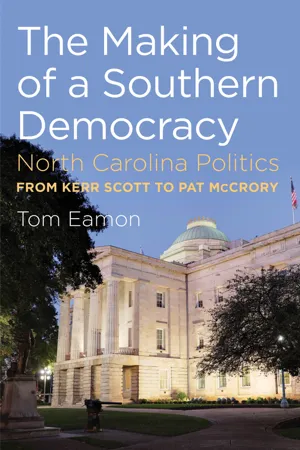
eBook - ePub
The Making of a Southern Democracy
North Carolina Politics from Kerr Scott to Pat McCrory
- 416 pages
- English
- ePUB (mobile friendly)
- Available on iOS & Android
eBook - ePub
About this book
Information
CHAPTER ONE
Uprisings
It is a well-known genre, especially in the American South—the self-proclaimed economic populist running for office on a platform calling for more abundant lives for struggling, ordinary, hardworking folks. Some of the more strident—Eugene Talmadge of Georgia, Theodore “The Man” Bilbo in Mississippi—were foul-mouthed racists who poisoned the political environments in their states. Others, notably North Carolina’s Senator Bob Reynolds (1933–45), provided loud, entertaining rhetoric and did minimal harm.1
Immediately after World War II, two committed neopopulists sought the highest positions in their respective states—James “Kissin’ Jim” Folsom, who was elected as Alabama’s governor in 1946, and Kerr (pronounced “car”) Scott, who was elected North Carolina’s governor in 1948. Both attracted an almost fanatical following based largely on their rural appeal. Both were rough-hewn and occasionally crude politicians. Both met resistance from economically conservative legislatures wanting to maintain the status quo. Folsom and Scott were racial moderates by the standards of their day, taking segregation for granted while favoring steps that would enhance the economic status of African Americans. But there were differences. Folsom was a heavy drinker and womanizer whose appetites became a bigger story than his forward-thinking policies. Scott was a devout and straitlaced Presbyterian whose vices were tobacco and earthy language. Folsom could find humor in nearly every situation. Scott’s greatest flaws were his temper and unforgiving spirit.
THE CAMPAIGN OF ’48
Economic populists had sought the North Carolina governorship earlier in the twentieth century. All were defeated. Scott was a latecomer to the nomination fight. At the campaign’s onset, liberals looked to R. Mayne Albright, a young and liberal Raleigh attorney who announced his candidacy in August 1947. A war veteran, he had been the state director of the United World Federalists, not considered a radical organization in the immediate aftermath of the carnage of World War II. Albright proclaimed himself the “antimachine candidate” as he toured the state in a Ford, pulling a campaign trailer. He favored repeal of the state sales tax. Albright was a serious candidate but was unlikely to beat the organization’s choice, state treasurer Charles Johnson, a native of the Burgaw area of Pender County in southeastern North Carolina.2
Governor O. Max Gardner had named Johnson to head the state treasurer’s office when a vacancy occurred in 1932. Since then, Johnson had won election at four-year intervals and so was one of the state’s more seasoned officials. The white-haired Johnson possessed an understanding of the intricacies of state government matched by few others, but critics thought him pompous.3 A majority of the legislators endorsed Johnson, as did myriad state officials, county commissioners, and Democratic Party activists. The state’s 1947–48 Speaker of the House, Thomas Pearsall of Rocky Mount, served as Johnson’s campaign manager, and he had the support of most business leaders. Among the most prominent were tobacco magnate James Gray of Winston-Salem, textile giant Charles Cannon of Kannapolis, and banker Robert Hanes of Winston-Salem, then the most astute and politically powerful of corporate leaders. Political kingpin Gardner had died early in 1947, just before he was to depart for England to serve as the U.S. ambassador there.4 The Johnson apparatus, however, was one of the greatest assemblages of former Gardner people ever seen. Johnson was about as close to being a crown prince as any North Carolina politician had ever been.
The hint of another scenario came when Scott spoke at the annual wild game dinner on January 9 at Raleigh’s Carolina Hotel, an event sponsored by the state agriculture department. Amid the aroma of cooked rabbit, squirrel, and venison, Scott announced that he would not seek reelection as agriculture commissioner but instead return to tending the two hundred cows on his dairy farm in the Hawfields community of Haw River, just east of Burlington in piedmont Alamance County.5 In reality, however, he had other plans. At a February 3 appearance in Asheville, Scott delivered a passionate oration calling for paved farm-to-market roads, more extensive rural electric and phone service, and an improved state school system. It sounded like a campaign appeal. At a Burlington press conference three days later, Scott made his candidacy official, adding, “I shall resign immediately from the office of commissioner of agriculture because I feel that no man occupying a high state office can serve the people properly while campaigning for the governorship.”6 This statement was a direct swipe at Johnson, who planned to remain state treasurer while running for governor.
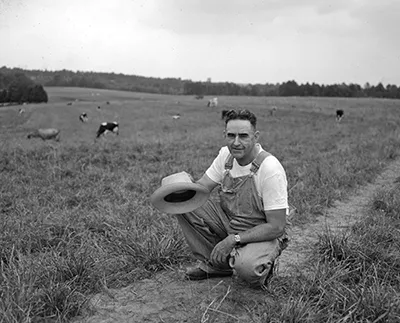
Governor Kerr Scott on his Haw River Farm, early 1950s. Hugh Morton Collection of Photographs and Films (P081), University of North Carolina at Chapel Hill, Wilson Library, North Carolina Collection Photographic Archives.
Scott’s allies cheered, but his outlook was guarded at best. Scott’s entry would divide the liberal vote with Albright, although Scott had better personal and political connections than his rival. Accordingly, Albright suggested that Scott was part of the ruling state political organization, an assertion that Scott rejected even as he hoped to recruit organization members who for a variety of reasons did not like Johnson. Furthermore, Scott’s call for sharing increased state wealth with rural people resonated in a rural state. Scott possessed a folksy appeal lacked by both Johnson and Albright.
Albright, Johnson, and Scott called for many of the same programs: a teacher pay scale ranging from twenty-four hundred dollars to thirty-six hundred dollars for nine months, state assistance in building local schools, and compulsory school attendance laws. On matters of public education, conservative establishment candidates had often been as progressive as liberals. The campaign of 1948 was no exception.
While Albright opposed the sales tax and Johnson favored it, Scott’s position was equivocal. He said that the tax should be removed immediately from restaurant meals—grocery store food items were already exempt—and repealed on other items as soon as was feasible.7 Johnson called for a one-hundred-million-dollar bond issue to finance rural roads. Scott asserted that Johnson’s proposal would line the pockets of bankers and said that the road money should come from unused state monies held in banks.8 This position eventually came back to haunt Scott.
Both Albright and Scott portrayed themselves as men in the mold of the late, mourned president, Franklin Delano Roosevelt. Albright possessed a polish more akin to Roosevelt’s, but Scott, who personified the president’s spirit, connected with the voters. Johnson ran as an advocate of fiscal responsibility and a friend of free enterprise and tried to counteract his urbane image by noting that he had grown up on a “dirt farm.” Up north he might have been a Republican; in North Carolina, however, he was a conservative Democrat with a few progressive instincts.
THE OUTCOME
Johnson led in the May 29 primary, but the results did not augur well for him. The count: Johnson 170,141; Scott 161,293; Albright 76,281; and others 15,371. Johnson ran best in western North Carolina, his native southeast, and parts of the Charlotte region. Scott led in rural counties and small towns scattered across the state as well as in the urban counties of Forsyth (Winston-Salem), Guilford (Greensboro and High Point), and Wake (Raleigh). Johnson had carried fifty-one counties and Scott forty-one. Albright took seven counties, mostly in the western coastal plain or nearby areas of the piedmont. These counties, which included the towns of Rocky Mount, Tarboro, and Wilson, had been strongholds for populist-style insurgents of the past.9 All had large black populations but overwhelmingly white electorates. A Johnson-Scott primary runoff was on.
Albright believed that his bid had been derailed by Scott and refused to endorse either candidate in the runoff, but his state manager, John Barnes, joined Scott’s campaign. Indeed, Scott was the logical choice for Albright voters who wanted the state to break with the status quo. One Albright voter who switched to Scott was young Terry Sanford, a former World War II paratrooper and future governor then in law practice in Fayetteville.
Second (runoff) primaries were nearly always nasty. In this one, the stakes were high, and the candidates could not have been more different. Many power brokers—bankers, textile and tobacco executives, and entrenched politicians—feared a loss of access and influence if Scott won. Johnson saw his long and respectable career imperiled. Johnson forces accused Scott of managing his huge dairy farm when he should have been tending to the agriculture department. Johnson also asserted that Scott had built a political machine within the department. Scott called for more open government and a break from business as usual. He portrayed Johnson as a man out of touch with the needs of working people.10
One issue not discussed in the campaign was race. In the 1930s and 1940s, candidates were united in their support for segregation. The federal courts had begun to hint that they would look much more closely at the “equal” part of the “separate but equal” doctrine, but they had not dealt head-on with segregation. With Albright out of the race, Scott counted on getting most of the urban black vote, support that could help in a close primary. Outside of a few urban areas, the African American vote was of little consequence. So the campaign bluster was aimed more at whites, with the candidates preaching to their respective choirs and hoping that their supporters would come out and vote.
Scott was a more forceful campaigner than Johnson and knew better how to connect with the voters. Scott understood farmers and talked the way they did. He could be simultaneously funny and bitingly sarcastic when attacking enemies. Late in the afternoon before a night appearance, he might take a ride on a dirt road in the company of his local manager, jotting down the names of people living in the houses. Then in his evening stump speech, Scott would say, “Mrs. Clodfelter, living out on——road, would love to have her road paved so the dust won’t blow on her sheets out on the clothesline.”11 The person named and others wanting paved roads might well be at the rally and hear the remarks. Kerr Scott was adept at personalizing the issues, and he had a penchant for detail that impressed his young driver, Lauch Faircloth, himself a future politician. Many years later, Faircloth recalled, “Kerr had an amazing knowledge down to the precinct level across the state. He could tell you [in advance] who the people would be that you would meet.”12 Scott knew their concerns and what might motivate them to work harder in the campaign.
Scott knew how to use the machine issue. He went so far as to say that machine control put North Carolina in danger of having a “Russian system” in which people might go through the motions of voting but really have no choice.13 The popular and shrewd Gardner was no longer around to promote organization interests. Moreover, the organization itself was split in the concurrent U.S. Senate race, with some members going for former governor J. Melville Broughton and others for William B. Umstead, the incumbent, whom Governor Gregg Cherry named to fill the seat after longtime Senator Josiah William Bailey died in 1946. Many organization loyalists devoted their energies to that race rather than Johnson’s.
After Broughton’s 287,901–183,865 Senate win in May, backers of both Broughton and Umstead were able to spend more time helping Johnson, but the hour was late. Furthermore, bitterness from the Senate race lingered, with many in the organization’s ranks continuing to believe that Umstead deserved the nomination. New tensions further imperiled unity as well as Johnson’s candidacy for governor. Johnson ultimately found the organization’s support both an albatross and a blessing.
In the runoff primary, Scott beat Johnson 217,620–182,648. Scott claimed a mandate. The size of his victory surprised nearly everyone. Scott led in the northern coastal plain, partly because he attracted the votes of former Albright backers. Johnson led in his native southeastern coastal plain, a lot of mountain counties, and the Charlotte-Gastonia-Shelby area of the southwest piedmont. Many mountain counties and piedmont Gastonia and Shelby had a history of favoring organization candidates. Scott led in sixty-five of the state’s one hundred counties. Except for Johnson’s home county of Pender and a few mountain areas, Scott garnered respectable numbers of votes almost everywhere.14
Scott’s timing was fortunate. His son, Bob, later remarked, “My daddy was a pure populist. The time was right for him to do that. There was a pent-up demand for infrastructure. [Before that time,] the money had gone off for the war effort.”15 Not since the late 1920s had there been such optimism and an ability to pay for new programs. While both Scott and Johnson favored increased spending on education and public works, Scott came across as the candidate of change. During the 1930s and most of the 1940s, the most ambitious initiatives had come from the national government. Now it was the state’s turn. A new era had dawned, at least for the moment.
A pattern had emerged in the primary that would become still more pronounced when Scott pursued his populist agenda. Scott understood the phenomenon well. He liked to say that the big shots in the well-heeled urban areas were in his opponent’s camp. The proportion of Scott backers increased in small towns and rural areas and grew even further in the backwoods—up the creek or the branch, as a lot of southerners called a small creek. Finally, at the source or head of the branch, the real backwoods, everyone was for Scott. So went the myth. And like a lot of myths, this one had an element of truth to it. Scott called his most fervent backers the “branch head boys,” a term that would stick for a long time in Tar Heel politics. Farmers and other rural residents who backed Scott generally came to be known as “branch head boys.”16
DISSENSION AND VICTORY
Before Scott could lead the crusade for his rural kindred, there was the formality of a general election, in which everyone assumed that Scott would defeat Republican George Pritchard, an Asheville attorney and past political candidate.
Though Scott was never threatened, the 1948 election saw the development of a deep chasm in the national Democratic Party that had implications for the party’s future in southern states. Incumbent president Harry S. Truman had incurred the wrath of many of the party’s conservatives as well as its liberals, and when the Democrats convened their convention in Philadelphia, the smell of impending November defeat permeated the atmosphere. Southerners, including most North Carolina delegates, voted for Georgia’s brilliant and deeply conservative senator, Richard Russell. The majority of convention delegates, however, seemed ready to go with Truman, though an ignominious loss to the Republican nominee, Governor Thomas Dewey of New York, seemed inevitable. The heat—the kind measured by a thermometer—was intense, and the sweat was only enhanced when a floor fight broke out over the plank relating to African Americans’ civil rights. Most white southerners, including North Carolinians, wanted no mention of the issue unless it was to support “separate but equal” facilities or “states’ rights.” Truman, a racist in his younger days, had evolved on the issue and favored a platform expressing general support for human equality and gradual movement toward racial integration but stopping short of a call for specific actions that would stir the pot.17 He thought he needed a solid bloc of southern electoral votes to have a chance in the November election.
Truman and his top strategists listened with apprehension when a young, brash Hubert Humphrey, the mayor of Minneapolis, rose to the podium and delivered a ringing oration: “There are those who say to you—we are rushing this issue of civil rights. I say we are a hundred and seventy-two years late!”18 The convention adopted a civil rights plan calling for an antilynching law, integration of the military, voting rights for blacks, ending the poll tax, and a move towar...
Table of contents
- Cover Page
- The Making of a Southern Democracy
- Copyright Page
- Dedication
- Contents
- Illustrations and Maps
- Acknowledgments
- Prologue
- CHAPTER ONE: Uprisings
- CHAPTER TWO: The 1950s
- CHAPTER THREE: There’s a New Day Coming
- CHAPTER FOUR: The Unsettled Society
- CHAPTER FIVE: Dirges in the Dark
- CHAPTER SIX: The Storms of ’72
- CHAPTER SEVEN: Transition in the Shadow of Watergate
- CHAPTER EIGHT: Eyes toward Washington
- CHAPTER NINE: The New South Meets the New Right
- CHAPTER TEN: Breaking New Ground
- CHAPTER ELEVEN: Partisan Mix
- CHAPTER TWELVE: Seismic Shifts
- EPILOGUE: The Perilous Climb
- APPENDIX: Comments on Methodology and General Approach
- Notes
- Index
Trusted by 375,005 students
Access to over 1.5 million titles for a fair monthly price.
Study more efficiently using our study tools.
Frequently asked questions
Yes, you can cancel anytime from the Subscription tab in your account settings on the Perlego website. Your subscription will stay active until the end of your current billing period. Learn how to cancel your subscription
No, books cannot be downloaded as external files, such as PDFs, for use outside of Perlego. However, you can download books within the Perlego app for offline reading on mobile or tablet. Learn how to download books offline
Perlego offers two plans: Essential and Complete
- Essential is ideal for learners and professionals who enjoy exploring a wide range of subjects. Access the Essential Library with 800,000+ trusted titles and best-sellers across business, personal growth, and the humanities. Includes unlimited reading time and Standard Read Aloud voice.
- Complete: Perfect for advanced learners and researchers needing full, unrestricted access. Unlock 1.5M+ books across hundreds of subjects, including academic and specialized titles. The Complete Plan also includes advanced features like Premium Read Aloud and Research Assistant.
We are an online textbook subscription service, where you can get access to an entire online library for less than the price of a single book per month. With over 1.5 million books across 990+ topics, we’ve got you covered! Learn about our mission
Look out for the read-aloud symbol on your next book to see if you can listen to it. The read-aloud tool reads text aloud for you, highlighting the text as it is being read. You can pause it, speed it up and slow it down. Learn more about Read Aloud
Yes! You can use the Perlego app on both iOS and Android devices to read anytime, anywhere — even offline. Perfect for commutes or when you’re on the go.
Please note we cannot support devices running on iOS 13 and Android 7 or earlier. Learn more about using the app
Please note we cannot support devices running on iOS 13 and Android 7 or earlier. Learn more about using the app
Yes, you can access The Making of a Southern Democracy by Tom Eamon in PDF and/or ePUB format, as well as other popular books in History & North American History. We have over 1.5 million books available in our catalogue for you to explore.