Children — white and black, northern and southern — endured a vast and varied range of experiences during the Civil War. Children celebrated victories and mourned defeats, tightened their belts and widened their responsibilities, took part in patriotic displays and suffered shortages and hardships, fled their homes to escape enemy invaders and snatched opportunities to run toward the promise of freedom.
Offering a fascinating look at how children were affected by our nation’s greatest crisis, James Marten examines their toys and games, their literature and schoolbooks, the letters they exchanged with absent fathers and brothers, and the hardships they endured. He also explores children’s politicization, their contributions to their homelands' war efforts, and the lessons they took away from the war. Drawing on the childhoods of such diverse Americans as Jane Addams, Booker T. Washington, and Theodore Roosevelt, and on sources that range from diaries and memoirs to children’s “amateur newspapers,” Marten examines the myriad ways in which the Civil War shaped the lives of a generation of American children.
“An original-minded, skillfully and suggestively presented history, haunting in its detailed unfolding of a war that put so many already vulnerable youngsters in danger, but elicited from some of them, as well, impressively sensitive, responsive thoughts, gestures, and deeds in what became, as this extraordinary book’s title insists, their civil war.” — Journal of American History
“James Marten’s thoroughly researched and engagingly written study . . . stands as one of the most exciting studies to emerge in the last dozen years. . . . Marten has taken a topic ignored by both Civil War historians and historians of childhood and crafted an engaging, masterful, nuanced, and readable study that will not quickly leave the reader’s mind or heart.” — American Studies
“The first comprehensive account of Civil War children. . . . Thoroughly researched and nicely illustrated, The Children’s Civil War will be a touchstone for historians and generalists who seek to gain a fuller understanding of life on the home front between 1861 and 1865.” — Civil War History
The Children’s Civil War is a poignant and fascinating look at childhood during our nation’s greatest crisis. Using sources that include diaries, memoirs, and letters, James Marten examines the wartime experiences of young people — boys and girls, black and white, northern and southern — and traces the ways in which the Civil War shaped the lives of a generation of American children. — >
- 368 pages
- English
- ePUB (mobile friendly)
- Available on iOS & Android
eBook - ePub
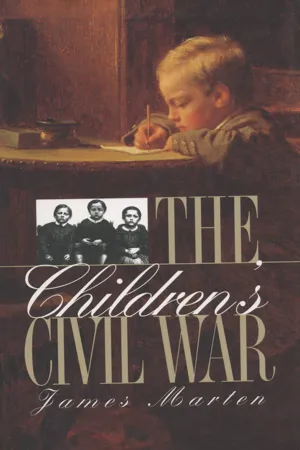
The Children's Civil War
About this book
Trusted by 375,005 students
Access to over 1.5 million titles for a fair monthly price.
Study more efficiently using our study tools.
Information
Topic
GeschichteChapter 1: War Ain’t Nuthin’ but Hell on Dis Earth
Children, Society, and War
“One need not be a grown-up to imbibe the peculiar feeling that hangs over everything in time of war,” wrote Hermon DeLong nearly fifty years after the war ended. “It was something like that sensation that goes about when a contagious disease suddenly breaks out in a peaceful community and the infected houses are placarded and streets barricaded. Young and old felt it weighing down like an incubus, and … our happy town seemed suddenly to grow grim and forbidding.” Hermon was a northern boy who never heard a shot fired in anger, never feared invasion, and barely felt wartime hardships. But in his enthusiasm and participation in his country’s war effort, he speaks for all Civil War children.
Although Hermon and his friends, tucked safely away in a small New York town, realized the magnitude of the crisis, they could be “just boys,” taking pleasure from the excitement and drama of enlistment drives, the “awkward squads drilling on the public square,” and the departure of recruits for the seat of war. Hermon fondly recalled war rallies, where bands played, “our most eloquent citizens” delivered “fervid speeches,” and enlistment bounties crept higher as recruits “became more reluctant.” At meetings of the local chapter of the U.S. Sanitary Commission, “young and old would meet and pick lint and sew bandages, singing at our work those sad old war songs such as ‘Tenting Tonight,’ ‘Dear Mother, I’ve Come Home to Die,’ ‘[The] Vacant Chair.’”
Hermon and his friends became avid politicians, “about equally divided between … Black Abolitionists and Copperheads.” The latter wore Indian-head pins cut out of big copper cents, “while we Republicans had a big marching organization called the Wideawakes, all fitted out with caps, capes, and torches.” When war bulletins arrived at the local telegraph office, “we boys would read them to the eager crowd assembled” outside.
Even though Dansville never came within range of Rebel guns, the war did occasionally hit home. Northern children noticed the rising prices and declining quality of their snacks: “Peanuts were rare and wormy, and sticks of candy were reduced to the size of pipe stems.” More seriously, Hermon remembered a friendly, older boy who was wounded; his “terrible suffering came very close to me, and I was glad when he got safely home.” When another acquaintance died in battle, the dead youth’s mother invited “we boys … to look at him, for in the midst of her grief there was a strong Spartan pride in the sacrifice she had made and she knew the lesson to us young Americans would be a good one.”
Such occasions made for “solemn times,” even in an isolated village, “and their influence was felt keenly by the boys through those long four years.” Yet Hermon recognized that life went on, even in wartime: “People married and were given in marriage, business throve, and we boys kept right on with our tasks and sports. Our bodies and our minds developed with the passing years and all political differences were buried when we met on the ball field, at the swimming hole or at our homes.”1
If war often meant reflective funerals and shoddy candy for northern children, it could mean blood and destruction for southern children. Fourteen-year-old Sue Chancellor described the extremes faced by Confederate children in a memoir published nearly sixty years after the war. Sue, her mother, and her six siblings lived in their ancestral home, the imposing brick house that had at one time served as an inn on the Plank Road between Fredericksburg and upcountry Virginia. From early in the war, Confederate pickets had frequently taken their meals at the Chancellor house, pausing to hear Sue’s sisters play piano and to teach them card games. A number of Confederate generals visited, including J. E. B. Stuart, who presented Sue’s sister Fannie with a gold dollar. Yankees also joined the Chancellor landscape early in the war. They would “come in a sweeping gallop up the big road with swords and sabres clashing,” while servants hid meat under the front steps and Sue would “run and hide and pray … more and harder than ever in my life, before or since.” Completing the wartime scenario in the Chancellor household were several refugees from Fredericksburg.
But nothing they had experienced so far prepared them for the cataclysm of the battle that would bear their name. Sue’s account of the battle of Chancellorsville began with the arrival of Gen. George G. Meade and his staff, who established Gen. Joseph Hooker’s headquarters in the house. The Chancellor women and their refugee friends had little idea of what was going on beyond their crossroads clearing, but they saw “couriers coming and going” and sensed that the Yankee officers “were very well satisfied with their position and seemed to be very confident of victory.” Sue and her family and friends “got through Thursday and Friday as best we could.” On Saturday—the day of Gen. Thomas “Stonewall” Jackson’s famous march across the Union front—the firing grew nearer and the women took shelter in the basement. “There was firing, fighting, and bringing in the wounded all that day,” Sue reported, and then, on Saturday afternoon, as Jackson launched his flank attack, the fighting took a sharp turn for the worse.
The Chancellor house quickly filled with wounded, screaming men, and surgeons turned the piano on which the girls had entertained Confederate officers into an amputating table. As Jackson’s corps crashed into the Federal right flank, the situation worsened. “Such cannonading on all sides, such shrieks and groans, such commotion of all kinds!” Sue exclaimed. “We thought that we were frightened before, but this was far beyond everything, and it kept up until long after dark.” When the bloodshed resumed the next morning, the Chancellor house caught fire, thrusting the Chancellors into the most harrowing portion of their trial.
Union general Joseph Dickinson, Hooker’s adjutant, led the frightened women and children out of the cellar and through their battered home. “As this terrified band of women and children came stumbling out of the cellar,” they saw amputated limbs spilling from an open window and “rows and rows of dead bodies covered with canvas” littering the yard. The little band followed Dickinson through the bombardment. “The woods around the house were a sheet of fire,” wrote Sue, “the air was filled with shot and shell; horses were running, rearing, and screaming; the men were amass with confusion, moaning, cursing, and praying.” Ducking “missiles of death” and gingerly treading among “the bleeding bodies of the dead and wounded,” the Chancellors joined the Union exodus. “At our last look, our old home was completely enveloped in flames.” The Chancellors found General Dickinson to be an honorable and steadfast guard. As he led his little group of southerners through the chaos, Dickinson again and again proved his gallantry by obtaining a horse for Sue’s ill sister and shielding them from less chivalrous Yankees. Other Federals also aided them. A kind chaplain escorted them across the “wobbly” pontoon bridge that spanned the Rappahannock, and a jovial Yankee guard promised “to write my mother and tell her what a good time I have had with these rebel ladies.” On another occasion a “little drummer boy” scrounged up some ice and a lemon for Sue’s sister. Although the Chancellor girls were at first “very cool” toward their Federal guards, Sue remembered that “after a while they relaxed and relieved the irksomeness of our confinement by talking, playing cards, and music.” In retrospect Sue even believed “that there were some flirtations going on.” After their release, the family sat out the rest of the war in Charlottesville, where Sue attended school and Mrs. Chancellor worked as a hospital matron.2
A third version of the children’s war comes from the oral reminiscence of Hammett Dell, who experienced the war as a young slave near Murfreesboro, Tennessee. Hammett remembered his master, “Mars White,” as a kindly man who fed his single family of five slaves well and never, as far as Hammett could remember, sold one off the plantation. In fact, the years before the war were “the happiest in all my life.” But about the time the fighting began, his mother died; shortly after, apparently, his father ran off to join the Union army. Hammett was aware of the war because he heard his white folks talking about moving away. “I didn’t lack [like] the talk but I didn’t know what ‘war’ was,” he recalled.
Hammett would find out about war soon enough, however. When the great Union and Confederate armies clashed at Murfreesboro, “it was a continual roar. The tin pans in the cubbard rattle all time.… The house shakin’ all time.… The earth quivered. It sound like the judgment.” Even after the fighting was over, “nobody felt good” because both armies ranged through the country, “foragin’ one bad as the other, hungry, gittin’ everything you put way to live on.” By the time the soldiers were through, “there couldn’t be a chicken nor a goose nor a year of corn to be found bout our place.” It seemed to Hammett that “we couldn’t make a scratch on the ground nowhere the soldiers couldn’t find it.” Soldiers carried off all the salt on the plantation, forcing the residents to salvage what they could from the dirt floor of the smokehouse. After a Yankee cavalry company rounded up every horse on the place, they set the house on fire. “We all got busy then, white folks and darkies both carryin’ water ter put it out.” They succeeded in dousing the fire, but Hammett was so angry that he later burst a hornets’ nest with a well-thrown rock just as a Yankee squad rode underneath it. He boasted to his master about his stunt, but Mars White scolded the boy and ordered him never to do anything like it again. The Yankees, White warned, “would [have] killed you right on the spot” if they had found him. “That’s ‘war,’” Hammett declared emphatically as an old man. “I found out all bout what it was. Lady it ain’t nuthin’ but hell on dis earth.”3
These three narratives highlight many of the facets of the children’s Civil War, showing how children in both sections, white and black, played roles in the war. There were significant differences, however. Northern children generally watched the conflict from afar, while southern children were much more likely to be slapped by the hard hand of war. White children passionately supported their sections’ war efforts, while black children distrusted soldiers of both armies and, especially when they enjoyed civil relationships with their masters, often remained loyal to them. As the spectrum of experiences described by Hermon DeLong, Sue Chancellor, and Hammett Dell show, children missed little of what the war had to offer, from the pageantry and the excitement to the hardships and the tragedy.
Children as Symbols and as Consumers
Children who lived through the war assigned it a central place in their memories and attributed many of their political, social, and personal characteristics to their wartime experiences. Subsequent chapters show just how exposed they were to the war and how thoroughly involved they became. But contemporaries also seemed to recognize the importance—as actors and as symbols—of the children of war. Children comprised a much larger portion of the population in 1860 than in the late twentieth-century, making up well over a third of the population in 1860 (compared with less than 22 percent in 1988).4 They could hardly be avoided, and the sketch artists of the great weekly magazines such as Harper’s or Frank Leslie’s rightly placed them in nearly every off-the-battlefield scene. When artists portrayed troops marching past cheering throngs, the giant Sanitary Fairs of 1864 and 1865, southern refugees or “contrabands,” and besieged residents of Vicksburg or Petersburg, they frequently included children. In their pictures, cap-waving boys run beside troops, girls comfort brokenhearted mothers, and babies are threatened by foul-looking Missouri guerillas. Youngsters appeared as heroes in illustrations such as the maudlin “The Drummer-Boy’s Burial” and wearing zouave uniforms, firing cannon, and riding in howitzer-shaped baby carriages in the satiric cartoon “After the War: Everything and Everybody en militaire.” Children in wartime illustrations tearfully hugged soldiers goodbye, saw them off at train stations, appeared in their dreams, prayed for their safe return, visited them in hospitals, and listened intently as they related war stories in front of roaring fires. They even showed up as hyena-like draft rioters in at least one illustration.5 Painters sprinkled children into scenes of refugees warming themselves before a wintry fire outside Fredericksburg and in the famous evocation of southern piety and patriotism, The Burial of Latane. Others offered warlike children brandishing toy guns, swords, and pikes; celebrating news of battlefield victories; playing nurse; writing letters to absent fathers; and knitting socks for soldiers.6
In addition to these sometimes fanciful impressions of children’s participation in the war, contemporaries often invoked children to explain why or how the war should be fought. Soldiers who tried to explain what motivated them frequently wrote that they had their children’s best interests in mind. They naturally hoped to save the Union or the Confederacy for the sake of their children’s futures, but they more frequently referred to the importance they placed on their own and their children’s honor as defenders of their nations. An Alabama cavalryman clearly missed his seven young children when he wrote his wife shortly after joining the army that “I would bee glad to see little ginny and give her a kiss and see the rest of the children frolic around and play on my lap and see babe suck his thum.” Yet his duty to his country and to his family kept him in the field; if not for “the love I have for them and my country I would have been ther now.” Nearly two years later he assured his wife that he would not give up the cause. “I dont want it throwed up to my children after I am dead and gone that I was a deserter from the confederate army.” Marcus Spiegel, an Ohio colonel, told his wife during the Vicksburg campaign “that my fighting in this War will leave an inheritance to my beloved children of more value than all the Gold in India.” Even death would not be too high a price to pay. A Georgian frequently asked his wife not to grieve for him if he died in the line of duty, for “if I fall I will fall like a man and leave no stigma on my darling boy.” Another Georgian, in one of the first letters he had written in his life, assured his wife that he longed to see their two-year-old boy, but if he came home “in that way … it would be a scandle to me as long as I live and to my sweet Willie after I was dead and gone.”7

War Spirit at Home, by Lilly Martin Spencer (1866). Spencer’s painting of a family celebrating news of the Union capture of Vicksburg—modeled after herself and her children—shows the enthusiasm with which northern children embraced the war effort. (Newark Museum)
Just as Civil War soldiers projected their own loyalty and service onto the futures of their children, adult slaves took great pleasure in the knowledge that their children would grow up to be free men and women. Annie Burton’s mother literally had to kidnap her three children from a master who refused to admit that his bondservants were free. When the hired slave of an Austin, Texas, woman learned that slavery had ended, she scooped up her little daughter, threw her into the air, and cried, “Tamar, you’re free! You’re free.” Her employer, normally quite typical in her racial assumptions, recorded perceptively in her diary that, to this mother, “freedom was for her child; she looked in its face, at its hands, at its feet. It was a new baby to her—a free baby.”8
Children clearly inspired soldiers to risk their lives and slaves to welcome their emancipation. Children also became central to the war effort in a somewhat different way, especially in the South, where the proper political education of children became a home front war aim. North Carolina teachers meeting in Raleigh early in the war issued an “Address to the People of North Carolina” that stressed the importance of maintaining their public school system despite the pressures and excitement of war. The struggle against the North, they declared, must be carried not only through “legislative acts” and “force of arms,” but also “in the school room, at the fireside, and by all those moral agencies which preserve society, and which prepare a people to be a free and self-governing nationality.” The common schools of North Carolina comprised a “nursery of popular intelligence and patriotism,” the interruption of which would be a serious blow to liberty in the South. A primary weapon in this intellectual war was the publication of textbooks that would correct the “erroneous opinions” of the South and of slavery promulgated by northern propagandists. “Distinguished by a peculiar social system, and one obnoxious to the phariseeism of the world,” the Confederate states “are especially called on to think in such things for themselves, and to see that their children are instructed out of their own writing.”9
Two years later, educators met in Columbia, South Carolina, to establish the Educational Association for the Confederate States of America. In addition to writing a constitution and discussing curricular issues, the delegates formed a number of committees, including one on “educational interests and text-books.” The committee’s report declared that southern children “must be able to appreciate the greatness of the trusts committed to their hands” by the Confederate cause. One way of ensuring this, of course, was to publish and distribute textbooks reflecting Confederate interests. The crash publishing program of Confederate schoolbooks produced scores of prim...
Table of contents
- Cover Page
- Title Page
- Copyright Page
- Dedication
- Contents
- Illustrations
- Acknowledgments
- Introduction
- Chapter 1: War Ain't Nuthin’ but Hell on Dis Earth
- Chapter 2: Fighting against Wrong, and for the Good, the True, and the Beautiful
- Chapter 3: When I Come Home Again, I Won't Go Away Any More
- Chapter 4: I We Lived Years in As Many Days
- Chapter 5: Rabid Partisans among Their Playmates
- Chapter 6: Childhoods Lost and Found
- Notes
- Bibliography
- Index
Frequently asked questions
Yes, you can cancel anytime from the Subscription tab in your account settings on the Perlego website. Your subscription will stay active until the end of your current billing period. Learn how to cancel your subscription
No, books cannot be downloaded as external files, such as PDFs, for use outside of Perlego. However, you can download books within the Perlego app for offline reading on mobile or tablet. Learn how to download books offline
Perlego offers two plans: Essential and Complete
- Essential is ideal for learners and professionals who enjoy exploring a wide range of subjects. Access the Essential Library with 800,000+ trusted titles and best-sellers across business, personal growth, and the humanities. Includes unlimited reading time and Standard Read Aloud voice.
- Complete: Perfect for advanced learners and researchers needing full, unrestricted access. Unlock 1.5M+ books across hundreds of subjects, including academic and specialized titles. The Complete Plan also includes advanced features like Premium Read Aloud and Research Assistant.
We are an online textbook subscription service, where you can get access to an entire online library for less than the price of a single book per month. With over 1.5 million books across 990+ topics, we’ve got you covered! Learn about our mission
Look out for the read-aloud symbol on your next book to see if you can listen to it. The read-aloud tool reads text aloud for you, highlighting the text as it is being read. You can pause it, speed it up and slow it down. Learn more about Read Aloud
Yes! You can use the Perlego app on both iOS and Android devices to read anytime, anywhere — even offline. Perfect for commutes or when you’re on the go.
Please note we cannot support devices running on iOS 13 and Android 7 or earlier. Learn more about using the app
Please note we cannot support devices running on iOS 13 and Android 7 or earlier. Learn more about using the app
Yes, you can access The Children's Civil War by James Marten in PDF and/or ePUB format, as well as other popular books in Geschichte & Amerikanische Bürgerkriegsgeschichte. We have over 1.5 million books available in our catalogue for you to explore.