Puerto Ricans maintain a vibrant identity that bridges two very different places — the island of Puerto Rico and the U.S. mainland. Whether they live on the island, in the States, or divide time between the two, most imagine Puerto Rico as a separate nation and view themselves primarily as Puerto Rican. At the same time, Puerto Ricans have been U.S. citizens since 1917, and Puerto Rico has been a U.S. commonwealth since 1952.
Jorge Duany uses previously untapped primary sources to bring new insights to questions of Puerto Rican identity, nationalism, and migration. Drawing a distinction between political and cultural nationalism, Duany argues that the Puerto Rican “nation” must be understood as a new kind of translocal entity with deep cultural continuities. He documents a strong sharing of culture between island and mainland, with diasporic communities tightly linked to island life by a steady circular migration. Duany explores the Puerto Rican sense of nationhood by looking at cultural representations produced by Puerto Ricans and considering how others — American anthropologists, photographers, and museum curators, for example — have represented the nation. His sources of information include ethnographic fieldwork, archival research, interviews, surveys, censuses, newspaper articles, personal documents, and literary texts.
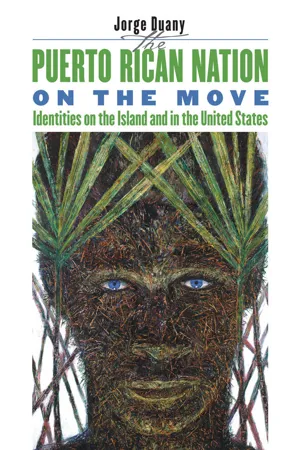
eBook - ePub
The Puerto Rican Nation on the Move
Identities on the Island and in the United States
- 368 pages
- English
- ePUB (mobile friendly)
- Available on iOS & Android
eBook - ePub
About this book
Information
CHAPTER ONE
The Construction
of Cultural
Identities in
Puerto Rico
and the Diaspora
of Cultural
Identities in
Puerto Rico
and the Diaspora
More than one hundred years ago, the French scholar Ernest Renan (1990 [1882]) posed the question, “What is a nation?”1 Renan answered that it was a “spiritual principle” based on shared memories, the cult of a glorious past, as well as the ability to forget certain shameful events, and above all a “daily plebiscite”: the collective affirmation of a national “will” by the citizens of a country (1990 [1882]: 19). But how is this spiritual principle translated into practice? How does the cult of the past relate to the present and project into the future? How exactly is the national will expressed in everyday life? Who defines the nation, and for what purpose? Who is included and excluded in the nationalist discourse? How does one map the territorial and symbolic boundaries of the nation?
The search for the essence of the nation has continued unabated throughout the twentieth century, especially among colonized peoples such as Puerto Ricans. In such situations, questions of cultural identity are far from academic but instead touch on people’s struggles for survival, lived experiences, and rights to political representation. Intellectual and public debates on the Island suggest that it may be too premature to announce the end of nationalism or to romanticize transnationalism in an increasingly global world. Nationalist ideas and practices continue to circulate worldwide and organize much of people’s daily lives.
As I argued in the introduction, the case of Puerto Rico is distinctive because of its persistent colonial condition. Although Puerto Ricans have been U.S. citizens since 1917, the legal definition of their identity does not correspond to their self-perception as “Puerto Ricans first, Americans second.” The juridical status of Puerto Rican citizenship (as opposed to U.S. citizenship) has been debated in both the United States and the Island’s legislative and juridical branches. One dispute was sparked by the pro-independence leader Juan Mari Bras’s well-publicized resignation of his U.S. citizenship in 1995. Yet most Puerto Ricans see no contradiction between asserting their Puerto Rican nationality at the same time as they defend their U.S. citizenship (Morris 1995, 1997). On December 13, 1998, Puerto Rico held a plebiscite on its political status, and more than half of the voters supported neither annexation to nor independence from the United States but voted instead for “none of the above,” including the current commonwealth formula, the Estado Libre Asociado.
A second distinctive element of the Puerto Rican case is the sheer magnitude of the diaspora. Few other countries in recent memory have exported such a large share of their population abroad—more than half a million out of a total of roughly 2 million people between 1945 and 1965. The exodus resumed massive proportions in the 1980s and 1990s. Between 1991 and 1998, nearly 250,000 Island residents moved to the U.S. mainland (Junta de Planificación 1998). In 2000 the census found 3.4 million persons of Puerto Rican origin residing in the mainland, compared with more than 3.8 million persons on the Island (Guz-mán 2001). At the same time, thousands of returning Puerto Ricans, Dominicans, Cubans, and other foreigners entered the Island. In 1990 more than 321,000 residents of Puerto Rico, roughly 9 percent of the total population, had been born in the U.S. mainland and in foreign countries—most of whom were persons of Puerto Rican parentage, but many were born in the Dominican Republic and Cuba (U.S. Bureau of the Census 1993b). Demographically and geographically, Puerto Rico is a nation on the move, as well as a nation without a state.
At this juncture, Island intellectuals are sharply divided between those who believe that Puerto Ricans should fight for independence to preserve their cultural identity and those who believe that this struggle necessarily invokes a homogenizing, essentialist, and totalitarian fiction called “the nation.” Roughly speaking, local nationalists of various strands tend to assume the former position, while some postmodernists have espoused the latter. Hence, the battle between the two intellectual camps has multiple implications for ideological discourses, political strategies, and tactical alliances. For a nationalist sympathizer such as Juan Manuel Carrión (1996), the defense of the Spanish language and other icons of the Hispanic heritage has the practical advantage of uniting the Puerto Rican people against a common foe: U.S. imperialism. For a skeptical postmodernist such as Carlos Pabón (1995b), the Hispanophilia of the native elite is a discursive practice that glosses over the internal diversity of the collective imaginary. For the former camp, the rise of cultural nationalism is an integral part of the anticolonial struggle in Puerto Rico; for the latter, it is merely a “light” form of nationalism or neonationalism, devoid of its subversive and progressive connotations.2 The two camps have probably overstated their opposition in the heat of the discussion, and neither has systematically considered the diaspora in their reflections on the Puerto Rican nation.
Much of the current controversy among scholars on Puerto Rico centers on their standpoints vis-à-vis the question of national identity and sovereignty. The influence of poststructuralist theories in the social sciences and the humanities, as they have developed in Western Europe and the United States, has led many scholars to question the very existence of a national character, essence, or substance that can be fixed, defined, and preserved unequivocally (see J. Duany 1996, 1998a).3 Still others have argued that the deconstruction of the nationalist discourse need not imply surrendering all practical commitments to progressive social movements such as the quest for independence (Coss 1996). More recently, some Puerto Rican scholars living on the Island and the mainland have asserted that a radical democratic agenda can be accomplished only under complete annexation to the United States (Duchesne et al. 1997). To a large extent the politics of decolonization (whether through statehood, independence, or increased autonomy) is contingent on competing discourses of identity.
In this chapter I analyze recent intellectual debates on the Puerto Rican nation and its persistent colonial relation with the United States. First I trace the development of a nationalist discourse on the Island, primarily among creative writers, artists, and scholars during the twentieth century, and then I identify several problems with this discourse, especially the exclusion of ethnic and racial others from its definition of the nation. I also examine the recent challenges to nationalist projects in Puerto Rico from the growing ethnic diversity of the Island’s population, especially Dominican and Cuban immigrants. Next, I argue that public and academic discourses on Puerto Rican identity must encompass the diaspora in the United States. It is especially urgent to think about the nation in nonterritorial terms because of the increasing numbers of people who now live outside their country of origin.
In what follows I engage in a critical dialogue with Benedict Anderson’s seminal book Imagined Communities (1991). Although I agree with Anderson that nations “are cultural artefacts of a certain kind” (4), I do not believe that they are necessarily imagined as sovereign or as limited to a particular territory.4
Moreover, the idea of the community as a “deep, horizontal comradeship” (7) should not obscure the internal cleavages within all nations or that identities are constructed in different ways, from various social positions. Anderson’s original formulation of nationalism tends to take for granted that communities are imagined from a fixed location, within a firmly bounded space. Although Anderson (1992) has more recently paid more attention to “long-distance nationalism,” further work is needed to spell out the theoretical and political impact of population movements on nationalist thought and practice. I intend this chapter as a reflection on this wider topic, with a focus on contemporary Puerto Rico and its diaspora.
CULTURAL POLITICS IN A STATELESS NATION
Public and academic debates about whether Puerto Rico has its own national identity have always been fraught with strong political repercussions because of the Island’s colonial relations, first with Spain and now with the United States.
For decades the main conceptual and political paradox in the construction of cultural identities in Puerto Rico has been the growing popularity of cultural nationalism, together with the weakness of the independence movement. Culturally speaking, Puerto Rico meets most of the objective and subjective characteristics of conventional views of the nation—among them a shared language, territory, and history—except for sovereignty. The Island also possesses many of the symbolic attributes of a nation, such as a national system of universities, museums, and other cultural institutions; a national tradition in literature and the visual arts; and even a national representation in international sports and beauty contests. Most important, the vast majority of Puerto Ricans imagine themselves as distinct from Americans as well as from other Latin American and Caribbean peoples (Morris 1997).
Yet the Island remains a colonial possession, and most of the electorate does not currently support an independent republic in Puerto Rico. Rather, it has reiterated an overwhelming preference for U.S. citizenship and permanent union with the United States.5A key issue is the freedom to travel to the United States under any political status option. Under the Commonwealth, Puerto
Ricans have unrestricted entry into the U.S. mainland. In a striking gesture, the Puerto Rican Independence Party president Rubén Berríos has recently argued that the U.S. Congress should grant Puerto Ricans the right to enter the United States freely, even if the Island became independent. Berríos acknowledged the importance of U.S. citizenship for most Puerto Ricans, especially as a practical way of facilitating the movement between the Island and the mainland (Magdalys Rodríguez 1997). Questions of citizenship, migration, and identity in Puerto Rico acquire a sense of urgency seldom found in well-established nation-states that do not have to justify their existence or fight for their survival. Consequently, the affirmation of a separate cultural identity is closely linked with the unfinished project for self-determination, which is typical of colonial liberation movements throughout the world (Chatterjee 1995).
Since the mid–twentieth century, the pro-independence movement has been unable to retain a mass following in Puerto Rico. As Carrión (1980, 1996) has argued, the struggle for independence has not represented the bulk of the native ruling and working classes. Instead, independence has been primarily the political project of a radicalized sector of the petty bourgeoisie—including small merchants, manufacturers, independent artisans, liberal professionals, and government employees. For instance, the leadership of the Nationalist Party during the 1930s was primarily composed of lawyers, journalists, physicians, dentists, pharmacists, and small business owners (Ferrao 1990). Most local entrepreneurs have not embraced a nationalist discourse because they identify their class interests with continued association with the United States (González Díaz 1991). Moreover, the massive extension of public welfare benefits through transfer payments from the federal government has strengthened popular support for annexation. Without the allegiance of either the native bourgeoisie or the proletariat, resistance to colonialism has largely been displaced from party politics to the contested terrain of culture. As a result, local intellectuals—especially college professors, scholars, and writers—have played a role in the construction of a nationalist discourse disproportionate to their numbers. Here as elsewhere, the local intelligentsia has helped to define and consolidate a national culture against what it perceives as a foreign invasion. In John Hutchinson’s terms (1994), native intellectuals have sought to regenerate the moral fabric of the nation as an organizing principle in the daily lives of the people.
Since 1898, national identity in Puerto Rico has developed under—and often in outright opposition to—U.S. hegemony. During the first third of the twentieth century, the local movement to obtain sovereignty garnered growing support, and several political parties included independence as part of their ideological platforms. But after World War II, the autonomist and annexationist movements became the dominant forces in Puerto Rican politics. Recent studies have focused on the fall of political nationalism and the rise of cultural nationalism on the Island since the 1940s (see, for example, Alvarez-Curbelo and Rodríguez Castro 1993; Carrión 1999; Carrión, Gracia Ruiz, and Rodrí-guez Fraticelli 1993; Gelpí 1993). In Puerto Rico, cultural nationalism became increasingly disengaged from political nationalism and identified with populism after World War II (Díaz Quiñones 1993). As I develop in Chapter 5, the charismatic leader Luis Muñoz Marín, the Island’s governor from 1949 to 1964, was a key figure in that ideological transition.6During this period, Muñoz Marín came into direct confrontation with the president of the Nationalist Party, Pedro Albizu Campos, who advocated independence for the Island.7 Muñoz Marín adopted an autonomist position that sought to reconcile the Island’s political and economic incorporation to the United States with the preservation of Puerto Rican identity or, as he preferred to call it, “personality.”
Muñoz Marín, then, was one of the chief architects of cultural nationalism in postwar Puerto Rico. I would argue that this is not a lesser or minor form of political nationalism, as the pejorative labels “neonationalism” and “lite nationalism” imply. Cultural nationalism represents a serious (though perhaps limited) attempt to assert Puerto Rico’s distinctive collective identity, within the context of continued political and economic dependence on the United States. Like Arlene Dávila (1997: 3), I approach cultural nationalism “not as an apolitical development but as part of a shift in the terrain of political action to the realm of culture and cultural politics, where the idiom of culture constitutes a dominant discourse to advance, debate, and legitimize conflicting claims.” Unlike Dávila, I argue that this turn to culture has a strong potential to subvert ideologically the colonial regime in Puerto Rico. In Chapter 5 I assess the repercussions of cultural nationalism for the anticolonial struggle on the Island.
Today, cultural nationalism transcends political party loyalties on both the left and the right. It is now the official rhetoric of the three political parties on the Island—proindependence, pro-commonwealth, and even pro-statehood. In the 1998 plebiscite campaign, the pro-statehood party prominently displayed the traditional symbols of the Puerto Rican nation, such as the flag, the Spanish language, and Olympic representation. The other two parties also employed a nationalistic language of collective self-respect to advance their respective causes. Thus, Puerto Rico exemplifies better than other places the significance of cultural nationalism in that it is still a colony, rather than a nation-state, and yet most people on the Island (as well as on the mainland) continue to identify themselves as Puerto Ricans as their primary collective affiliation. I would argue that the construction of cultural identities in contemporary Puerto Rico involves a profound ideological rift between citizenship and nationality, as well as the constant transgression of the boundaries of territory, language, and ethnicity established by standard views of the nation.
On the Island, Puerto Ricans from different political parties share a strong consensus with regard to their primary collective affiliations, a clear dichotomy between “us” and “them”—that is, between Puerto Ricans and Americans (Morris 1995, 1997; Rivera 1996). Cultural nationalism has become one of the leading discourses of identity in contemporary Puerto Rico, even though it is articulated across various social positions, including class, gender, race and color, age, and ideology. In the 1940s Julian Steward and his colleagues (1956) also found substantial regional differences, but these have diminished since the advent of industrialization, migration, and urbanization. Moreover, the dominant representations of Puerto Ricanness are no longer confined to an intellectual elite, the petty bourgeoisie, or the pro-independence movement. Rather, popular icons of national identity (such as the omnipresent flag or salsa music) have filtered down, sprung from the bottom up, or recirculated through the Island’s class structure. Such symbolic expressions of Puerto Rican culture have penetrated the colonial state apparatus, local political parties, the mass media, and grassroots organizations (Dávila 1997).
INTELLECTUAL DISCOURSES OF IDENTITY
Nationalist thought has permeated academic discussion on Puerto Rican culture at least since the 1930s. Ideologically, nationalism has been characterized by the defense of local values and customs against the U.S. occupation of the Island in 1898—or, to cite the revealing title of a book on the topic, “the North American cultural aggression in Puerto Rico” (Méndez 1980). According to another well-known scholar, “the essential dilemma” of twentieth-century Puerto Rico was “cultural assimilation vs. national consciousness” (Maldonado-Denis 1972). Nationalists have insistently denounced “Yankee imperialism” on the Island and have claimed the right to the self-determination of the Puerto Rican people, including the preservation of their national identity. During the first half of the twentieth century, most Puerto Rican nationalists embraced the Spanish vernacular as the dominant symbol of their culture, as well as other elements of the Hispanic heritage such as Catholicism. Contrary to nineteenth-century Latin America (Anderson 1991: 47–48), language is a crucial element in Puerto Rican nationalism, partly as a reaction to the ill-fated attempt by the U.S. colonial government to impose English as the official language of public instruction on the Island until 1948. Today, critics often equate Puerto Rican nationalism with Hispanophilia—the cult of all things Spanish—or at least with a special preference for the Hispanic basis of Creole identity (Pabón 1995b), usually at the expense of the African sources. The recent revitalization of Taíno culture has also served to root national identity in mythical pre-Columbian times (see Chapter 11).
Nationalism faces three recurrent problems in the analysis of contemporary Puerto Rican society. First, it has historically set up an artificial binary opposition between American and Puerto Rican culture—one English-speaking, the other Spanish-speaking; one Protestant, the other Catholic; one Anglo-Saxon in origin, the other Hispanic; one modern, the other traditional; and so on. But such a rough dichotomy no longer exists in Puerto Rico, if it ever did anywhere.
For instance, many Puerto Ricans born and raised in the United States now use English as their dominant language; many Puerto Ricans on and off the Island have converted to Protestantism; and many Puerto Ricans have mixed ancestry, not just a Spanish background. Several of the traditional symbols of the Puerto Rican nation were invented during the late nineteenth century, such as the national flag and anthem, and some are even more modern, such as salsa music. In 1998 the controversial privatization of the Puerto Rican Telephone Company led to its popular reinterpretation as part of the national patrimony. In 2000 all three political parties reached a consensus that the U.S. Navy should stop its military exercises in Vieques, which is now portrayed as an integral part of the ...
Table of contents
- Table of Contents
- Title Page
- Copyright Page
- Dedication
- Table of Figures
- List of Tables
- Acknowledgments
- INTRODUCTION. Rethinking Colonialism, Nationalism, and Transnationalism: The Case of Puerto Rico
- Chapter 1. The Construction of Cultural Identities in Puerto Rico and the Diaspora
- Chapter 2. The Rich Gate to Future Wealth: Displaying Puerto Rico at World’s Fairs
- Chapter 3. Representing the Newly Colonized: Puerto Rico in the Gaze of American Anthropologists, 1898-1915
- Chapter 4. Portraying the Other: Puerto Rican Images in Two American Photographic Collections
- Chapter 5. A Postcolonial Colony?: The Rise of Cultural Nationalism in Puerto Rico during the 1950s
- Chapter 6. Collecting the Nation: The Public Representation of Puerto Rico’s Cultural Identity
- Chapter 7. Following Migrant Citizens: The Official Discourse on Puerto Rican Migration to the United States
- Chapter 8. The Nation in the Diaspora: The Reconstruction of the Cultural Identity of Puerto Rican Migrants
- Chapter 9. Mobile Livelihoods: Circular Migration, Transnational Identities, and Cultural Borders between Puerto Rico and the United States
- Chapter 10. Neither White nor Black: The Representation of Racial Identity among Puerto Ricans on the Island and in the U.S. Mainland
- Chapter 11. Making Indians out of Blacks: The Revitalization of Taíno Identity in Contemporary Puerto Rico
- CONCLUSION. Nation, Migration, Identity
- Notes
- Works Cited
Trusted by 375,005 students
Access to over 1.5 million titles for a fair monthly price.
Study more efficiently using our study tools.
Frequently asked questions
Yes, you can cancel anytime from the Subscription tab in your account settings on the Perlego website. Your subscription will stay active until the end of your current billing period. Learn how to cancel your subscription
No, books cannot be downloaded as external files, such as PDFs, for use outside of Perlego. However, you can download books within the Perlego app for offline reading on mobile or tablet. Learn how to download books offline
Perlego offers two plans: Essential and Complete
- Essential is ideal for learners and professionals who enjoy exploring a wide range of subjects. Access the Essential Library with 800,000+ trusted titles and best-sellers across business, personal growth, and the humanities. Includes unlimited reading time and Standard Read Aloud voice.
- Complete: Perfect for advanced learners and researchers needing full, unrestricted access. Unlock 1.5M+ books across hundreds of subjects, including academic and specialized titles. The Complete Plan also includes advanced features like Premium Read Aloud and Research Assistant.
We are an online textbook subscription service, where you can get access to an entire online library for less than the price of a single book per month. With over 1.5 million books across 990+ topics, we’ve got you covered! Learn about our mission
Look out for the read-aloud symbol on your next book to see if you can listen to it. The read-aloud tool reads text aloud for you, highlighting the text as it is being read. You can pause it, speed it up and slow it down. Learn more about Read Aloud
Yes! You can use the Perlego app on both iOS and Android devices to read anytime, anywhere — even offline. Perfect for commutes or when you’re on the go.
Please note we cannot support devices running on iOS 13 and Android 7 or earlier. Learn more about using the app
Please note we cannot support devices running on iOS 13 and Android 7 or earlier. Learn more about using the app
Yes, you can access The Puerto Rican Nation on the Move by Jorge Duany in PDF and/or ePUB format, as well as other popular books in History & Latin American & Caribbean History. We have over 1.5 million books available in our catalogue for you to explore.