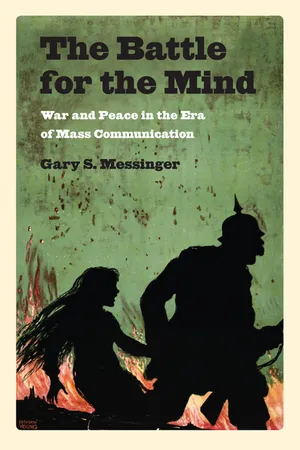
Most people typically think of armed conflict in physical terms, involving guns and bombs, ships and planes, tanks and missiles. But today, because of mass communication, war and the effort to prevent it are increasingly dependent on non-physical factors—the capacity to persuade combatants and citizens to engage in violence or avoid it, and the packaging of the information on which decision making is based. This book explores the many ways that mass communication has revolutionized international relations, whether the aim is to make war effectively or to prevent it.
Gary Messinger shows that over the last 150 years a succession of breakthroughs in the realm of media has reshaped the making of war and peace. Along with mass newspapers, magazines, books, motion pictures, radio, television, computer software, and telecommunication satellites comes an array of strategies for exploiting these media to control popular beliefs and emotions. Images of war now arrive in many forms and reach billions of people simultaneously. Political and military leaders must react to crowd impulses that sweep around the globe. Nation-states and nongovernmental groups, including terrorists, use mass communication to spread their portrayals of reality.
Drawing on a wide range of media products, from books and articles to films and television programs, as well as his own research in the field of propaganda studies, Messinger offers a fresh and comprehensive overview. He skillfully charts the path that has led us to our current situation and suggests where we might go next.
- 312 pages
- English
- PDF
- Available on iOS & Android
eBook - PDF
About this book
Information
Publisher
University of Massachusetts PressYear
2011Print ISBN
9781558498532
9781558498525
eBook ISBN
9781613760307
Table of contents
- Cover
- Title Page
- Copyright Page
- Table of Contents
- Preface: A Change in the Landscape
- Acknowledgments
- Chapter 1: War Encounters Mass Communication:1850– 1914
- Chapter 2: Mass Communication Enlists: 1914–1918
- Chapter 3: The Democracies Try to Demobilize: 1919–1939
- Chapter 4: Dictators Conquer Their Media: 1919–1939
- Chapter 5: The Battle for the Mind Deepens: 1939–1945
- Chapter 6: Symbolic War Takes Precedence: 1945–1991
- Chapter 7: Mass Communication Becomes Multipolar: 1991 and After
- Notes
- Index
- Back Cover
Trusted by 375,005 students
Access to over 1.5 million titles for a fair monthly price.
Study more efficiently using our study tools.
Frequently asked questions
Yes, you can cancel anytime from the Subscription tab in your account settings on the Perlego website. Your subscription will stay active until the end of your current billing period. Learn how to cancel your subscription
No, books cannot be downloaded as external files, such as PDFs, for use outside of Perlego. However, you can download books within the Perlego app for offline reading on mobile or tablet. Learn how to download books offline
Perlego offers two plans: Essential and Complete
- Essential is ideal for learners and professionals who enjoy exploring a wide range of subjects. Access the Essential Library with 800,000+ trusted titles and best-sellers across business, personal growth, and the humanities. Includes unlimited reading time and Standard Read Aloud voice.
- Complete: Perfect for advanced learners and researchers needing full, unrestricted access. Unlock 1.5M+ books across hundreds of subjects, including academic and specialized titles. The Complete Plan also includes advanced features like Premium Read Aloud and Research Assistant.
We are an online textbook subscription service, where you can get access to an entire online library for less than the price of a single book per month. With over 1.5 million books across 990+ topics, we’ve got you covered! Learn about our mission
Look out for the read-aloud symbol on your next book to see if you can listen to it. The read-aloud tool reads text aloud for you, highlighting the text as it is being read. You can pause it, speed it up and slow it down. Learn more about Read Aloud
Yes! You can use the Perlego app on both iOS and Android devices to read anytime, anywhere — even offline. Perfect for commutes or when you’re on the go.
Please note we cannot support devices running on iOS 13 and Android 7 or earlier. Learn more about using the app
Please note we cannot support devices running on iOS 13 and Android 7 or earlier. Learn more about using the app
Yes, you can access The Battle for the Mind by Gary S. Messinger in PDF and/or ePUB format, as well as other popular books in Social Sciences & North American History. We have over 1.5 million books available in our catalogue for you to explore.