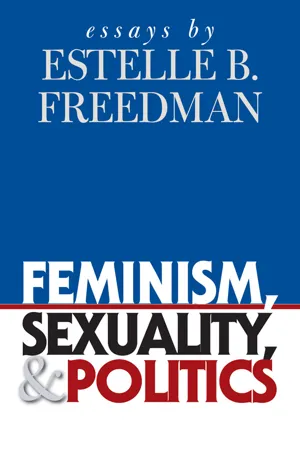
One of a small group of feminist pioneers in the historical profession, Estelle B. Freedman teaches and writes about women’s history with a passion informed by her feminist values. Over the past thirty years, she has produced a body of work in which scholarship and politics have never been mutually exclusive. This collection brings together eleven essays — eight previously published and three new — that document the evolving relationship between academic feminism and political feminism as Freedman has studied and lived it.
Following an introduction that presents a map of the personal and intellectual trajectory of Freedman’s work, the first section of essays, on the origins and strategies of women’s activism in U.S. history, reiterates the importance of valuing women in a society that has long devalued their contributions. The second section, on the maintenance of sexual boundaries, explores the malleability of both sexual identities and sexual politics. Underlying the collection is an inquiry into the changing meanings of gender, sexuality, and politics during the nineteenth and twentieth centuries along with a concern for applying the insights of women’s history broadly, from the classroom to the courthouse.
- 272 pages
- English
- ePUB (mobile friendly)
- Available on iOS & Android
eBook - ePub
About this book
Information
Part One
| Feminist Strategies
1
| Separatism as Strategy | Female Institution Building and American Feminism, 1870-1930
At the time I wrote this essay, I had begun to question liberal feminism in light of the separatist “women’s culture” of the 1970s. In the work of Emily Newell Blair, the feminist politician who in the late 1920s reconsidered the strategy of integrating women into mainstream political parties, I found historical precedents for applying the concept of women’s culture to feminist politics. I continue to value female separatism but always with the caveats that we should distinguish carefully between women’s and feminist institutions, remain aware of the costs of racial exclusiveness, and avoid romanticizing the past. My own revision of the argument about women’s separatism, along with references to later studies, appears in chapter 2.
Scholarship and Strategies
The feminist scholarship of the past decade has often been concerned, either explicitly or implicitly, with two central political questions: the search for the origins of women’s oppression and the formulation of effective strategies for combating patriarchy. Analysis of the former question helps us answer the latter. As anthropologist Gayle Rubin has wryly explained: “If innate male aggression and dominance are at the root of female oppression, then the feminist program would logically require either the extermination of the offending sex, or else a eugenics project to modify its character. If sexism is a by-product of capitalism’s relentless appetite for profit, then sexism would wither away in the advent of a successful socialist revolution. If the world historical defeat of women occurred at the hands of an armed patriarchal revolt, then it is time for Amazon guerrillas to start training in the Adirondacks.”1
Previously published as Estelle B. Freedman, “Separatism as Strategy: Female Institution Building and American Feminism, 1870-1930,” Feminist Studies 5, no. 3 (Fall 1979): 512-29. Reprinted by permission of Feminist Studies, Inc.
Another anthropologist, Michelle Zimbalist Rosaldo, provided an influential exploration of the origins-strategies questions in her 1974 theoretical overview of women’s status.2 Rosaldo argued that “universal sexual asymmetry” (the lower value placed on women’s tasks and roles in all cultures) has been determined largely by the sexually defined split between domestic and public spheres. To oversimplify her thesis, the greater the social distance between women in the home and men in the public sphere, the greater the devaluation of women. The implications for feminist strategies become clear at the end of Rosaldo’s essay when she says that greater overlap between domestic and public spheres means higher status for women. Thus, to achieve an egalitarian future, with less separation of female and male, we should strive not only for the entry of women into the male-dominated public sphere but also for men’s entry into the female-dominated domestic world.
Rosaldo also discusses an alternative strategy for overcoming sexual asymmetry, namely, the creation of a separate women’s public sphere, but she dismisses this model in favor of integrating domestic and public spheres. Nonetheless, the alternative strategy of creating “women’s societies and African queens” deserves further attention.3 Where female political leaders have power over their own jurisdiction (women), they also gain leverage in tribal policy. Such a separate sexual political hierarchy would presumably offer women more status and power than the extreme male-public/female-domestic split, but it would not require the entry of each sex into the sphere dominated by the other sex. At certain historical periods, the creation of a public female sphere might be the only viable political strategy for women.
I would like to argue through historical analysis for the alternative strategy of creating a strong, public female sphere. A number of feminist historians have recently explored the value of the separate, though not necessarily public, female sphere for enriching women’s historical experience. Carroll Smith-Rosenberg’s research has shown how close personal relationships enhanced the private lives of women in the nineteenth century.4 At the same time, private “sisterhoods,” Nancy Cott has suggested, may have been a precondition for the emergence of feminist consciousness.5 In the late nineteenth and early twentieth centuries, intimate friendships provided support systems for politically active women, as demonstrated by the work of both Blanche Cook and Nancy Sahli.6 However, the women’s culture of the past — personal networks, rituals, and relationships — did not automatically constitute a political strategy. As loving and supportive as women’s networks may have been, they could keep women content with a status that was inferior to that of men.
I do not accept the argument that female networks and feminist politics were incompatible. Rather, in the following synthesis of recent scholarship in American women’s history, I want to show how the women’s movement in the late nineteenth and early twentieth centuries provides an example of the “women’s societies and African queens” strategy that Rosaldo mentioned. The creation of a separate, public female sphere helped mobilize women and gained political leverage in the larger society. A separatist political strategy, which I refer to as “female institution building,” emerged from the middle-class women’s culture of the nineteenth century. Its history suggests that in our own time, as well, women’s culture can be integral to feminist politics.7
What Happened to Feminism?
My desire to restore historical consciousness about female separatism has both a personal and an intellectual motivation. As a feminist working within male-dominated academic institutions, I have realized that I could not survive without access to the feminist culture and politics that flourish outside mixed institutions. How, I have wondered, could women in the past work for change within a male-dominated world without having this alternative culture? This thought led me to the more academic questions. Perhaps they could not survive when those supports were not available, and perhaps this insight can help explain one of the most intriguing questions in American women’s history: What happened to feminism after the suffrage victory in 1920?
Most explanations of the decline of women’s political strength focus on either inherent weaknesses in suffragist ideology or external pressures from a pervasively sexist society.8 But when I survey the women’s movement before suffrage passed, I am struck by the hypothesis that a major strength of American feminism prior to 1920 was the separate female community that helped sustain women’s participation in both social reform and political activism. Although the women’s movement of the late nineteenth century contributed to the transformation of women’s social roles, it did not reject a separate, unique female identity. Most feminists did not adopt the radical demands for equal status with men that originated at the Seneca Falls Convention of 1848. Rather, they preferred to retain membership in a separate female sphere, one which they did not believe to be inferior to men’s sphere and one in which women could be free to create their own forms of personal, social, and political relationships. The achievements of feminism at the turn of the century came less through gaining access to the male domains of politics and the professions than through the tangible act of building separate female institutions.
The self-consciously female community began to disintegrate in the 1920s just as “new women” were attempting to assimilate into male-dominated institutions. At work, in social life, and in politics, I will argue, middle-class women hoped to become equals by adopting men’s values and integrating into their institutions. A younger generation of women learned to smoke, drink, and value heterosexual relationships over female friendships in their personal lives. At the same time, women’s political activity epitomized the process of rejecting women’s culture in favor of men’s promises of equality. The gradual decline of female separatism in social and political life precluded the emergence of a strong women’s political bloc that might have protected and expanded the gains made by the earlier women’s movement. Thus, the erosion of women’s culture may help account for the decline of public feminism in the decades after 1920. Without a constituency, a movement cannot survive. The old feminist leaders lost their following when a new generation opted for assimilation in the naive hope of becoming men’s equals overnight.
To explore this hypothesis, I will illustrate episodes of cultural and political separatism within American feminism in three periods: its historical roots prior to 1870; the institution building of the late nineteenth century; and the aftermath of suffrage in the 1920s.
Historical Roots of Separatism
In nineteenth-century America, commercial and industrial growth intensified the sexual division of labor, encouraging the separation of men’s and women’s spheres. While white males entered the public world of wage labor, business, the professions, and politics, most white middle-class women remained at home, where they provided the domestic, maternal, and spiritual care for their families and the nation. These women underwent intensive socialization into their roles as “true women.” Combined with the restrictions on women that denied them access to the public sphere, this training gave American women an identity quite separate from men’s. Women shared unique life experiences as daughters, wives, childbearers, childrearers, and moral guardians. They passed on their values and traditions to their female kin. They created what Smith-Rosenberg has called “the female world of love and ritual,” a world of homosocial networks that helped them transcend the alienation of domestic life.9
The ideology of “true womanhood” was so deeply ingrained and so useful for preserving social stability in a time of flux that those few women who explicitly rejected its inequalities could find little support for their views. The feminists of the early women’s rights movement were certainly justified in their grievances and demands for equal opportunity with men. The Seneca Falls Declaration of Sentiments of 1848, which called for access to education, property ownership, and political rights, has inspired many feminists since then, while the ridicule and denial of these demands have inspired our rage. But the equal rights arguments of the 1850s were apparently too radical for their own times.10 Men would not accept women’s entry into the public sphere, but more important, most women were not interested in rejecting their deeply rooted female identities. Both men and women feared the demise of the female sphere and the valuable functions it performed. The feminists, however, still hoped to reduce the limitations on women within their own sphere, as well as to gain the right of choice — of autonomy — for those women who opted for public rather than private roles.
Radical feminists such as Elizabeth Cady Stanton and Susan B. Anthony recognized the importance of maintaining the virtues of the female world while eliminating discrimination against women in public. As their political analysis developed at mid-century, they drew upon the concepts of female moral superiority and sisterhood and affirmed the separate nature of woman. At the same time, their disillusionment with even the most enlightened men of the times reinforced the belief that women had to create their own movement to achieve independence. The bitterness that resulted when most male abolitionists refused to support women’s rights in the 1860s, and when the Fifteenth Amendment failed to include woman suffrage, along with the introduction of the term “male citizen” into the Constitution in the Fourteenth Amendment, alienated many women reformers. When male abolitionists proclaimed in defense, “This is the Negro’s hour,” the more radical women’s rights advocates followed Stanton and Anthony in withdrawing from the reform coalition and creating a separatist organization. Their National Woman Suffrage Association had women members and officers; supported a broad range of reforms, including changes in marriage and divorce laws; and published the short-lived journal, The Revolution. The radical path proved difficult, however, and the National Woman Suffrage Association merged in 1890 with the more moderate American Woman Suffrage Association. Looking back on their disappointment after the Civil War, Stanton and Anthony wrote prophetically in 1881:
Our liberal men counselled us to silence during the war, and we were silent on our own wrongs; they counselled us to silence in Kansas and New York (in the suffrage referenda), lest we should defeat “Negro Suffrage,” and threatened if we were not, we might fight the battle alone. We chose the latter, and were defeated. But standing alone we learned our power: we repudiated man’s counsels forever-more; and solemnly vowed that there should never be another season of silence until woman had the same rights everywhere on this green earth, as man. . . .
We would warn the young women of the coming generation against man’s advice as to their best interests. . . . Woman must lead the way to her own enfranchisement. . . . She must not put her trust in man in this transition period, since while regarded as his subject, his inferior, his slave, their interests must be antagonistic.11
Female Institution Building
The “transition period” that Stanton and Anthony invoked lasted from the 1870s to the 1920s. It was an era of separate female organization and institution building, the result on the one hand of the negative push of discrimination in the public, male sphere and on the other hand of the positive attraction of the female world of close, personal relationships and domestic institutional structures. These dual origins characterized, for instance, one of the largest manifestations of “social feminism” in the late nineteenth century — the women’s club movement.
The club movement illustrated the politicization of women’s institutions as well as the limitations of their politics. The exclusion of women reporters from the New York Press Club in 1868 inspired the founding of the first women’s club, Sorosis. The movement then blossomed in dozens and later hundreds of localities, until a General Federation of Women’s Clubs formed in 1890. By 1910, it claimed over one million members. Although club social and literary activities at first appealed to traditional women who simply wanted to gather with friends and neighbors, by the turn of the century, women’s clubs had launched civic reform programs. Their activities served to politicize traditional women by forcing them to define themselves as citizens, not simply as wives and mothers. The clubs reflected the societal racism of the time, however, and the black women who founded the National Association of Colored Women in 1896 turned their attention to the social and legal problems that confronted both black women and black men.12
The Women’s Christian Temperance Union (WCTU) had roots in the social feminist tradition of separate institution building. As Ellen DuBois has argued, the WCTU appealed to late-nineteenth-century women because it was grounded in the private sphere — the home — and attempted to correct the private abuses against women, namely, intemperance and the sexual double standard.13 Significantly, though, the WCTU, under Frances Willard’s leadership, became a strong prosuffrage organization, committed to righting all wrongs against women, through any means, including gaining the right to vote.
The women’s colleges that opened in these same decades further attest to the importance of separate female institutions during this “transition period.” Originally conceived as training grounds of piety, purity, and domesticity, the antebellum women’s seminaries, such as Mary Lyon’s Mt. Holyoke and Emma Willard’s Troy Female Academy, laid the groundwork for the new collegiate institutions of the postwar era. When elite male institutions refused to educate women, the sister colleges of the East, like their counterparts elsewhere, took on the task themselves. In the process, they encouraged intimate friendships and professional networks among educated women.14 At the same time, liberal arts and science training provided tools for women’s further development, and by their examples, female teachers inspired students to use their skills creatively. As Barbara Welter noted when she first described the “cult of true womanhood,” submissiveness was always its weakest link.15 Like other women’s institutions, the colleges could help subvert that element of the cult by encouraging independence in their students.
The most famous example of the impact of women’s colleges may be Jane Addams’s description of her experience at Rockford Seminary, where she and other students were imbued with the mission of bringing their female values to bear on the entire society. Although Addams later questioned the usefulness of her intellectual training in meeting the challenges of the real world, other women did build upon academic foundations when, as reformers, teachers, doctors, and social workers, they increasingly left the home to enter public or quasi-public work. Between 1890 and 1920, the number of professional degrees granted to women increased 226 percent, three times the rate of increase for men. Some of these professionals had attended separate female institutions such as the women’s medical colleges in Philadelphia, New York, and Boston. The new female professionals often served women and children clients, in part because of the discrimination against their encroachment on men’s domains but also because they sincerely wanted to work with the traditional objects of their concern. As their skills and roles expanded, these women would demand the right to choose for themselves where and with whom they could work. This first generation of educated professional women became supporters of the suffrage movement in the early twentieth century, calling for full citizenship for women.
The process of redefining womanhood by the extension rather than the rejection of the female sphere may be best illustrated by the settlement house movement. Although both men and women resided in and supported these quasi-public institutions, the high proportion of female participants and leaders (approximately three-fifths of the total), as well as the domestic structure and emphasis on service to women and children, qualify the settlements as female institutions. Mary P. Ryan has captured the link these ventures provided between “true womanhood” and “new womanhood” in a particularly fitting metaphor: “Within the settlement houses, maternal sentiments were further sifted and leavened until they became an entirely new variety of social reform.”16 Thus did Jane Addams learn the techniques of the political world through her efforts to keep the neighborhood clean. So too did Floren...
Table of contents
- Table of Contents
- Title Page
- Copyright Page
- Dedication
- OTHER BOOKS BY ESTELLE B. FREEDMAN
- Preface
- Introduction
- Part One - | Feminist Strategies
- Part Two - | Sexual Boundaries
- Notes
- GENDER AND AMERICAN CULTURE
Trusted by 375,005 students
Access to over 1.5 million titles for a fair monthly price.
Study more efficiently using our study tools.
Frequently asked questions
Yes, you can cancel anytime from the Subscription tab in your account settings on the Perlego website. Your subscription will stay active until the end of your current billing period. Learn how to cancel your subscription
No, books cannot be downloaded as external files, such as PDFs, for use outside of Perlego. However, you can download books within the Perlego app for offline reading on mobile or tablet. Learn how to download books offline
Perlego offers two plans: Essential and Complete
- Essential is ideal for learners and professionals who enjoy exploring a wide range of subjects. Access the Essential Library with 800,000+ trusted titles and best-sellers across business, personal growth, and the humanities. Includes unlimited reading time and Standard Read Aloud voice.
- Complete: Perfect for advanced learners and researchers needing full, unrestricted access. Unlock 1.5M+ books across hundreds of subjects, including academic and specialized titles. The Complete Plan also includes advanced features like Premium Read Aloud and Research Assistant.
We are an online textbook subscription service, where you can get access to an entire online library for less than the price of a single book per month. With over 1.5 million books across 990+ topics, we’ve got you covered! Learn about our mission
Look out for the read-aloud symbol on your next book to see if you can listen to it. The read-aloud tool reads text aloud for you, highlighting the text as it is being read. You can pause it, speed it up and slow it down. Learn more about Read Aloud
Yes! You can use the Perlego app on both iOS and Android devices to read anytime, anywhere — even offline. Perfect for commutes or when you’re on the go.
Please note we cannot support devices running on iOS 13 and Android 7 or earlier. Learn more about using the app
Please note we cannot support devices running on iOS 13 and Android 7 or earlier. Learn more about using the app
Yes, you can access Feminism, Sexuality, and Politics by Estelle B. Freedman in PDF and/or ePUB format, as well as other popular books in Social Sciences & Social History. We have over 1.5 million books available in our catalogue for you to explore.