Between 1845 and 1855, 2 million Irish men and women fled their famine-ravaged homeland, many to settle in large British and American cities that were already wrestling with a complex array of urban problems. In this innovative work of comparative urban history, Matthew Gallman looks at how two cities, Philadelphia and Liverpool, met the challenges raised by the influx of immigrants.
Gallman examines how citizens and policymakers in Philadelphia and Liverpool dealt with such issues as poverty, disease, poor sanitation, crime, sectarian conflict, and juvenile delinquency. By considering how two cities of comparable population and dimensions responded to similar challenges, he sheds new light on familiar questions about distinctive national characteristics — without resorting to claims of “American exceptionalism.” In this critical era of urban development, English and American cities often evolved in analogous ways, Gallman notes. But certain crucial differences — in location, material conditions, governmental structures, and voluntaristic traditions, for example — inspired varying approaches to urban problem solving on either side of the Atlantic.
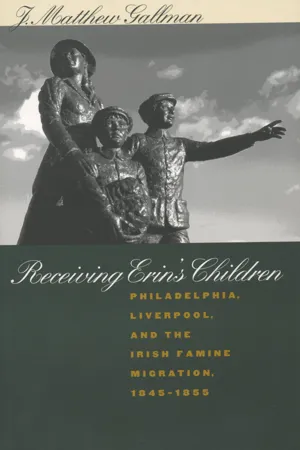
eBook - ePub
Receiving Erin's Children
Philadelphia, Liverpool, and the Irish Famine Migration, 1845-1855
- 320 pages
- English
- ePUB (mobile friendly)
- Available on iOS & Android
eBook - ePub
Receiving Erin's Children
Philadelphia, Liverpool, and the Irish Famine Migration, 1845-1855
About this book
Information
1: Immigrants and Hosts
INTRODUCTION: THE IRISH FAMINE MIGRANTS
In July 1847 eighteen-year-old Ann Murphy left home for Belfast on a journey that would eventually lead her to Philadelphia. She carried with her a steerage ticket for passage from Liverpool to Philadelphia on the Susquehanna, one of the packet ships owned by Philadelphia’s H & A Cope Company. Theodore Wilson, an Irishman living in Philadelphia, had purchased the ticket at the Cope Company’s Walnut Street offices on January 22. Before mailing the ticket, Wilson had scrawled a few hasty words of advice on the back:
[Tell] her to pay particular attention to the following directions I am going to give her, when she has got her sea store and clothes packed up as small bulk as possibel she can get to Belfast by the best conveyance and get put on board the steamer for Liverpool in Belfast and on board the boat she must be very careful of herself and things and form no acquaintance with any body, and take care of any body medling with her things when she arrives in Liverpool and she can find one of the Steam Boat porters to take her to the office of [Harnden and Company?].1
The following February, Margaret McKee and her friend Catherine Ronaghan arrived at the Liverpool docks with steerage tickets—also for the Susquehanna—purchased in Philadelphia by Margaret’s brother Michael. Michael’s written advice and warnings picked up where Theodore Wilson’s had left off: “Inquire for Copes office and show them this and you will get your passage, be there on the eighth of the month that you are going to come bring herrings plenty with you that is the mainstay on board of ship … when you come on the ship … be wise and take care of yourselves for board of ship is an awful place and make no freedom with any person and no one will enterfere with yous keep to your selves when you land.”2
Ann, Margaret, and Catherine were all part of the massive Irish migration during the potato famine. The history of the famine and migration has been told often, from many different perspectives, and needs no detailed retelling here.3 In the fall of 1845 a deadly blight struck the potato crop in eastern Ireland. The next year the potato famine swept across the country. In 1847 the potato crop was small, although the yields were actually fairly strong, but 1848 saw another round of disaster. Four years of poor harvests took a tremendous toll, as a weakened citizenry fell easy victim to typhus, dysentery, and other deadly diseases. By some estimates, roughly a million Irish men and women—or about a ninth of the total population—succumbed to starvation and disease because of the famine.4 Many others faced eviction or fled their homes in search of new lives. Between 1845 and 1855 an estimated 1.5 million Irish women and men sailed for the United States, landing largely in New York, Philadelphia, New Orleans, Boston, and Baltimore. Another 600,000 left Ireland for England, Canada, Australia, and other destinations.5
During the peak of the Irish famine migration the H & A Cope Company—which had five vessels in operation in 1848—was sending packet ships westward from Liverpool to Philadelphia on the twelfth of every month. The passenger lists ranged from as few as 150 to well over 300 steerage travelers per voyage, the vast majority coming originally from Ireland.6 Between January 1847 and the end of 1849, Cope’s Philadelphia offices sold more than 2,500 tickets for passage from Liverpool, primarily to Irish immigrants who mailed them home to friends and relatives. Perhaps a hundred or so of the small notes written on the back of tickets survive.7 Taken together they describe a world of great opportunities, but a journey fraught with dangers and hardship. John Stott’s message to John and Sarah Glehill and their four young daughters was typical: “we hope that you will brace your nerves and steel your face and be nothing daunted and you will soon join with us on this Great Continent. There will be dificultyes to meet with but then consider the object you have in view.”8 Often those difficulties would be from strangers, with familiar sounding brogues, who haunted the Liverpool and Philadelphia docks preying on migrants who carried all their possessions in their hands and their savings in their pockets. One correspondent warned Howard Berne that “Liverpool is full of Imposters if they can trick any person they can lay hold of … you will require to be very cautious & clever & no way shy without getting your rights.”9 Mary Kon left home with explicit instructions to seek out a Mr. Lynch in Liverpool; if he did not appear she was to “inquire for the Constable and show him the card and he will dirrect you wher the house is.”10 Catherine Cardary directed Alice Cleland to a small court off of Carlton Street “opposit the cloureness dock liverpool,” adding that “we think you would be safer there thane aney other plase when you lave the steem boat.”11
Other notes offered advice on what food to pack to supplement the meager official rations and appropriate clothing for the voyage. “My advice to you” wrote Hugh Clark to Mary Clark, “is to keep off the Deck in the night and stormy times as it is dangeres[.] you will want [a] tin pan … in the shape of a bottil that will hold 4 qt for your fresh water[.] you will want some tin plats and some tin cups and a boiler[.] you need not get any new close [clothes] as it is not the fashins in america that thy hav at home.”12 Many other correspondents shared this last suggestion. Apparently clothing in Philadelphia was sufficiently inexpensive and distinctive that even the humblest migrant should expect to acquire a new wardrobe on arrival.
Those immigrants who were fortunate enough to have relatives or friends in the United States were generally told to hurry to a particular lodging house or tavern near the docks where a friendly face would await them. One woman was to “Inquire for William Rushworth” at the “English Tav[ern,] No 87 South Water Street Philadelphia.”13 Another correspondent told his nineteen-year-old brother that “when he lands in Philadelphia Enquire for 252 North Water Street and you will find your Friend to welcome you.”14 Catherine Whelan told her brother and sister to “come to Mrs. Weines[,] 159 Front Street between Spruce St and Dock St.”15 Some of the Philadelphians who mailed tickets promised to meet each of the Cope vessels until their relative arrived. Whatever their economic prospects, strangers were best off with a trustworthy human contact as a buffer against a potentially hostile new world.
The disaster that struck Ireland in the late 1840s had a very real agricultural basis. By some estimates the lost potato crop between 1846 and 1848 was enough to have fed almost five million people daily. Nonetheless, the Irish peasantry had ample reason to see human agency behind their troubles. Parliamentary debates about the Irish crisis moved within tight ideological constraints, shaped by a trio of powerful—and often painfully abstract—ruling principles: localism, laissez-faire economics, and “less eligibility.” Landlords, encouraged by public policy, sometimes ruthlessly drove starving tenants from their homes; between 1846 and 1855 an estimated half-million people faced eviction. The public relief forthcoming from Parliament amounted to a tiny portion of the nation’s resources, as policymakers clung to a faith in charitable assistance and local poor rates.16 One historian has described the Great Famine as “the tragic outcome of three factors: an ecological accident that could not have been predicted, an ideology ill-geared to saving lives and, of course, mass poverty.”17 A similar confluence of factors—material conditions, intellectual assumptions, and the serendipity of events—shaped the experiences of the Irish migrants as they fled their homeland.
Proximity and shipping routes dictated that most emigrants headed for Liverpool. The first step in the journey would be overland to an Irish port, where crowded ferries made the crossing to the Merseyside city in twenty-four hours or more. Many would remain in the thriving port city, either by design, or because of limited resources, or simply because disease took its toll too quickly. Others soon boarded ships bound for North America. Along the way the weary, often sickly travelers were subject to all sorts of dangers. The passage across the Irish Sea was barely regulated. Ferry operators cared little for health and sanitation as they crammed as many deck passengers as they could onto each vessel. The migrants arrived in Liverpool seasick, exhausted, and ripe for plucking at the hands of an assortment of unscrupulous “runners,” lodging house keepers, ticket brokers, and other crooks. The lucky ones had a place to sleep and prepaid passages in hand. However long they stayed, the migrants found themselves in a world of crowded housing, unsanitary streets, and ethnic tension. For those who set off for North America, the hardships were just beginning. Ships varied tremendously in size and condition, generally falling far short of their advertised specifications. A slowly evolving set of laws regulated the amount of sleeping space, the food and water to be allocated for each passenger, and the circumstances when a surgeon was required to be on board. But much of the most important legislation passed on both sides of the Atlantic came after the heaviest migration. On their arrival at an American port, passengers were liable to physical inspection, quarantine, and perhaps prohibitive bonds. As they disembarked, the exhausted immigrants were once again targets for competing armies of shady characters and diverse philanthropists. It is no wonder that the snippets of advice written on the back of the Cope tickets stressed packing food and clothing with care and trusting no one along the way.18
The famine migrants are at the center of this book, but it is not really their story. Rather, it is the story of the worlds that they entered and the ways in which their presence helped to change those worlds.19 If the circumstances of their exodus and the nature of their journeys reflected the combined forces of historic chance, contemporary ideology, and material circumstances, so too did the evolution of their new homes. This book compares the histories of two important host cities—Liverpool and Philadelphia—during the famine years. It is an attempt to understand how the famine migration both illuminated and shaped circumstances and policies in each city and nation. In a broader sense, this study seeks to use the years of the famine migration to compare two societies at a crucial moment in their histories.
As for any historical study, the design of this book reflects several conscious decisions, each with its own underlying assumptions. The project has its genesis in a desire to examine nineteenth-century urban development, with a particular emphasis on the ways in which cities confronted the broad array of social challenges that accompanied increased size and population density. Having spent considerable time studying Northern cities during the American Civil War, I was drawn to the immediate antebellum decades as the occasion for many of the most crucial urban developments. I also brought to this project an interest in comparative history and a conviction that my examination of these urban questions should not be confined to a single nation. Clearly English and American cities faced many of the same challenges at roughly the same time. My goal was to construct a study that would allow for a profitable comparative analysis across the Atlantic.20
The decision to focus on the Irish famine migration proceeded logically from this scholarly agenda. Given my interest in examining how cities in both England and the United States faced numerous midcentury challenges—including poverty, disorder, and disease—the central task was to sharpen the focus as much as possible to enhance the value of the comparison. The famine migrants did not create these urban problems, but their arrival made the circumstances more dire in some cities, suggesting the possibility that cities in both countries may have been addressing similar problems at roughly the same time. But that having been said, I also did not want to let the tail wag the dog. My comparative focus is on the responses to a specific set of urban problems during the famine years, not merely on the direct responses to the Irish newcomers. In some cases the analysis indicates that the crucial institutional developments preceded the migration, and in other instances the immigrants did not prove to be the major shaping forces in one or both cities. In such situations the focus remains on the emerging responses to the specific constellation of problems, not merely on the institutions and policies as experienced by the Irish immigrants.
The final preparatory decision was to compare Liverpool and Philadelphia. There were certainly other reasonable candidates, including London, Manchester, and Glasgow on one side of the Atlantic and New York, Boston, and Quebec on the other. I quickly excluded London as an option, both because it was several times larger than any American city at midcentury and because the Irish community had been already so carefully examined by Lynn Hollen Lees. Among the remaining alternatives, I selected Philadelphia and Liverpool largely because they were similar in size (both demographically and geographically) and had similarly large Irish populations, allowing for some control over those crucial variables.21 In selecting those two cities I was also opting for a relatively limited comparison, rather than, for instance, attempting an analysis of a half-dozen cities of different sizes and circumstances. This choice reflects a preference for depth over breadth. By limiting my research to two cities I have been able to address a wider range of topics in some detail, rather than restricting my attention to a single set of issues.22
LIVERPOOL AND PHILADELPHIA AT MIDCENTURY
Liverpool and Philadelphia played similar roles in their respective worlds.23 Second in size and importance to the dominant metropolises of London and New York, they both enjoyed international prominence as major ports and commercial centers. Between 1831 and 1851 the borough of Liverpool’s population jumped from 165,175 to 375,955. In the same two decades Philadelphia County’s population more than kept pace, rising from 167,751 to 408,742.24 Both cities, too, had large Irish populations dating from well before the potato famine. By midcentury nearly 72,000 Philadelphians (17.6 percent) and 84,000 Liverpudlians (22.3 percent) were Irish-born immigrants.25 Philadelphia’s population was otherwise more demographically diverse than its English counterpart, with nearly 50,000 (12 percent of the total population) non-Irish immigrants, including 22,750 (5.6 percent) Germans and 17,500 (4.3 percent) English natives. Over 10 percent of Liverpool’s residents were non-Irish immigrants, but the vast majority of these were from neighboring Wa...
Table of contents
- Cover Page
- Title Page
- Copyright Page
- Dedication
- Contents
- Acknowledgments
- 1: Immigrants and Hosts
- 2: Migration and Reception
- 3: Poverty, Philanthropy, and Poor Relief
- 4: Hospitals, Cholera, and Medical Care
- 5: Environmental Reform
- 6: Sectarian Conflicts: Churches and Schools
- 7: Street Violence and the Pursuit of Public Order
- Conclusion
- Notes
- Index
Trusted by 375,005 students
Access to over 1.5 million titles for a fair monthly price.
Study more efficiently using our study tools.
Frequently asked questions
Yes, you can cancel anytime from the Subscription tab in your account settings on the Perlego website. Your subscription will stay active until the end of your current billing period. Learn how to cancel your subscription
No, books cannot be downloaded as external files, such as PDFs, for use outside of Perlego. However, you can download books within the Perlego app for offline reading on mobile or tablet. Learn how to download books offline
Perlego offers two plans: Essential and Complete
- Essential is ideal for learners and professionals who enjoy exploring a wide range of subjects. Access the Essential Library with 800,000+ trusted titles and best-sellers across business, personal growth, and the humanities. Includes unlimited reading time and Standard Read Aloud voice.
- Complete: Perfect for advanced learners and researchers needing full, unrestricted access. Unlock 1.5M+ books across hundreds of subjects, including academic and specialized titles. The Complete Plan also includes advanced features like Premium Read Aloud and Research Assistant.
We are an online textbook subscription service, where you can get access to an entire online library for less than the price of a single book per month. With over 1.5 million books across 990+ topics, we’ve got you covered! Learn about our mission
Look out for the read-aloud symbol on your next book to see if you can listen to it. The read-aloud tool reads text aloud for you, highlighting the text as it is being read. You can pause it, speed it up and slow it down. Learn more about Read Aloud
Yes! You can use the Perlego app on both iOS and Android devices to read anytime, anywhere — even offline. Perfect for commutes or when you’re on the go.
Please note we cannot support devices running on iOS 13 and Android 7 or earlier. Learn more about using the app
Please note we cannot support devices running on iOS 13 and Android 7 or earlier. Learn more about using the app
Yes, you can access Receiving Erin's Children by J. Matthew Gallman in PDF and/or ePUB format, as well as other popular books in History & British History. We have over 1.5 million books available in our catalogue for you to explore.