This ambitious work uncovers the constitutional foundations of that most essential institution of modern democracy, the political party. Taking on Richard Hofstadter’s classic The Idea of a Party System, it rejects the standard view that Martin Van Buren and other Jacksonian politicians had the idea of a modern party system in mind when they built the original Democratic party.
Grounded in an original retelling of Illinois politics of the 1820s and 1830s, the book also includes chapters that connect the state-level narrative to national history, from the birth of the Constitution to the Dred Scott case. In this reinterpretation, Jacksonian party-builders no longer anticipate twentieth-century political assumptions but draw on eighteenth-century constitutional theory to justify a party division between “the democracy” and “the aristocracy.” Illinois is no longer a frontier latecomer to democratic party organization but a laboratory in which politicians use Van Buren’s version of the Constitution, states' rights, and popular sovereignty to reeducate a people who had traditionally opposed party organization. The modern two-party system is no longer firmly in place by 1840. Instead, the system remains captive to the constitutional commitments on which the Democrats and Whigs founded themselves, even as the specter of sectional crisis haunts the parties' constitutional visions.
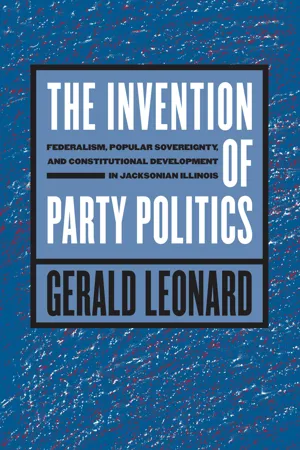
eBook - ePub
The Invention of Party Politics
Federalism, Popular Sovereignty, and Constitutional Development in Jacksonian Illinois
- 344 pages
- English
- ePUB (mobile friendly)
- Available on iOS & Android
eBook - ePub
The Invention of Party Politics
Federalism, Popular Sovereignty, and Constitutional Development in Jacksonian Illinois
About this book
Information
Chapter One
The Antiparty Constitutional Tradition from Bolingbroke to Van Buren
It is now familiar enough that James Madison and many of his colleagues in the Convention of 1787 had aimed to exclude party from the functioning of their new Constitution. They had sought to implement a constitution of popular sovereignty not by way of mass party competition but through an institutional design that would actually limit popular influence and neutralize party.1 In the words of Scott Gordon, these founders had tried to establish a constitution of “countervailance,” in which checks on governmental power were achieved by replacing the idea of an active sovereign—here, the people—with that of an interlocking set of institutions. No sovereign body would steer the government; governmental action could result only from the concurrence of multiple, nonsovereign governmental institutions.2 Half a century later, however, the partyist reformers sought to stand the elitist, antiparty Framers’ Constitution on its head. Rejecting the Framers’ premise of an “absent People”—whose nominal “sovereignty” would be functionally supplanted by a self-checking institutional design3—they drew on an alternative tradition from the founding generation. This tradition did anticipate an active popular sovereign within the constitutional framework.4 But, where that populist, constitutional tradition had continued to reject the device of party into the nineteenth century, the reformers of the 1820s finally concluded that a partyless Constitution must always be an undemocratic Constitution. Since the written Constitution did not actually say anything explicit about political parties, good or bad, the partyists remained free to “construct”5 a Constitution in which party was fundamental to popular sovereignty. And so they did.
As of the 1820s, the established constitutional order in America had not included a regular place for party organization. Even as a rising democracy marginalized advocates of rule-by-the-best-men, the Madisonian constitutional commitment to a partyless lawmaking process had remained pervasive. Numerous episodes of economic and cultural dislocation had left unshaken the popular antiparty consensus. But the battle to intrude party organization into that order was in the offing.
This battle was not the inevitable product of broad suffrage and a modernizing economy, although those features of American life were, in the event, important conditions of the development of mass parties. Instead, the war over party was produced by a constitutional reform movement that sought selfconsciously to revise the entrenched antipartyism of American political and constitutional culture. In fact, quixotic as the ultimate goal may have been, the reformers sought to establish for the Democratic party, and only the Democratic party, a kind of lawmaking authority at least as important as that of any formal branch of government.
In order to make the arguments stick, however, the partyist reform movement necessarily seized on the concrete sufferings of the people. The reformers worked to prove that economic problems were not just economic in nature but constitutional.6 Only Democratic party organization, therefore, could adequately address them. Thus did the social and economic battles of the 1820s and ultimately the great controversy over the Independent Treasury in the 1830s become episodes in the campaign to replace a designedly elitist Constitution with one in which the party of the popular sovereign was in command of the institutions of government.
But the story begins well before the Jacksonian period with the tradition of antiparty constitutionalism. The purpose of this opening chapter is to emphasize the genuinely revolutionary quality of the partyists’ ambitions by recovering the deeply antiparty constitutional traditions of the early republic.
The Anglo-American Unwritten Constitution before the Revolution
The unwritten constitution of early modern England celebrated the political autonomy of the undivided locality. Each locality was connected politically to others by little other than the common necessity of maintaining a central authority (such as Parliament) whose main function was to sanction and protect local autonomy. Within these communities the central constitutional value was unity through hierarchy. All politics and governance had as its fundamental purpose to sustain the structure of the local hierarchy of families, to make clear the sources of ultimate authority in the community, and thus to preempt any possible cause of division among the people as a whole.7
Division of the community would ultimately arrive by way of the central authority’s extension of its power into local affairs,8 but experience had shown that division was not only expensive, dishonorable, and subversive but pregnant with violence as well. Especially after the persistent civil unrest of England’s seventeenth century, according to Richard Hofstadter, “party was associated with painfully deep and unbridgeable differences in national politics, with religious bigotry and clerical animus, with treason and the threat of foreign invasion, with instability and dangers to liberty. Even in 1715, the Tories, the opposition party, could still be seen as quasi-treasonable.”9 Society simply lacked regular mechanisms for resolving large-scale clashes of interest. All assumed that the roots of division were in private interests, which were further assumed to be inconsistent with the public interest of a naturally harmonious community. Such divisions within the ruling class were expected to be worked out quietly, lest division be extended to the electorate as a whole and the ruling structure of the community itself be challenged. There was little or no challenge to the model of localist, paternalist aristocracy and little doubt that the symbiotic relationship between hierarchical authority and communal peace lay at the core of the unwritten constitution.10
This model of the British constitution was not merely an abstract ideal. Although membership in the House of Commons was elective, these elections had traditionally featured only a single candidate, presented by the local elite for mere ratification by the restricted electorate. Most of the way through the eighteenth century, a large majority of elections to Parliament remained un-contested. The mutual obligations of aristocracy and people continued to reinforce the unity of the local polity against the potentially divisive exercise of authority by the central government.11
At the same time, British emigrants carried these constitutional convictions to the New World. The great majority of colonists remained fully within the British culture of monarchy. They believed in unity, dependency, and deference, not in popular initiative or popular politics. Depending ultimately on the king for protection, they forthrightly avowed their allegiance to him. And they understood the hierarchy that descended from royal authority to the local elite as the legitimate political structure of royal protection and popular allegiance. In this picture, division of a community necessarily reflected a factious dissatisfaction with the status quo and thus a constitutional challenge to the royal structure of authority.12
The clearest examples of the passion for unity through hierarchy appear in the Puritan colonies. There the theory of covenanted communities and the unitary nature of God’s will impelled the people to political unity.13 And this imperative to unity was manifested in election procedures. In many Massachusetts towns, for example, if an election was contested, it was common practice to announce only the winners. Names of the losers and their vote totals were withheld on the premise that such information would only encourage resentment when the community should be uniting under the legitimate authority of the winners. The purpose of the town meeting, where decisions were made by consensus, not by majority, was less to make policy decisions than to reaffirm the unity of the town.14
If the commitment to unity was most easily seen in the land of covenants and Christian mission, it was present elsewhere too. The attempts to create stable political and social structures in all of the colonies drew on the assumptions of the monarchical culture of dependence. Nothing was more important to stable government in this vision than the existence of an elite that bore the standard marks of authority: wealth, education, family, aristocratic bearing, and the rest. Such an elite could manage society without having its authority questioned and thus without risking political division. Unfortunately, the absence of such an indigenous elite in the New World was the central political characteristic of the colonies.15 Bacon’s Rebellion, for example, has been explained as the product of the Virginia political elite’s weak claims to its status and power by seventeenth-century standards. Challenges to authority in New York and North Carolina had very different histories but again can be explained not as efforts to escape the constitution but to rescue it from false elites. In fact, Bernard Bailyn’s survey of the colonies attributes their general political instability to the colonists’ desire to see a closer match than was possible between constitutional ideals and political reality. The New World’s greater equality of condition, combined with the imperial establishment’s patent inability to reproduce the British constitution of hierarchy and unity in the colonies, opened the door to the colonies’ frequent challenges to authority and consequent factionalism. Factionalism—or party contention—was the prima facie evidence that the constitution had been corrupted. And political competitiveness remained a source of unease as the colonists clung to constitutional tradition.16
Origins of the Discourse of Party
Before the eighteenth century, then, there hardly existed a discourse of party, unless routine, blanket condemnation counts as a discourse. Party, or faction, was any group organized to further its private interests at the expense of the public good. Party had virtually no defenders, and its opponents, therefore, had virtually no reason to refine the theory of antipartyism. But the eighteenth century would bring refinements that would prove crucial in the later, American invention of permanent, legitimate party organization. The key idea here is that society and polity were constituted by estates. The monarchy, the aristocracy, and the democracy were distinct strata of both society and polity, and each might, in rare times of crisis, embody itself temporarily as a kind of “antiparty party”—a special sort of party that might defend the constitution against the attacks of the more conventional sort of party, the self-interested cabal.
In England, the constitution to be defended was the “balanced constitution” or “mixed government.” Looked to as the guarantee of England’s unrivaled freedom, the constitution was “mixed” or “balanced” in the sense that it incorporated the three distinct estates or constitutional orders into a single governing structure. The crown, the nobility, and the commoners were not just constitutional abstractions but easily recognized, discrete elements of both society and polity. By institutionalizing the three constitutional orders in the monarch, the House of Lords, and the House of Commons, each limiting the others’ ability to engross power, history had presented eighteenth-century England with a constitution that offered the hope of eternal liberty. This far, nearly all the English polity was in agreement.17
The development of English society and politics after the Glorious Revolution, however, prompted fundamental disagreement over the actual functioning of that constitution and its relationship to the greater society, especially in light of the eighteenth-century financial revolution.18 Thus, on the Whig side, the secretary of the treasury, Sir Robert Walpole, set out to settle the essentials of the English constitution by establishing a permanent interdependence among the branches, by which the dominance of any one of them would be forever forestalled. To this end the Whig oligarchy refined government by “influence,” a regularized connection between the ministry and the House of Commons. “Influence” was achieved by the ministry’s appointing members of Parliament to executive offices or “places” and by the ministry’s reliance on this influenced Commons for its effectiveness. It made for efficient government by a fairly coherent ruling group. It excluded Tories from affecting policy or otherwise wielding influence. And it prevented either King or Commons from dominating the other, since they were mutually dependent. In all these ways, influence put into operation the Whig view of mixed government as rule by a single constitutional party—although most Whigs would have rejected the term party—embodying the entire legitimate political nation and acting through the interdependent branches and estates of the balanced constitution.19
To the Tory opposition, of course, the Whig oligarchy was nothing more than the worst kind of faction. It was a ministerial party, armed with the new resources of the financial revolution—the na...
Table of contents
- Cover Page
- The Invention of Party Politics
- Copyright Page
- Dedication
- Contents
- Acknowledgments
- Introduction
- Chapter One The Antiparty Constitutional Tradition from Bolingbroke to Van Buren
- Chapter Two The Antiparty Consensus of the Illinois Democracy
- Chapter Three State Sovereignty and the “Proscriptive Party,” 1828–1830
- Chapter Four National Politics, the Constitution, and the Price of Party in Illinois, 1831–1834
- Chapter Five Partyism Unchained, 1834–1836
- Chapter Six The Spoils Aristocracy and the Paper Aristocracy, 1837–1838
- Chapter Seven Ideological Origins of the Two-Party Constitution, 1839
- Chapter Eight The Elections of 1839–1840: Popular Sovereignty?
- Chapter Nine The Rise and Fall of Constitutional Partyism: Illinois and the Nation, 1815–1854
- Notes
- Bibliography
- Index
Trusted by 375,005 students
Access to over 1.5 million titles for a fair monthly price.
Study more efficiently using our study tools.
Frequently asked questions
Yes, you can cancel anytime from the Subscription tab in your account settings on the Perlego website. Your subscription will stay active until the end of your current billing period. Learn how to cancel your subscription
No, books cannot be downloaded as external files, such as PDFs, for use outside of Perlego. However, you can download books within the Perlego app for offline reading on mobile or tablet. Learn how to download books offline
Perlego offers two plans: Essential and Complete
- Essential is ideal for learners and professionals who enjoy exploring a wide range of subjects. Access the Essential Library with 800,000+ trusted titles and best-sellers across business, personal growth, and the humanities. Includes unlimited reading time and Standard Read Aloud voice.
- Complete: Perfect for advanced learners and researchers needing full, unrestricted access. Unlock 1.5M+ books across hundreds of subjects, including academic and specialized titles. The Complete Plan also includes advanced features like Premium Read Aloud and Research Assistant.
We are an online textbook subscription service, where you can get access to an entire online library for less than the price of a single book per month. With over 1.5 million books across 990+ topics, we’ve got you covered! Learn about our mission
Look out for the read-aloud symbol on your next book to see if you can listen to it. The read-aloud tool reads text aloud for you, highlighting the text as it is being read. You can pause it, speed it up and slow it down. Learn more about Read Aloud
Yes! You can use the Perlego app on both iOS and Android devices to read anytime, anywhere — even offline. Perfect for commutes or when you’re on the go.
Please note we cannot support devices running on iOS 13 and Android 7 or earlier. Learn more about using the app
Please note we cannot support devices running on iOS 13 and Android 7 or earlier. Learn more about using the app
Yes, you can access The Invention of Party Politics by Gerald Leonard in PDF and/or ePUB format, as well as other popular books in Politics & International Relations & North American History. We have over 1.5 million books available in our catalogue for you to explore.