eBook - ePub
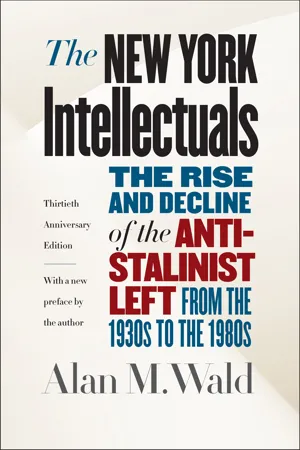
The New York Intellectuals, Thirtieth Anniversary Edition
The Rise and Decline of the Anti-Stalinist Left from the 1930s to the 1980s
- 504 pages
- English
- ePUB (mobile friendly)
- Available on iOS & Android
eBook - ePub
The New York Intellectuals, Thirtieth Anniversary Edition
The Rise and Decline of the Anti-Stalinist Left from the 1930s to the 1980s
About this book
For a generation, Alan M. Wald’s The New York Intellectuals has stood as the authoritative account of an often misunderstood chapter in the history of a celebrated tradition among literary radicals in the United States. His passionate investigation of over half a century of dissident Marxist thought, Jewish internationalism, fervent political activism, and the complex art of the literary imagination is enriched by more than one hundred personal interviews, unparalleled primary research, and critical interpretations of novels and short stories depicting the inner lives of committed writers and thinkers. Wald’s commanding biographical portraits of rebel outsiders who mostly became insiders retains its resonance today and includes commentary on Max Eastman, Elliot Cohen, Lionel Trilling, Sidney Hook, Tess Slesinger, Philip Rahv, Mary McCarthy, James T. Farrell, Irving Kristol, Irving Howe, Hannah Arendt, and more. With a new preface by the author that tracks the rebounding influence of these intellectuals in the era of Occupy and Bernie Sanders, this anniversary edition shows that the trajectory and ideological ordeals of the New York intellectual Left still matters today.
Chapter 1. Jewish Internationalists
Like Marx, Rosa Luxemburg and Trotsky strove, together with their non-Jewish comrades, for the universal, as against the particularist, and for the internationalist, as against the nationalist, solutions to the problems of their time.
—Isaac Deutscher, “The Non-Jewish Jew”1
THE NON-JEWISH JEWS
A substantial number of studies have been devoted to probing the social and historical roots of modern Jewish radicalism. Despite the variety of conclusions such studies have yielded, most analyses usually begin by noting the dilemma of young Jewish intellectuals who have attempted to escape the confines of the religio-cultural ghetto, only to confront an alien society toward which they feel ambivalent if not hostile.2 Political radicalism with its internationalist élan has often served as a magnetic pole of attraction to such intellectuals, especially in a period of social upheaval. One of the most important yet least documented developments in the evolution of modern American culture concerns just such a group of Jewish intellectuals. Seeking to forge a liberal Jewish cultural movement under the aegis of “cultural pluralism” in the 1920s, they found themselves propelled first toward Communism and then toward Trotskyism during the 1930s. Their experience produced several of the earliest pioneers of the anti-Stalinist left who later achieved national prominence as New York intellectuals.
In their origins and outlook, as recorded in the pages of the Menorah Journal between 1923 and 1931, these intellectuals shared many characteristics with the archetype that Isaac Deutscher depicts in his 1958 essay “The Non-Jewish Jew.” Deutscher used this term to describe rationalist Jews—such as Spinoza, Marx, and Freud —who lived “on the borderlines of various civilizations, religions, and national cultures,” and who were shaped by the cross-fertilization of such diverse influences.3 More specifically, as these particular Jewish-American intellectuals gained confidence in their ideas and deepened their political commitments, they progressively shed ambivalent feelings about their ethnic backgrounds while embracing a universalist internationalism. As they increasingly came to terms with their Jewish origins in a positive way (some, in fact, felt a special empathy with Jewish history because of its record of struggle against oppression), they refused to credit any specifically Jewish trait or achievement as inherently superior or more significant simply because they themselves were born Jews. Sidney Hook recalled that “we took ourselves for granted as Jews and were concerned with the Jewish question primarily as a political one.”4 To them, Judeocentrism in any form was repugnant. If one chose to write for a Jewish magazine or about Jewish issues, one did so only from the perspective of the interconnection of the fate of all humanity.
The particular kind of universalism to which these young Jewish intellectuals were drawn as they encountered Marxism is best exemplified in the twentieth century by such revolutionary internationalists of Jewish origin as Rosa Luxemburg, Leon Trotsky, and Deutscher himself, who sought to overthrow the existing social order in order to construct a world culture that drew the best from all people from every class, ethnic group, and continent. Such an aspiration differs quite markedly from assimilationism or accommodationism, which means adapting to or even imitating features of the dominant culture of one’s society. In its ideal form, internationalism can also be distinguished from the variant of universalism (sometimes called, pejoratively, “national nihilism”) that demands total abandonment or only perfunctory recognition of one’s ethnic identity; this abandonment might be a virtue, perhaps, if one comes from a dominant group, but it is potentially a form of selfdenial if one comes from a persecuted race or nationality, as in the case of Afro-Americans or a colonized people. The universalist-internationalist perspective, fraught as it is with many difficulties, often remains more an aspiration than a goal concretely achieved. For the group that was to become the New York intellectuals, it did not come clearly into focus until the early years of the Great Depression, when the combination of sudden social dislocation and the rediscovery of Marxist theory exposed the limitations of the cultural pluralist doctrine.
Cultural pluralism, the product of American Progressivism’s response to eastern and southern European immigrants, had a special meaning for Jewish Americans at that time. In the century following the French Revolution, Jews in western Europe seemed to have the possibility of assimilation within their grasp, while those in the east faced persecution, oppression, and isolation. Massive Jewish immigration to the United States, however, reinforced the concept of cultural pluralism that was vigorously put forward and defended by Horace Kallen, Randolph Bourne, and other liberal and radical intellectuals just before World War I.
As a theory, cultural pluralism suffers, as John Higham has noted, from “chronic indistinctness”; in fact, two ostensibly contradictory theses are embraced in the work of Kallen and Bourne.5 While cultural pluralism was opposed to assimilation and the concept of the “melting pot,” it was equally opposed to cultural and ethnic parochialism, positing as an alternative the future achievement of cosmopolitan values, including the absence of narrow loyalties and provincial prejudices, as well as a willingness to borrow from all cultures to achieve the richest blend. The precise relationship between these two desiderata unfortunately was never probed. Further, the doctrine was predicated upon a situation of stability and steady economic growth in which all groups shared equally. It did not take into account the possibility that in a class society certain cultures become the instrument of political and economic domination, while others are expressions of sectors of the population possessing few resources to promote their values.
Even before the turn of the century, the pluralist doctrine, advocating the development by different groups of their own cultures within the confines of a common civilization, had been articulated by such advocates as William James. Kallen’s version came to fruition in the optimistic atmosphere of the Progressive era, which also produced John Dewey’s instrumentalist philosophy, the liberal historical scholarship of Charles and Mary Beard, Lincoln Steffens’s muckraking journalism, and Herbert Croly’s New Republic. Bourne’s views were partly motivated by his opposition to the national chauvinism that he saw engendered by the onset of World War I.
The anti-assimilationist aspect of cultural pluralism is emphasized in Kallen’s famous description of society as an orchestra with multiple ethnic groups serving as various instruments in order to “make up a symphony of civilizations.”6 The antiparochialist and cosmopolitan facets were developed by Randolph Bourne who, in accord with Kallen’s perspectives, praised some Zionist Jews for their ability to incorporate into their outlook the latest advances in science and other areas of knowledge. Bourne excoriated the melting pot thesis, which he took to be a mere euphemism for assimilation to the dominant Anglo-Saxon culture, arguing instead for what he termed a “spiritual welding,” which, rather than diluting humanity to a single strain, would instead create a rich and powerful blend.7
The Menorah Journal was the main Jewish publication that promoted this particular combination of anti-assimilationism and cosmopolitanism. Horace Kallen was a founder of the Menorah Society, and one of Bourne’s most famous polemics against the melting pot thesis appeared in the Menorah Journal in 1916.8 The vital atmosphere created by combining cultural pluralism and the cosmopolitan ideal attracted such diverse sponsors as Henry Hurwitz (the Menorah Journal’s official editor throughout its existence), Harry Wolfson, Adolph Oko, and Waldo Frank in their efforts to create a place for the Jewish intellectual and Jewish culture in modern society. The first Menorah Society had been formed at Harvard University in a 1906 response to the ostracism and insecurity experienced by Jewish students. Nine years later, Hurwitz published the first issue of the Menorah Journal. The new magazine promoted a nonsectarian and academic humanist spirit, which aspired to cultivate respect for the Jewish past while also responding to the American present.9
The Menorah Society, which was eighty chapters strong by 1920, was animated by the temper of Hurwitz’s publication and its search for a more positive definition of Jewry in America. The journal’s program of developing a Jewish humanism led directly to the formation of a Jewish intellectual vanguard that aimed to create a Jewish cultural renaissance within the framework of cultural pluralism. Early on there were signs that the Menorah Journal could not entirely escape the ethnocentric bias in American culture. The magazine’s strategy, as Robert Alter has since noted, was to “validate Jewish cultural phenomena by assimilating them to Western analogues.”10
PORTRAIT: ELLIOT COHEN
Into this movement, in its inchoate stages, came the unique and catalytic personality of Elliot Ettleson Cohen. Born in Des Moines, Iowa, in 1899, Cohen was reared in Mobile, Alabama. His father, Henry Cohen, had remained in Russia to become a rabbi when his family immigrated to the United States. Later, to escape serving in the czar’s army, he crossed the ocean by himself at the age of twenty. Elliot’s mother, Rose Ettleson, also came from eastern Europe. Her family settled in Texacali, Texas. Beginning his career as a peddler, Henry Cohen soon opened a clothing store in Tama, Alabama, near Mobile, and met his future wife at a cousin’s home while on a buying trip to Chicago.
Elliot Cohen was a prodigy from birth. At the age of two or three he could pick up a newspaper and read the headlines. By then his head was already as big as his father’s, and it remained large in proportion to his body throughout his life. As a young man of medium height, graced with a fine smile and sparkling eyes, he also had a quick and nasty temper. Once a man outside of his father’s clothing store began to beat a horse, and Elliot terrified his family by the violence with which he rushed out the door to stop him.11
At the age of fifteen he enrolled at Yale, graduating with a brilliant record at eighteen having specialized in English literature and philosophy. Believing that it was impossible for him to obtain a university appointment, open to few Jews in the liberal arts at that time, he passed several years at Yale’s graduate school and then looked elsewhere for a profession.12 He had been president of the Menorah Society at Yale, and he had won an intercollegiate essay contest with an article critical of American rabbis’ lack of knowledge about contemporary Jewish life. Hence it came as no surprise when in October 1923 his first contribution to the Menorah Journal was a report on the New York summer school program that reflected the fundamental cultural perspective that would become Cohen’s hallmark.
In interpreting the Menorah movement’s stated goal, the seeking of the place of the Jew in the modern world, Cohen argued that the Jew be treated not in isolation but as part of the life of humanity as a whole. He emphasized that the Jew was dependent on the same social, economic, and psychological forces that conditioned the lives of other people. Thus, he concluded, knowledge about the Jew was of value for all human self-understanding and advancement. The terminology of cultural pluralism was evident in his plea that Jewish history should be studied “for the light it is sure to lend to those pressing problems of adjustment among all self-conscious racial, national, and cultural minorities in the modern state.”13
Yet Cohen was a complex if not contradictory person; such high seriousness represented only one facet of his personality. Within a year he began writing monthly humor columns, first called “Notes for a Modern History of the Jews” and later “An Elder of Zion.” Here he mainly attempted to recreate the satirical, debunking style of H. L. Mencken’s American Mercury by presenting a cacophony of quotations, marginal annotations, and news items depicting Jews in all walks of life, including gangsters, athletes, eccentrics, and civil libertarians. Lionel Trilling, one of the Menorah Journal’s assistant editors, recalled afterward that “when it came to the Jewish present, we undertook to normalize it by suggesting that it was not only as respectable as the present of any other group but also as foolish, vulgar, complicated, impossible and promising.”14
Even though these early writings expressed Cohen’s distinctive temperament, his paramount influence on the Menorah Journal came not through his own literary contributions. Trilling later recalled Cohen as a Socratic personality who “conversed endlessly, his talk being a sort of enormously enlightened gossip—about persons, books, baseball players and football plays, manners, morals, comedians . . . clergymen . . . colleges, the social sciences, philanthropy and social work.” Cohen felt that he had gained special benefits from his Alabama upbringing and “was proud of his knowledge of an American life that wasn’t easily available to young Jewish intellectuals, and he cherished his feeling for the unregenerate commonplaces of ordinary experience.”15 Cohen also had severe difficulty sustaining his own writing, which prompted a tendency to use the literary endeavors of others as surrogates. Although judged by Trilling and others to be a great editor and teacher, Cohen so compulsively devoted himself to improving the Menorah Journal contributions that some of the writers found it necessary to withdraw from the strangling embrace of his tutelage in self-protection.
In the latter 1920s and at the very beginning of the next decade, Cohen’s influence on the Menorah Journal was at its zenith. It was during this period that a small but lively band of talented young writers coalesced into a distinct coterie inspired largely by Cohen’s personality and cultural sensibilities. In fact, the intellectuals grouped around the Menorah Journal might best be understood as an elite carefully selected by Cohen, the creator and molder of the group. Most had been Columbia students: Lionel Trilling (b. 1905) had earned his B.A. and M.A. at Columbia and then taught for a year at the University of Wisconsin before returning to work on his doctorate in English; Herbert Solow (b. 1903) worked as a journalist; Clifton Fadiman (b. 1904) had published widely and was teaching English at Ethical Cultural High School; Henry Rosenthal (b. 1906) was enrolled at the Jewish Theological Seminary; Tess Slesinger (b. 1905) was a short-story writer and a reviewer for several New York newspapers; Anita Brenner (b. 1905) was a specialist in Mexican art who had done graduate work at Columbia; Felix Morrow (b. 1906), formerly editor of the Arch at Washington Square College of New York University, was studying philosophy at Columbia. Also published by Cohen were Louis Berg (b. 1906), a Russian-born journalist who held various jobs, and Albert Halper (b. 1904), who was just beginning his career as a novelist. The group’s influence through friendships and acquaintances reached out beyond these Menorah Journal contributors.
Through his elucidation of the Menorah Journal’s literary-cultural mission, Cohen provided a theoretical framework and vista that helped fertilize the literary imaginations of these young intellectuals. Trilling remembered his college days “as an effort to discover some social entity to which I could give the credence of my senses, as it were, and with which I could be in some relation.” He felt that he had “no ground upon which to rear an imagination of society” until he came under Cohen’s influence.16 Felix Morrow recalled that Cohen had the ability to attract young intellectuals who were not at all drawn to things Jewish. Instead of proselytizing, he simply offered them an opportunity to write and publish in a prestigious journal, thereby creating “the simulacrum of a movement of young Jewish writers.”17 Later, they found out they had set down roots in the Jewish experience, although in a way that kept most distanced from official Jewish institutions and conventional religious practices.
PORTRAIT: LIONEL TRILLING
Lionel Mordecai Trilling never identified himself as having been a cultural pluralist in his youth, but he was closely associated with Elliot Cohe...
Table of contents
- Cover Page
- Title Page
- Copyright Page
- Dedication
- Contents
- Preface to the Thirtieth Anniversary Edition
- Acknowledgments
- A Note on the Text and the Illustrations
- Introduction. Political Amnesia
- Part I. Origins of the Anti-Stalinist Left
- Part II. Revolutionary Intellectuals
- Part III. The Great Retreat
- Epilogue. Marxism and Intellectuals in the United States
- Notes
- Index
Trusted by 375,005 students
Access to over 1.5 million titles for a fair monthly price.
Study more efficiently using our study tools.
Frequently asked questions
Yes, you can cancel anytime from the Subscription tab in your account settings on the Perlego website. Your subscription will stay active until the end of your current billing period. Learn how to cancel your subscription
No, books cannot be downloaded as external files, such as PDFs, for use outside of Perlego. However, you can download books within the Perlego app for offline reading on mobile or tablet. Learn how to download books offline
Perlego offers two plans: Essential and Complete
- Essential is ideal for learners and professionals who enjoy exploring a wide range of subjects. Access the Essential Library with 800,000+ trusted titles and best-sellers across business, personal growth, and the humanities. Includes unlimited reading time and Standard Read Aloud voice.
- Complete: Perfect for advanced learners and researchers needing full, unrestricted access. Unlock 1.5M+ books across hundreds of subjects, including academic and specialized titles. The Complete Plan also includes advanced features like Premium Read Aloud and Research Assistant.
We are an online textbook subscription service, where you can get access to an entire online library for less than the price of a single book per month. With over 1.5 million books across 990+ topics, we’ve got you covered! Learn about our mission
Look out for the read-aloud symbol on your next book to see if you can listen to it. The read-aloud tool reads text aloud for you, highlighting the text as it is being read. You can pause it, speed it up and slow it down. Learn more about Read Aloud
Yes! You can use the Perlego app on both iOS and Android devices to read anytime, anywhere — even offline. Perfect for commutes or when you’re on the go.
Please note we cannot support devices running on iOS 13 and Android 7 or earlier. Learn more about using the app
Please note we cannot support devices running on iOS 13 and Android 7 or earlier. Learn more about using the app
Yes, you can access The New York Intellectuals, Thirtieth Anniversary Edition by Alan M. Wald in PDF and/or ePUB format, as well as other popular books in History & North American History. We have over 1.5 million books available in our catalogue for you to explore.