Billings disputes the assumption that an incipient merchant class built the state’s cotton mills; he reveals that a majority of the early mills was owned by prominent planters and agrarians. He shows the persistent hegemony and support for industrialization among the landed upper class and describes several generations of five powerful North Carolina families who spread plantation paternalism to the mill-village system. Billings compares this with similar cases in Germany and Japan.
A UNC Press Enduring Edition — UNC Press Enduring Editions use the latest in digital technology to make available again books from our distinguished backlist that were previously out of print. These editions are published unaltered from the original, and are presented in affordable paperback formats, bringing readers both historical and cultural value.
eBook - ePub
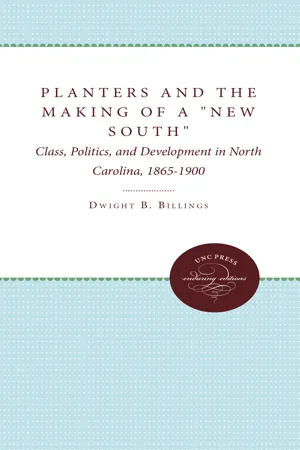
Planters and the Making of a "New South"
Class, Politics, and Development in North Carolina, 1865-1900
- 297 pages
- English
- ePUB (mobile friendly)
- Available on iOS & Android
eBook - ePub
Planters and the Making of a "New South"
Class, Politics, and Development in North Carolina, 1865-1900
About this book
Information
1. Introduction
The history of the American South provides many challenges to the sociologist studying social classes and social change. Although the region’s commercial agriculture developed as part of the modern world market system, slavery is reputed to have produced a society in the South whose aristocratic tendencies and economic interests were at odds with the rest of American society. Slaveholding conflicted with the dynamic, expansionist, middle-class capitalism of the North. The political expression of this conflict was the Civil War, a bloody fight to determine which pattern of social relations would be dominant on the American continent.
Historians have been fascinated by the effects of the war on southern society. C. Vann Woodward in Origins of the New South is an example of one who claims that no other class in our history fell so rapidly or so completely as the South’s planter aristocracy after the Civil War. A number of French aristocrats who never lived to see the nineteenth century or Russian aristocrats who did not see much of the twentieth century might argue the point were they here to do so. Nevertheless, apart from its accuracy, which I shall discuss later, this prevalent view dramatizes the extent of social change in the South: a rich agricultural South based on the labor of African slaves; a wartorn South first conquered by northern troops and then by northern railroads; and, finally, a “New South,” rich in industry and poor in wages.
This drama creates fascinating problems for sociologists interested in the process of stratification; they could correlate the rise and fall of social classes with the confusing patterns of southern politics. The South’s uneven development poses important problems for students of political and economic development. Why have some formerly backward areas of the South, such as the Carolina Piedmont, industrialized and others, such as the Delta region, seem never to change? I shall try to make sense of the patterns of social stratification and social change in the South by analyzing the economic and political development in the state of North Carolina after the Civil War.
In 1860, North Carolina was the poorest southern state. Compared with the grandeur of its neighbors, Virginia and South Carolina, North Carolina appeared humble. Its eastern counties supported a patrician class of slaveholders who dominated the state politically, but its vast western territories housed a huge population of yeomen and subsistence farmers whose life styles, in comparison, must have seemed frontierlike. Despite its comparative backwardness, however, by 1900, North Carolina was becoming the industrial leader of the New South. If we could return to the North Carolina of 1880, at the midpoint of this transition, it would not be clear at all how such a remarkable transformation could be possible.
In 1880 the effects of Civil War were still highly visible in North Carolina. The last of the federal troops had been withdrawn from the South only three years earlier. Roughly forty thousand North Carolinians (the greatest number in any Southern state) died in a war many had opposed. Approximately 350,000 slaves had been emancipated, but proprietary control was restored with the development of the sharecropping system. Much of the land was still in ruins. Because slaves and land had been the South’s capital, there was little money for rebuilding.1 North Carolina’s financial assets in 1880 were the lowest in the South.2 The ruinous costs of war were further compounded by chronic agricultural depression. There were more white than black sharecroppers because yeomen fell increasingly into debt and were forced into the tenancy system. By 1880 one-third of the state’s farms were operated by tenants.
North Carolina’s transportation system had been inadequate during the antebellum years. Postbellum capital deficiency crippled its rebuilding and extension. If we could again travel North Carolina’s sparse, rugged roads from the Tidewater across the rolling, red clay Piedmont and up into the wild, majestic mountains west of the Blue Ridge, we would realize how separate and hostile were its geographical subregions. Even compared with the rest of the South, North Carolina was extremely rural. A rugged coast, outlined with deadly sandbars, permitted no great seaport cities like Charleston to the south. Poor internal transportation prevented urban growth. Only four towns in North Carolina in 1880 numbered more than four thousand people and only one of these—Charlotte, with a population just over seven thousand—was not in the coastal region.3
Despite such obstacles, or perhaps because of them, North Carolina distinguished itself by launching an industrial revolution. In 1880 the value of farm products had exceeded the value of manufactured products by more than 250 percent. Twenty years later, however, the pattern was reversed, when manufactured products outstripped agricultural production by several million dollars.4 For its cotton mills and tobacco towns, its development of a fine system of public highways, and its regional leadership in school building and public health, North Carolina began to acquire a new popular image. Its reputation for progress seems almost to have set it apart from the rest of the South. V. O. Key, for instance, wrote: “Many see in North Carolina a closer approximation to national norms, or national expectations of performance, than they find elsewhere in the South. In any competition for national judgment they deem the state far more ‘presentable’ than its southern neighbors. It enjoys a reputation for progressive outlook and action in many phases of life, especially industrial development, education, and race relations.”5 Key—a southern liberal who saw the South’s “way out” in urbanization, industrialization, and outmigration of blacks—shared in and took hope from this view of North Carolina. He reported that from 1900 to 1939 the state ranked first among southern states in its 1,397 percent increase in value added by manufacturing and second in its 194 percent increase in the value of its farm products. He called the profound political and economic changes that occurred at the turn of the century a “political and educational renaissance” that “set in motion the progressive, productive forces that today distinguish the state.”6
Yet North Carolina’s economic development has been uneven. The state ranks thirteenth nationally in absolute value added by manufacturing. In 1976, North Carolina unseated Florida as the South’s business leader. A recent report notes that “thirty-five North Carolina firms made the [region’s] Top 200 . . . posting $13.77 billion in sales.”7 Two of the five largest southern corporations are in North Carolina, and no southern state has larger banks. The same report reveals that more of the chief executives of the region’s top businesses were natives of North Carolina than of any other state and that more had been educated at its state university than at any other educational institution. North Carolina also remains the seventh most rural state in the United States. Although it has the second highest proportion of nonagricultural employees in goods-producing industries in the United States, it ranks fiftieth in proportional union membership. North Carolina ranks fiftieth in average hourly earnings for production workers and forty-third in total per capita income. The state has the fifth most poorly educated population, despite its celebrated education “renaissance,” and the seventh highest rate of infant mortality in the nation.
Just as the pattern of North Carolina’s economic development has not been unambiguous, neither has its politics. Joseph Steelman, for example, concluded that his “search for an explanation of why North Carolina acquired the reputation, early in the 20th century, of being a ‘preeminent’ state of the ‘New South,’ progressive in outlook, enlightened in political, social, and economic matters has probably raised more issues than it has resolved.”8 No writer has made adequate sense of the paradoxical nature of North Carolina’s politics. In a recent critical bibliography on New South politics, J. Morgan Kousser remarked: “North Carolina’s historians have assiduously uncovered the facts of that state’s political history, but have been less successful in arranging them into patterns which advance our understanding of Southern history or institutions.”9
My goal in this book is as much to develop hypotheses about the South as to test them with the facts of North Carolina’s development. My strategy has been to use class as an analytic tool for studying social change. Gerhard Lenski’s Power and Privilege and Barrington Moore’s Social Origins of Dictatorship and Democracy have shown that theories of social stratification provide powerful analytical tools for understanding social change. Lenski redefined stratification analysis as the study of the dynamics of distribution, the age-old question of who gets what and why. He integrated economics, political sociology, and the sociology of social movements to explain long-term trends and comparative patterns of inequality. Moore demonstrated the lasting effects of historical factors in modernization. In a number of case studies, he related the technological and social aspects of agricultural production to subsequent patterns of economic and political development. These two studies have provided the empirical foundations for several recent theoretical discussions, and they return social stratification to the central place it held in classical sociology.10
When Karl Marx wrote that all history is the history of class struggle, he was stating a methodological principle. Marx examined the potential conflicts of economic life. He argued that profound social changes occur when productive classes (defined by their relationship to the means of production) become aware of their common interests and organize into political parties to advance or defend these interests. The renewed interest in classical sociology among students of social change results in a heightened appreciation for the methodology of political-economic analysis.11
This approach focuses on how an economic surplus is socially obtained. Since an economic surplus is “socially and politically defined from the very start,” a political economy “is characterized by a particular class structure—that is, the way in which a surplus is extracted from the economy, how and by whom it is distributed, and for what purposes.”12 Tied up with changes in how a surplus is generated or used are profound changes in many aspects of social life. These include not only class structures and the nature of work relations, but authority relationships in general, politics, and aspects of daily life such as family patterns and community membership as well as cultural standards and expressions. These factors are affected by political-economic changes and permit them to occur although in historical situations their interplay is usually most difficult to analyze.13 Given the fact that in the past few centuries such changes have occurred in a worldwide context, this approach invites—indeed, requires—comparative and historical investigation. A comparative perspective, in particular, has been absent from much of the literature on the South because so much attention has focused on the region’s unique experience within American society.
It is important to remember that class relations are sociological abstractions that can be inferred only from the actions of real people. The principal methodological strategy throughout this book will be an attempt to understand the actions of key economic and political actors and to infer from these interpretations of class structures, class Interests, and class consciousness. I accept quite literally C. Wright Mills’s claim that sociological imagination consists of grasping the relationship between history and social structure as these interact in biography.14 Throughout this work I propose to keep an eye not only on abstract social configurations but on the real lives, at least sketched in broad strokes, of North Carolina leaders. Close attention is paid to planters, industrialists, and politicians. It is hoped that the lives of North Carolina planters such as Paul Carrington Cameron, mill builders such as Daniel Tompkins, tobacco magnates such as James B. Duke, agrarian leaders such as Leonidas Polk and Marion Butler and the lives of middle-class reformers such as Walter Hines Page and Josephus Daniels will show the changing patterns and continuities of social life in the early postbellum South.15
2. Underdevelopment in Plantation Societies
Persistent poverty and a multitude of other social and economic indications of backwardness characterize all societies and regions dominated by plantation agriculture. This is true whether the case is the Caribbean, South and Central America, Southeast Asia, Africa, or the southern region of the United States. In this chapter I shall discuss a macrosociological approach to this problem, the political economy of plantation society. This approach locates plantation production in its context of the world capitalist market system and explains its persistent underdevelopment in terms of both its external trade dependency and its internal class structure.
Plantations and the World Capitalist System
Modern economic stagnation cannot be understood apart from the fact of worldwide economic interdependence, as a number of scholars, especially Gunnar Myrdal, Andre Gunder Frank, and Immanuel Wallerstein, have stressed.1 Frank, for instance, criticizes modernization theories for their emphasis on the spread of psychological modernity. In their assumption that economic backwardness is a consequence of cultural isolation, these theories, he says, fail “to take account of the economic and other relations between the metropolis and its economic colonies throughout the history of the worldwide expansion and development of the mercantilist and capitalist system.” Frank argues that economic growth and underdevelopment are often products of the same historical process. He laments most of all the failure of social theory “to explain the structure and development of the capitalist system as a whole and to account for its simultaneous generation of underdevelopment in some of its parts and of economic development in others.”2 The structure and dynamics of the capitalist world system have been the object of extensive macrosociological research by Immanuel Wallerstein. His research is one of the foundations for my investigation of the American South.
Interpretations vary regarding the complex technological, demographic, economic, and sociopolitical changes that resulted in the emergence of the worldwide capitalist market in the sixteenth century.3 It is clear, however, that the most important fact about this social system has been its complex division of labor. “This division,” according to Wallerstein, “is not merely functional—that is, occupational—but geographical. That is to say, the range of economic tasks is not evenly distributed throughout the world system. In part this is the consequence of ecological considerations, to be sure. But for the most part, it is a function of the social organization of work, one which magni...
Table of contents
- Cover Page
- Title Page
- Copyright Page
- Dedication
- Contents
- Acknowledgments
- 1. Introduction
- 2. Underdevelopment in Plantation Societies
- 3. The Political Economy of the American South: Persistence and Change
- 4. Social Origins of the New South: The Case of North Carolina
- 5. Modernization in the South: North Carolina’s Revolution from Above
- 6. Labor Relations and Ideology in the New South: Consequences of North Carolina’s Revolution from Above
- 7. Populism, Progressivism, and Paternalism: The Politics of Development
- 8. Uneven Development and the Agrarian Revolt
- 9. The Conservative Triumph
- 10. “Softly, Do You Not Hear ...?”
- Notes
- Bibliography
- Index
Trusted by 375,005 students
Access to over 1.5 million titles for a fair monthly price.
Study more efficiently using our study tools.
Frequently asked questions
Yes, you can cancel anytime from the Subscription tab in your account settings on the Perlego website. Your subscription will stay active until the end of your current billing period. Learn how to cancel your subscription
No, books cannot be downloaded as external files, such as PDFs, for use outside of Perlego. However, you can download books within the Perlego app for offline reading on mobile or tablet. Learn how to download books offline
Perlego offers two plans: Essential and Complete
- Essential is ideal for learners and professionals who enjoy exploring a wide range of subjects. Access the Essential Library with 800,000+ trusted titles and best-sellers across business, personal growth, and the humanities. Includes unlimited reading time and Standard Read Aloud voice.
- Complete: Perfect for advanced learners and researchers needing full, unrestricted access. Unlock 1.5M+ books across hundreds of subjects, including academic and specialized titles. The Complete Plan also includes advanced features like Premium Read Aloud and Research Assistant.
We are an online textbook subscription service, where you can get access to an entire online library for less than the price of a single book per month. With over 1.5 million books across 990+ topics, we’ve got you covered! Learn about our mission
Look out for the read-aloud symbol on your next book to see if you can listen to it. The read-aloud tool reads text aloud for you, highlighting the text as it is being read. You can pause it, speed it up and slow it down. Learn more about Read Aloud
Yes! You can use the Perlego app on both iOS and Android devices to read anytime, anywhere — even offline. Perfect for commutes or when you’re on the go.
Please note we cannot support devices running on iOS 13 and Android 7 or earlier. Learn more about using the app
Please note we cannot support devices running on iOS 13 and Android 7 or earlier. Learn more about using the app
Yes, you can access Planters and the Making of a "New South" by Dwight B. Billings in PDF and/or ePUB format, as well as other popular books in History & North American History. We have over 1.5 million books available in our catalogue for you to explore.