In 1899 the United States, having announced its arrival as a world power during the Spanish-Cuban-American War, inaugurated a brutal war of imperial conquest against the Philippine Republic. Over the next five decades, U.S. imperialists justified their colonial empire by crafting novel racial ideologies adapted to new realities of collaboration and anticolonial resistance. In this pathbreaking, transnational study, Paul A. Kramer reveals how racial politics served U.S. empire, and how empire-building in turn transformed ideas of race and nation in both the United States and the Philippines.
Kramer argues that Philippine-American colonial history was characterized by struggles over sovereignty and recognition. In the wake of a racial-exterminist war, U.S. colonialists, in dialogue with Filipino elites, divided the Philippine population into “civilized” Christians and “savage” animists and Muslims. The former were subjected to a calibrated colonialism that gradually extended them self-government as they demonstrated their “capacities.” The latter were governed first by Americans, then by Christian Filipinos who had proven themselves worthy of shouldering the “white man’s burden.” Ultimately, however, this racial vision of imperial nation-building collided with U.S. nativist efforts to insulate the United States from its colonies, even at the cost of Philippine independence. Kramer provides an innovative account of the global transformations of race and the centrality of empire to twentieth-century U.S. and Philippine histories.
eBook - ePub
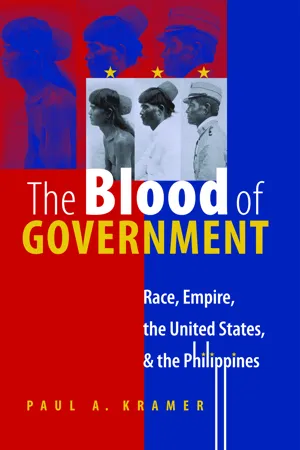
The Blood of Government
Race, Empire, the United States, and the Philippines
- 552 pages
- English
- ePUB (mobile friendly)
- Available on iOS & Android
eBook - ePub
About this book
Information
Chapter 1
Blood Compacts
Spanish Colonialism and the Invention of the Filipino
In the conscience of everyone, with the exception of those who for some type of atavism of schooling are seized by antiquated preoccupations, there is the notion that genius is cosmopolitan; that knowledge is not bound to any privileged race; that color does not presume talent, just as the habit does not make the monk.
La Solidaridad, 1889
La Solidaridad, 1889
When [the Spanish colonial government] has to ask us for something, it puts a human nature in our bodies, and takes it away when we ask for representation in the Cortes, freedom of press, rights, etc.
JOSÉ RIZAL, 1887
JOSÉ RIZAL, 1887
We begin our story not in Manila or Washington but in Madrid, beneath the trees of the Parque del Retiro, where, in summer 1887, the Spanish state put its largest remaining colony, rather defensively, on display before Spanish and European publics at a grand Philippine Exposition. In doing so, the Spanish state was participating in an emerging European imperial tradition, the use of colonial and metropolitan resources and institutions to mount elaborate spectacles that would simultaneously advertise national glory and sovereignty and colonial goods. But the exposition was also specifically attuned to Spanish and Philippine political realities. Liberal Overseas Minister Victor Balaguer had pressed for the exposition as a neomercantilist effort to interest Spanish investors and merchants in Philippine trade that was being increasingly lost to British and German companies. He was also eager to showcase the Philippines as a self-consciously modern colony, in an effort to challenge symbolically, if not politically, the overarching power of the Catholic friar orders that continued to monopolize power in the archipelago. The exposition’s two ornate pavilions, one a Crystal Palace (modeled on London’s 1851 Victorian exposition) and the other a Palace of Industry, were well stocked with geological, mineralogical, and meteorological displays that reflected Spanish scientific knowledge of the islands and, by extension, the colony’s modernity and suitability for business. The exposition, for Balaguer, would deepen, widen, and tighten the fraying ties between Spain and its farthest imperial extension, ties that were seen as increasingly problematic in the wake of ongoing rebellions in Cuba. In retrospect, he recalled that the event had “rectified the opinion of some, opened new horizons for many, taught things that had been ignored,” and “awakened curiosity and study.” It had also, he believed, “embodied in the nation mutual sentiments of love between those islands and the metropolis.”1
At least some visitors to the exposition were, however, not so persuaded that “mutual sentiments of love” had been awakened. Global integration was placing imperial spectacles in front of unanticipated and undesired audiences. By 1887, Madrid had, along with other European capitals, small “colonies” of elites from the islands, engaged largely in the pursuit of higher education in subjects closed to them in the Philippines itself. Although many of them were becoming versed in the very scientific discourses in which the exposition traded, these ilustrado (enlightened, educated) elites had been neither consulted in the making of the exposition nor invited to its formal events, facts that offended their sense of entitlement and honor. Demanding recognition, they felt themselves ignored and misrepresented. Most outrageous to some was the transport and display of approximately thirty actual “natives,” housed in “typical” dwellings. This group, which contained several animists and Muslims, was widely seen as a deliberate effort by Spanish colonialists—despite the promise to “rectify” Spanish opinion—to promote images of the islands’ backwardness and savagery. Even in anticipation of the event itself, Evaristo Aguirre, a creole from Cavite, suspected “a Machiavellian spirit set on domination and exploitation.” Ministers would “take notes,” journalists “invent witticisms, stories, and anecdotes,” and missionaries lecture the public on the “docile, apathetic, and ignorant character of that people.”2
The ilustrados’ encounter with the Philippine Exposition was one decisive moment in a two-decade-long campaign for recognition, the subject of this chapter. The Philippines had been the Spanish Empire’s great political exception from the 1830s onward, its inhabitants denied any representation in the Spanish Cortes, unlike Cuba and Puerto Rico. Even as Spain itself underwent political upheavals and liberal challenges, the islands continued to be ruled by a repressive politico-military state and the reactionary friar orders. Where it was challenged, the Philippines’ political exceptionalism within the Spanish Empire was defended predominantly on racial grounds: if the Philippines was excluded from representation, it was because the islands’ peoples were uniquely undeserving of it, its ostensibly Catholic indios (natives) mired in superstition, its “savage” infieles (infidels, i.e., animists and Muslims) entirely untouched by the saving hand of the church. By the late nineteenth century, however, the Philippines’ isolation from liberal currents would be challenged by the ilustrados, who would argue for Philippine “assimilation,” the political normalization of the islands within the Spanish Empire through the extension of metropolitan political and legal institutions, including representation in the Cortes.
Seeking Spanish rights, the ilustrados would chart and unravel the dense fabric of Spanish imperial racial formations that justified the status quo. This meant interposing themselves as authorities between the islands’ peoples and the Spanish imperialists who deprecated them. Writers in what came to be known as the Propaganda movement would seek Spanish and broader European recognition of Philippine sociocultural development in ways that both undermined and confirmed Spanish colonial hierarchies. The Propaganda writers both satirized Spanish imperial racism and held Philippine peoples up favorably to some of its standards. Their starting point was that Spanish colonial illiberalism was the result— deliberate or not—of misrecognition. Where Spaniards saw lazy, primitive savages in need of military repression, Catholic evangelization, and coercive labor control, they should instead recognize the Philippines’ peoples as “overseas Spaniards,” their “civilization” illustrated by their education, artistic achievement, eloquence in Spanish, and loyalty to Spain. What Spanish imperialists called the “abyss” between the islands’ peoples and Spaniards was bridged by the legend of a “blood compact,” which bound the two through shared blood. This glancing, rather than frontal, attack on Spanish imperial racism, by predicating political rights on sociocultural features, would also exclude certain Philippine peoples from an “assimilated” Philippines. The ilustrado quest for Spanish recognition, in other words, delimited the boundaries of who would ultimately be recognized as “Filipino.”
The energies of the Propaganda campaigners would have unintended consequences: when the activists encountered intensified Spanish racial-imperial defenses and failed to achieve their political goals, they would become increasingly alienated from Spain. When revolution broke out in the islands in 1896, its leaders would take up many of the concepts the reformist Propaganda movement had developed in defense of the islands’ inhabitants, including the category of “Filipino” itself, in their effort to construct the “imagined community” of an independent Filipino nation. That identity would be transformed again by the search for international recognition of the Philippines as an independent republic.
Race and Spanish Colonialism
The dramatic Philippine transformations of the late nineteenth century had their roots in both metropolitan and colonial tensions. Beginning with its colonization of the archipelago in the early sixteenth century, the Spanish had ruled the Philippines as a political extension of Latin America, subject to the Laws of the Indies and extensive Catholic evangelization. In economic terms, the Philippines was treated primarily as an essential commercial entrepôt in the highly profitable galleon trade between China and Mexico, revenues from which funded the Spanish colonial state. External and internal shocks impacted upon and altered this system in the eighteenth and nineteenth centuries. The British takeover of Manila in 1763 demonstrated the relative weakness of Spanish control and of Spain’s monopoly on Philippine trade. Spanish American independence in the first half of the nineteenth century dealt a crippling blow to Spanish mercantilism; Spain was unable to maintain its traditional monopolies and isolationist policies and was forced to open the Philippines to greater extraimperial commerce. At the same time, Spanish domestic politics in the first three-quarters of the century involved volatile shifts between liberal and reactionary regimes. Liberals in power challenged the authority of the Catholic religious orders, through their secularization and the confiscation of church property. But the loss of Latin America made liberals aware of the fragility of their remaining colonies and led to policies of retrenchment: the Philippines, which had had parliamentary representation in the Cortes during three constitutional periods prior to 1837, was excluded from representation subsequently. Unlike Spain’s other colonies, Cuba and Puerto Rico, which would continue to be represented, the Philippines would, for the remaining six decades of Spanish rule, be the politico-legal exception, the last of Spain’s colonies to be ruled through modified versions of the Laws of the Indies and a series of “special laws” that pertained to no other part of Spain’s dominion.3
Spanish colonial society in the islands by the nineteenth century was highly racially stratified, with colonial difference marked in terms of territorial nativity, mestizaje (blood mixture), and religious “civilization.” On the one hand, racial difference was associated with territorial nativity, with “peninsular” Spaniards—those with bilineal Spanish ancestry and European nativity—at the pinnacle of colonial society. Philippine “creoles,” or “Philippine Spaniards,” blessed with bilineal Spanish ancestry but corrupted by their colonial births, were beneath them and often resentful of their lesser status. The ranks of the friar orders were drawn exclusively from both “Spanish” communities, which also monopolized— with few exceptions—all governmental positions above the level of alcalde mayor (mayor). A second mode of difference was measured in blood mixture. “Spanish mestizos,” the children of Spanish men and indio women, were relatively few in number, compared with other mestizo groups, and would become prosperous through both landholdings and as economic middlemen between indios and European commercial houses, although they would also be objects of racial scorn and social exclusion. Chinese mestizos were far more numerous, with Chinese-indio intermarriage encouraged by Spanish authorities as a means of Catholic evangelization. By the late nineteenth century, they were prominent among the islands’ economic elites, having taken advantage of their unique position between rural small producers and urban merchants to profit enormously from the growth of export trade. A third line of distinction divided those who were inside and outside Hispanic Catholic civilization. There were the Chinese, whose commercial success and resistance to conversion made them suspect to both Spanish authorities and indios. On the territorial frontiers of the Spanish colony, there were the infieles, the still-unconquered highland animists of Luzon, often collectively referred to as “Igorots,” and the “Moros” of the south, Muslims whom Spaniards had named by borrowing a term used to describe the Muslims that Catholic Spain had fought in its reconquest of the peninsula. Those who were “inside” Hispanic Catholic evangelization and “unmixed” in blood, the masses of lowland peoples, were called indios, a term adapted from the New World context.4
Racial distinctions between these communities were embedded in, and defended by, the institutions of church, state, and market. The line between Spaniard and non-Spaniard was most sharply exercised in the realm of state or church positions. Racial lines also were institutionalized in racialized systems of taxation, forced labor, and economic exclusion. Regulations exempted both Spaniards and Spanish mestizos from the tribute, or polo, the annual, compulsory six-week period of labor on public works, which indios were forced to provide; Chinese mestizos were taxed double the rate of indios, and the Chinese higher rates still, with the latter community also banned from agriculture. The colonial courts racialized justice, requiring the testimony of six indios to balance that of one Spaniard. The racial origin of a defendant was to be taken into account as a complicating factor in guilt since, as the 1887 Penal Code put it, the offense of the guilty must be punished “and not the condition of inferiority that nature has endowed him with.” Especially in urban areas, there were elaborate patterns of residential segregation. Before 1768, Spaniards were prohibited from residing among indios unless they were married to one; prior to the nineteenth century, only Spaniards and their permanent household servants were allowed to reside in Manila’s walled Intramuros district, pushing mestizo elites into the suburbs of Binondo, Ermita, Trozo, and Quiapo. The Chinese were subjected to the strictest segregation, with mandated residence in parianes (ghettos) in Manila and other urban areas. Ghettoization was closely correlated with racialized violence, with Chinese parianes routinely attacked and destroyed in the eighteenth and nineteenth centuries. The racial politics of state position, taxation, labor, and residential segregation were emphasized in everyday rituals of deference and submission. Upon meeting or passing a Spaniard, non-Spaniards were to remove their hats as a gesture of submission; upon meeting a Spanish friar, they were to remove their hats, kiss the friar’s hand, and kneel before speaking.5
The first struggles over racial-imperial exclusion involved parish appointments. The “protection” of the Philippines from liberal reform was the concession Spanish liberals made to the overarching power of the Catholic religious orders in the islands. Since the Spanish conquest, the friar orders had been the regime’s principal representatives and the immediate face of colonialism before Spain’s Philippine subjects, overseeing conscription, imprisonment, health conditions, elections, and other state functions. They maintained a monopoly on education in the colonies, emphasizing tertiary education in theology, philosophy, canon, and civil law. They were also among colonialism’s chief economic beneficiaries, the landlords of much of the islands’ valuable land. Because the liberals relied on the friar orders, the latter were exempted from liberal decrees that devastated the church’s power in the metropole. These same exemptions also produced a heightened reactionary sensibility among the friars, who were able to imagine themselves as the last bastion of an unreconstructed order.6
In the late 1860s, conflict erupted when Philippine priests challenged friar supremacy over local parishes. Following the expulsion of the Jesuits from the Philippines in 1768, efforts had been made to replace Spanish religious parish priests with Philippine secular priests. But especially following Mexican priests’ participation in the independence revolution, Philippine priests were viewed with suspicion and their parishes increasingly handed over to the Spanish friar orders. When the Jesuits returned in 1859, they were assigned at the expense of Philippine clergy, who lost wealthy parishes in Manila. A movement among the clergy, led first by Father Pedro Peláez and subsequently by Father José Burgos, led a campaign against the turnover of parishes.7
The priests’ arguments resembled those made later by the Propaganda movement: Philippine priests were not corrupt, incompetent and disloyal, as the friars held, but responsible, intellectually capable, and dedicated servants of church and crown. “If in our days we do not see more Filipinos outstanding in learning,” Burgos wrote in an 1864 “Manifesto of Filipinos,” strikingly redefining a S...
Table of contents
- Cover Page
- The Blood of Government
- Copyright Page
- Dedication
- Contents
- Illustrations
- Acknowledgments
- Introduction
- Chapter 1 Blood Compacts
- Chapter 2 From Hide to Heart
- Chapter 3 Dual Mandates
- Chapter 4 Tensions of Exposition
- Chapter 5 Representative Men
- Chapter 6 Empire and Exclusion
- Conclusion The Difference Empire Made
- Notes
- Bibliography
- Index
Trusted by 375,005 students
Access to over 1.5 million titles for a fair monthly price.
Study more efficiently using our study tools.
Frequently asked questions
Yes, you can cancel anytime from the Subscription tab in your account settings on the Perlego website. Your subscription will stay active until the end of your current billing period. Learn how to cancel your subscription
No, books cannot be downloaded as external files, such as PDFs, for use outside of Perlego. However, you can download books within the Perlego app for offline reading on mobile or tablet. Learn how to download books offline
Perlego offers two plans: Essential and Complete
- Essential is ideal for learners and professionals who enjoy exploring a wide range of subjects. Access the Essential Library with 800,000+ trusted titles and best-sellers across business, personal growth, and the humanities. Includes unlimited reading time and Standard Read Aloud voice.
- Complete: Perfect for advanced learners and researchers needing full, unrestricted access. Unlock 1.5M+ books across hundreds of subjects, including academic and specialized titles. The Complete Plan also includes advanced features like Premium Read Aloud and Research Assistant.
We are an online textbook subscription service, where you can get access to an entire online library for less than the price of a single book per month. With over 1.5 million books across 990+ topics, we’ve got you covered! Learn about our mission
Look out for the read-aloud symbol on your next book to see if you can listen to it. The read-aloud tool reads text aloud for you, highlighting the text as it is being read. You can pause it, speed it up and slow it down. Learn more about Read Aloud
Yes! You can use the Perlego app on both iOS and Android devices to read anytime, anywhere — even offline. Perfect for commutes or when you’re on the go.
Please note we cannot support devices running on iOS 13 and Android 7 or earlier. Learn more about using the app
Please note we cannot support devices running on iOS 13 and Android 7 or earlier. Learn more about using the app
Yes, you can access The Blood of Government by Paul A. Kramer in PDF and/or ePUB format, as well as other popular books in History & North American History. We have over 1.5 million books available in our catalogue for you to explore.