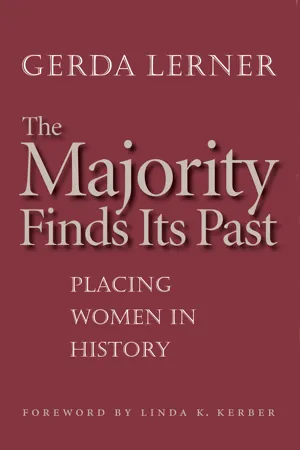
Lauded for its contribution to the theory and conceptualization of the field of women’s history and for its sensitivity to the differences of class, ethnicity, race, and culture among women, The Majority Finds Its Past became a classic volume in women’s history following its publication in 1979. This edition includes a foreword by Linda K. Kerber, introducing a new generation of readers to Gerda Lerner’s considerable body of work and highlighting the importance of the essays in this collection to the development of the field that Lerner helped establish.
- 208 pages
- English
- ePUB (mobile friendly)
- Available on iOS & Android
eBook - ePub
About this book
Information
1
New Approaches to the Study of Women in American History
The striking fact about the historiography of women is the general neglect of the subject by historians. As long as historians held to the traditional view that only the transmission and exercise of power were worthy of their interest, women were of necessity ignored. There was little room in political, diplomatic, and military history for American women, who were, longer than any other single group in the population, outside the power structure. At best their relationship to power was implicit and peripheral and could easily be passed over as insignificant. With the rise of social history and increasing concern with groups out of power, women received some attention, but interest was focused mainly on their position in the family and on their social status.1 The number of women mentioned in textbooks of American history remains astonishingly small to this day, as does the number of biographies and monographs by professional historians dealing with women.
The literature concerning the role of women in American history is topically narrow, predominantly descriptive, and generally devoid of interpretation. Except for the feminist viewpoint, there seems to be no underlying conceptual framework.a
This article first appeared in The Journal for Social History, Vol. III, No. 1 (Fall 1969), pp. 53–62. Statements about the state of the field refer to 1969, not to the present.
Feminist writers, not trained historians, were the first to undertake a systematic attempt to approach the problem of women’s role in American life and history. This took the form of feminist tracts, theoretical approaches, and compilations of women’s “contributions.”2 The early compilers attacked the subject with a missionary zeal designed, above all, to right wrong. Their tendency was to praise anything women had done as a “contribution” and to include any women who had gained the slightest public attention in their numerous lists.3 Still, much positive work was done in simply recounting the history of the woman’s rights movement and some of its forerunners and in discussing some of the women whose pioneering struggles opened opportunities to others. Feminist writers were hampered by a two-fold bias. First, they shared the middle-class, nativist, moralistic approach of the Progressives and tended to censure out of existence anyone who did not fit into this pattern. Thus we find that women like Frances Wright and Ernestine Rose received little attention because they were considered too radical. “Premature feminists” such as the Grimké sisters, Maria Weston Chapman, and Lydia Maria Child are barely mentioned. The second bias of the feminists lies in their belief that the history of women is important only as representing the history of an oppressed group and its struggle against its oppressors.
This latter concept underlies the somewhat heroic, collectively authored History of Woman Suffrage. This work, probably because it represents an easily available though disorganized collection of primary sources, has had a pervasive influence on later historians. Following the lead and interpretation of the feminists, professional historians have been preoccupied with the woman’s rights movement in its legal and political aspects. Modern historians, too, think that what is important to know about women is how they got the ballot.4
The only serious challenge to this conceptual framework was offered by Mary Beard in the form of a vigorous though often fuzzy polemic against the feminists.5 What is important about women, said Mary Beard, is not that they were an oppressed group—she denied that they ever were—but that they have made a continuous and impressive contribution to society throughout all of history. It is a contribution, however, which does not fit into the value system generally accepted by historians when they make decisions as to who is or is not important to history. Mary Beard undertook in several of her books to trace the positive achievements of women, their social role, and their contributions to community life. Her concepts are most successfully reflected in The Rise of American Civilization, which she co-authored with her husband Charles Beard. In it the position of women is treated throughout in an integrated way with great attention to the economic contributions made by women.6 But the Beards’ approach to the subject of women had little influence on the historical profession. Perhaps this was due to the fact that in the 1930s and 1940s both the general public and historians became somewhat disenchanted with the woman’s rights movement.
The winning of suffrage had made only a slight change in the actual status of women, and other factors—technological and economic changes, access to higher education, changing sexual mores—now loomed a great deal larger. The impact of Freudianism and psychology had made reformers in general somewhat suspect. Feminism was not infrequently treated with the same humorous condescension as that other successful failure: temperance.
Women have received serious attention from economic historians. There is a good deal of excellent literature dealing with the problem of women workers. Women as contributors to the economy from colonial times on, the laws affecting them, their wages and working conditions, and their struggle for protective legislation have been fully described.7 Although female labor leaders have not generally been given much attention, their activities are on record. Excellent collections of material pertaining to women at Radcliffe and Smith College are available, but remain insufficiently explored.
Modern historians of the reform movements have done much to restore a sane balance to female achievement in reform; yet one still finds excluded from notice certain women who would have been included as a matter of course had they been men. Sophie Loeb, Grace Dodge, and Mary Anderson could be cited as examples.8
The historical literature on the family in America is quite scanty, but there seems to be a revival of interest in the subject. Several interesting monographs have begun to deal with the family role of women in its various aspects. This approach is promising and should be pursued by other historians.9
A new conceptual framework for dealing with the subject of women in American history is needed. The woman’s rights movement frame of reference has become archaic and fairly useless. The 20th-century revolution in technology, morality, education, and employment patterns has brought enormous changes in the status and role of American women; these changes demand a historical perspective and understanding. The emergence of a recent “new feminism” is a social phenomenon requiring interpretation. Most important, women themselves are as entitled as minority group members are to having “their” history fully recorded.
Yet the subject is complex. It is difficult to conceptualize women as a group, since they are dispersed throughout the population. Except for special-interest organizations, they do not combine together. The subject is full of paradoxes which elude precise definitions and defy synthesis.
Women at various times and places were a majority of the population, yet their status was that of an oppressed minority, deprived of the rights men enjoyed. Women have for centuries been excluded from positions of power, both political and economic, yet as members of families, as daughters and wives, they often were closer to actual power than many a man. If women were among the most exploited of workers, they were also among the exploiters. If some women were dissatisfied with their limited opportunities, most women were adjusted to their position in society and resisted efforts at changing it. Women generally played a conservative role as individuals and in their communities, the role of conserving tradition, law, order, and the status quo. Yet women in their organizations were frequently allied with the most radical and even revolutionary causes and entered alliances with the very groups threatening the status quo.
If women themselves acted paradoxically, so did society in formulating its values for women. The rationale for women’s peculiar position in society has always been that their function as mothers is essential to the survival of the group and that the home is the essential nucleus of society as we know it. Yet the millions of housewives and homemakers have throughout our history been deprived of the one tangible reward our society ranks highest: an income of their own. Neither custom, law, nor changes of technology, education, or politics have touched this sacred tradition. The unpaid housewife-and-mother has affected attitudes toward the women who perform homemaking services for strangers. Traditionally women in the service trades have been the lowest paid among all workers. Nor has this pattern been restricted to the unskilled groups. When women have entered an occupation in large numbers, this occupation has come to be regarded as low status and has been rewarded by low pay. Examples for this are readily found in the teaching and nursing fields. Even intellectual work has been treated with the same double standard. Creative fields in which women excel—poetry, the short story—have been those carrying the lowest rewards in money and esteem. Only in the performing arts has individual female talent had the same opportunity as male talent. Yet a cursory glance at the composition of any major symphony orchestra even today will reveal that in this field, too, opportunities for women have been restricted.
In dealing with the subject of women, studies frequently use other distinctive groups in our society as models for comparison. Women’s position has variously been likened to that of the slaves, oppressed ethnic or racial minorities, or economically deprived groups. But these comparisons quickly prove inadequate. The slave comparison obviously was a rhetorical device rather than a factual statement even at the time when Harriet Martineau first made it.10 While the law denied women equal citizenship and for certain purposes classed them with “Indians and imbeciles,” it never denied them physical freedom nor did it regard them as “chattel personnel.” In fact, even within the slavery system, women were oppressed differently from men. The “minority group model” is also unsatisfactory. All members of a minority group which suffers discrimination share, with a very few exceptions, in the low-status position of the entire group. But women may be the wives of Cabinet members, the daughters of Congressmen, the sisters of business leaders, and yet, seen simply as persons, they may be disfranchised and suffer from economic and educational discrimination. On the other hand, a lower-class woman may advance to a position of economic or social power simply by marriage, a route which is generally not open to members of racial minority groups. In one particular respect the minority group comparison is illuminating: like Negroes, women suffer from “high visibility”; they remain more readily identifiable for their group characteristics than for their personal attainments.11
Modern psychology, which has offered various conflicting theories about the role and place of women, has further complicated the task of the historian. If a social historian wishes to study a particular ethnic or religious minority, he can study its location and economy, its culture, leadership, adjustment to American society, and contributions. The question of psychology would only arise in dealing with personal biographies. But the historian of women is at once faced with the necessity of making psychological judgments. Is it not a basic fact that the psychology as well as the physiology of women is different from that of men? Therefore they must of necessity have different expectations, needs, demands, and roles. If so, is the difference in “rights” not simply natural, a reflection of reality? The problems become more vexing when dealing with individual women. The biographer feels obliged first of all to concern himself with his subject’s sexual role. Was she married? A mother? If she was not, this indicates that whatever she achieved was the result of sexual frustration. If she was married, one is under an obligation to explain that she did not neglect her children or perhaps that she did. And always there is the crucial question: “What was her relationship to her father?” This is not intended to disparage the efforts of those biographers who wish to enlist the aid of modern psychology for their work. But it should be pointed out that a great deal of excellent history about men has been written without the author’s feeling compelled to discuss his subject’s sex life or relationship to his mother in explaining his historical significance. In dealing with women, biographers are impeded by the necessity of dealing first with sex, then with the person. This is an approach which must be examined in each case for its applicability: where it is useful, it should be retained; where it is not, it should be discarded without apology.b
In order to broaden the study of women in American history, it is not really necessary to suggest new sources. Primary research material is readily available, not only in the several manuscript collections devoted to the subject, but in the usual primary sources for social historians: local historical records, letters, diaries, the organizational records of women’s clubs, religious and charitable organizations, labor unions in fields employing women workers. There are numerous magazines, especially written for women, which provide good source material. Archives of Congress and of state governments contain petitions and statements made at hearings which can yield valuable information about the activities and interests of women. Many of these readily available sources remain neglected.
A fresh approach to known material and to available sources could provide valuable new insights. The following suggestion might make a useful beginning:
First, the subject “Women” is too vast and diffuse to serve as a valid point of departure. Women are members of families, citizens of different regions, economic producers, just as men are, but their emphasis on these various roles is different. The economic role of men predominates in their lives, but women shift readily from one role to another at different periods in their lives. It is in this that their function is different from men and it is this which must form the basis for any conceptual framework. In modern society the only statement about women in general which can be made with validity concerns their political status. Therefore the subject should be subsumed under several categories, and any inquiry, description, and generalization should be limited to a narrower field. It is useful to deal with the status of women at any given time—to distinguish their economic status, family status, and political-legal status. There must also be a consideration of class position, as has been usefully proven in recent studies of the feminist movement.12
Second, we should look at different aspects of women’s role in American history. We must certainly be concerned with the woman’s rights movement, but only as part of the total story. Historians must painstakingly restore the actual record of women’s contributions at any given period in history. It is interesting that the history of women before the advent of the feminist movement has been more fully recorded and in a more balanced way than it has afterward, so that the story of colonial women can be quite fully traced through secondary literature.13 But when we deal with the period after 1800, it often proves difficult to establish even descriptive facts. During the early national period, women organized elaborate welfare and relief systems which they staffed and administered. This story should be part of the history of the period; it is not now. Women were the teachers in most of the nation’s public schools during the 19th century; this is worth recording and exploring. Women made a significant contribution to the growth and development of frontier communities. These are but a few of the many areas in which more research and uncovering of factual information are needed.
Third, we might well discard the “oppressed group model” when discussing women’s role in the political life of the nation. Instead, we might start with the fact that one generalization about women which holds up is that they were, longer than any other group in the nation, deprived of political and economic power. Did this mean they actually wielded no power or did they wield power in different forms? My research has led me to believe that they wielded considerable power—in the middle of the 19th century even political power. They found a way to make their power felt through organizations, through pressure tactics, through petitioning, and various other means; these later became models for other mass movements for reform.
Fourth, another important fact is that women as a group were, for a considerable period of history, deprived of equal access to education. While they were not illiterate, their education was limited, usually to below the high school level. This was true of the majority of women until the end of the 19th century. It might be very useful to investigate wha...
Table of contents
- Cover Page
- The Majority Finds Its Past
- Copyright Page
- Dedication
- Contents
- Foreword
- Preface
- Autobiographical Notes, by Way of an Introduction
- 1 New Approaches to the Study of Women in American History
- 2 The Lady and the Mill Girl: Changes in the Status of Women in the Age of Jackson
- 3 The Feminists: A Second Look
- 4 Women’s Rights and American Feminism
- 5 Black Women in the United States: A Problem in Historiography and Interpretation
- 6 Community Work of Black Club Women
- 7 Black and White Women in Interaction and Confrontation
- 8 The Political Activities of Antislavery Women
- 9 Just a Housewife
- 10 Placing Women in History: Definitions and Challenges
- 11 The Majority Finds Its Past
- 12 The Challenge of Women’s History
- Notes
- Index
Trusted by 375,005 students
Access to over 1.5 million titles for a fair monthly price.
Study more efficiently using our study tools.
Frequently asked questions
Yes, you can cancel anytime from the Subscription tab in your account settings on the Perlego website. Your subscription will stay active until the end of your current billing period. Learn how to cancel your subscription
No, books cannot be downloaded as external files, such as PDFs, for use outside of Perlego. However, you can download books within the Perlego app for offline reading on mobile or tablet. Learn how to download books offline
Perlego offers two plans: Essential and Complete
- Essential is ideal for learners and professionals who enjoy exploring a wide range of subjects. Access the Essential Library with 800,000+ trusted titles and best-sellers across business, personal growth, and the humanities. Includes unlimited reading time and Standard Read Aloud voice.
- Complete: Perfect for advanced learners and researchers needing full, unrestricted access. Unlock 1.5M+ books across hundreds of subjects, including academic and specialized titles. The Complete Plan also includes advanced features like Premium Read Aloud and Research Assistant.
We are an online textbook subscription service, where you can get access to an entire online library for less than the price of a single book per month. With over 1.5 million books across 990+ topics, we’ve got you covered! Learn about our mission
Look out for the read-aloud symbol on your next book to see if you can listen to it. The read-aloud tool reads text aloud for you, highlighting the text as it is being read. You can pause it, speed it up and slow it down. Learn more about Read Aloud
Yes! You can use the Perlego app on both iOS and Android devices to read anytime, anywhere — even offline. Perfect for commutes or when you’re on the go.
Please note we cannot support devices running on iOS 13 and Android 7 or earlier. Learn more about using the app
Please note we cannot support devices running on iOS 13 and Android 7 or earlier. Learn more about using the app
Yes, you can access The Majority Finds Its Past by Gerda Lerner in PDF and/or ePUB format, as well as other popular books in History & North American History. We have over 1.5 million books available in our catalogue for you to explore.