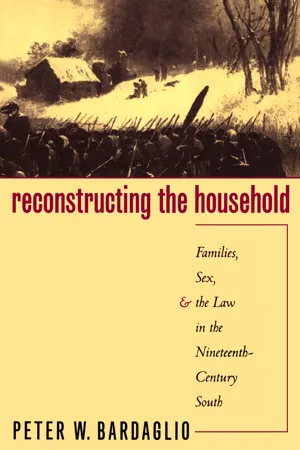
eBook - ePub
Reconstructing the Household
Families, Sex, and the Law in the Nineteenth-Century South
- 382 pages
- English
- ePUB (mobile friendly)
- Available on iOS & Android
eBook - ePub
Reconstructing the Household
Families, Sex, and the Law in the Nineteenth-Century South
About this book
In Reconstructing the Household, Peter Bardaglio examines the connections between race, gender, sexuality, and the law in the nineteenth-century South. He focuses on miscegenation, rape, incest, child custody, and adoption laws to show how southerners struggled with the conflicts and stresses that surfaced within their own households and in the larger society during the Civil War era. Based on literary as well as legal sources, Bardaglio’s analysis reveals how legal contests involving African Americans, women, children, and the poor led to a rethinking of families, sexuality, and the social order. Before the Civil War, a distinctive variation of republicanism, based primarily on hierarchy and dependence, characterized southern domestic relations. This organic ideal of the household and its power structure differed significantly from domestic law in the North, which tended to emphasize individual rights and contractual obligations. The defeat of the Confederacy, emancipation, and economic change transformed family law and the governance of sexuality in the South and allowed an unprecedented intrusion of the state into private life. But Bardaglio argues that despite these profound social changes, a preoccupation with traditional notions of gender and race continued to shape southern legal attitudes.
Information
PART ONE
THE DAYS BEYOND THE FLOOD
The LORD saw that the wickedness of man was great in the earth, and that every imagination of the thoughts of his heart was only evil continually.
CHAPTER 1
PATRIARCHY AND THE LAW IN THE OLD SOUTH
On November 1, 1843, Governor James Henry Hammond of South Carolina received a fateful letter from his brother-in-law Wade Hampton II, one of the wealthiest and most powerful men in the state. In his letter, Hampton accused the governor of trying to seduce Hampton’s nineteen-year-old daughter Catherine. It remains unclear whether Hampton knew the entire story at the time, but the incident with Catherine marked the climax of an extraordinary relationship between Hammond and his four teen-aged nieces, Catherine, Harriet, Ann, and Caroline.
AN AFFAIR BETWEEN MEN
The Hampton sisters frequently visited their uncle’s home in Columbia while he was governor, and over a long period of time the relationship developed to the point where Hammond became sexually intimate with the young women during their encounters, which occurred at least once a week and often more frequently. In a remarkable passage from his diary, Hammond recounted the illicit meetings with his nieces, noting that the transgressions involved “all of them rushing on every occasion into my arms and covering me with kisses, lolling on my lap, pressing their bodies almost into mine, wreathing their limbs with mine, encountering warmly every portion of my frame, and permitting my hands to stray unchecked over every part of them and to rest without the slightest shrinking from it, in the most secret and sacred regions, and all this for a period of more than two years continuously.” Hammond observed that his intimacies with the four girls “extended to every thing short of direct sexual intercourse,” but he insisted that he “had never designed anything criminal.”1
Wade Hampton finally discovered at least some of the particulars of Hammond’s relationship with his daughters when Catherine reported to her father in the autumn of 1843 that the governor had become too familiar with her. Hampton immediately wrote Catherine’s uncle, denouncing Hammond for the attempted seduction and severing all ties with him. In 1844, following the end of his term as governor, Hammond left Columbia and returned to his plantation at Silver Bluff, leaving behind a swirl of rumor and speculation about the falling out between the two brothers-in-law. Although the sordid details of the affair had not become public knowledge, Hammond suspected that his political prospects for the near future had suffered serious damage due to Hampton’s influential position in the state. Conclusive evidence of Hammond’s political difficulties came in 1846 when Wade Hampton moved to block Hammond’s candidacy for the U.S. Senate by threatening to expose the family scandal. Hammond stayed in the race but lost the Senate seat on the third ballot of the legislative vote.
For the next thirteen years, James Henry Hammond remained in exile at Silver Bluff. Not until 1857 did he hold political office again, when he won a seat in the Senate following Hampton’s removal to Mississippi. As for the Hampton daughters, they lived out the rest of their lives under a cloud of innuendo and disgrace, and none of them ever married. As one state legislator summed up, “After all the fuss made no man who valued his standing could marry one of the Hampton girls.”2
Because Hammond’s sexual involvement with his four nieces was one of the most sensational scandals in the antebellum South, it is important not to make too much of so bizarre an affair. Still, the deviant nature of the incident and the way in which it was handled reveal much about the dynamics of gender in southern society.3 Most obviously, the outcome of the affair exposed the traditional double standard of sexual conduct that held sway in the Victorian South, one which condemned female sin but downplayed the consequences of male lust. Thomas R. Dew in 1835 sought to explain the reasoning behind this double standard; as he put it, woman’s “virtue is the true sensitive plant, which is blighted even by the breath of suspicion. … Man may, by reformation, regain a lost character, but woman rarely can.”4 Accordingly, Hammond’s political career experienced a setback as a result of his sexual indiscretion, but he eventually returned to public office. Once the four Hampton sisters came under suspicion, however, they could never restore their good name. Unlike Hammond, they were permanently driven to the outer edges of proper society.
In the aftermath of the scandal the rival politicians demonstrated their adherence to the ideal of patriarchal authority. Hammond announced to his younger brother Marcellus that “Women were meant to breed—Men to do the work of the world.”5 As the father of the wronged girls, Wade Hampton perceived the incident as an assault on his good name, for he was responsible for preserving the sexual purity of white women under his care and any tarnishing of his daughters’ virtue reflected upon him.6 From Hammond’s perspective, though, it appeared as if Hampton had threatened to publicize the disgrace of his children in order to block him from gaining a seat in the U.S. Senate. Hammond’s sense of honor dictated that he remain silent about the affair, and he viewed the father as having betrayed the girls’ reputation for his own selfish purposes.7
At any rate, Hammond and Hampton both understood the episode as a matter that primarily concerned the two of them. The four young women assumed only a secondary role in the rivalry between these men, and neither brother-in-law gave any indication that he viewed the Hampton daughters as autonomous individuals. The very terms of the struggle for power between these two planter-politicians reflected the subordinate position of women in southern society, as well as a severely circumscribed sexual identity for females.
THE MAKING OF SOUTHERN LEGAL CULTURE
Like Hammond and Hampton, many white men in the Old South preferred to settle private disputes and matters of morality and sexual misconduct outside the legal system, and they viewed the courts as a last resort.8 A vigorous attachment to the concept of honor—the constellation of ideas and values in which one’s sense of self-worth rested on the degree of respect commanded from others in the community—led white southerners to believe that such affairs did not belong before the bench and should be handled without turning to the third party of the state. Honor, in short, placed a premium on personal rather than impersonal justice.9
Members of the southern bar were as quick to subscribe to this ethos as anyone. Samuel H. Hempstead, a lawyer newly arrived in Little Rock, Arkansas, wrote his uncle in 1836, asking to purchase his pistols. “No menaces or threats shall ever deter me from discharging my duty of whatsoever nature it may be,” explained Hempstead, “and as on the one hand I shall always use every honorable means to avert a quarrel, so on the other I am equally fixed in protecting my person from attack and my reputation from insult.” Nineteenth-century southern fiction suggests that even judges were not immune to the demands of honor. Judge York Leicester Driscoll in Mark Twain’s Pudd’nhead Wilson (1894), a caustic account of social mores in a Mississippi River town during the antebellum era, is a case in point. Informed that his nephew has taken an assailant to court rather than challenge him to a duel, the judge berates his kinsman for having violated the code of honor: “You cur! You scum! You vermin! Do you mean to tell me that blood of my race has suffered a blow and crawled to a court of law about it?”10
The predisposition to engage in extralegal action did not gain the support of all white southerners. Some recognized that taking the law into one’s own hands could have harmful consequences in the long run. A lawyer who initially supported the resort to private retaliation as a way to regulate the behavior of individuals in the community explained his change of heart in 1839: “Tolerate this in one case, and you authorize it in a thousand; and that is anarchy at once.”11 For many southerners, the law represented a crucial source of stability in society, a reliable bulwark against anarchy and disorder. As a New Orleans minister proclaimed in 1847, “Amid all the busy scenes of life, the eagerness of competition, and the violence of conflicting passions, LAW lifts up her majestic front, calm, unmoved, and unaffected by the various changes which agitate us, like some lofty mountain towering far above the surrounding plain, unshaken by storms, and ever irradiated by heaven’s own light.”12 More than a guarantor of social order, law legitimized the ideas of interdependence and stratification that formed the basis of slave society. As J. D. B. De Bow held, law “is the ligament which binds society together; and the whole machine must tumble into pieces if that ligament be disturbed.… Superiority and inferiority are contained in it; law is the language of a superior to an inferior.”13
The southern reputation for lawlessness stemmed mainly from the conviction that only the pursuit of personal vengeance could properly restore one’s injured honor, and that state intervention was of little use in such circumstances—hence the customs of brawling and disfigurement among backwoodsmen and dueling among planters, all of which disclosed the preoccupation of white men with the world of appearances. The duel, in particular, was a ritual that revealed the dependence of the individual male on community opinion and public image to confirm his status. Always occurring between social equals, the duel publicly expressed the membership of the parties in the ruling elite and displayed the values of this elite, as well as its solidarity, for all to see. In this social drama, instead of the written law, an elaborate code understood and shared by gentlemen mediated the resolution of the dispute.14 The unwritten laws of honor, as Twain observes in Pudd’nhead Wilson, “were as clearly defined and as strict as any that could be found among the statutes of the land.” For Judge Driscoll, a member of the Virginia gentry who moved west, “those laws were his chart; his course was marked out on it; if he swerved from it by so much as half a point of the compass, it meant shipwreck to his honor; that is to say, degradation from his rank as a gentleman.” There was no question in the minds of white southerners like the judge about which set of laws would have to give way in the event of a conflict between them; in Twain’s words, “Honor stood first.”15
Although the culture of honor and deference to the written laws often clashed, this did not prevent the legal system from occupying an important place in southern society. Except for Louisiana, which adopted the civil law of France as the basis of its legal system, the South drew extensively on English common law as a source of inspiration. Settlers of the American colonies along the southern Atlantic seaboard who came from England carried with them the set of rights, procedures, and customs that made up the common law. Subscribing to a unitary view of the legal and political order during the seventeenth century, southern colonists established a layered system of courts that combined legislative and judicial functions. The main tribunals were the general court, consisting usually of the governor and his council, and the county court, composed of the justices of the peace. This system prevailed in Virginia until the American Revolution. In Maryland, however, the highest court divided into two after 1692: the Provincial Court, headed by a chief justice and members of the upper house of assembly, and the Court of Appeals, made up of the governor and council. In South Carolina an even more elaborate judicial system emerged at the provincial level, with the more serious criminal and civil suits going to one of three tribunals located in Charleston, either the Court of Common Pleas, General Sessions, or Chancery. A chief justice and four associate justices (usually laymen who went unpaid) constituted the former two courts, and the governor and council sat as the Chancery Court. The highest provincial courts exercised original jurisdiction over capital criminal cases (except for those involving slave defendants), heard appeals from the lower courts, and often handled chancery and admiralty proceedings. For much of the colonial period, appeals could be made from the general courts to the assemblies, but eventually the final appellate court became the Privy Council in England.16
The legal system of the colonial South was first and foremost a local system. County courts became the primary centers of power, wielding a broad jurisdiction that extended to nearly all aspects of daily life. Besides trying criminal offenders and settling disputes, the county courts assessed taxes, oversaw their collection, supervised road and bridge construction, and licensed taverns and inns. They also recorded deeds, granted poor relief, and supervised the proper administration of estates, the transfer of land titles, and the care of orphans.17 Members of the landed gentry dominated the county courts, and court day became an important occasion for the ritual expression of their social position and authority. Court day brought together the scattered community, providing a welcome opportunity to debate politics, conduct business, and socialize. Wearing wigs and fine attire, the gentlemen judges administered oaths and handed down justice to their less prosperous neighbors and kin. These men were amateur justices whose administration of the law was rudimentary and unsophisticated. Their lives centered on the planting and marketing of tobacco and other staple crops, and they came to the bench with little or no legal training.18
The county court was one of the few institutions that could effectively maintain order and harmony in the colonial South, and it played a crucial role in defining and promoting the values of the community. Members of the grand jury, as well as justices of the peace, contributed to the accomplishment of this task. The justices were supposed to call together a grand jury made up of freeholders twice a year to present those accused of committing a wide array of minor offenses, such as bearing a bastard child, not attending the local parish church, and failing to keep up roads. Free persons and indentured servants indicted for felonies were tried in the general courts, whereas slaves were brought before special slave-trial courts consisting of two or three justices of the peace and several local freeholders. Crimes that threatened the social order—contempt, assault, homicide, and moral misconduct—generated the highest conviction rates, but convictions for crimes against property increased as economic growth accelerated. The grand jurymen, courts, and law enforcement officers, including the sheriff, his deputies, and the constables, all worked together to enforce the law and uphold gentry authority at the local level, establishing a legal system that reflected the social order in which they lived.19
As the rule of law became a more significant part of life in the southern colonies, the bar attained increasing influence. Like the magistrates, lawyers during the seventeenth century were often unschooled in the law. By the eighteenth century, however, law had emerged as a distinct profession, and the flowering of a complex agricultural and mercantile economy produced a need for specialists who had legal training. Not only did the southern bar grow in numbers and prestige, but also the level of legal education and practice underwent significant improvement. A few colonial lawyers trained at the Inns of Court in London, but most would-be lawyers read law in the office of a practicing attorney. Stratification of the bar developed as lawyers who resided and worked in the colonial capitals came to believe that they were superior to the county court attorneys. Virginia lawyers who practiced at the general court in Williamsburg, for example, made clear their disdain for what they saw as the lack of proper preparation of the justices and lawyers at the county level, and in the early eighteenth century the general court bar called for a more formal, learned, and technical approach to the law.20
The growing authority and sophistication of attorneys in the colonial South went hand in hand with an expanding role in politics, and by the outbreak of the revolutionary crisis, members of the bar had assumed a place in the forefront of the colonial elite. During the Revolution, lawyers helped to write the new state constitutions in the South that established more highly differentiated legal and political systems, reflecting the new emphasis on balanced government and separation of powers. Virginia in 1776 became the first of the new states to define the judiciary as a ...
Table of contents
- Cover Page
- Reconstructing the Household
- Copyright Page
- Dedication
- Epigraph
- CONTENTS
- PREFACE
- ACKNOWLEDGMENTS
- PART ONE THE DAYS BEYOND THE FLOOD
- PART TWO AFTER THE FLOOD
- APPENDIX: TABLES
- NOTES
- BIBLIOGRAPHY
- INDEX
Trusted by 375,005 students
Access to over 1.5 million titles for a fair monthly price.
Study more efficiently using our study tools.
Frequently asked questions
Yes, you can cancel anytime from the Subscription tab in your account settings on the Perlego website. Your subscription will stay active until the end of your current billing period. Learn how to cancel your subscription
No, books cannot be downloaded as external files, such as PDFs, for use outside of Perlego. However, you can download books within the Perlego app for offline reading on mobile or tablet. Learn how to download books offline
Perlego offers two plans: Essential and Complete
- Essential is ideal for learners and professionals who enjoy exploring a wide range of subjects. Access the Essential Library with 800,000+ trusted titles and best-sellers across business, personal growth, and the humanities. Includes unlimited reading time and Standard Read Aloud voice.
- Complete: Perfect for advanced learners and researchers needing full, unrestricted access. Unlock 1.5M+ books across hundreds of subjects, including academic and specialized titles. The Complete Plan also includes advanced features like Premium Read Aloud and Research Assistant.
We are an online textbook subscription service, where you can get access to an entire online library for less than the price of a single book per month. With over 1.5 million books across 990+ topics, we’ve got you covered! Learn about our mission
Look out for the read-aloud symbol on your next book to see if you can listen to it. The read-aloud tool reads text aloud for you, highlighting the text as it is being read. You can pause it, speed it up and slow it down. Learn more about Read Aloud
Yes! You can use the Perlego app on both iOS and Android devices to read anytime, anywhere — even offline. Perfect for commutes or when you’re on the go.
Please note we cannot support devices running on iOS 13 and Android 7 or earlier. Learn more about using the app
Please note we cannot support devices running on iOS 13 and Android 7 or earlier. Learn more about using the app
Yes, you can access Reconstructing the Household by Peter W. Bardaglio in PDF and/or ePUB format, as well as other popular books in History & North American History. We have over 1.5 million books available in our catalogue for you to explore.