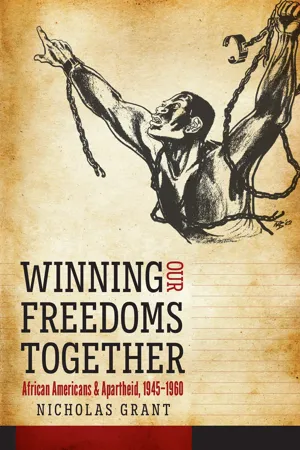
In this transnational account of black protest, Nicholas Grant examines how African Americans engaged with, supported, and were inspired by the South African anti-apartheid movement. Bringing black activism into conversation with the foreign policy of both the U.S. and South African governments, this study questions the dominant perception that U.S.-centered anticommunism decimated black international activism. Instead, by tracing the considerable amount of time, money, and effort the state invested into responding to black international criticism, Grant outlines the extent to which the U.S. and South African governments were forced to reshape and occasionally reconsider their racial policies in the Cold War world.
This study shows how African Americans and black South Africans navigated transnationally organized state repression in ways that challenged white supremacy on both sides of the Atlantic. The political and cultural ties that they forged during the 1940s and 1950s are testament to the insistence of black activists in both countries that the struggle against apartheid and Jim Crow were intimately interconnected.
- 324 pages
- English
- ePUB (mobile friendly)
- Available on iOS & Android
eBook - ePub
About this book
Information
Part I Cold War
1 South Africa, the United States, and the Racial Politics of the Cold War
In 1953, the Council on African Affairs was accused of subversion under the McCarran Internal Security Act. In response, Paul Robeson, the organization’s chairman, posed the following question, which found its way into the pages of the anti-apartheid press in South Africa. “Is it ‘subversive,’ ” Robeson wondered, “not to approve our Government’s action of condoning and abetting the oppression of our brothers and sisters in Africa and other lands?”1 In this case, in the eyes of both the U.S. and South African governments, the answer was a resounding “yes.” The CAA’s commitment to African freedom, condemnation of American imperialism in Africa, and close ties with anticolonial activists overseas moved the organization beyond what the state defined as acceptable black protest during the early Cold War. Robeson’s criticism of the State Department offers an insight into how the governments of the U.S. and South Africa responded to black international criticism during the early Cold War. Transnational black activism was highly suspect; to attempt to establish links with other oppressed people of African descent was often interpreted as sedition; to provide assistance to those subjected to the kinds of racial injustices that you yourself faced could be defined as treason.
Anticommunism worked to place severe restrictions on black internationalism. The exaggerated fear of Soviet subversion was symbolically linked to black protest in ways that limited opportunities to challenge both American racism and South African apartheid. Acutely attuned to the politics of the era, South African policymakers also played a significant, and often overlooked, role in promoting apartheid as a political system that would prevent the spread of communism in southern Africa. How they attempted to do this is telling, shedding further light on the Cold War as a complex and multifaceted conflict that not only shaped debates about race in the United States but around the world. Crucially, African Americans and black South Africans ensured that repressive Cold War policies would not go uncontested. As leftists, like Robeson, denounced the anticommunist connections that existed between the United States and the apartheid regime as imperialistic, black liberals worked to ensure that people of African descent were not excluded from the Cold War rhetoric of freedom and democracy.
The politics of anticommunism was used to stifle black protest on both sides of the Atlantic.2 In the United States, legislation such as the Smith Act (1940), Mundt-Nixon Bill (1950), McCarran Act (1950), and McCarran-Walter Act (1952) placed limitations on African American protest, making it illegal to advocate for the overthrow of the U.S. government, forcing the registration of communists with the U.S. Office of the Attorney General, and preventing the immigration of politically “undesirable” individuals.3 As McCarthyism took hold in the early 1950s, the American government actively pursued black activists whom they believed represented foreign and subversive elements within the American nation.4 Bodies such as the House Un-American Activities Committee (HUAC) were used in conjunction with anticommunist legislation in order to limit and control black protest in the United States.5
In South Africa too, the rise to power of the National Party in 1948 meant white supremacist and anticommunist ideology became increasingly intertwined. The Suppression of Communism Act (1950) mirrored anticommunist legislation in the United States in that communist organizing was effectively made illegal. In 1951 the act was extended to enable the banning of individuals or organizations judged to be instigating “any political, industrial, social or economic change in the Union by the promotion of disturbances or disorder.”6 More expansive and repressive than the American legislation on which it was modeled, this extremely broad definition of communist organizing was used to mercilessly suppress anti-apartheid protest. Specifically it enabled the banning of prominent individuals and organizations that challenged government power. All too aware of the problem of selling white supremacy to the world following World War II, the National Party regularly framed the containment of black protest in South Africa in the language of anticommunism. As Prime Minister D. F. Malan outlined his “African Charter,” it was essential that Europeans throughout the continent “come to an understanding, an agreement, to suppress communistic activity wherever it appears.”7 As the Cold War began then, the National Party responded by justifying its racial practices as being a key part of its strategy to prevent the spread of communism in what was a strategically important region to the United States.8
Historians have largely failed to explore the extent to which the South African government engaged with the racial politics of the Cold War.9 White politicians in South Africa made a concerted effort to justify their racial policies to those they viewed as potential overseas allies. As a result, National Party officials attempted to sell apartheid to both the U.S. government and the American public, stressing their credentials as an effective bulwark against the spread of communism across southern Africa. The ideological fervor of the Cold War meant that apartheid policymakers would have to be receptive to the way in which white supremacy was viewed and consumed by a global audience. Increasingly concerned with how African American protest would affect how the apartheid state was perceived globally, South African officials based in the United States also monitored the development of the civil rights movement. Compiling detailed reports, South African diplomats configured the United States, and the American South in particular, as a key foreign battleground in the struggle to legitimize apartheid rule in the eyes of the world. As scholars such as Marilyn Lake, Henry Reynolds, and Ann Laura Stoler have noted, state racisms have been produced in exchange, through transnational expressions of white racial solidarity that have been used to obstruct a range of racial reforms.10 Anticommunism often acted as a conduit for these interactions, a global ideology that helped reinforce and legitimate white supremacy in the United States and South Africa. Global anticommunism shaped the character of black freedom struggles in South Africa and America, increasingly circumscribing and hemming in radical black politics and placing significant obstacles in the way of more moderate movements for racial equality.11
Analyzing the global contours of anticommunism and white supremacy is key to understanding the interrelated nature of state power and transnational black activism during the Cold War. Despite the repressive local and global forces they faced, black activists in both countries maintained an extensive global outlook throughout this period. The rapid development of anticolonial nationalism provided new opportunities for activists to establish race as an important international issue. Indeed it was this tension between anticommunist repression and the desire to challenge racism on a global level that characterized black activism in the postwar period. For individuals pushing for black self-determination in the United States and South Africa, the politics of the Cold War and the politics of race were fundamentally interconnected—part of the same overlapping processes and operating simultaneously throughout the black diaspora. Anti-apartheid activists often viewed black America through the lens of the United States’ bold Cold War ideological claims. As an article in the anti-apartheid press commented in regard to the lynching of Emmett Till in 1955, “America’s diplomats in Asia boast of the absence of racialism in the United States. The Till case has demonstrated to the world the falsity of this claim. Negroes in the Southern States suffer all the viciousness of apartheid.”12 Here the claims of freedom, democracy and racial equality made by American government officials and the vicious murder of the fourteen-year-old Emmett Till for “improperly” addressing a white woman in Mississippi are compared and contrasted.
The international response to the Till case is just one example of how African Americans and black South Africans set out to expose the connections between anticommunism and white supremacy, while challenging the idea that South Africa’s ideological opposition to the Soviet Union in any way justified the apartheid system. American racism and South African apartheid could be challenged through the political and ideological debates of the Cold War.13 Global tensions between Cold War rhetoric and the continuation of racial discrimination provided important international opportunities for black activists in the 1940s and 1950s. In spite of the state clampdown on radical black politics, the Cold War would also produce contradictions, anomalies, and inconsistencies around which black international connections could be launched. It was certainly true that black internationalism was dealt a series of heavy blows by the rise of anticommunism after World War II; however it was often these very setbacks that fostered an increased awareness of the global nature of racism. African Americans regularly addressed the issues of white supremacy in South Africa, explicitly tying this to their own experiences of racism in the United States. The same in reverse was true of anti-apartheid activists in South Africa, where publications such as Liberation, Fighting Talk, and the Guardian provided spaces in which American involvement with Africa could be denounced as imperialistic and where contradictions between Cold War rhetoric and white racism in South Africa were exposed.
“From U.S. Steel to Coca Cola—They’re All in South Africa”: Black Protest and the U.S.–South Africa Cold War Alliance
During the Cold War the racial politics of the United States and South Africa, each with comparable histories of racial discrimination, became even more closely interconnected. South Africa took its place alongside the United States as one of the nations of the so-called free world, becoming an important political, economic, and ideological ally for the United States against the Soviet Union in Africa.
This strategic alliance, based on free-market capitalism and mutual military interests, was driven by the fact that South Africa, a country rich in raw materials and precious metals, also boasted a vast supply of uranium ore.14 The American government’s pursuit of uranium in order to realize its nuclear weapons–building program, coupled with the need of the South African government to attract funding and investment to make its vast reserves of raw materials profitable, brought both countries together during the early Cold War. Just as it seemed that legalized racial discrimination and segregation was on its way out in the United States, the American government was investing heavily in the apparatus of a rapidly expanding white supremacist state. Although it is perhaps too much of an overstatement to say that U.S. investment in South Africa directly funded apartheid, American trade and loans to South Africa were certainly central in propping up National Party policies and legitimizing the apartheid economy.15 Both the Truman and the Eisenhower administrations failed to mount any sustained criticism of the apartheid regime. As thousands of black South Africans took to the streets to protest attempts to fully exclude them from the workings of the state and as African Americans simultaneously challenged segregation en masse, millions of U.S. dollars were being directed toward the apartheid state. Indeed, anti-apartheid activists would have to wait until 1958 for the U.S. government to nominally challenge white supremacist rule in South Africa, when the American delegation to the UN voted in favor of a resolution condemning apartheid laws.16 The Cold War initially helped bring the economic and political objectives of the United States and South Africa increasingly into alignment. Extensive trading links were established, military treaties signed, and loans agreed.17 As a CAA pamphlet noted in 1953, “From U.S. Steel to Coca Cola—They’re All in South Africa.”18
Following World War II, American corporations invested heavily in South African industry and, in particular, the extraction and processing of raw materials. Overall trade with sub-Saharan Africa between 1945 and 1960 expanded almost sixfold, a statistic that is indicative of the rapidly increasing importance of Africa to the world economy.19 South Africa quickly became the most important site for U.S. business on the African continent. This economic relationship was highly profitable for both countries and helped to drastically reshape the nature of South African industry. For the National Party the development of the South African economy was of vital importance. Despite South Africa’s extensive reserves of valuable raw materials, it desperately needed investment in industrial mechanization in order to turn these natural resources into profit.20 Although Britain would remain the largest economic investor in the region, the U.S. presence increased dramatically in the postwar period and briefly, in 1948, American companies traded more with South Africa than their British counterparts. In that same year, foreign investments in the country yielded average profit margins of 42 percent, and while this had fallen to around 35 percent by 1960, profit rates remained substantially higher than in most developed capitalist countries.21 The South African government did everything it could to encourage foreign investment, signing an agreement with the United States that granted special privileges to American investors, including making them exempt from taxation in the Union of South Africa.22 Mining companies found South Africa to be particularly profitable. By investing in existing mines or setting up new operations in the region, companies such as Newmont Mining, Morgan, and Kennecott Copper were able to access large quantities of metals and minerals, includin...
Table of contents
- Cover
- Series Page
- Title Page
- Copyright
- Dedication
- Contents
- List of Illustrations
- Acknowledgments
- Abbreviations in the Text
- Introduction
- Part I: Cold War
- Part II: Travel, Politics, and Cultural Exchange
- Part III: Challenging Anticommunism
- Part IV: Gender and Anti-Apartheid Politics
- Conclusion
- Notes
- Bibliography
- Index
Trusted by 375,005 students
Access to over 1.5 million titles for a fair monthly price.
Study more efficiently using our study tools.
Frequently asked questions
Yes, you can cancel anytime from the Subscription tab in your account settings on the Perlego website. Your subscription will stay active until the end of your current billing period. Learn how to cancel your subscription
No, books cannot be downloaded as external files, such as PDFs, for use outside of Perlego. However, you can download books within the Perlego app for offline reading on mobile or tablet. Learn how to download books offline
Perlego offers two plans: Essential and Complete
- Essential is ideal for learners and professionals who enjoy exploring a wide range of subjects. Access the Essential Library with 800,000+ trusted titles and best-sellers across business, personal growth, and the humanities. Includes unlimited reading time and Standard Read Aloud voice.
- Complete: Perfect for advanced learners and researchers needing full, unrestricted access. Unlock 1.5M+ books across hundreds of subjects, including academic and specialized titles. The Complete Plan also includes advanced features like Premium Read Aloud and Research Assistant.
We are an online textbook subscription service, where you can get access to an entire online library for less than the price of a single book per month. With over 1.5 million books across 990+ topics, we’ve got you covered! Learn about our mission
Look out for the read-aloud symbol on your next book to see if you can listen to it. The read-aloud tool reads text aloud for you, highlighting the text as it is being read. You can pause it, speed it up and slow it down. Learn more about Read Aloud
Yes! You can use the Perlego app on both iOS and Android devices to read anytime, anywhere — even offline. Perfect for commutes or when you’re on the go.
Please note we cannot support devices running on iOS 13 and Android 7 or earlier. Learn more about using the app
Please note we cannot support devices running on iOS 13 and Android 7 or earlier. Learn more about using the app
Yes, you can access Winning Our Freedoms Together by Nicholas Grant in PDF and/or ePUB format, as well as other popular books in Social Sciences & African History. We have over 1.5 million books available in our catalogue for you to explore.