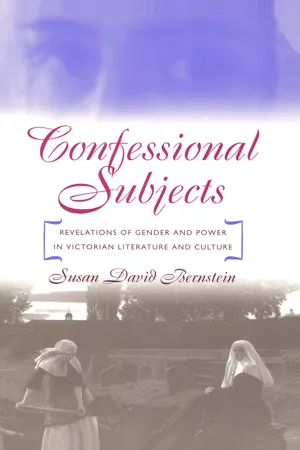
Susan Bernstein examines the gendered power relationships embedded in confessional literature of the Victorian period. Exploring this dynamic in Charlotte Brontâ’s Villette, Mary Elizabeth Braddon’s Lady Audley’s Secret, George Eliot’s Daniel Deronda, and Thomas Hardy’s Tess of the d'Urbervilles, she argues that although women’s disclosures to male confessors repeatedly depict wrongdoing committed against them, they themselves are viewed as the transgressors. Bernstein emphasizes the secularization of confession, but she also places these narratives within the context of the anti-Catholic tract literature of the time. Based on cultural criticism, poststructuralism, and feminist theory, Bernstein’s analysis constitutes a reassessment of Freud’s and Foucault’s theories of confession. In addition, her study of the anti-Catholic propaganda of the mid-nineteenth century and its portrayal of confession provides historical background to the meaning of domestic confessions in the literature of the second half of the century.
Originally published in 1997.
A UNC Press Enduring Edition — UNC Press Enduring Editions use the latest in digital technology to make available again books from our distinguished backlist that were previously out of print. These editions are published unaltered from the original, and are presented in affordable paperback formats, bringing readers both historical and cultural value.
eBook - ePub
Confessional Subjects
Revelations of Gender and Power in Victorian Literature and Culture
- 224 pages
- English
- ePUB (mobile friendly)
- Available on iOS & Android
eBook - ePub
Confessional Subjects
Revelations of Gender and Power in Victorian Literature and Culture
About this book
Information
1 THEORIZING CONFESSION, GENDERING CONFESSION
The confession is a ritual of discourse in which the speaking subject is also the subject of the statement; it is also a ritual that unfolds within a power relationship, for one does not confess without the presence (or virtual presence) of a partner who is not simply the interlocutor but the authority who requires the confession.
—Michel Foucault, The History of Sexuality
The woman is not the agent of any institutional power. She has no authority either to exact penance or to interpret the situation according to norms that could, in effect, increase the prestige of the institution she represents, hence her own prestige.
—Sandra Bartky Femininity and Domination
To theorize confession from the vantage point of the late twentieth century requires an encounter with its two master theorists Michel Foucault and Sigmund Freud.1 For Foucault, confession means the police; for Freud, confession means the talking cure. For Foucault, confession guarantees ideological control; for Freud confession overcomes psychological repression. Thus, according to Foucault’s scheme, confession by any name at all—the religious sacrament of Catholic confession, the so-called unconscious discourse that emerges through psychoanalysis, the medical history of the examining room, an admission of guilt extracted by a representative of the law—is still a form of subjugation. But in Freud’s account, the divulgence through psychoanalysis of traumatic memories, often of sexual transgression, spells psychic liberation.
Despite these discrepancies, both Foucault and Freud understand confession as a dialogic event that occurs between confessor and confessant, analyst and analysand.2 In this interchange, both theorists assign enormous power to the position of the confessor, “the interlocutor,” as Foucault stipulates in the epigraph above, “the authority who requires the confession.” Yet neither theorist explicitly considers the cultural components of this domination. Given that historically men have filled the shoes of confessors and that too often women are disempowered even before entering the scene of confession, one might well ask how the genders of confessor and confessant amplify or diminish the process of power that the confessional act unfolds. In what ways do these master theories of confession overlook, dismiss, or ignore such cultural configurations of power?
Another correspondence between Foucault and Freud is that both identify sex, particularly whatever is considered pathological, perverse, or illicit, as the privileged subject of confession. Foucault claims that especially in the nineteenth century “the principle of sex as a ‘cause of any and everything’ was the theoretical underside of confession.” Allowing that this sexual etiology sometimes seems a bit overstated, Foucault theorizes that Victorian discourses on sexuality, chiefly Freudian psychoanalysis, understand the “ways of sex” to be obscure and obdurate, a kind of “principle of a latency intrinsic to sexuality.” Such latency justifies techniques of extraction whereby the retrieval of confession becomes a modern, “scientific” practice.3
While sex seems at the root of all confession, the formulations of sex and sexual “pleasure” in Foucault and Freud are often oblivious to differences of male and female sexuality, that is, to the social differences that construct such divisions of sexuality and gender.4 Yet these are cultural distinctions of power. As Gayle Rubin observes, “Sex is always political.” In contrast to this idea that sex is mediated through the politics of historically specific institutions and cultural practices, Rubin defines sex essentialism as “the idea that sex is a natural force that exists prior to social life and shapes institutions” and that sex is “eternally unchanging, asocial, and transhistorical.”5 Neither Foucault nor Freud supports sex essentialism explicitly in their theories of sex; neither do they offer sustained critiques of the ways standards of sexuality are intertwined with cultural constructions of femininity and masculinity. The very category of sexual “pleasure” must be regarded in relation to not simply some vague idea of power but to historical and cultural manifestations of power relations like gender.
Foucault’s Confession: Whose Power? Whose Pleasure?
Foucault’s first volume of The History of Sexuality offers the most extensive theory of confession since Freud.6 Reversing historical chronology, I begin with Foucault because of my interest in the relations of power that pattern confession, an interest that Foucault specifically addresses. Foucault defines the discourse of confession as an effect of power so that confession is “a ritual that unfolds within a power relationship.” For Foucault, confession is a disciplinary device, an injunction to render into language what is often culturally unspeakable: “one confesses one’s crimes, one’s sins, one’s thoughts and desires, one’s illnesses and troubles; one goes about telling with the greatest precision, whatever is most difficult to tell.” The conventions of confession typically define the “unspeakable” as sex. One feature of confessional discourse is its tendency to sexualize any transgression or aberration, to subsume any violation under the master category of sex. In Foucault’s model, the deeds and desires of the flesh—what Foucault also refers to as “pleasures”—constitute sin and require surveillance and punishment.7
Why is sexual pleasure critical to Foucault’s theory of confession? The “truth” of the disciplinary subject floats through this discourse on sex: confessions of the body serve as an index to character and individuality. Nonetheless, the emergence of this “truth” is an effect of power relations, something Foucault emphasizes repeatedly. The meaning of this “truth” is imposed by the confessor, the authority who enjoys interpretive privilege, and by the institution that frames the confession, an establishment of which the confessor is an agent. As a cog in this machinery of the power/knowledge complex, the “yoke of confession”8 functions as a vise on the wayward social subject who may speak but cannot authorize this confessional narrative of sex.
Foucault stipulates that the act of confession itself is an act of power. Such deployment of power can be invisible where the confession seems to be freely given or it can be manifest where a confession is clearly a consequence of force: “When it is not spontaneous or dictated by some internal imperative, the confession is wrung from a person by violence or threat; it is driven from its hiding place in the soul, or extracted from the body.”9 Thus power in confession functions from below or above; it appears to be initiated by the confessant alone or it is externally exhorted and extorted by a confessor and by the institution under which confession is enforced.
For Foucault, the nineteenth century marks a watershed in the history of confession as an act of power. During this period with the secularization of confession through medicine and psychoanalysis, the scope of confession expanded from what the confessant knew and kept secret to “what was hidden from himself, being incapable of coming to light except gradually and through the labor of a confession.” The confessional subject may speak a narrative of sex, but cannot authorize its meaning. Instead, the confession emanates from the body, from the unconscious, and, most significantly, from the confessor who is entitled to define the speaker of the confession: “Causality in the subject, the unconscious of the subject, the truth of the subject in the other who knows, the knowledge he holds unbeknown to him, all this found an opportunity to deploy itself in the discourse of sex.”10
If this power that compels confession can be invisible, the force of the confessor can be silent: “the agency of domination does not reside in the one who speaks . . . but in the one who listens and says nothing.” Foucault suggests here that domination is complete when it requires no visible effort to reinforce itself. The confessor is the actual agent of confession but the confessing subject appears to engine the self-regulation that absolution confers by virtue of simply making the disclosure: “the expression alone, independently of its external consequences, produces intrinsic modifications in the person who articulates it: it exonerates, redeems, and purifies him; it unburdens him of his wrongs, liberates him, and promises him salvation.”11
The preponderance of masculine pronouns attached to the confessant in this passage inadvertently marks a gender difference that Foucault otherwise overlooks; confession is seldom so restorative for women. Certainly Foucault understands confession as a corrective measure that is effectively a form of ideological laundering, but my point here is that techniques of containment function differently for those outside the purview of a dominant social identity. Although Foucault acknowledges a heterosexual or straight-sex imperative to the policing of sexual pleasure through confession, he is often inattentive to an untroubled masculine standard that informs this theory. In The Use of Pleasure, the second volume of The History of Sexuality, Foucault does recognize that a masculine perspective dominates “the history of desiring man”: “an ethics for men: an ethics thought, written, and taught by men, and addressed to men. . . . A male ethics, consequently, in which women figured only as objects.”12 Yet in the first volume, where his theory of confession is most fully diagrammed, this bias is implicit, a partiality that Foucault’s own viewpoint shares. The salubrious effects of confession that Foucault lists may rehearse abstract assumptions about how confession is supposed to operate, about how it polices even as it appears to pardon. How might such suppositions differ in an analysis that underscores the gendered implications of a theory of confession where “women figured only as objects”?
According to Foucault, confession plays a crucial role in constructing and producing sexuality, in determining the standards of pleasure. Observes Foucault, “A dissemination . . . of procedures of confession, a multiple localization of their constraint, a widening of their domain: a great archive of the pleasures of sex was gradually constituted.” Drawn from examinations of the bodies of the criminal and the diseased including prostitutes and hysterics, this “great archive” furnishes the material for sexology research. Male sexuality supplies a tacit standard, but female bodies stock the annals of medicine with data to determine pathology and degeneracy. Foucault refers to the “hysterization of women” as the displaced site of confession through the medical diagnosis of their bodies “as being thoroughly saturated with sexuality.”13 Through symptoms culled from examinations of women’s bodies, medical men construct women’s confessional narratives of sexual desire, sexual pleasure, and sexualized, unfeminine aggression. In other words, as Linda Williams remarks in her study of pornography, “techniques of confession . . . [were] applied first and foremost to female bodies.”14 Throughout the nineteenth century the “truth” of the subject is increasingly located through detailed visual investigations of female bodies.
I would like to turn now to Foucault’s phrase “pleasures of sex” because it highlights a contradiction in his theory of confession. On the one hand, the confessional archive collates research on women’s bodies; on the other, this investigation of the “pleasures of sex” presumes a masculine sexual teleology, what Williams calls the “hydraulics” of male desire. Foucault’s repressive hypothesis unmasks the paradox of so-called Victorian prudery, whose effect is to channel sex into specialized discourses of confession. Yet this same precept also suppresses gender, sex, and class differences in the structure, substance, and outcome of confession.
The reason for this silence hinges on Foucault’s concept of power; it is ubiquitous, affecting all disciplinary subjects alike, permeating all institutions without discriminating specific political agents: “There is no binary and all-encompassing opposition between rulers and ruled at the root of power relations.”15 With no central location, power is irreducible so that it is impossible to locate domination in gender relations. Even within the family, Foucault equivocates on the issue of power and thus fails to distinguish the political dimensions of familial roles. There is no subject outside or above Foucauldian power, a corollary in its totalizing scheme to the Freudian unconscious. Nancy Hartsock aptly axiomatizes Foucault’s program, “Power is everywhere, and so ultimately nowhere.”16 Power seems to render all subjects agentless; all subjects are subjected to this power that seems, for all intents and purposes, to smack of transcendence. In fact, Foucault replaces the notion of subjectivity with the idea of the individual as an effect of power relations; neither does he define these power relations nor refine any differences between the ways individuals are constructed through them. Foucault’s theory of power does not consider social categories like gender that are organized according to unequal power relations.17
For instance, what constitutes “pleasures of sex” has everything to do with power, with the way power encodes notions of gender and sexuality. Yet in Foucault’s analysis of confession, sex—like power—is everywhere and nowhere, pervasive but unspecific. An anecdote from The History of Sexuality illuminates this elision in Foucault’s theory of confession, power, and sex. Foucault tells of “a farm hand . . . somewhat simple-minded” who “obtained a few caresses from a little girl” in the form of “the familiar game called ‘curdled milk.’” Foucault argues elsewhere that there is no outside to discourse, specifically to confessional discourses of sex, and that power functions through discourse. Nevertheless, in this account Foucault romanticizes “inconsequential bucolic pleasures” as “timeless gestures,” as a carefree game routinely played by “village urchins” before the intrusion of the disciplinary, confessional discourses of sex, as if such “pleasures” endure separate from language and power. Assailing “the institutions of knowledge and power” for encumbering “this everyday bit of theater with their solemn discourse,” Foucault laments such discursive interventions on “these barely furtive pleasures between simple-minded adults and alert children.” At the same time, Foucault seems oblivious to his own deployment of pastoral discourse that glosses over the gendered power relations between the “farm hand” and the “little girl” of his story.18
In my reading of this anecdote I do not uphold the idea that sex is inherently dangerous—what Rubin calls “sex negativity,” although admittedly sexual power, like any form of domination, can be deleterious.19 Nonetheless, I think Foucault’s tale of “inconsequential bucolic pleasures” does beg for commentary on the relationship between power, gender, and confessions of sex. Just as sexual practices are not natural or intrinsic, just as their representations do not exist as “timeless gestures” outside historical and social forces, pleasure is never “inconsequential” to power. This narrative of “the familiar game called ‘curdled milk’” troubles Foucault’s notion of evanescent power if one wonders whose “bucolic pleasures” this game serves. And once the role of domination is recognized, these pleasures can hardly remain “inconsequential.”20
Foucault does acknowledge the power of class in this little narrative of sexual pleasure between an itinerant field laborer and a girl whose family clearly enjoys some economic stability by virtue of their alliance with the local authorities: “So he was pointed out by the girl’s parents to the mayor of the village, reported by the gendarmes, led by the gendarmes to the judge, who indicted him and turned him over first to a doctor, then to two other experts who not only wrote their report but also had it published.” Foucault’s point here is to demonstrate the transformation of something like pure sex—those “timeless gestures”—into detailed documentation and analysis of illicit activity and medical pathology authorized by various institutions and discourses. The story is meant to condemn structures of confession that put sex into words as a ploy of power, in this case, the power of class. Yet Foucault mythologizes this scene as a benign, innocent, “everyday occurrence in the life of village sexuality.” By doing so he overlooks other configurations of social power such as gender and age as well as the authorizing gaze of his own discourse that frames the description in the first place.21
Confessions of sex are not necessarily confessions of pleasure, especially when one takes into account social categories defined through domination and subordination, the very political arrangement that structures confessional discourse itself. Although Foucault recognizes religion and psychoanalysis as discourses that normalize sexual desires, he does not regard standards implicit in his own descriptions of sexuality. Given that confession reinforces power relations...
Table of contents
- Cover Page
- Confessional Subjects
- Copyright Page
- Dedication
- CONTENTS
- PREFACE
- INTRODUCTION CONFESSION AND GENDER
- 1 THEORIZING CONFESSION, GENDERING CONFESSION
- 2 HISTORIES AND FICTIONS OF VICTORIAN CONFESSION
- 3 THAT NARROW BOUNDARY LINE
- 4 THE BONDS AND BONDAGE OF GENDER AND RACE
- 5 THE UN-INTACT STATE
- NOTES
- BIBLIOGRAPHY
- INDEX
Trusted by 375,005 students
Access to over 1.5 million titles for a fair monthly price.
Study more efficiently using our study tools.
Frequently asked questions
Yes, you can cancel anytime from the Subscription tab in your account settings on the Perlego website. Your subscription will stay active until the end of your current billing period. Learn how to cancel your subscription
No, books cannot be downloaded as external files, such as PDFs, for use outside of Perlego. However, you can download books within the Perlego app for offline reading on mobile or tablet. Learn how to download books offline
Perlego offers two plans: Essential and Complete
- Essential is ideal for learners and professionals who enjoy exploring a wide range of subjects. Access the Essential Library with 800,000+ trusted titles and best-sellers across business, personal growth, and the humanities. Includes unlimited reading time and Standard Read Aloud voice.
- Complete: Perfect for advanced learners and researchers needing full, unrestricted access. Unlock 1.5M+ books across hundreds of subjects, including academic and specialized titles. The Complete Plan also includes advanced features like Premium Read Aloud and Research Assistant.
We are an online textbook subscription service, where you can get access to an entire online library for less than the price of a single book per month. With over 1.5 million books across 990+ topics, we’ve got you covered! Learn about our mission
Look out for the read-aloud symbol on your next book to see if you can listen to it. The read-aloud tool reads text aloud for you, highlighting the text as it is being read. You can pause it, speed it up and slow it down. Learn more about Read Aloud
Yes! You can use the Perlego app on both iOS and Android devices to read anytime, anywhere — even offline. Perfect for commutes or when you’re on the go.
Please note we cannot support devices running on iOS 13 and Android 7 or earlier. Learn more about using the app
Please note we cannot support devices running on iOS 13 and Android 7 or earlier. Learn more about using the app
Yes, you can access Confessional Subjects by Susan David Bernstein in PDF and/or ePUB format, as well as other popular books in Literature & English Literary Criticism. We have over 1.5 million books available in our catalogue for you to explore.