A major new interpretation of the impact of ancient Rome on our culture, this study charts the effects of two diametrically opposed views of Roman antiquity: the virtuous republic of self-less citizen soldiers and the corrupt empire of power-hungry tyrants. The power of these images is second only to those derived from Christianity in constructing our modern culture. Few modern readers are aware of how indebted we are to the Roman model of our political philosophy, art, music, cinema, opera, and drama.
Originally published in 1987.
A UNC Press Enduring Edition — UNC Press Enduring Editions use the latest in digital technology to make available again books from our distinguished backlist that were previously out of print. These editions are published unaltered from the original, and are presented in affordable paperback formats, bringing readers both historical and cultural value.
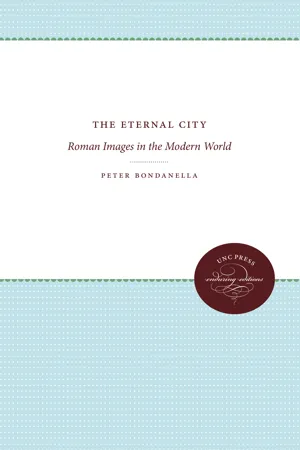
- 304 pages
- English
- ePUB (mobile friendly)
- Available on iOS & Android
eBook - ePub
About this book
Information
Index
Page numbers in boldface refer to illustrations.
Adams, John, 128, 129, 130; Defense of the Constitutions of America, 130
Adrian IV (pope), 31
Agrippa, 6
Agrippina the Younger, 19
Alciati, Andrea, 78–80; Annotationes in Comelium Taritum, 78–79, 81; Emblemata, 79, 80, 81
Alfieri, Vittorio, 113–14; Bruto primo, 137; Bruto seconde 137
Allori, Alessandro, 76–78; The Consul Flaminius in Coundl with the Achaeans, 76; Julius Caesar Receives Tribute from Egypt, 76; Syphax of Numidia Receives Scipio, Victor Over Hasdrubal in Spain, 76; The Return of Cicero from Exile, 76, 77
Ammirato, Scipione, 83; Discourses on Cornelius Taritus, 83
Anderson, Poul, 232–33
Antiquity, cult of: in “civic” humanism, 37–46; in the American Revolution, 129–30, 136–37; in the French Revolution, 130–36, 138–39, 141–43; in the Italian Risorgimento, 160–65; as justification for imperialism, 165–66; in Italian fascism, 172–206
Antoninus Pius (emperor), 20
Antony, Mark, 87–89, 215, 216
Appleton, Thomas, 144
Aquinas, St. Thomas, 30
Arcimbaldo, Angelo, 66
Aristode, 41–42
Armellini, Carlo, 160
Arminius, 68–69, 70–71
Arnold of Brescia, 31
Asimov, Isaac: invention of “galactic empire” theme by, 229; link to Gibbon in, 229; influence on science fiction cinema of, 233; Foundation trilogy by, 229–33
Aude, Joseph, 143
Augustine, St., 23–25, 84; The City of God, 23,31
Augustus (emperor), 8, 18, 150; in Corneille, 106–7; in Montesquieu, 119; compared to Napoleon, 189; compared to Mussolini, 191, 201–3; in Graves, 220, 221, 222
Aurelius, Marcus (emperor), 20, 61, 224, 225, 226, 227
Autocracy, 8
Bara, Theda, 210, 212
Barzini, Luigi, Jr., 35, 183, 206
Barzini, Luigi, Sr., 177
“Battle of the Books,”...
Table of contents
- Cover Page
- Title Page
- Copyright Page
- Dedication
- Contents
- Preface
- Acknowledgments
- Introduction
- ONE. History Into Myth
- TWO. The Rebirth of The Myth of Rome In The Early Renaissance
- THREE. The Myth of Rome In The High Renaissance and the Reformation
- FOUR. Roman Myth and Melodrama In the Baroque and Neoclassical Ages
- FIVE. The Myth of Rome In An Age of Reason and Revolution
- SIX. Romanticism and Risorgimento
- SEVEN. Mussolini’s Fascism and The Imperial Vision of Rome
- EIGHT. Permutations of The Myth of Rome In Modern Literature, Cinema, and Popular Culture
- NINE. Epilogue
- Notes
- Bibliography
- Index
Trusted by 375,005 students
Access to over 1.5 million titles for a fair monthly price.
Study more efficiently using our study tools.
Frequently asked questions
Yes, you can cancel anytime from the Subscription tab in your account settings on the Perlego website. Your subscription will stay active until the end of your current billing period. Learn how to cancel your subscription
No, books cannot be downloaded as external files, such as PDFs, for use outside of Perlego. However, you can download books within the Perlego app for offline reading on mobile or tablet. Learn how to download books offline
Perlego offers two plans: Essential and Complete
- Essential is ideal for learners and professionals who enjoy exploring a wide range of subjects. Access the Essential Library with 800,000+ trusted titles and best-sellers across business, personal growth, and the humanities. Includes unlimited reading time and Standard Read Aloud voice.
- Complete: Perfect for advanced learners and researchers needing full, unrestricted access. Unlock 1.5M+ books across hundreds of subjects, including academic and specialized titles. The Complete Plan also includes advanced features like Premium Read Aloud and Research Assistant.
We are an online textbook subscription service, where you can get access to an entire online library for less than the price of a single book per month. With over 1.5 million books across 990+ topics, we’ve got you covered! Learn about our mission
Look out for the read-aloud symbol on your next book to see if you can listen to it. The read-aloud tool reads text aloud for you, highlighting the text as it is being read. You can pause it, speed it up and slow it down. Learn more about Read Aloud
Yes! You can use the Perlego app on both iOS and Android devices to read anytime, anywhere — even offline. Perfect for commutes or when you’re on the go.
Please note we cannot support devices running on iOS 13 and Android 7 or earlier. Learn more about using the app
Please note we cannot support devices running on iOS 13 and Android 7 or earlier. Learn more about using the app
Yes, you can access The Eternal City by Peter Bondanella in PDF and/or ePUB format, as well as other popular books in History & Roman Ancient History. We have over 1.5 million books available in our catalogue for you to explore.