Significant as a political, economic, and social organization, the southern Farmers' Alliance was the largest and most influential farmers' organization in the history of the United States until the rise of the American Farm Bureau Federation. McMath suggests that the ideas advanced by the People’s party in the 1890s had been incubated within the alliance and that the shared experience of 1.5 million rural Americans helped give those ideas power in the Populist crusade.
Originally published 1976.
A UNC Press Enduring Edition — UNC Press Enduring Editions use the latest in digital technology to make available again books from our distinguished backlist that were previously out of print. These editions are published unaltered from the original, and are presented in affordable paperback formats, bringing readers both historical and cultural value.
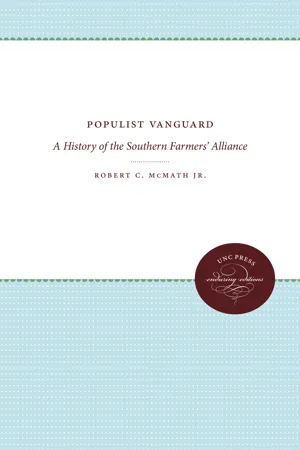
- 240 pages
- English
- ePUB (mobile friendly)
- Available on iOS & Android
eBook - ePub
About this book
Information
CHAPTER 1
Frontier Beginnings
Settlers heading west from Fort Worth in the 1870s might almost have feared they had reached the edge of the earth. In a few miles, the familiar woodlands gave way to a strange, treeless prairie. Pressing on, they reached a vague but equally important line of demarcation, the farming frontier, beyond which open-range cattle ranching prevailed. In the course of their journey, they had also reached another invisible boundary, the cultural edge of the South.
In the 1870s these demographic, economic, and cultural frontiers stretched across Texas from Clay and Montague counties on the Red River down through Brown and San Saba.1 Into this tier of counties poured an army of settlers from the South and Midwest, pushed by financial failure and pulled by a host of private dreams. Those too late, or too poor, to take up land along the tree-lined creek bottoms settled in the inhospitable cross timbers or edged onto the prairie. All found this new home to be a hostile place, violent and disorganized.
During and after the Civil War, the white man's efforts to “civilize” West Texas crumbled. Indian raids jeopardized outlying settlements until 1875. Deadly feuds continued throughout the 1870s and 1880s, despite the efforts of the Texas Rangers. Well-organized bands of desperados made stealing and murdering profitable enterprises, and the clash of two competing economic systems, cattle ranching and small-scale farming, compounded the difficulties.2
Settlers responded to the problems of the frontier as they had to social disorganization in their old homes, by forming voluntary associations. These ranged from vigilante groups to associations of stockmen, sheepraisers, or farmers, and to social institutions, including schools, churches, Masonic lodges—even literary societies—each struggling to bring civilization to the frontier.
The line separating these types of organizations was seldom distinct. For example, a club organized by farmers and stockmen near Lampasas in the late 1870s combined features of all three. It practiced vigilantism by protecting its members against rustlers, furthered their economic interests by helping them locate strays, and as a secret oath-bound fraternity helped meet social needs. The club was short-lived, but one of its members transplanted it to another frontier neighborhood in Parker County, one hundred miles to the north, and from it emerged the Farmers' Alliance.
Historians of the agrarian movement have not pinpointed the beginnings of the Alliance. Most suggest that it began in Lampasas in 1874 or 1875, although some argue that the Texas group sprang from similar organizations in Kansas or New York.3 The uncertainty stems in part from the multiple sources of the Alliance movement and in part from the naturally obscure beginnings of such a group. The issue is further confused, however, by a controversy that raged in the 1880s and 1890s between competing “founders” of the order.
That dispute involved two points, the genesis of the Lampasas group and, more significantly, the degree of continuity between it and an Alliance that William T. Baggett formed in Parker County. The creation story that, with some modifications, became the standard Alliance line was first published by William L. Garvin in 1885. Garvin, who farmed and taught school near Poolville, Parker County, had joined the revived Alliance in 1880. He probably received his information concerning the Lampasas group from Baggett, who insisted that it began sometime between 1870 and 1875 and disbanded in 1879. Thereupon Baggett, who moved north to Parker County that year, founded a new organization, taking ideas from several sources, including the Grange and the defunct Alliance.4
Members of the Lampasas group remembered the beginnings differently. According to John R. Allen, A. P. Hungate, and other charter members, they formed the Alliance in September 1877 on Allen's farm. Lampasas Alliancemen argued that Baggett's group sprang directly from their own. Still smarting from a resolution adopted by the State Farmers' Alliance in 1888 which honored Baggett as “father of the Texas Alliance,” they won from the state body in 1893 a decision that Allen “was the first person to conceive the idea of the Alliance organization.”5
The ultimate wellspring of the Alliance, like that of most social movements, seems beyond discovery. Even A. P. Hungate, who interviewed Lampasas Alliancemen with the idea of writing an “official” history, had to admit, “It is not probable that the world will ever have a full and correct account of our origin and early development.”6
Whatever its exact relation to the overall Alliance movement, an indigenous farmers' organization did develop in Lampasas County during the late 1870s. In that decade, Lampasas faced problems common to the frontier. The influx of small farmers quadrupled the county's population. The clash between ranchers and small farmers was apparently less bitter than elsewhere, but violence nevertheless abounded. Only weeks before John Allen called his neighbors together to form the first Alliance, Texas Rangers suppressed a long and bloody feud between two families in the county.7
To deal with social and economic upheaval, citizens of Lampasas formed all manner of associations. In the summer of 1877, the county boasted, in addition to a number of Protestant churches, two Granges, an immigration aid society, and lodges of the United Friends of Temperance, Masons, and the Odd Fellows. Most of these, however, were located in the county seat. The club that John Allen and his neighbors formed was among the first organizations of any kind in the sparsely settled northern section of the county. First calling their club the Knights of Reliance, they chose as president Lewis S. Chavose, a former Confederate captain and an established farmer and fruitgrower in the neighborhood.8
No sooner was the club organized than one of its officers, F. O. Yates, a large landowner, tried unsuccessfully to convert it into a local Grange. One of the members who opposed such a move was A. P. Hungate whose speech to the club revealed dissatisfaction with the Grange's self-help approach to agricultural problems. The Grange, he said, might discover secrets of nature as would enable them to grow one hundred ears of corn where they now harvest fifty nubbins. But what benefit would that be if while engaged in that achievment, their negligence as citizens had allowed laws to find place upon our statute books that would render the fine ears worth less than nubbins. As Knights of reliance we stand upon a broader and stronger platform. We have undertaken the erection of a more comodious structure. We propose to employ the whole foundation of the Grange as a single corner stone of a grand social and political pallace, where liberty may dwell and where justice may be safely domiciled.9
The group remained an independent club but soon changed its name from Knights of Reliance to Farmers' Alliance. The club, which soon had forty or fifty members, sent out organizers to establish new lodges. William T. Baggett, then a schoolteacher in neighboring Coryell County, organized several lodges there. As affiliated clubs sprang up nearby, the original group on Donaldson's Creek took the name “Pleasant Valley No. 1.” In February 1878 a county Alliance was organized at Pleasant Valley with Chavose as president, and in May lodges from Lampasas, Coryell, and Hamilton counties formed a “state” Alliance, again with Chavose as president.10
What sort of people joined this new organization? Information about them is scarce, and two of the founders later disagreed about their economic condition. Allen recalled that most “were in comfortable circumstances,” but according to Hungate, “all were comparatively poor.” Some of them left enough evidence to permit more precise descriptions.11 Almost all had arrived in Lampasas County since 1870. The twelve members about whom something is known came from eight different states, but except for two Hoosiers, all were southerners. In 1880 nearly all owned their own farms. Most had taken the state's offer of a 160-acre homestead, but several owned substantially more land, with F. O. Yates's 1,400-acre holding being the largest. The value of their land was roughly equal to that of other farmers in the county.12 Most of them combined stockraising with general farming on a small scale. All of them raised cattle, and most grew feed grain. By 1880 most were also raising a bale or two of cotton. One, Captain Chavose, had a flourishing apple and peach orchard. In short, the early Alliancemen were not markedly different from their neighbors. They represented a cross section of a farming community on the Texas frontier.
The careers of two leaders suggest something of the group's diversity. John R. Allen was born in Tennessee in 1831.13 When his mother died eleven years later, he was sent to live with his grandfather, a Louisiana physician. When the grandfather reneged on a pledge to train him in medicine, Allen moved to East Texas, where he farmed until the outbreak of the Civil War. He served in the Confederate army and was mustered out as a second lieutenant, whereupon he returned to his farm. After the death of his second wife in 1874, he moved to Lampasas and began farming on Donaldson's Creek. By 1880 his small farm was valued at a respectable $1,200.14
Unlike Allen and most Lampasas Alliancemen, A. P. Hungate was not a southerner. He was born on a farm in Indiana in 1842. Like Allen, he received no formal education, but he was able to study medicine under a physician in Terre Haute. When the war came, he enlisted in the Indiana Volunteers, serving as a surgeon. Hungate did not practice medicine after the war but instead opened a drug store. When a fire destroyed his store in 1874, be packed up and moved to Texas, where he settled near Donaldson's Creek. By 1880 his 160-acre farm was valued at only $600. Unlike Allen, who remained a Democrat until his death in 1899, Hungate became a Populist and, after the People's party collapsed, a socialist.15
Like many subsequent Alliance leaders, both Allen and Hungate were active farmers but also had skills and social standing that fitted them for leadership. Allen was a successful farmer and acknowledged community leader, while Hungate's professional and business experience and his gift for oratory made him a natural leader for any community organization.
No single crisis moved these men to organize their club. John Allen's call was reportedly couched in the rhetoric of traditional agricultural societies. The neighbors were to meet “for the purpose of bettering the conditions of the agricultural classes.” Hungate recalled that “there were about as many objects in view for organization as there were men participating.” Some thought lawyers or merchants were at the root of their problems, while others wanted only to protect themselves against cattle thieves.16 All agreed on the need for a system of finding strayed or stolen cattle, for barbed-wire fences had not been introduced in the county, and cattle grazed at will. Following the lead of the Grange, the club appointed two officers (called “Grand Smok-eys”) to record brands, report strays, and work for the apprehension of rustlers. Initiates to the club swore to report strays found on their property and to assist officers of the Alliance in maintaining “peace and harmony” in the county. As other Alliances sprang up, a system was developed whereby the local groups reported on strays to the county or state secretaries of the order.17
In a frontier county having few institutions to create a community out of the heterogeneous mass of settlers, the Alliance came to play an important socializing role. What a defender of the Alliance later said of rural Texas in general applied to Lampasas: “[W]ithout some common cause for the assembling of the families of each neighborhood together, [Texans] … being a land of strangers, would for a great many years to come, remain strangers to each other.”18
The new group took the form of a secret society, replete with passwords, grips, oaths, and regalia. This pattern of organization reflected Grange influences but no doubt also stemmed from a generalized familiarity with fraternal organizations. Both the ritualism and the secrecy came to have practical significance in the economic and political dealings of the Alliance, but they first offered a feeling of community to isolated farm families. The local “lodge” provided a setting not unlike the Protestant churches to which most of its members belonged, within which shared values could be reaffirmed and new courses of action clothed with authority.
The most significant function of the Lampasas Alliance, and the one that led to its quick demise, was political. The birth of the Alliance coincided with the rise of the Greenback party, which in Texas began organizing at the local level early in 1877. By February 1878 the city of Lampasas had a flourishing Greenback club.19 Throughout its career, the Alliance conducted a running debate on its proper relation to the exercise of political power. That debate began at Lampasas. John R. Allen expressed a wish rather than a fact when he stated in 1891 that the original group “did not let party politics come into the alliance.” Some early members, probably including F. O. Yates, opposed any contact with politics, but A. P. Hungate envisioned the Alliance as a vehicle for “education” in antimonopoly principles which would act as a nonpartisan pressure group.20
One wing of the Lampasas order, led by L. S. Chavose, sought to make the Alliance a vehicle of political insurgency. At an early meeting, the Donaldson's Creek club adopted a constitution, supported by Chavose, that apparently committed the order to overt political action. No copy of the document has survived, but it was controversial enough to elicit from Hungate, author of a rival constitution, a warning that its publication would “be a death warrant to our organization.”21 The group did not publish the inflammatory document, and it was, in fact, modified, but Chavose's view prevailed, and the Alliance endorsed the Greenback party. Chavose, though an energetic organizer, made no effort to reconcile the conflicts that political involvement created within the order. The Alliance survived the trauma of the 1878 campaign and may have lasted through 1880, when the county experienced a bitterly contested election in which Greenbackers fielded a full county slate.22 The Greenback ticket in 1880 included Chavose's lieutenant in the Alliance, John Reeves, and, strangely enough, F. O. Yates. If the Alliance had in fact survived until then, the decisive defeat of the local Greenback ticket would no doubt have killed it.23
What then was the significance of the abortive effort in Lampasas for the overall development of the Alliance? Parker and Wise counties, not Lampasas, provided the nucleus of leadership for expansion beyond the frontier. The cooperative enterprises that sparked the expansion also stemmed from the Alliance's second growth. Even the organizational structure of the order probably owed more to Baggett and his associates than to John Allen's neighborhood club. The Lampasas beginnings provided the Alliance with a myth of creation, appropriately vague, the exegesis of which helped fuel the ongoing debate about the proper course of action for the movement. Alliance leaders seeking a coalition of southern and midwestern farmers could point to the Lampasas experience as the beginning of intersectional cooperation. As the Texas Alliance became more class-oriented during the 1880s, leaders could describe it (incorrectly) as an organization born in the struggle between small farmers and wealthy cattle kings and the land-company agents. Most frequently, those who strove to maintain the order's “nonpartisan” posture could sermonize, as did W. Scott Morgan in 1889, that the Alliance “though originally organized for the protection of the farmers, had become, through the selfishnes...
Table of contents
- Cover Page
- Halftitle Page
- Title Page
- Copyright Page
- Dedication
- Contents
- Acknowledgments
- Introduction
- Populist Vanguard
- 1. Frontier Beginnings
- 2. Expansion across Texas
- 3. Organizing the Cotton Belt
- 4. Cooperation in Business and Politics
- 5. Brothers and Sisters: THE ALLIANCE AS COMMUNITY
- 6. The “Southern” Alliance Goes West
- 7. The Alliance in Politics: SOUTHERN INTEREST GROUP AND MIDWESTERN INSURGENCY
- 8. The Road to the People's Party
- 9. The Demise of the Farmers’ Alliance
- 10. The Alliance Movement in Retrospect
- Appendix A. Profile of Alliance Leadership in the South
- Appendix B. Alliance Membership in Perspective
- Notes
- Bibliography
- Index
Trusted by 375,005 students
Access to over 1.5 million titles for a fair monthly price.
Study more efficiently using our study tools.
Frequently asked questions
Yes, you can cancel anytime from the Subscription tab in your account settings on the Perlego website. Your subscription will stay active until the end of your current billing period. Learn how to cancel your subscription
No, books cannot be downloaded as external files, such as PDFs, for use outside of Perlego. However, you can download books within the Perlego app for offline reading on mobile or tablet. Learn how to download books offline
Perlego offers two plans: Essential and Complete
- Essential is ideal for learners and professionals who enjoy exploring a wide range of subjects. Access the Essential Library with 800,000+ trusted titles and best-sellers across business, personal growth, and the humanities. Includes unlimited reading time and Standard Read Aloud voice.
- Complete: Perfect for advanced learners and researchers needing full, unrestricted access. Unlock 1.5M+ books across hundreds of subjects, including academic and specialized titles. The Complete Plan also includes advanced features like Premium Read Aloud and Research Assistant.
We are an online textbook subscription service, where you can get access to an entire online library for less than the price of a single book per month. With over 1.5 million books across 990+ topics, we’ve got you covered! Learn about our mission
Look out for the read-aloud symbol on your next book to see if you can listen to it. The read-aloud tool reads text aloud for you, highlighting the text as it is being read. You can pause it, speed it up and slow it down. Learn more about Read Aloud
Yes! You can use the Perlego app on both iOS and Android devices to read anytime, anywhere — even offline. Perfect for commutes or when you’re on the go.
Please note we cannot support devices running on iOS 13 and Android 7 or earlier. Learn more about using the app
Please note we cannot support devices running on iOS 13 and Android 7 or earlier. Learn more about using the app
Yes, you can access Populist Vanguard by Robert C. McMath Jr. in PDF and/or ePUB format, as well as other popular books in History & North American History. We have over 1.5 million books available in our catalogue for you to explore.