eBook - ePub
In My Father's House Are Many Mansions
Family and Community in Edgefield, South Carolina
- 501 pages
- English
- ePUB (mobile friendly)
- Available on iOS & Android
eBook - ePub
In My Father's House Are Many Mansions
Family and Community in Edgefield, South Carolina
About this book
Burton traces the evolution of Edgefield County from the antebellum period through Reconstruction and beyond. From amassed information on every household in this large rural community, he tests the many generalizations about southern black and white families of this period and finds that they were strikingly similar. Wealth, rather than race or class, was the main factor that influenced family structure, and the matriarchal family was but a myth.
Information
1. Edgefield, South Carolina
There is nothing that distinguishes the settlement of Edgefield from that of other districts in the upper and middle country.
Robert Mills, Statistics of South Carolina
Robert Mills, Statistics of South Carolina
Midway between the Blue Ridge Mountains and the Atlantic Ocean, Edgefield County (a “district” until 1868) was on the western border of South Carolina, separated from Georgia by the Savannah River (see Map 1).1 To the north lay Abbeville District, and to the east, separated from Edgefield by the Saluda River, Newberry. In the northeast corner, where it joined Newberry and Abbeville, Edgefield intersected the southeast tip of Laurens. To the south were Barnwell, Orangeburg, and Lexington. Edgefield itself, 1,702 square miles, was more a region than a county. In 1860 Edgefield, with 951,451 acres of land, was the second largest district in the state after the Charleston Coastal District.
After the Civil War new counties were formed from old Edgefield County (see Map 2). In 1871 the southernmost section of Edgefield County (along with areas from the northern parts of Orangeburg, Barnwell, and Lexington counties) was detached to form Aiken County. This area of old Edgefield County included the town of Hamburg, the Horse Creek area where William Gregg built his famed antebellum textile mill, the town of Aiken, and the rich land of Beech Island, where antebellum governor and U.S. senator James Henry Hammond had his home, Redcliffe. During the 1895 constitutional convention the county of Saluda was created entirely from Edgefield County. This section was the home of the prominent Butler family, which included Pierce Mason Butler, governor of South Carolina, as well as two heroes of the Alamo, Commander William Barret Travis and James Butler Bonham.
In 1897 Greenwood County was formed from Edgefield and Abbeville; this northern part of the section was the home of Congressman Preston Brooks, famed for his attack on Senator Charles Sumner, and the home of Benjamin E. Mays, a well-known twentieth-century educator. Finally, in 1917 part of the area that had been taken from Edgefield County to form Greenwood County was combined with a part of Abbeville County to form McCormick County. This northwestern section of the Edgefield District was the home of postbellum governor John Sheppard and of the Tillmans: George D., congressman, and his younger brother, the colorful Benjamin Ryan, more popularly known as “Pitchfork Ben,” postbellum agrarian protest leader, governor, and senator.2
Although boundaries have shifted, all of these various counties and areas may be regarded as a single economic, geographical, and social entity. Neither black nor white people of Edgefield recognized rigid boundaries. Social, political, and economic concerns overlapped county and even state boundaries. For example, James Henry Hammond’s main plantation was in Barnwell District, but his home was in Edgefield. Edgefield blacks and whites traveled to Chappells in Newberry County to have their cases heard by a local trial justice. During Reconstruction crises, white militia companies rode from neighboring counties to the aid of other white paramilitary groups.3 Nevertheless, statistical sources for family life in South Carolina were collected by county; therefore the quantitative data for the period prior to 1871 comes from within the defined geographical limits of pre-1871 Edgefield County and, subsequent to 1871, from all the area of the antebellum district except for that which was lost to Aiken County.
South Carolina was traditionally divided into up-country and low-country sections, each section having its own geography and culture. The low country was emblematic of the plantation aristocracy of the South; it comprised generally the tidewater and sand-hill regions of the state. The up-country coincided very nearly with what is called the Piedmont region of the state. The land in the up-country had a heavy red clay soil and lower temperatures and a shorter growing season owing to the proximity of the Blue Ridge Mountains. Although Edgefield District was considered part of the up-country, the lower section of the district had the sand hills more commonly associated with the low country. Since the aristocratic elements of the state imputed unattractive connotations to the designation “up-country,” many in Edgefield preferred to call part of the district the “midlands,” identifying “culturally” with districts like Camden and Cheraw and the state capital, Columbia.4
The Savannah River, Edgefield District’s western border, one of South Carolina and Georgia’s most important avenues of commerce, linked coastal ports with inland areas. Reaching from the mountains to the sea, the river obstructed westward movement; Augusta and Hamburg developed at the site of one of the few natural fords. Buffalo, deer, and other wild game had long used this crossing, and Indians and then eighteenth- and nineteenth-century pioneers followed. Augusta, on the Georgia banks of the Savannah River, was established in the 1730s as a frontier outpost. It was sited at the fall line, above which waterfalls and rapids made navigation upriver difficult.5
Opposite Augusta, a twenty-mile-wide belt of steep rolling hills stretched across South Carolina in a northeasterly direction from the bottom lands of the Savannah River. These sand hills were the vestiges of an ancient ocean shoreline, a region of porous sandy soil that supported little indigenous vegetation beyond thick pine stands and scrub brush. Undulating gently, these hills climbed slightly for about fifteen miles in from the river, then rose abruptly to a six-hundred-foot-high plateau. The sand hills plateau was nearly level, running toward the southeast before it blended into the hills of the upper pine belt region below Edgefield District. In the east this ten-mile-wide plateau descended rapidly to the South Edisto River. The bottomlands of the South Edisto and North Edisto in the southeastern section of Edgefield District were swampy and densely overgrown, and an eight-mile-wide sandy plateau obstructed east-west travel by wagon or horseback. Thus the Edisto plateau communities were drawn more toward Columbia and the low country for travel and trade than were the other sections of the district. From the northern limits of this plateau, near where the Reconstruction settlement of Johnston grew around the Charlotte-Columbia-Augusta Railroad, a ridge of steep granite and clay hills six hundred feet high ran west to the Savannah River valley north of Edgefield Court House and then northwestward up the Savannah toward Abbeville District. This ridge–fall line zone, with an elevation of over five hundred feet, ran westward from Edgefield Court House, crossed the Savannah River, and passed north of Augusta. North of the ridge the terrain descended slightly. To the South, however, it was steep and undulating, marked by large streams, such as the Horse, Turkey and Stevens creeks, that carved numerous valleys through the land. These fast-flowing streams severely limited travel between settlements, so the topography funneled trade and travel toward Augusta and, for a time, toward Hamburg on the South Carolina side of the river.
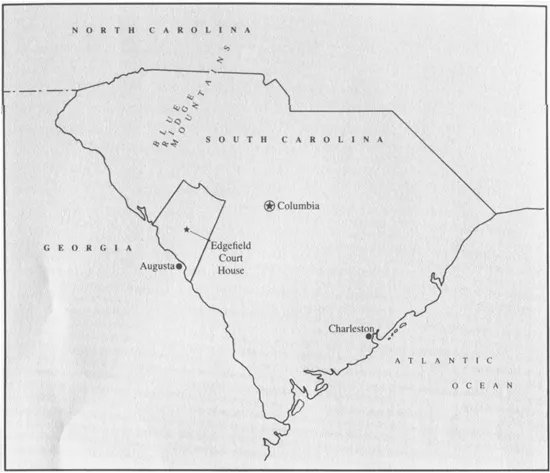
Map 1.
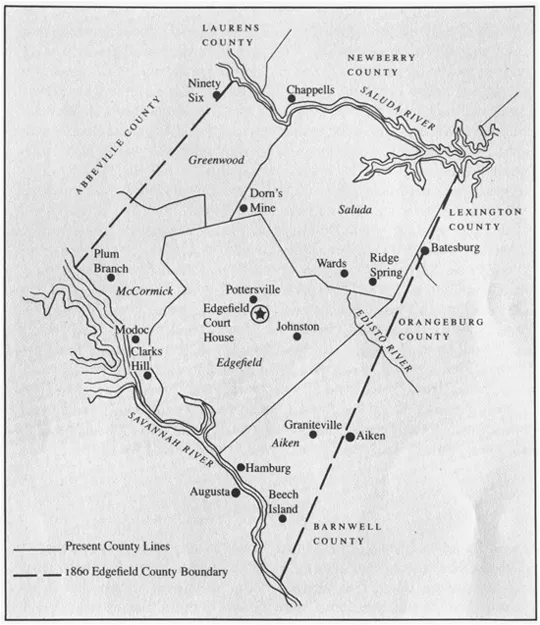
Map 2.
Settlement
David Ramsay’s history reported that as late as “the year 1755 the country from the Waxhaws on the Catawba across to Augusta on the Savannah River did not contain twenty-five families.”6 But permanent settlers had begun moving into the area about 1748, after treaties with the Indians were signed. Soon after the Revolution the same area was sufficiently populated to contain twelve political units. Edgefield County was one of these twelve, the largest and most southern of the six (Abbeville, Newberry, Laurens, Union, and Spartanburg) created from the Ninety Six District, most of the entire northwestern portion of South Carolina. With the encouragement of bounties from the Carolina colonial government, European immigrants settled in and around areas that would become Edgefield County. The government especially encouraged the English and Irish, and in 1737 a group of Swiss located in New Windsor in what is now Aiken County; in 1764 more than one hundred French Huguenots settled at New Bordeaux in what is now McCormick County; in 1765 more than two hundred German Palatines moved south of Ninety Six, where they felt more secure from Indian attacks than in the area originally designated for them near New Bordeaux. Despite these groups of bounty immigrants from Europe, though, most settlers in Edgfield had emigrated from Pennsylvania and Virginia into North Carolina and then into the Piedmont of South Carolina and thence into Edgefield. They came into Edgefield District through two peripheral communities, an eastern outpost (Ninety Six) or up the Savannah to a western outpost (Augusta).7
Blacks and whites entered the area at about the same time. In addition to a few free black families, Afro-American slaves came into Edgefield with the early migrants and helped settle the frontier. As early as 1736 slaves rowed boats laden with a thousand pounds sterling worth of furs down the Savannah river from the Carolina frontier outpost at Fort Moore to the coast. Many of the blacks in Edgefield were reputed to be of the Gullah African tribe, defiant and unruly as slaves. Afro-Americans were not the only unfree persons, however. In the mid-eighteenth century Edgefield had both white indentured servants and Indian slaves. Then too Indians made slaves of white captives. During the frontier years race was probably less an issue than status.8
Blacks came to outnumber whites in the first decade of the nineteenth century (Table 1-1 shows how their numbers increased from 1790 to 1900). Important black leaders emerged from the old Edgefield district. Afro-American leaders established the first independent black church in America in Edgefield District between 1773 and 1775. David George, a slave exhorter who preached at the Silver Bluff Baptist Church, took advantage of the British offer of freedom for slaves and emigrated first to Nova Scotia in 1782 and then to Sierra Leone in 1792, establishing Baptist churches wherever he went. David George’s childhood friend and fellow Edgefield slave George Liele left the Edgefield Silver Bluff Church and established a Baptist ministry in Jamaica. Alexander H. Bettis founded more than forty churches, two Baptist associations, and an educational academy. Baptist preacher and educator Dr. Benjamin E. Mays became president of Morehouse College and the spiritual and intellectual mentor to several generations of local and national black leaders, including Martin Luther King, Jr.9
During Reconstruction a number of former Edgefield slaves served as state representatives. Lawrence Cain was a state senator, and among the state representatives were Paris Simkins, David Graham, and Augustus Simkins. Black leaders also held local offices. Civil War hero Prince Rivers, the “Black Prince,” called Edgefield his home, as did the famous militia leader Ned Tennant.10
The ratio of black to white persons changed over time. In 1800 the population of whites was 13,063, but by 1820 had decreased to 12,864. Slaves, 5,006 in 1800, numbered 19,198 by 1820. This nearly fourfold increase in the number of slaves and a decrease in the number of whites signified the development of an increasingly wealthy white planter class in Edgefield.11
Many of these large planters came from the coastal plains of South Carolina.
Table 1-1. Population of Edgefield County, 1790–1900 | |||
| Year | Edgefield Aggregate Population | Number White | Number Black |
| 1790 | 13,289 | 9,605 | 3,684 |
| 1800 | 18,130 | 13,063 | 5,067 |
| 1810 | 23,160 | 14,433 | 8,727 |
| 1820 | 25,119 | 12,864 | 12,255 |
| 1830 | 30,509 | 14,957 | 15,522 |
| 1840 | 32,852 | 15,020 | 17,832 |
| 1850 | 39,262 | 16,252 | 23,010 |
| 1860 | 39,887b | 15,653 | 24,233 |
| 1870 | 42,486b | 17,040 | 25,417 |
| 1880a | 45,844 | 16,018 | 29,826 |
| 1890a | 45,259b | 17,340 | 31,916 |
| 1900 | 44,444 | 16,166 | 28,278 |
a. Parts of Edgefield County were lost to form new counties: in 1871, Aiken; in 1896, Saluda; in 1897, Greenwood. However, Saluda County, created entirely from Edgefield, is included in the 1900 figures above.
b. When the total exceeds the sum of blacks and whites, American Indians and Chinese have been added. In 1860, there was one Indian; in 1870, twenty-nine Indians; in 1890, two Indians and one Chinese. The censuses aggregated Chinese and Indians as white population.
Source: U.S., Bureau of the Census, 8th (1860) Census, vol. 1, Population, pp. 449–52; U.S., Bureau of the Census, 9th (1870) Census, vol. 1, Population, pp. 60–61; U.S., Bureau of the Census, 11th (1890) Census, vol. 1, pp. 38, 427, 440, 448; U.S., Bureau of the Census, 12th (1900) Census, vol. 1, Population, pt. 1, p. 37; S.C., Dept. of Agriculture, Commerce, and Immigration, Handbook of South Carolina, pp. 524, 527–28; Wallace, History South Carolina, 3:504.
They were Episcopalians and closely linked to the Charleston elite. These low-country migrants, accustomed to command, considered themselves more refined and more noble than their rustic neighbors, even when those neighbors owned large numbers of slaves.12
Still, the great majority of whites were usually Baptists and Methodists (Presbyterians were prominent elsewhere, but not in Edgefield). In contrast to the aristocratic settlers from the seaboard areas, these whites were fiercely independent and democratic; early settlers were noted for disobeying officers and officials and for arguing with authorities. This area became the home of the regulator movement in South Carolina, and the Revolutionary War was here a civil war as well, marked by extreme violence and vengeance.13
Perhaps this mixture of seaboard aristocracy and heterogeneous backcountry elements in Edgefield helped to account for the distinguished white political leadership that emerged. For from among whites alone Edgefield has produced ten governors and five lieutenant governors. From George McDuffie’s election to the Senate in 1842 (to replace William Preston) until the Civil War, Edgefield supplied one of South Carolina’s national senators (McDuffie, A. P. Butler, James Henry Hammond). As soon as the Democrats regained control of the state in 1877, Edgefield again supplied a senator, Matthew Calbraith Butler until 1894, followed by Benjamin Ryan “Pitchfork Ben” Tillman. Edgefield’s representatives in the Senate had national as well as statewide influence.14
One clue to the number of prominent politicians was the high quality of lawyers in the county. Leaders at antebellum Edgefield Court House were celebrated by Judge J. Belton O’Neall as a “brilliant galaxy.” In his 1859 ...
Table of contents
- Cover Page
- In My Father’s House Are Many Mansions
- Copyright Page
- Dedication
- Contents
- List of Tables
- List of Figures and Maps
- List of Illustrations
- Preface
- Introduction
- 1. Edgefield, South Carolina
- 2. Edgefield from the White Perspective
- 3. The White Family and Antebellum Social Structure
- 4. The Slave Family
- 5. The Free Afro-American in Antebellum Edgefield
- 6. The Culture of Postbellum Afro-American Family Life
- 7. Black and White Postbellum Household and Family Structure
- Conclusion
- Appendix 1. Methodology
- Appendix 2. Occupational Groupings
- Notes
- Bibliography
- Index
Trusted by 375,005 students
Access to over 1.5 million titles for a fair monthly price.
Study more efficiently using our study tools.
Frequently asked questions
Yes, you can cancel anytime from the Subscription tab in your account settings on the Perlego website. Your subscription will stay active until the end of your current billing period. Learn how to cancel your subscription
No, books cannot be downloaded as external files, such as PDFs, for use outside of Perlego. However, you can download books within the Perlego app for offline reading on mobile or tablet. Learn how to download books offline
Perlego offers two plans: Essential and Complete
- Essential is ideal for learners and professionals who enjoy exploring a wide range of subjects. Access the Essential Library with 800,000+ trusted titles and best-sellers across business, personal growth, and the humanities. Includes unlimited reading time and Standard Read Aloud voice.
- Complete: Perfect for advanced learners and researchers needing full, unrestricted access. Unlock 1.5M+ books across hundreds of subjects, including academic and specialized titles. The Complete Plan also includes advanced features like Premium Read Aloud and Research Assistant.
We are an online textbook subscription service, where you can get access to an entire online library for less than the price of a single book per month. With over 1.5 million books across 990+ topics, we’ve got you covered! Learn about our mission
Look out for the read-aloud symbol on your next book to see if you can listen to it. The read-aloud tool reads text aloud for you, highlighting the text as it is being read. You can pause it, speed it up and slow it down. Learn more about Read Aloud
Yes! You can use the Perlego app on both iOS and Android devices to read anytime, anywhere — even offline. Perfect for commutes or when you’re on the go.
Please note we cannot support devices running on iOS 13 and Android 7 or earlier. Learn more about using the app
Please note we cannot support devices running on iOS 13 and Android 7 or earlier. Learn more about using the app
Yes, you can access In My Father's House Are Many Mansions by Orville Vernon Burton in PDF and/or ePUB format, as well as other popular books in History & North American History. We have over 1.5 million books available in our catalogue for you to explore.