Conceived at the same conference that produced the Student Nonviolent Coordinating Committee (SNCC), the Student Interracial Ministry (SIM) was a national organization devoted to dismantling Jim Crow while simultaneously advancing American Protestant mainline churches’ approach to race. In this book, David P. Cline details how, between the founding of SIM in 1960 and its dissolution at the end of the decade, the seminary students who created and ran the organization influenced hundreds of thousands of community members through its various racial reconciliation and economic justice projects. From inner-city ministry in Oakland to voter registration drives in southwestern Georgia, participants modeled peaceful interracialism nationwide. By telling the history of SIM — its theology, influences, and failures — Cline situates SIM within two larger frameworks: the long civil rights movement and the even longer tradition of liberal Christianity’s activism for social reform.
Pulling SIM from the shadow of its more famous twin, SNCC, Cline sheds light on an understudied facet of the movement’s history. In doing so, he provokes an appreciation of the struggle of churches to remain relevant in swiftly changing times and shows how seminarians responded to institutional conservatism by challenging the establishment to turn toward political activism.
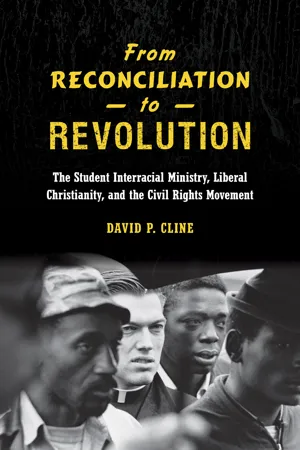
eBook - ePub
From Reconciliation to Revolution
The Student Interracial Ministry, Liberal Christianity, and the Civil Rights Movement
- 304 pages
- English
- ePUB (mobile friendly)
- Available on iOS & Android
eBook - ePub
From Reconciliation to Revolution
The Student Interracial Ministry, Liberal Christianity, and the Civil Rights Movement
About this book
Information
CHAPTER ONE
So That None Shall Be Afraid
Establishing and Building the Student Interracial Ministry, 1960–1961
Only insofar as we lend our support and energies to a creative witness such as this will we ever realize the promise of the Holy Scripture: “… And every man will sit down under his own vine and fig tree and none shall be afraid.”
—Reverend Martin Luther King Jr., March 29, 1961, offering to sponsor the Student Interracial Ministry
The sun was just coming up on May 31, 1960, as John Collins, a gangly thirty-one-year-old white seminary student and former naval officer from Chicago, pulled his car to the side of the road outside Anniston, Alabama. Collins was scared. He had been driving for several days from his parents’ home in Illinois, bound for a summer of ministry among black “church folk.” Four months earlier, a series of nonviolent lunch counter sit-ins against segregation had rocked the South and much of the rest of the country. Collins was studying to be a minister at Union Theological Seminary (UTS) in New York City and wanted to take part in this potentially transformative social movement, and so here he was, traveling for the first time into the Deep South. He would be working hand-in-hand with a young black minister named John Watts in Talladega, Alabama, under the auspices of an embryonic civil rights organization that would become known as the Student Interracial Ministry. The grand imperial dragon of the Ku Klux Klan was reputed to reside in Talladega. For a Yankee like Collins, this was the belly of the beast. And the racial situation was only getting hotter; Alabama had just recently expelled student demonstrators from its state university and was one of two southern states that reacted to the student-led sit-ins earlier that year by passing new laws expressly prohibiting integrated dining facilities.1 He was suddenly conscious of the license plates on his car that proudly declared he had just arrived from “The Land of Lincoln.”
Collins tried to calm himself by recalling the advice that Ella Baker had given him a few weeks earlier, when he had admitted his fear over his impending journey. Baker, the outgoing executive director of the Southern Christian Leadership Conference and an adviser to both the Student Interracial Ministry and the Student Nonviolent Coordinating Committee, told him, “Don’t be afraid. You can go into a strange country. Abraham did.”2 Now, as he sat in his car parked in the dust by the side of a rural Alabama road, Collins cracked open the cover of his new journal and began to write: “I am not as frightened as I have been at times the past couple of days. I know that handling hostility will be my biggest problem and that if I can do that I can stick it out. Even with the apprehension, there is the thrill of being here and going into the midst of this situation. It is certainly being alive—I hope my fears will not blot out the vital sparks. I am determined to stay, not heroically, but just to stay. Grant unto me, O Lord, faith to know, when I need to know, that thy grace is sufficient.”3
Collins had wanted to go south ever since February 1, 1960, when four students from all-black Agricultural and Technical College of North Carolina sat down at the segregated lunch counter of a Greensboro Woolworth’s store and asked for service. That demonstration, while not the first of its kind in the South, garnered unprecedented publicity and launched a wave of nonviolent demonstrations throughout the region, one of the most visible and influential campaigns of the early 1960s’ phase of the civil rights movement. Within six weeks, more than 935 black and white students had been arrested in nonviolent protests.4 In the North, the Congress of Racial Equality (CORE), a nearly twenty-year-old interracial organization that promoted nonviolence and racial equality, organized “sympathy pickets” of a number of Woolworth’s branches in New York City. Collins and some of his seminary colleagues, including Jane Stembridge, enthusiastically joined the picket lines to demonstrate solidarity with their southern brothers and sisters.
The CORE-led pickets connected the UTS students to the long lineage of their liberal Protestant predecessors. Many of these seminarians were questing for a real-world application of the Christian Gospel they were studying, and the pickets gave them an exhilarating taste of theology—whether it was known as Social Gospel or Christian Realism or some combination of these and other ideas—in practice in the world. In return, Collins, Stembridge, and some of their fellow students gradually integrated their religious beliefs and practices into the demonstrations, so that within several weeks, student-led “pre-picket worship services” had become an integral part of the New York Woolworth’s protests.5
The racial crisis in the South sparked a movement of reexamination and self-reflection at both institutional and student levels at many mainline seminaries. It had special resonance for students studying a theology that stressed the importance of human beings’ reconciliation to one another as well as to God and Jesus Christ. The sit-ins were cause for much self-reflection at Union, which was known for its liberal theology and its pioneering teaching on Christian ethics, and where, according to one student, “the whole seminary was faced with the realization that the church itself confronted a serious race problem within the fold.”6 For many students who had studied religion and philosophy only in the classroom, the southern situation brought biblical teachings to life and demanded an active response. “The sit-ins knocked us out of our arm chair theology,” wrote another student in the seminary’s newspaper. “Now we have to make a decision.”7
On March 6, 1960, five southern veterans of those sit-ins presented a lecture at Union, regaling the seminarians with their firsthand accounts of lunch-counter demonstrations, arrests, and community reactions. What they described sounded to Collins and others like a true test of Christian faith. The final event that seems to have spurred the seminary students to take action, however, was an attack against one of their own. News reached Union that James Lawson, then a Vanderbilt Divinity School senior, had recently been expelled for his participation in the southern sit-ins, despite the fact that a majority of Vanderbilt’s own faculty believed that Lawson had simply “endeavor[ed] to follow his Christian conscience.”8
Many Union students and some faculty identified with Lawson—a fellow seminarian and a future minister—and rallied around his cause. Roger Shinn, Union’s professor of Christian ethics, spoke to Lawson and to other students and faculty at the Vanderbilt Divinity School, reporting back that “they are greatly strengthened by the solidarity of Christians in theological seminaries and colleges across the country.”9 To be sure, Lawson was not a typical young seminarian engaging in theological consideration of the world around him for the first time. He was at that point already a committed pacifist and was fast becoming an established civil rights leader. He had spent fourteen months in prison as a conscientious objector in the early 1950s, after which he had served as a Methodist missionary in India, where he studied Gandhi’s satyagraha techniques of nonviolent resistance. While attending the Graduate School of Theology at Oberlin College in Ohio, Lawson met Martin Luther King Jr., and they began a long association that had a strong influence on King’s later adoption of nonviolence as a protest tactic. Lawson moved to Nashville toward the end of the decade to attend the Vanderbilt Divinity School and to work as the southern director of the Fellowship of Reconciliation. He developed a cadre of Nashville students who would become major civil rights leaders in their own right, including John Lewis, Marion Barry, Diane Nash, Bernard Lafayette, and James Bevel. With them, Lawson conducted some of the first test sit-ins at southern establishments in 1958 and 1959.10 At the time of his dismissal from Vanderbilt, Lawson was three months shy of completing his bachelor of divinity, a degree now equivalent to the master’s in divinity. Union’s student cabinet sent a letter of protest to the Board of Trustees at Vanderbilt University, warning them that they were being watched by “fellow citizens, fellow members of the wider academic community, and Christians.”11
The sit-ins and the Lawson incident created a division among some members of the Student Christian Movement. The National Student Christian Federation (NSCF), for example, celebrated the tide of reconciliation it felt was at work in the South, but it also urged respect for the rule of law. In a nationally circulated “Letter to Christian Students and Campus Christian Student Groups in the U.S.A.,” the group’s central committee wrote, “We, as Christian students, do not simply seek the realization of American democratic values; we witness to the fact that Christ died to reconcile all men to each other and to God.” The southern situation was proof, they wrote, that a living Christ was hard at work, “healing and reconciling where our efforts have fallen short.”12 But rather than enjoin Christian students to join the sit-ins or similar demonstrations, they urged strict observance of the law, which they claimed had been divinely inspired “to preserve relative order and peace.” They urged Christian students to embrace another kind of reconciliation—that between themselves and the demonstrators—so as to understand that black Americans’ cause was just even if their methods were not.13
The national councils of the other leading national Christian student organizations, the YWCA and the YMCA, disagreed with the NSCF’s position and took a more activist stance. While they urged students to inform themselves, they also cautioned against taking too long to act. In a nationally-distributed joint report, the YWCA and YMCA wrote, “Action apart from an attempt to keep informed is irresponsible. Yet to wait for the day when all the facts are in is to read history, not to participate in it significantly.”14 Among these student Christian groups can be seen the variety of liberal Protestant approaches to contemporary problems, from a social gospel faith in humankind’s goodness and liberal progress to a Christian realism arguing for real-time action that met the world where it was.
At Union Theological Seminary, student reactions to the sit-ins varied widely, some agreeing with the National Student Christian Federation’s cautious approach and others urging direct action and immediate change. However, the entire campus community did take notice of the sit-ins and their religious implications. Many on campus went to listen to Martin Luther King Jr. speak at nearby Salem Methodist Church in Harlem on April 1, including Jane Stembridge. As she later recalled, King spoke about the growing protest movement in the South, “which was home,” and thought to herself, “Why am I here, even though this is an incredibly fine and radical and free institution? … It was really on the cutting edge of biblical scholarship and on the cutting edge of social gospel, theology, and everything.… And I love it [but] … it was far, far away from the Bible Belt [and being at seminary] seemed so irrelevant, after I heard him. Then I wanted to go home and do something.” She talked with King at a reception following his talk and asked him if she could help with the movement in some way. King invited her south and gave her the contact information for Ella Baker.15
Not all were as moved by King’s talk and the student action in the South. Union’s newspaper, the Grain of Salt, published an entire special edition on “the present racial crisis” under the headline “Report for Action.”16 At the same time, the student government’s Social Action Committee called a special campus-wide meeting to discuss appropriate responses to the sit-ins and to Lawson’s dismissal. Again responses varied. Some students vowed to travel south to join the sit-ins themselves, while others decried the public demonstrations as breaking the rule of law. Referring to those demonstrators who had been arrested for trespass, student Roger Nils Folsom claimed that they had broken good laws and violated the rights of others. “May we not recklessly destroy rights in the process of fighting for rights?” he asked. “At least may we consider what other rights we are destroying, and whether their destruction is really necessary.”17 Another student in the audience suggested a compromise: the seminarians, who regularly spent summers doing pastoral fieldwork, might involve themselves directly in the civil rights situation—and adhere to both civic law and their Christian consciences—by undertaking their assistant pastorates in southern communities.18 This would soon become the plan of action pursued by what became the Student Interracial Ministry.
The students who urged caution and care for the rule of law and property typified the conservative, cautious, noninterventionist approach that characterized the mainline churches and most seminaries before World War II. Even in 1960, a liberal seminary like Union still harbored a number of faculty and students who thought the parish minister’s duty was to attend quietly to the needs of his immediate flock or to convert heathens overseas, not to challenge American beliefs and social structures. As one Union student put it, “The seminary campus [at that time] was the last place one would have looked for an awakened social concern.”19 The Second World War, however, and the terror and cruelty it exposed, had shaken up a number of church folk, radicalizing them in their beliefs about the church’s role in influencing social conditions. The traditionalists in churches and seminaries were thus joined through the 1950s by a swelling cohort of both faculty and students who urged the mainline churches to take a stand on social issues and actively involve themselves in contemporary affairs. Among this growing group of proto-activists were those who supported the ecumenical movement and found in it both common cause and strength in numbers. Chief among the supporters at Union, which was widely considered one of the most liberal of the mainline seminaries, were ethics professors Roger Shinn and Reinhold Niebuhr, one of the most influential theologians in the country at the time. At Union in 1960, the sit-ins, the local Woolworth’s pickets, and the Lawson discussions eventually led directly to involvement in the southern civil rights movement. The student government established a new Special Committee on the Racial Crisis, whose first task was to organize a trip to the South during Union’s spring break.20 When Ella Baker’s invitation to the Raleigh conference arrived, plans were modified, sev...
Table of contents
- Cover
- Frontispiece
- Title Page
- Copyright
- Contents
- Preface: A Tale of Two Gatherings
- Abbreviations in the Text
- Chapter One: So That None Shall Be Afraid: Establishing and Building the Student Interracial Ministry, 1960–1961
- Chapter Two: To Be Both Prophet and Pastor: Crossing Racial Lines in Pulpits and Public Spaces, 1961–1962
- Chapter Three: These Walls Will Shake: New Forms of Ministry for Changing Times, 1962–1965
- Chapter Four: Into the Heart of the Beast: Ministry in the Fields and Towns of Southwest Georgia, 1965–1968
- Chapter Five: Seminarians in the Secular City: Embracing Urban Ministry, 1965–1968
- Chapter Six: Seminaries in the Storm: Theological Education and the Collapse of SIM, 1967–1968
- Afterword
- Illustrations
- Acknowledgments
- Notes
- Bibliography
- Index
Trusted by 375,005 students
Access to over 1.5 million titles for a fair monthly price.
Study more efficiently using our study tools.
Frequently asked questions
Yes, you can cancel anytime from the Subscription tab in your account settings on the Perlego website. Your subscription will stay active until the end of your current billing period. Learn how to cancel your subscription
No, books cannot be downloaded as external files, such as PDFs, for use outside of Perlego. However, you can download books within the Perlego app for offline reading on mobile or tablet. Learn how to download books offline
Perlego offers two plans: Essential and Complete
- Essential is ideal for learners and professionals who enjoy exploring a wide range of subjects. Access the Essential Library with 800,000+ trusted titles and best-sellers across business, personal growth, and the humanities. Includes unlimited reading time and Standard Read Aloud voice.
- Complete: Perfect for advanced learners and researchers needing full, unrestricted access. Unlock 1.5M+ books across hundreds of subjects, including academic and specialized titles. The Complete Plan also includes advanced features like Premium Read Aloud and Research Assistant.
We are an online textbook subscription service, where you can get access to an entire online library for less than the price of a single book per month. With over 1.5 million books across 990+ topics, we’ve got you covered! Learn about our mission
Look out for the read-aloud symbol on your next book to see if you can listen to it. The read-aloud tool reads text aloud for you, highlighting the text as it is being read. You can pause it, speed it up and slow it down. Learn more about Read Aloud
Yes! You can use the Perlego app on both iOS and Android devices to read anytime, anywhere — even offline. Perfect for commutes or when you’re on the go.
Please note we cannot support devices running on iOS 13 and Android 7 or earlier. Learn more about using the app
Please note we cannot support devices running on iOS 13 and Android 7 or earlier. Learn more about using the app
Yes, you can access From Reconciliation to Revolution by David P. Cline in PDF and/or ePUB format, as well as other popular books in Social Sciences & Christian Ministry. We have over 1.5 million books available in our catalogue for you to explore.