Egypt figured prominently in United States policy in the Middle East after World War II because of its strategic, political, and economic importance. Peter Hahn explores the triangular relationship between the United States, Great Britain, and Egypt in order to analyze the justifications and implications of American policy in the region and within the context of a broader Cold War strategy.
This work is the first comprehensive scholarly account of relations between those countries during this period. Hahn shows how the United States sought to establish stability in Egypt and the Middle East to preserve Western interests, deny the resources of the region to the Soviet Union, and prevent the outbreak of war. He demonstrates that American officials' desire to recognize Egyptian nationalistic aspirations was constrained by their strategic imperatives in the Middle East and by the demands of the Anglo-American alliance.
Using many recently declassified American and British political and military documents, Hahn offers a comprehensive view of the intricacies of alliance diplomacy and multilateral relations. He sketches the United States' growing involvement in Egyptian affairs and its accumulation of commitments to Middle East security and stability and shows that these events paralleled the decline of British influence in the region.
Hahn identifies the individuals and agencies that formulated American policy toward Egypt and discusses the influence of domestic and international issues on the direction of policy. He also explains and analyzes the tactics devised by American officials to advance their interests in Egypt, judging their soundness and success.
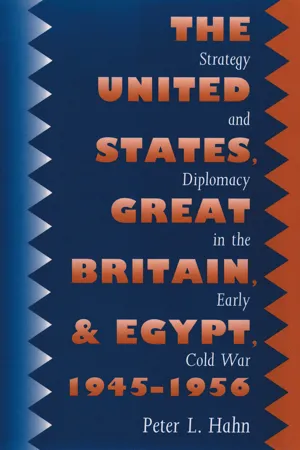
eBook - ePub
The United States, Great Britain, and Egypt, 1945-1956
Strategy and Diplomacy in the Early Cold War
- 374 pages
- English
- ePUB (mobile friendly)
- Available on iOS & Android
eBook - ePub
The United States, Great Britain, and Egypt, 1945-1956
Strategy and Diplomacy in the Early Cold War
About this book
Information
1: Introduction
This book explores and analyzes American policy toward Egypt between 1945 and 1956. It examines the strategic, political, and economic interests and imperatives that guided American officials who shaped policy toward Egypt and identifies the specific objectives they defined, the dilemmas produced by conflicts between these objectives, and how those dilemmas were resolved. The circumstances, motivations, and interests that determined American policy toward a significant Middle East country in the immediate postwar period are the focus of the analysis.
American policy toward Egypt was formulated in the context of a broad effort to establish stability in the Middle East, which United States officials defined as the region being at peace, governed by leaders friendly to the West, open to American economic opportunities, and free from Soviet influence. Stability seemed the best way to preserve American interests in the region and around the world and to avoid another world war. It would secure the resources and facilities of the region for the use of the Western powers in containing Soviet influence in peace and defeating Soviet power in war. Maintenance of stability was the sine qua non of American postwar policy in the Middle East.
Immediately following World War II, conditions in the Middle East seemed unfavorable to the attainment of stability. Indigenous nationalistic aspirations for independence clashed with the desires of the traditionally imperialist powers, Great Britain and France, to maintain their colonial empires in the region. Corrupt and undemocratic local governments generated political unrest that portended revolution. The question of sovereignty in Palestine spawned tension and perpetual violence within the region. Economic underdevelopment and restrictive commercial systems produced poverty and social discontent that seemed to render the area vulnerable to the influence of communism or other extremist doctrines. Apparent Soviet political expansionism raised the specter of communist influence penetrating the region and denying its facilities and resources to the Western powers. These destabilizing factors were interdependent and mutually reinforcing, and they posed immense impediments to the American quest for stability in the Middle East.
Egypt figured prominently in the American effort to establish stability in the Middle East. Western strategists believed that in the event of war against the Soviet Union, Egypt’s location and facilities would render it extremely valuable. Straddling the intersection of three continents, Egypt protected interhemispheric lines of communication and transportation. Egyptian military bases could be supplied from two oceans. Of all Western air bases that could be defended against Soviet ground forces, those in Egypt were closest to Soviet oil-producing and industrial targets. Furthermore, Britain maintained an enormous military base in the Suez Canal Zone. Spanning nearly five thousand square miles, the base boasted ten airfields, thirty-eight camps, railroads, ordnance depots, repair shops, and a host of other valuable facilities. During World War II, the base supported forty-one Allied divisions in the Middle East and eastern Mediterranean, and in 1945 nearly eighty-four thousand British troops remained stationed there. American strategists stressed that this base must remain in Western hands in case war erupted against the Soviet Union.
Egypt was also of political significance. Following the war, intensifying Egyptian nationalism threatened to destabilize the entire region. Nationalists demanded complete and unconditional freedom from the historic British domination of their homeland. In the early 1950s, they sought to overthrow their corrupt but basically pro-Western monarchy and to abolish the vestiges of Western imperialism, not only in Egypt but throughout the Middle East. Egyptian political authorities appeared to be the prospective leaders of the entire Arab world. Their loyalty could determine the ideological and political orientation of all Arab states. Furthermore, Egyptian policy toward Israel seemed to determine the positions taken by other Arab states on the issue. Revolutionary Egyptian nationalism, in short, could diminish the value of the British base in the Canal Zone, destabilize other area states, increase the violence between Israel and the Arabs, and spawn neutralism in the Cold War throughout the developing world. American officials hoped to channel Egyptian nationalism toward constructive ends as they defined them.
Egypt also attracted American economic interest. During and immediately following World War II, American officials sought to promote economic growth in Egypt as part of their quest for stabilization. The Suez Canal figured prominently in American plans for exploiting Middle East petroleum resources. The war had made industrialized nations aware of the importance of oil, and by 1945 policy makers realized that the Middle East possessed the world’s greatest oil reserves. Not wishing to deplete Western Hemisphere reserves in peacetime, American officials designated Middle East oil for the reindustrialization of Western Europe. The most efficient route for transporting oil from the Middle East to Western Europe was through the Suez Canal. Thus the economic welfare of Western Europe depended on unrestricted transit of the canal In the postwar period, however, Egypt restricted canal transit rights and ultimately nationalized the Western corporation that operated the waterway. These actions embittered Western European powers and caused them to deal forcefully with Egypt.
Egypt was also important in American thinking because of the perpetual state of confrontation between Egypt and Britain. The primary Anglo-Egyptian dispute centered on the Canal Zone military base. Britain had relied on this base through two world wars and was determined to retain access to the Canal Zone facilities for strategic reasons. Egyptian nationalists, however, embittered by the occupation of their homeland by foreign troops, launched a campaign of negotiation, diplomacy, and violence to expel the British. American officials were confronted with a choice between endorsing British base rights in Egypt or approving the aspirations of Egyptian nationalists. A dispute involving sovereignty over Sudan also generated tension in Anglo-Egyptian relations. Sudan had been governed jointly by London and Cairo through a condominium agreement dating from 1899 and had become a virtual British protectorate by 1945. Britain planned to advance it toward independence and self-government both to deny its resources to Egypt and to demonstrate the beneficence of British colonialism. Citing historical and cultural ties with Sudan, Egyptian nationalists demanded political union between Cairo and Khartoum. The Sudan issue became significant because it continually impeded settlement of the Anglo-Egyptian dispute over the military base. Other conflicts involving Suez Canal transit rights and British supply of weapons to Egypt further embittered Anglo-Egyptian relations. American officials were frequently caught in the middle of such disputes.
This book analyzes several key themes of American policy toward Egypt. First, it explores the nature of the relationship between the United States and Egypt and the American response to Egyptian and Arab nationalism. Were American-Egyptian relations basically friendly or strained? Did American officials interact effectively with Egyptian leaders, or was their relationship tense? How well did American officials understand the aspirations of Egyptian nationalists? How effectively did they mobilize Egyptian nationalism to serve American interests in Egypt and the Middle East? To what extent did they subject Egyptian national aspirations to Western strategic imperatives? How did they respond to Egyptian neutralism in the Cold War?
Second, this study analyzes the relationship between the United States and Britain in their formulation of policy toward Egypt. How significant was the Anglo-American partnership in determining American policy toward Egypt, a country dominated by British political and commercial influence and strategic facilities? To what degree did American officials pursue an independent policy toward Egypt? To what extent were the United States and Britain rivals for influence or prestige in Egypt and the Middle East? Were American officials ever willing to break with the British over any matter pertaining to Egypt? Why did the United States censure the action of its closest ally during the Suez War of 1956? Was the Anglo-American relationship basically competitive or cooperative?
Third, this analysis underscores the United States’s growing involvement in Egyptian affairs and its accumulation of commitments to Middle East security and stability. At the end of World War II, Britain was the dominant power in the Middle East; American interests were limited to commercial and cultural enterprises. By 1956, British power had nearly vanished from the region, and the United States had gained significant influence. Why did this reversal occur? Was the rise in American influence a cause or an effect of the British decline? Did American officials accept new commitments to Middle East security haltingly or eagerly? How did American involvement in the Middle East influence the evolution of the Cold War?
Fourth, this analysis identifies the individual officials and agencies that formulated policy toward Egypt. Who was primarily responsible for deciding and implementing policy toward Egypt? What role did officials in the Division of Near Eastern Affairs play? How much influence did other State Department officials, Defense Department strategists, and other members of the executive branch have? Were groups such as the Central Intelligence Agency and the National Security Council significantly involved? How important were American ambassadors in Cairo? When did the secretaries of state and the presidents become involved in policy making toward Egypt? Did Congress exercise any influence? What was the correlation, if any, between the accumulation of American responsibilities for Middle East security and stability and the offices and persons responsible for American policy making toward Egypt?
Fifth, this study places American policy toward Egypt in the context of events and developments in the Middle East, in the United States, and in other areas of the world. How did the political situation in Cairo impede Western objectives regarding Egypt? What impact did the creation of Israel have on Middle East stability, on the growth of Egyptian and Arab nationalism, and on American prestige among the Arab powers? What effect did the confrontation between Iranian nationalists and a British-owned oil company have on Egyptian nationalism? How did Egypt’s rivalry with Iraq for leadership of the Arab world limit its willingness to cooperate with American plans to secure the Middle East?
The formulation of American policy was also influenced by domestic issues. Did budgetary limits prevent American officials from implementing policy that might have better promoted American interests in Egypt? Did pro-Israeli groups and individuals impede American implementation of policy that might have improved relations with Egypt or curbed the growth of Egyptian nationalism and neutralism? Or, conversely, did they force American officials to implement policy that embittered Egyptian nationalists? To what extent did congressmen prohibit policies that might have damaged the interests of their constituents? How influential was domestic anticommunism in determining the views of policy makers and congressmen toward Egyptian neutralism?
Furthermore, events around the world influenced American policy making. How did events of the Cold War affect American policy toward Egypt? Did the tension produced by the Czech coup, the Berlin blockade, and the Korean war have a discernible effect on American policy in the Middle East? What strategic importance did the United States assign to Egypt and the Middle East in the Cold War, and how significant were strategic interests in determining American policy? How did the United States respond to the Soviet and Communist Chinese efforts to gain influence in the Middle East in the 1950s? What effect did developments in Britain have on American policy? How important was the British economic depression of the 1940s in determining American policy toward the Middle East? To what extent did domestic politics in London impede American policy toward Egypt?
Finally, this study explains and analyzes the tactics devised by American officials to advance their interests in Egypt. How successful were these tactics? Were they reasonably conceived, taking into account all factors that existed at the moment? Or did they reflect policy makers’ delusions, misperceptions, and false optimism? Did the tactics adopted ever prevent the attainment of the objective or create new conditions that undermined American interests?
Because the Anglo-Egyptian relationship proved so important in American postwar policy making toward Egypt, the second chapter of this study surveys the development of that relationship from the late eighteenth century to 1945. Chapter 3 analyzes the origins of American interest in Egypt in the late 1930s, the development of relations with Egypt and Britain during the war and in late 1945, and the evolution of American policy toward the Anglo-Egyptian base dispute in 1946. Chapter 4 examines the formulation of American policy regarding the Anglo-Egyptian confrontation at the United Nations in the summer of 1947, the convergence of American and British strategic thinking toward the Middle East in late 1947 and early 1948, and the development of conflict in American-Egyptian bilateral relations. Chapter 5 introduces the Palestine question and explores how American officials reacted to the Arab-Israeli war of 1948–49. Chapter 6 analyzes the American effort in 1950 and 1951 to stabilize and secure the Middle East by arranging a tripartite declaration against an intraregional arms race and by establishing a Middle East Command (MEC) based in Egypt. Chapter 7 explores American efforts between October 1951 and January 1953 to settle the Anglo-Egyptian dispute, extend economic and military aid to Egypt, and establish a variation of MEC in the Middle East. Chapter 8 discusses changes in American policy made by the new Republican administration and analyzes its contribution to the settlement of the military base issue in July 1954. Chapter 9 discusses the American response to Egyptian neutralism in 1954–56 and the American effort to arrange a permanent peace settlement in the Middle East in 1955–56, and Chapter 10 analyzes American policy during the Suez crisis of 1956. The final chapter summarizes the major findings of this study and offers some conclusions about the issues addressed.
2: Backdrop to American Policy Making: Anglo-Egyptian Relations, 1798–1945
When American diplomatic interest in Egypt originated during the 1930s, Britain already had more than a century of experience there, including nearly sixty years of military occupation. Born of imperial ambition, Britain’s presence in Egypt began during the Napoleonic era and expanded into a position of military, political, and commercial dominance during the following 150 years. By the time American officials arrived on the Egyptian scene, Britain and Egypt were locked in an imperialist-colonial relationship, which became tense during the twentieth century and provided the backdrop to American policy making toward Egypt during and immediately after World War II.
British interest in Egypt dated to the 1790s, when Napoleon Bonaparte tried to conquer the land as an avenue to challenge the British in India. “To destroy England completely.” Napoleon wrote in 1797, “we must seize Egypt.” and the next year he led thirty-eight thousand troops on an expedition to conquer and colonize the territory. Sensing the danger to the British Empire, Admiral Horatio Nelson destroyed Napoleon’s fleet at Aboukir in 1798. Within three years Anglo-Ottoman forces routed the remnants of the stranded French army.1
After defeating the French, British officials were troubled by Egypt’s desire to separate from the Ottoman Empire. Mohammed Aly, an Albanian mercenary who fought against the French, was recognized by the Ottomans as khedive of Egypt in 1805. Until his death in 1849, Aly ruled Egypt independent of Ottoman control, establishing a family dynasty that would govern the land until 1952. In addition, Aly sought to liberate Arabs from Ottoman rule, and by 1840 his armies had extended Egyptian hegemony as far as Khartoum, Mecca, and Damascus. Britain viewed Ottoman power as a bulwark against Russia and reacted to Aly’s actions with alarm. The British tried to unseat the khedive in 1807 and used political and military leverage to force him to retreat to the Nile Valley in 1840–41. Britain also tried to gain a modicum of influence in Egypt by securing trade concessions such as a stagecoach route between Alexandria and Suez (established in 1837) and a railroad between Alexandria and Cairo (1854).2
British hopes of dominating Egypt were momentarily dimmed by the work of a Frenchman, Ferdinand de Lesseps, who advanced toward reality the aged vision of building a canal between the Mediterranean and Red seas. Such a waterway had been dreamed of since antiquity. Napoleon seriously studied the idea in 1798, and after his death it remained a popular notion in Paris as a means to challenge Britain in the East. The development of steam-powered ships in the early nineteenth century made it possible to transit such a waterway and thereby halve the distance between European and Oriental ports.3
While vice-consul in Alexandria in the 1830s, de Lesseps explored the prospect of constructing a canal between the Mediterranean Sea and the Gulf of Suez, in 1856, he secured from Aly’s successor, Khedive Mohammed Said, a concession to construct a canal and operate it for ninety-nine years through the Compagnie Universelle du Canal Maritime Suez. Said controlled 44 percent of the company’s stock, and de Lesseps and other French investors owned the remainder. Construction began in 1859, and the Suez Canal opened with pomp and pageantry on 17 November 1869. The Suez Canal Company would operate the waterway until 1968.4
British officials originally opposed the construction of the canal, but they changed their minds when the project neared completion. The prospect of a waterway under Napoleon’s rule had terrified them at the turn of the century, and after they opened the stagecoach and rail lines, they feared that a canal under French control would threaten their trade dominance in Egypt and encourage Egyptian separatism. in 1855, Prime Minister Lord Palmerston personally refused an invitation by de Lesseps to participate in the canal enterprise, and London encouraged the Ottomans to revoke the canal concession of 1856. In the early 1860s, however, British opposition waned when merchants and naval planners calculated the commercial and strategic potential of the canal. As construction neared completion, shipping companies prepared to change routes to use the canal when it opened. Admiralty officers ordered improvement of dock facilities at Malta. Palmerston’s death in 1865 marked the end of substantial government opposition to the canal, and in 1869, Queen Victoria bestowed royal medallions on de Lesseps. British ships dominated traffic on the canal from the day it opened.5
In the last quarter of the nineteenth century, the British government secured complete financial and military control of the canal. Khedive Mohammed Ismail, who succeeded Said, bankrupted Egypt and in 1875 sold the Egyptian share of canal company stock to the British government under Prime Minister Benjamin Disraeli. In 1876 Anglo-French commissioners imposed dual control over Egyptian finances. When Ismail and Egyptian army officers under Colonel Ahm...
Table of contents
- Cover Page
- The United States, Great Britain, and Egypt, 1945–1956
- Copyright Page
- Dedication
- Contents
- Acknowledgments
- 1: Introduction
- 2: Backdrop to American Policy Making: Anglo-Egyptian Relations, 1798–1945
- 3: Commercial Rivalry, Egyptian Nationalism, and Strategic Interests: The United States and Anglo-Egyptian Disputes, 1937–1946
- 4: The Canal Zone Base, the United Nations, and the Cold War, January 1947–April 1948
- 5: American Policy and Strategy in the Egyptian-Israeli War? May 1948–December 1949
- 6: The British Base, the Korean War, and Egyptian Nationalism: The First American Commitments to Middle East Stability, 1950–1951
- 7: American Policy toward Egypt in an Era of Violence and Revolution, October 1951–January 1953
- 8: Eisenhower, Dulles, and the Anglo-Egyptian Base Settlement, January 1953–July 1954
- 9: Containment, Peacemaking, and Egyptian Neutralism: American Policy toward Egypt, 1954–1956
- 10: American Policy during the Suez Crisis, July–December 1956
- 11: Conclusion
- Notes
- Bibliography
- Index
Trusted by 375,005 students
Access to over 1.5 million titles for a fair monthly price.
Study more efficiently using our study tools.
Frequently asked questions
Yes, you can cancel anytime from the Subscription tab in your account settings on the Perlego website. Your subscription will stay active until the end of your current billing period. Learn how to cancel your subscription
No, books cannot be downloaded as external files, such as PDFs, for use outside of Perlego. However, you can download books within the Perlego app for offline reading on mobile or tablet. Learn how to download books offline
Perlego offers two plans: Essential and Complete
- Essential is ideal for learners and professionals who enjoy exploring a wide range of subjects. Access the Essential Library with 800,000+ trusted titles and best-sellers across business, personal growth, and the humanities. Includes unlimited reading time and Standard Read Aloud voice.
- Complete: Perfect for advanced learners and researchers needing full, unrestricted access. Unlock 1.5M+ books across hundreds of subjects, including academic and specialized titles. The Complete Plan also includes advanced features like Premium Read Aloud and Research Assistant.
We are an online textbook subscription service, where you can get access to an entire online library for less than the price of a single book per month. With over 1.5 million books across 990+ topics, we’ve got you covered! Learn about our mission
Look out for the read-aloud symbol on your next book to see if you can listen to it. The read-aloud tool reads text aloud for you, highlighting the text as it is being read. You can pause it, speed it up and slow it down. Learn more about Read Aloud
Yes! You can use the Perlego app on both iOS and Android devices to read anytime, anywhere — even offline. Perfect for commutes or when you’re on the go.
Please note we cannot support devices running on iOS 13 and Android 7 or earlier. Learn more about using the app
Please note we cannot support devices running on iOS 13 and Android 7 or earlier. Learn more about using the app
Yes, you can access The United States, Great Britain, and Egypt, 1945-1956 by Peter L. Hahn in PDF and/or ePUB format, as well as other popular books in History & North American History. We have over 1.5 million books available in our catalogue for you to explore.