For decades, historians have primarily analyzed charges of black-on-white rape in the South through accounts of lynching or manifestly unfair trial proceedings, suggesting that white southerners invariably responded with extralegal violence and sham trials when white women accused black men of assault. Lisa Lindquist Dorr challenges this view with a careful study of legal records, newspapers, and clemency files from early-twentieth-century Virginia. White Virginians' inflammatory rhetoric, she argues, did not necessarily predict black men’s ultimate punishment.
While trials were often grand public spectacles at which white men acted to protect white women and to police interracial relationships, Dorr points to cracks in white solidarity across class and gender lines. At the same time, trials and pardon proceedings presented African Americans with opportunities to challenge white racial power. Taken together, these cases uncover a world in which the mandates of segregation did not always hold sway, in which whites and blacks interacted in the most intimate of ways, and in which white women and white men saw their interests in conflict.
In Dorr’s account, cases of black-on-white rape illuminate the paradoxes at the heart of segregated southern society: the tension between civilization and savagery, the desire for orderly and predictable racial boundaries despite conflicts among whites and relationships across racial boundaries, and the dignity of African Americans in a system dependent on their supposed inferiority. The rhetoric of protecting white women spoke of white supremacy and patriarchy, but its practice revealed the limits of both.
- 352 pages
- English
- ePUB (mobile friendly)
- Available on iOS & Android
eBook - ePub
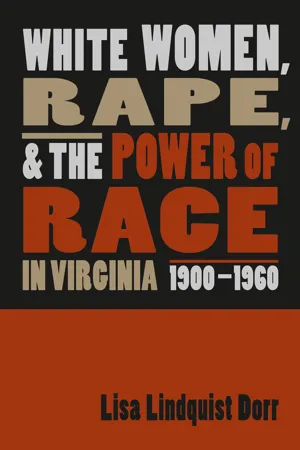
White Women, Rape, and the Power of Race in Virginia, 1900-1960
About this book
Information
Chapter 1
A Deadly Menace to the Very Framework of Society Itself
White Violence and the Legal System
In 1912, newspapers around Virginia reported that a young white widow named Bertha Ferguson had been attacked and raped. Within hours, police had apprehended Alfred Wright, an eighteen-year-old black man. When police brought Wright to Ferguson, she identified him as her assailant and he was charged with the crime. Despite Wright’s claims of innocence, the sheriff announced that the evidence against him was “complete.”1 Two days later, Wright’s case went to trial and the jury heard testimony for most of the day. Despite the efforts of Wright’s attorney to win mercy based on his youth, Wright was quickly convicted and sentenced to death. Wright’s trial was reportedly “the speediest trial and conviction that ever took place in the State,” the jury having deliberated only fifteen minutes before returning its guilty verdict to the expectant crowd.
To many white Virginians reading about the case, the trial represented a victory of order over lawlessness. Newspapers reported that tempers of the community were “stirred to the highest pitch of excitement” at news of the crime. Feeding on white southerners’ apparent appetite for extralegal retribution against black men, initial media accounts of the case focused not on the crime but on the reaction it produced among local whites. “Appomatox [sic] Jail Heavily Guarded,” read one headline. Only underneath, in smaller print, did it state that the jail was guarded to prevent the lynching of a black man accused of assaulting a white woman.2 The promise of a speedy trial, however, had prevented the mob from taking the law into its own hands. Once the trial began, news reports emphasized the court’s commitment to due process. According to reports in the Richmond papers, Wright’s attorney, Duncan Drysdale, “put up a magnificent defense” and made an “excellent argument for the life of his client.” Hearing the verdict and the jury’s imposition of the death penalty, “the community was entirely satisfied,” content to let Wright await his execution in Richmond.3
A closer look at Wright’s trial, however, reveals that whites in Appomattox did not entirely abandon extralegal violence in favor of the rule of law. The threat of violence permeated the trial and largely directed the jury’s verdict and sentence. In his request for an appeal, Drysdale called public opinion “bitterly inflamed and incensed against the accused” and pointed out that no one in the community questioned whether the crime had been committed or whether Wright was the guilty party. Drysdale noted that Wright had been heavily guarded from the moment he was arrested to prevent a lynching. The night before the trial, the sheriff, hearing of a plot to storm the jail, had moved Wright to a schoolhouse on the outskirts of town. The specter of violence accompanied Wright into court. Drysdale reported that the courtroom was “crowded with an audience composed exclusively of citizens of the county, that frequent mutterings could be heard while counsel was making this motion [to change the location of the trial], and that at said moment [authorities] found it necessary to have the prisoner guarded by four men armed with rifles and shot guns, loaded with gunpowder and leaden bullets, ready for instant action.”4 Moreover, Drysdale continued, the official responsible for ensuring Wright’s safety at trial “publicly stated in open court . . . that if [defense motions for a continuance and a change of venue] were granted, he could not answer for the safety of the prisoner, meaning thereby, that in the event [the motions were] granted, he was apprehensive that the prisoner would be taken by the people from the custody of the officials and lynched.”5 Only an immediate trial in Appomattox would satisfy local whites and prevent Wright’s punishment at the hands of a mob. Indeed, outraged members of the white community invaded the courtroom to ensure enforcement of their will.
For Alfred Wright, there was little meaningful distinction between mob action and the legal process. The angry whites who threatened violence in the courtroom and the legal officials who tried Wright’s case ultimately worked together to ensure that Wright paid for the rape of Bertha Ferguson with his life. Duncan Drysdale appealed Wright’s conviction on the grounds that the presence of the mob in the courtroom made it impossible for Wright to receive a fair trial, but his efforts were derailed by the judge’s ability to render the collaboration between the mob and the legal system invisible. The judge insisted that “the [court] has never seen a more peaceable and orderly crowd in the courtroom,” despite news reports during the trial that there was a plot within the courtroom itself to lynch Wright if he was not sentenced to death.6 In a terse opinion, the Virginia Supreme Court upheld Wright’s conviction and sentence, arguing that members of the defense presented no evidence other than their own affidavits about the sentiments of the courtroom spectators, nor did they provide evidence that, given time, Duncan Drysdale could have proved his client’s innocence.7 In short, even if Wright’s trial lacked important elements of due process, he was guilty and deserved no better. Alfred Wright was executed in May 1913, two months after the court issued its ruling.
In many respects, Alfred Wright’s experience with the legal system represented white Virginians’ preferred method of responding to black men’s crimes against white women. Although his trial and execution amounted to a “legal lynching,” where court procedure was a thinly veiled substitute for mob violence, white Virginians could nonetheless claim that Wright’s fate came at the hands of judicial authorities rather than a mob. White Virginians trusted their legal system to police the boundaries of racial interaction, and they prided themselves on avoiding the lawlessness that plagued states farther south. Between 1880 and 1930, Georgia lynched 460 people, 441 (96 percent) of whom were black. Virginia, by contrast, lynched 86 people, 70 (81 percent) of whom were black.8 Virginia’s success at avoiding mob violence and bringing accused black men to trial, however, did not mean that racial prejudice and white hostility did not influence court procedure. Legal trials did not represent white Virginians’ rejection of extralegal violence in the enforcement of white supremacy. Instead, the potential for violence was woven into the legal process. The threat of violence became a tool used by the legal establishment to assure the white community that black men would receive severe punishment when accused of crimes against white women. The relative paucity of lynchings in Virginia, despite the violent deaths of eighty-six people at the hands of mobs, did not indicate that Virginia was less prone to the racial violence that characterized southern states. It merely represented the degree to which lynching and legal trials worked hand in hand to protect the racial hierarchy. Both forms of retribution interacted along a continuum of social and racial control.
Convictions and severe sentences warned the black community about the limits of white racial toleration and the penalty blacks could expect for violating the rules of racial interaction. For Virginia’s legal establishment, “allowing the law to take its course” provided a better means than did vigilante violence of controlling the complex web of racial, class, and gender relationships that formed the basis of the social order. Criminal trials allowed the white community to participate in punishing errant black men while they simultaneously limited that participation. Trials also provided a clearly visible ritual enactment that defused and diffused the hysteria provoked by allegations of black-on-white assault. Trials, with their orderly procedures and seemingly color-blind legal protections, reassured whites that accused black men deserved their ultimate fate. While lynchings and trials could have the same end result—the death of a black man—trials allowed whites to convince themselves that black men received the same justice accorded to white defendants. Court procedures, like vigilante violence, enacted the white community’s will; unlike vigilante violence, legal proceedings created the fiction of a moral and egalitarian dispensation of justice.
Despite efforts by the legal system to guard black men from overt due-process violations, trials for charges of black-on-white rape resulted in predictable convictions. Black men accused of assaulting white women rarely escaped punishment precisely because white Virginians saw the crime of black-on-white rape as a direct attack on white civilization and on a social order founded upon white supremacy, and they guarded against it accordingly. George J. Hundley, the judge in Alfred Wright’s case, made explicit the connection between the literal rape of white women and the figurative rape of white civilization when he rejected Wright’s motions for a continuance to allow his attorney time to prepare for trial. The judge, in an unusual move, included his entire decision in the record of the court. He agreed that the time between the commission of the crime and Wright’s arraignment and trial had been very short, and he conceded that he was usually very lenient regarding requests for continuance. But Wright’s case, he argued, was different: “The offense charged is of a peculiarly heinous nature. By common consent it is regarded as the worst crime in all the catalogue denounced by our laws. No other crime so excites, alarms and arouses our people. It not only violates the laws of God and Man, but owing to the peculiar conditions prevailing in this our land, it is a deadly menace to the very framework of society itself.”9
Although Hundley’s decision was rendered in the courtroom, it nonetheless justified the collaboration of violence and legal procedure by emphasizing whites’ perception of the larger meaning of black-on-white rape. Bertha Ferguson’s rape was not one of the “worst crimes” because it represented a fate worse than death for her personally. It was one of the worst because the very act of a black man taking sexual relations with white women by force attacked the heart of white patriarchal civilization. Black men’s sexual violence fouled the highest and most sacred symbol of white supremacy—frail, white women dependent on white men for protection. It also represented an attempt to seize white men’s racial and patriarchal prerogatives—symbolized by their sole sexual access to white women—that placed white men at the top of the southern social order. In white eyes, black men, in assaulting white women, upended society by laying claim to the white masculinity on which civilization was founded.10
White responses to charges of black-on-white rape thus represented whites in defense of a social order based on interlocking, and mutually reinforcing, gender, racial, and class hierarchies, which helps explain the inflammatory nature of the crime. Allegations of black-on-white rape, however, also set in sharp relief paradoxes at the heart of southern society. Southern whites claimed to represent the highest achievement of civilization, yet they nevertheless encouraged the barbarity of lynching. White civilization existed at the intersection of civility and aggression, of white women’s protection and mob violence. That contradiction, even in the eyes of legal authorities, frequently required justice not only to maintain racial and gender hierarchies but also to co-opt whites’ desire for violence into the legal system itself.
Whites in Virginia made no secret of their belief in the superiority not only of their culture but of their evolutionary development as well.11 White men’s vaunted masculinity reached its apex in its ability to subvert their thirst for vengeance through the legal system. At the same time, white men earned their right to dominate both inferior women and inferior races because of their capacity for both restraint and aggression. Legal trials of black men accused of assaulting women, like that of Alfred Wright, however, did not merely represent the triumph of lawful order and restraint over lawless violence. They also demonstrated the ability of court procedure to absorb the violence of outraged whites. White savagery and white control were not antithetical but complementary.
The potential for violence was a palpable and necessary presence in Virginia courtrooms. It assured whites that their thirst for vengeance and retribution against blacks would be carried out in a way that satisfied white manhood’s primitive need for aggression and the simultaneous need to demonstrate the superiority of civilization made possible by white men’s power and dominance. Self-restraint, a quirky relic of a receding Victorian past, however, no longer needed to be located in the individual. Instead, white men in Virginia exerted controlled vengeance through the legal system. White men remained civilized because the court enacted their primitive desires for revenge, and indeed folded the threat and desire for violence into the legal process.12
The seeming lack of civility of mob violence was contained and incorporated into the law as a tool of racial control. Treating extralegal violence and the rule of law as complementary and indeed collaborative, rather than contradictory, resolved the seeming paradox of civilized men engaging in barbarous acts of violence and torture. Whites’ thirst for revenge and retribution, and the desire of local whites to participate in black men’s punishment when they were accused of sexual crimes by white women, became part of the legal process, expressed in the mutterings of court spectators and the verdicts and sentences of white juries. This pairing of violence and law seemingly united all whites against all blacks and gave all white men a role and a stake in enforcing the racial hierarchy. Both law and vigilante violence worked hand in hand in support of white civilization.
The South, including Virginia, however, was not free to create its own definition of white civilization and of the relationship between violence and order. White southern understandings of vigilante justice existed in the context of the nation’s increasing distaste for lynching as a form of retributive justice. Over the course of the twentieth century, it became increasingly untenable for white southerners to argue that lynching was part of white superiority or was anything other than a particularly brutal and barbaric form of murder. White Virginians came to this conclusion earlier than did most other southern states. Though the number of lynchings decreased in the twentieth century, the role of violence in the legal process did not. It only became less visible, routinized and subordinated to the grim ritual of courtroom procedure.
Most white Virginians would have agreed that a swift trial, a conviction, and an execution were the surest deterrents to mob violence. White Virginians shared with other southerners the belief that black men’s proclivity to rape white women represented the most severe challenge to white supremacy. Black men’s desires for white men’s patriarchal prerogatives, as exemplified by their supposed desire for white women, necessitated strict separation of the races, enforced by the laws of segregation. Invoking the rhetoric of white women’s need for protection became a standard white response not only to allegations of black-on-white rape but also to many alleged violations of racial etiquette. As one Virginian put it, “The writer of this believes (as every true Virginian must believe) in the language of the Bible: ‘A life for a life’; and the revised version ‘a life for the honor of a noble woman.’”13 When allegations of assault surfaced, this rhetoric initiated an impressive public spectacle, performed in the media and in local gossip and ritualized in either a lynching or a criminal courtroom, and perhaps finally in the electric chair. Whites used these spectacles to return errant black men to their “place” and to warn other African Americans, and white women as well, about the consequences of misbehavior. This public exhibition punished black men who failed to abide by mandates of racial separation while it reaffirmed appropriate relationships across race and gender lines for the rest of the community. Whites’ beliefs about the sexual purity of white women, their equation of black men’s supposedly violent sexual desires with a challenge to white power, and their need to suppress challenges to the racial hierarchy virtually guaranteed that black men accused of any sort of assault on a white woman would be convicted at trial.14
Punishing black men through the legal system did not deprive the white public of participating in the maintenance of racial boundaries. Legal trials theoretically prevented outraged whites from exacting extralegal punishment and assured them that their desires would continue to shape the legal process. That black men faced trials rather than lynch mobs does not mean that they received justice. Racial prejudice permeated the legal process at every step. Although law enforcement officials took actions to ensure that black men survived to face a jury, their whisking accused men out of town when rumors of gathering mobs surfaced and pushing for speedy trials to avert mob violence often deprived defendants adequate time to prepare their cases, as Alfred Wright learned. Moreover, law enforcement often used the threat of mob violence and other coercive methods to force confessions. Court-appointed lawyers did not always give their unpopular clients their best efforts. Consequently, there is no way to determine whether black men were indeed guilty of the crimes of which they were accused and convicted. The legal system capitalized on Virginia’s reputation for avoiding lynching and on the ever-present possibility of mob violence to guard the state’s power to punish blacks. At the same time, it carried out the will of the larger white community, with seemingly little concern for ascertaining guilt.15 Allegations of black-on-white crimes provided a powerful opportunity for the white community as a whole to use the courts to reinforce community standards determining appropriate relations across race and gender lines.16
By the twentieth century, fears of black men’s sexual desires occupied an exaggerated place in the white southern psyche that belied their recent origins.17 Few white southerners doubted that the separation of white women from black men was a critical and time-honored foundation of an increasingly segregated southern social order.18 The power of white southerners’ inflamed rhetoric is most apparent in lynchings—the brutal killing, usually of African Americans, by white mobs. Southerners justified resorting to mob violence, despite its horror, by insisting that swift, brutal retribution w...
Table of contents
- Cover Page
- White Women, Rape, and the Power of Race in Virginia, 1900–1960
- Copyright Page
- Contents
- Acknowledgments
- Introduction
- Chapter 1 A Deadly Menace to the Very Framework of Society Itself
- Chapter 2 Shadow and Act
- Chapter 3 Serving the Ends of Justice
- Chapter 4 Not Considered Worthy of the Respect of Decent People
- Chapter 5 Telling Tales
- Chapter 6 An Altogether New and Different Spirit
- Chapter 7 Another Negro-Did-It Crime
- Conclusion
- Notes
- Selected Bibliography
- Index
Trusted by 375,005 students
Access to over 1.5 million titles for a fair monthly price.
Study more efficiently using our study tools.
Frequently asked questions
Yes, you can cancel anytime from the Subscription tab in your account settings on the Perlego website. Your subscription will stay active until the end of your current billing period. Learn how to cancel your subscription
No, books cannot be downloaded as external files, such as PDFs, for use outside of Perlego. However, you can download books within the Perlego app for offline reading on mobile or tablet. Learn how to download books offline
Perlego offers two plans: Essential and Complete
- Essential is ideal for learners and professionals who enjoy exploring a wide range of subjects. Access the Essential Library with 800,000+ trusted titles and best-sellers across business, personal growth, and the humanities. Includes unlimited reading time and Standard Read Aloud voice.
- Complete: Perfect for advanced learners and researchers needing full, unrestricted access. Unlock 1.5M+ books across hundreds of subjects, including academic and specialized titles. The Complete Plan also includes advanced features like Premium Read Aloud and Research Assistant.
We are an online textbook subscription service, where you can get access to an entire online library for less than the price of a single book per month. With over 1.5 million books across 990+ topics, we’ve got you covered! Learn about our mission
Look out for the read-aloud symbol on your next book to see if you can listen to it. The read-aloud tool reads text aloud for you, highlighting the text as it is being read. You can pause it, speed it up and slow it down. Learn more about Read Aloud
Yes! You can use the Perlego app on both iOS and Android devices to read anytime, anywhere — even offline. Perfect for commutes or when you’re on the go.
Please note we cannot support devices running on iOS 13 and Android 7 or earlier. Learn more about using the app
Please note we cannot support devices running on iOS 13 and Android 7 or earlier. Learn more about using the app
Yes, you can access White Women, Rape, and the Power of Race in Virginia, 1900-1960 by Lisa Lindquist Dorr in PDF and/or ePUB format, as well as other popular books in Social Sciences & Gender & The Law. We have over 1.5 million books available in our catalogue for you to explore.